
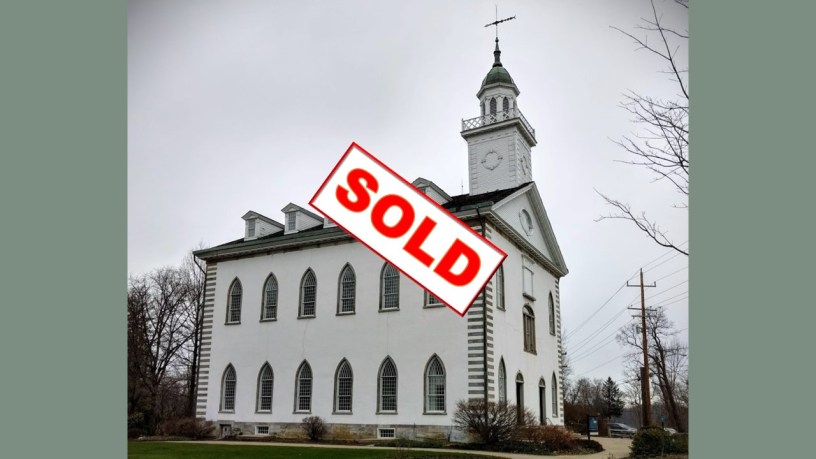
Yesterday, in a joint statement issued by the Church of Jesus Christ of Latter-day Saints and the Community of Christ (formerly RLDS), these groups announced the sale of the Kirtland Temple and other sacred sites. To put it in folk history terms, ownership of the first temple of the Restoration has passed from Emma’s Church to Brigham’s. For some there is rejoicing. For others there is mourning. On social media, there will doubtless also be gloating and anger.
As reported by Peggy Fletcher Stack and Tamarra Kemsley for the Salt Lake Tribune, the sale price was $192.5 million and includes the following historical sites and items:
- The Kirtland Temple
- The Smith Family Homestead (Nauvoo)
- The Mansion House (Nauvoo)
- The Red Brick Store (Nauvoo)
- Manuscripts and the Bible used in the Joseph Smith “Translation” of the Holy Bible
- Personal letters and paintings of Joseph and Emma Smith
- A “Caractors” document purporting to contain a sample of inscriptions from the Gold Plates
Here is a link to the Community of Christ webpage, including prepared statements by leaders, and here is a link to the joint statement. Must read.
Here is a link to the Salt Lake Tribune article. You may run into a paywall on that article (sorry, not sorry; professional journalists deserve to make a living wage).
Here is a helpful fact sheet put out by the Church in Salt Lake City, Utah.
Lastly, here is a wonderful article put out by Dialogue, a Journal of Mormon Thought, in 2014, detailing the history of the Kirtland Temple as an increasingly interfaith pilgrimage site for Mormons of every branch. Highly recommended reading.
So, Wheat & Tares readers. This is big news. It is already generating lots of response on social media. After you have read the joint statement, please share your thoughts and feelings below in the comments. Let’s be courteous and respectful of each other. As someone who grew up devout Latter-day Saint, but who has fellowshipped more recently with Community of Christ, I’m having lots of feelings.
We all will continue to share the Kirtland Temple as a place of common heritage. However, almost certainly, its facilities and public tour will now become a dedicated missionary tool for the LDS Church.
Questions for Discussion
How did you feel yesterday, or today, learning the Church has bought the Kirtland Temple and other sites?
What do you feel the future of these sites will look like? What is there to be positive about? What is there to be concerned about?
For those of you who’ve visited the Kirtland Temple, what was your experience?
 Wheat & Tares
I’ve had several family members who are very excited about the news.
To me though, it’s very meh! Just buildings which rot. I wish we would have spent the $192 million on feeding the homeless or caring for the sick.
There is a very different tone in the statements from the Church of Jesus Christ of Latter-day Saints (the Church) and Community of Christ (CoC). The Church is understandably very excited and celebratory about acquiring an important piece of our heritage.
CoC, on the other hand, obviously did not want to part with the Kirtland Temple, but really had no other option. Their finances have been (and still are) in pretty bad shape, and their FAQ makes it clear that this deal would not have happened at the level that they needed without the Temple being part of it.
Even with the deal getting CoC almost $200 million, it doesn’t solve their financial problems. They are still facing some significant lean years ahead, but this was really the most that they could have gotten. The only significant properties/artifacts that they still have that the Church might be interested in are the Smith Family Cemetery (Emma would be spinning in her grave for that to pass to anything to do with Brigham’s legacy), or their part of the Temple Lot (where their world HQ is located). Neither one of those is going to happen.
This is a momentous deal, but it’s important to note that it is affecting both sides in different ways.
Good: The LDS Church has the money to give the Kirtland Temple the repair and refurbishing work it needs. The building will remain open to the public and available to Community of Christ visitors and worshippers.
Bad: Tour guides will now be LDS proselytizers delivering correlated history scripts, mingled with folklore, to visitors. (The worst thing about LDS historical sites is that they are run by the LDS Missionary Dept.) Remember, the Saints were not chased out of Kirtland by persecution or “anti-Mormons.” The Church self-destructed there, it was all internal feuding, and Joseph left town by his own choice to escape creditors and lawsuits over the failed Kirtland Anti-Bank.
The tours run by the missionary department are so, so bad, just awful. You can usually tell they are the worst by reading the reviews. The reviews from LDS church members gush about them and talk about “the spirit” like they are on commission, while non-LDS visitors say “skip it–it’s an annoying sales pitch!” It’s basically the same thing as reading movie reviews for these Christian propaganda films that seem to be so popular right now, but are basically just emotionally manipulative treacle.
As someone else with an LDS-to-CofC journey, I also have a lot of complicated feelings. The Kirtland Temple was such a perfect symbol of that journey between the two faiths, and I don’t know if it’s possible to find another symbol quite like it.
That said, while I’ll always advocate for Community of Christ to lean more into its Restoration heritage, I’ve come to peace with this particular decision. Inn particular, I see it as a moment echoing the early Christians’ navigating of their religious identity (see, e.g., Acts 10). Maybe it’s okay to let go of some of the things that defined us in the past (in this case, only in a literal legal sense of “letting go,” the history will always be part of our identity) in order to let God lead us into an unsure but exciting future.
I feel really sad for the Community of Christ. I hope their members will continue to be able to access the building and grounds as a community. I think the LDS church could have paid a more generous price given what they are getting, and the historical importance.
I don’t feel especially excited about this as an LDS member. The LDS church does not have a great track record when it comes to respecting historical buildings. The Salt Lake and Manti temple debacles come to mind. I hope there are sufficient protections in place for these new acquisitions.
Hedgehog, there is a contractual agreement for the next 15 years that will allow CoC to hold at least 6 meetings/gatherings in the Kirtland Temple per year, and the Church has committed to maintaining all of the properties as historical landmarks open for free public access. After the 15 years, they will at least have the same access as the general public, but the door has been left open for more.
I have mixed feelings, but I think it was ultimately the right step for Community of Christ. They are trying to prioritize being able to care for their living members, and I respect that. All denominations within the umbrella of Mormonism should be grateful to Community of Christ for taking the initiative to acquire and preserve these sites and artifacts. They had that foresight long before the Salt Lake Church had the means or interest.
As far as the future goes, it depends how much latitude top leaders give the Church History department since they oversee the historical sites. (It used to be the Missionary department, but that changed a few years ago. Missionaries are still used to help staff the sites, though.) The professionals at the history department are more than capable of preserving, repairing, and restoring the historic sites. Ultimately, though, non-historians with the purse strings will have the final say.
I’ve been wrestling with my feelings and thoughts regarding this sale, as have so many other members of Community of Christ. How is it possible to be both heartbroken and hopeful at the same time?
Heartbroken because I care about the rich heritage the RLDS/CofC has cherished in places like Kirtland and Nauvoo. It almost seems like we’re turning our backs on all the generations who have gotten us to where we are today. Almost. Their dream of Zion was so very different from mine today, but we as a faith community would not have the opportunities and choices we do without their sacrifices and faithfulness.
I would like to think the new LDS owners of these sites and artifacts will continue to cherish them into the future. Of course, I/we have no control over that. May they feel God’s grace and presence in their caretaking.
I’m hopeful because, as a Christian I must accept that in our weakness as a faith community we reflect “God’s/Christ’s weakness” in opposition to the world’s power and wealth. That kind of foolishness makes no rational sense to those who believe Christ will somehow establish the peaceable kingdom through constantly growing power, prestige, influence, and wealth.
Twenty-three years ago we took upon the new name of Community of Christ. A pivotal moment.
I don’t mean to offend anyone by writing this. As I said at the start, I’m still trying to sort it all out. I simply hope we in Community of Christ have the strength to be weak, the faithfulness to be vulnerable, and the grace to keep moving into the future.
Lastly, I was deeply moved by Apostle Lachlan Mackay’ video thoughts. He, not incidentally has been intimately involved in historic site preservation for a long time and is a descendant of Joseph and Emma Smith.
It will be quite fascinating to see how they deal with name of the church on the entablature on the front of the temple. It has seen a few significant modifications over the decades.
Overall, it feels like a win-win, but considering that we just purchased some industrial real estate in Florida for $174 million back in January as an investment, hmm. I would have liked to have seen a more generous amount offered, considering the amazing historical implications of everything mentioned in the announcement and the fact that $192 million is essentially just a mere month or two of interest on our stock investments. But to be fair, how does one actually quantify the monetary artifacts like these in the first place?
This is a long time coming. Credit to the CoC for taking care of these sites and artifacts for many years, but now they are in the hands of the true Restored Church (I am not neutral in this regard, why should I be?).
With all due respect to the (dwindling) faithful members of the CoC, this is yet another piece of evidence that Brigham Young was the true successor to Joseph Smith. I hope the CoC will use this money to keep their heads above water for the foreseeable future, as they serve as a powerful warning to Latter Day Saints as to what happens when you reject the prophets and become just another declining, liberal mainline church.
They made almost every change that so many of the authors on this blog would like the Utah Church to make. Women ordination, embracing gay marriage, public finances, ditching unique latter day saints doctrines etc. Heck they’ll soon have a female president. And what have all these “correct” changes gotten them? Insolvency, schisms, massive member declines and continued irrelevance. Why again should the Utah Church become more like them? Not exactly a picture of health to say the least.
For many years they would use the fact that they had the Smith family as Presidents and the ownership of the Kirtland Temple to claim they were the true church, the “Josephites”, much better than those wayward “Brighamites”. Well they jettisioned both of those now, in 1996 and 2024 respectively. So what exactly are their truth claims now? If they truly were the Lords Church and had their financial house in order likes ours so clearly does they would have never had to sell the family jewels. Sad, but you don’t need to be a Prophet to have seen this coming.
Nate: Ah, yes, the prosperity gospel inevitably rears its head. “this is yet another piece of evidence that Brigham Young was the true successor to Joseph Smith” Riiight.
I agree with Dave B. It’s probably a good idea for the sites to be under the control of an organization with deep pockets that will properly care for and maintain them. However, my most recent experiences with tours of Church sites has been awful. Here’s 3 examples:
I agree that it can be challenging for a religious organization to decide how best to conduct tours of its own sacred sites. However, my most recent experiences at Church historic sites show that the Church isn’t even coming close to doing a good job. In each of those three cases, I left with a bad feeling about the tour, and as a result a bad impression of the Church itself. I was not at all interested in going on another Church historical tour any time soon. Hopefully the change in management of Church historical sites that Mary Ann mentioned will help improve the quality of Church tours of these sites. Perhaps the Church needs to offer both a “faith promoting” and a “regular” (i.e., historically accurate with no overt attempts at proselyting) tour at all of its sites and allow visitors to choose which of these two tours they’d like to join. You might think that no one would actually choose the “faith promoting” tour, but I rather suspect that a lot of Mormons would actually prefer that version of history, so these tours might actually be more popular depending on the mix of members and non-member visitors.
mountainclimber479, yes, I aso went to that tabernacle replica with my family. I held back a laugh when the sweet 11-year-old bore her testimony that she knew “the tabernacle was true.” I don’t believe that was under the purview of the Church History Department. It seemed more like training the youth how to be missionaries.
My fear is that Nelson will similarly emphasize a version of Nate’s triumphalism here (albeit more passive aggressive) and neglect to indirectly shore up against the current proclivity towards religious nationalism and democratic backsliding.
The mainline Mormon church has only a few conferences left to address any topic of existential importance to them before the next American presidential election. It has done just fine without the Kirtland temple for nigh 200 years. It lacks neither for wealth nor an established platform on the American public square.
But neither wealth nor platform can necessarily earn societal legitimacy. The members are the most consistent interaction points between the church and the rest of the world, and so when they think of the church they’ll think of the members.
Members like Nate.
If being wealthy and larger is all the evidence one needs to choose the correct church, why doesn’t everyone just become Catholic?
This does make me slightly sad, mainly because of the inevitable triumphalism that has already been displayed above, and because, like others have mentioned, the Community of Christ had done a great job in looking after the Kirtland Temple and because it is part of a shared history, heritage and identity.
When my friend and I visited Kirtland back in 2013 I was really impressed by the museum and tour given by our Community of Christ guide. No agenda, just a love of the site and the history of the Restoration. As far as I could tell, the rest of the group were also active Brighamites, but there was a great sense of connection and grounding between all of us and the guide. And having the opportunity to sing ‘The Spirit of God’ in the temple was a nice experience (it’s my favourite hymn). I’m no longer active but that visit brought together lots of the good things that I will always cherish from my LDS life.
In terms of my other experiences with tours of church historical sites, it’s a mixed bag. I can remember visiting Palmyra on that same trip and kind of having to endure the tour of the Smith family farm by the young missionaries because you could see the engineered ‘spiritual moments’ followed by the hard sell coming a mile off! In contrast, when we drove out to the Peter Whitmer Home, the lone senior missionary who took us around was absolutely delightful. Not sure whether he was just pleased to get some visitors, but again he had no agenda but was just chilled and full of enthusiasm for the history and the characters of the past.
Mountainclimber’s comment made me chuckle. When I finished my mission in Utah my parents flew out from the UK for a couple of weeks and we toured the mission, did Salt Lake, went to conference, etc. We went on a tour of the Beehive/Lion House, and bear in mind I’m still a set apart missionary in my suit and name badge, we still got the hard sell for referrals at the end of the tour! I can still remember thinking to myself “Please, sisters, I’ve just done this for two years. I’m exhausted. Give me a break!” I also remember at one point, genuinely a bit baffled, asking the missionary “So if Brigham Young lived in the Beehive House, who lived in the Lion House?” The missionary shifted about slightly, leant in closer and whispered “That’s where the wives lived!”
🙂
@Nate, I’m not sure if you’re trolling, but I’ll bite anyway. The Church’s recipe for wealth has been:
1. Make 10% tithing a requirement for temple attendance.
2. Regularly promise blessings to tithe-payers, including financial blessings. (A search in the General Conference archives reveals at least a dozen declarations that members cannot afford to not pay tithing.)
3. Invest the resulting tithing surplus. (According to the Widow’s Mite Report, it appears that virtually zero tithing went toward humanitarian causes before 2022.)
4. Hide the resulting wealth by (a) not reporting any numbers unless mandated, and (b) hiding the mandated reports by pretending to distribute investments among a dozen LLCs that cannot be easily traced to the Church, while in fact retaining control over the investments in Salt Lake.
This is why the Church can afford nice things. Do you really see this as evidence that our branch of Mormonism is the right one?
I’m sad because having shared sacred geographies that are owned by the other party forces us to go outside our bubble and go into theirs.
Example, Jerusalem, going there we step into our Jewish and Orthodox Christian roots to partake in their experience.
Going to Kirtland forced the LDS to go into the RLDS experience.
Sacred Grove, the RLDS come into the the LDS experience.
In my opinion this is a win-win.
If the LDS owns everything then the LDS loses out in sharing in the RLDS experience.
One of the best comments I’ve come across (and there’re been plenty!) is that your founding story cannot be your mission.
So I’ve been thinking about Nauvoo since before the announcement, and while this isn’t directly related to Kirtland per se it does deal with the sustainability of church history sites.
can someone with a Mormon Studies background do an article or study on the economic future of Nauvoo and similar places dependent upon Mormon tourism?
Nauvoo’s town council meetings/economic development plan presents a future where Mormon tourism is predicted to expand or stay the same. Nauvoo has been economically insulated since the church’s investment there in the 90’s from the gradual shuttering of small town America elsewhere in Illinois. The pandemic years demonstrated the town’s reliance upon Mormon tourism however, which makes me wonder about its future should Mormon birth, self-identification, and activity rates continue to stagnate or decline. (I recognize the last part is reductive and there remains debate over the correct indicators and rate of church growth)
The church will likely never experience financial issues in the near future like the CoC. But I gotta wonder if they and Nauvoo town council’s view of Mormon tourism is a bit too rosy.
There also remains tension among residents regarding the church’s presence in the community. Nonmormon residents appreciate the tourism and development, but it also came with drawbacks. Property values for example have soared in the town compared to neighbouring communities, which means poorer residents are finding themselves forced to move elsewhere.
Historical preservation in town is materially marvellous, but the presentation narratives at church owned sites neglect the pre-and post-Mormon history.
link to Nauvoo’s development plan
visitor centre controversy
Dr. Lisa Knopp article in reflection of Nauvoo faster revisiting in the early ? 2000’s
Town website
The town is in a unique socioeconomic context. It’s really quite bizarre when you think about it, and not necessarily in a bad way. Just niche.
Andy, this is a really important point, and one I was having a hard time articulating. I think the first time I went to Kirtland I was maybe 5 years old, and I’ve been there several times since. At that young age, I didn’t really understand that there were different (active) branches of Mormonism. I honestly was still pretty iffy about different strains of Christianity. When (at age 8) I told a Protestant Sunday School class of my peers that the Book of Mormon talked about such and such a topic they were asking the kids about, everyone looked at me and asked “What is the Book of Mormon?” There was an important element of religious tourism associated with hearing a fresh perspective on the Mormon mythology, one that was far more nuanced and historical and was not trying to force vacationers into schlocky “spiritual” experiences by making them sing Primary songs, bear spontaneous testimony, or sit in silence to reflect on…something, then brow-beating everyone into coughing up some referrals for the missionaries. The CoC experience was hands-down superior every time, as a tourist anyway.
This actually brings up a whole different point about Pilgrimages for devotees vs. historical tourism. The CoC definitely was on the side of the latter, but the former was covered (and capitalized on, big time, in terms of juicing members for referrals) by the LDS church. It reminds me that even in medieval times, Pilgrimages were a cottage industry, a specific flavor of tourism, but one in which people were torn between having a fun vacation, pretending piety in a social setting, and being grifted by those selling relics and indulgences.
Like others, I dread the tour guides at the LDS historical sites. Sometimes they go easy on us when we tell them we’re active, but usually they push too hard. We are there for the history, not for the testimony. If the history rings any bells, then let there opportunities for follow up and testimony, but those should be private and not for the whole group. Please don’t ask me for referrals, and please don’t testify. Tell me what happened here, and leave it at that.
The LDS church obviously has the means to ensure these sites are cared for, so that’s a plus. The church is currently led by a man who has been quite willing to substantially modify historic structures, including destroying artwork, to suit his renovation goals, so that makes me just a bit nervous.
I’ve been to Kirtland once, Nauvoo several times. Kirtland was 20+ years ago when I was more orthodox in my LDS beliefs. I don’t remember much about the temple experience, other than the guides were very knowledgable and it felt like a normal tour of a historic site. I remember lamenting that the LDS church didn’t own it, but then even at the time I thought the presentation at the LDS-owned sites down the street was too heavy handed. It seemed like they were trying too hard to be spiritual and faith-promoting, which has been my experience in Nauvoo as well. The whole experience feels Disnefied, full of costumed characters whose purpose is to make you feel good about your experience.
Nate
The story is told of a medieval Pope, who trying to bring a rogue priest who was condemning the church for amassing wealth brought him to Rome. After showing this poor priest the vast treasuries of Gold proclaimed:
“No more can Peter say, silver and gold have I none.”
The priest, unimpressed responded:
“Sadly, neither can he say, take up they bed and walk.”
A word to the wise.
I am a bit sad about the sale of the Kirtland temple. I visited the temple several time as a kid growing up in the midwest and it was during these visits that I learned about the RLDS church (as it was named back then) and the complex history of early Mormonism. I distinctly remember feeling uncomfortable when the brash LDS members in my tour group publicly challenged the gracious RDLS Kirtland temple host about historical issues, doctrinal issues, and who is “right”. These hosts were so patient and gracious in the face of such hostility. I think future visitors to Kirtland will lose a unique perspective of early Mormonism. I will personally miss our Community of Christs hosts to this sacred building.
To the members of the Community of Christ – thank you for your care of these sacred sites and your willingness to open them up to everyone these many years. Lets hope my community does the same.
I recently toured the Kirtland temple and absolutely loved hearing the CoC perspective having been raised mainstream LDS. In fact, I got very emotional looking at the portraits of Saints during the movie and seeing equal representation of women and men. After, we toured the sites ran by the LDS church down the street and the tour had a different feeling. I much preferred the CoC vibes.
One of my coworkers grew up in Nauvoo. She claims I think very accurately that she can tell immediately after telling someone that what their relationship is with the Mormon church. She had me nailed as a future apostate and my friend from BYU that also works with us as true blue and probably six kids. She has lots of stories about growing up with increasing Mormon tourism and pilgrimage and worries about the long term viability of her town as a memorial to Mormon history. The church invests in only the things it wants and isn’t trying to maintain the town.
I have read a lot of excited posts from active members on Facebook. I think it is a sad announcement with the church using its big reserves to buy what it wants in the world. I guess it is better than the warehouses or suburban development plots or large farms or the hotel in Hawaii. You really can buy anything in the world with money.
My initial thought was that $192 million seems like a bargain bin deal. If I were in charge of the CoC I wouldn’t have gone any lower than $500 million.
My second thought was that it seems like CoC must be on its way out. Religious organizations in NA are losing members rapidly and smaller sects like the CoC probably won’t last very long.
Then I wondered what this will look like when it’s the LDS church’s turn in say 40 years from now. Will they sell off their temples when there’s no one to go to them anymore?
Golden Clue:
Apparently negotiations began 3 years ago, with a very low ball offer from the LDS who also insisted Kirtland had to be part of the deal. A rumor that along the way an individual offered $100 million just for Kirtland Temple. At least the LDS have resources to ensure longtime caretaking and upkeep ability. Keep in mind there’s not a lot of potential buyers and nobody can match the finances of the LDS ($180 billion now?).
The best spin I can possibly put on all this is that now the CofC has the beginnings of an endowment to support its mission going ahead. The church separately raised $120 million from members to ensure its retirement system is financially stable. Full diaclosure: I’m a retiree who benefits from that. My pension is certainly different from most corporate ones, but at least I got in when it was still a defined benefit plan. Now it’s defined contibution (403b).
Hopefully, church leaders learned valuable lessons from their terrible investments that crashed with the 2007-2008 housing debacle/recession. More than a few folks thought they should all be replaced at the time.
In regard to your last comment: In a few decades, if the LDS has far more money than active members, who will be interested in buying either historical properties or meeting houses and temples? And will the church still be focused on its founding story and ministry for the dead? I know that sounds harsh, and perhaps overly mean spirited. If so, I’m sorry. But at some point all religious institutions will face difficult realities and decisions. Mine is doing it right now.
Back in the late ’80s when the RLDS was going through cataclysmic changes, there appeared in The Saints Herald an editorial titled “Silly Rumors”. One such was that the Kirtland Temple would be sold. “The Kirtland Temple is not for sale” was the proclamation.
Well, times change. Liberal-minded members do not observe the law of tithing, and conservative members keep their contributions in their local congregations, so the C of Christ is getting hit in the pocketbook pretty hard. Plus, the church has been de-emphasizing church history/heritage for decades. These are the real reasons for the transaction.
To this comment thread I will add the following video. Many have rightly called attention to apostle Lachlan Mackay’s prepared remarks regarding the sale. Now we have Pastor and Seventy John Hamer’s heartfelt and emotional remarks, delivered online during Beyond the Walls, the worship service held each Sunday at Centre Place in Toronto, Canada. Anyone who is the least bit surprised or baffled at the pain, even trauma, than many in Community of Christ are experiencing should watch his statement below. I’ll add that later in the service, around 1:13:25 on the runtime, John counters the misleading assumption that liberal/progressive/young members don’t tithe:
https://www.youtube.com/live/VdYEibeS5a0?si=cd1RAZvl1cf8CGPe&t=321
2018 my visit to Joseph Smith birthplace in Vermont – several books on display but the magnus opus of Richard Bushman was nowhere to be found.