
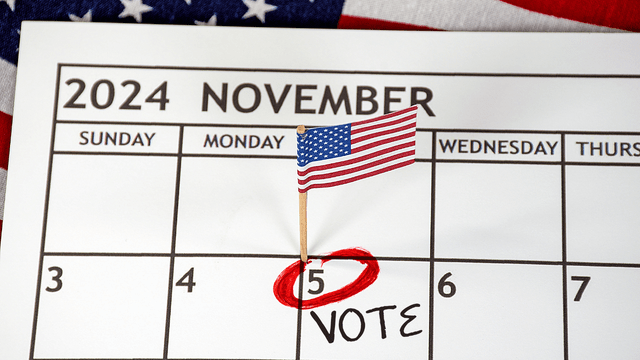
Given how closely tied the LDS Church is to America and to US politics, it’s worth a post reflecting on what the next twelve months will bring here in the United States and how the fateful election of November 2024 will play out. I think it’s going to be a messy, tumultuous, angry year. I’m laying out the election scenarios in some detail, largely for the benefit of non-US readers, followed by comments on how this will affect the country, the world, and the LDS Church.
What spurred this post was Trump’s recent win in the South Carolina primary a few days ago, roughly 60% for Trump and 40% for Nikki Haley, his sole remaining opponent on the Republican side. This win practically assures Trump of the Republican nomination: if Haley was going to do well anywhere, it would have been in South Carolina, where she had previously been a popular governor and where the open primary rules there allowed non-Republican voters to cross lines and vote for her. On the one hand, it looks like a big win for Trump. On the other hand, for a candidate who is essentially an incumbent and facing only one opponent to only get 60% highlights the fact that a minority of Republican voters (maybe one in ten?) simply won’t vote for him, nor will many independents and, of course, few Democrats.
Nevertheless, it looks like we are going to get the election no one really wants: Trump v. Biden, Round 2. And here is my prognostication: No matter how this turns out, a lot of people are going to be unhappy, possibly violently unhappy. Here are the various ways things are going to go wrong.
Scenario 1: The Supreme Court rules against Trump’s eligibility to hold office. The case of Trump v. Anderson has been argued before the US Supreme Court and a decision is expected shortly. The issue before the Court is whether the 14th Amendment, Section 3, applies to Trump and makes him ineligible to again hold federal office. That amendment bars anyone who previously took an oath as an officer of the United States to support the Constitution, then later engages in “insurrection or rebellion against the same,” from again holding office. There are legal arguments to be made on both sides of the case. Reports of the questioning by the Justices at oral argument suggest most are skeptical of using the amendment to bar Trump’s from holding office. If that’s where the decision goes, then Trump’s campaign will move forward.
Should the Court rule that the amendment applies to Trump and he cannot hold office, then all hell will break loose. There might be civil unrest across the country. The Republican Party will still have to nominate a candidate at their convention this July. If Trump is disqualified early, Nikki Haley might be able to garner enough delegates in remaining primary elections to get the nomination. If it happens later, after Trump has a majority of delegates locked up, those delegates and the leadership at the convention would probably pivot to a third candidate as Trump delegates would almost certainly not vote for Haley.
But it could get even messier. Trump could still get nominated by the party (the amendment doesn’t say a party can’t nominate such a person). In some states, the secretary of state or other official in charge of elections might leave Trump on the general election ballot anyway (again, the amendment doesn’t bar such a person from being on the ballot, only from holding office) while in other states Trump might be struck from the ballot. In states where his name is not on the ballot, thousands or millions of voters might write him in, which will of course make the ballot counting a lot more complicated. Then when electors (of the Electoral College) vote and slates of their votes are submitted to Congress, there will be reasonable grounds for objections to be made and it could be a fairly lengthy process to resolve those objections. There will no doubt be huge crowds outside the Capitol cheering and jeering, and maybe looting and shooting. If you thought Jan 6, 2021 was a circus, wait until Jan. 6, 2025 under this scenario. Regardless of the merits of the case, I think it will be better for the country if Trump runs and loses, repudiated by the voters in a free and fair election, than if he is disqualified.
Scenario 2: Trump is convicted of a crime before the election on Tuesday Nov. 5, 2024. You’ve probably seen a statement like this several times in the last few months: Trump is facing four criminal cases that allege a total of 91 felony counts. Most politicians facing that sort of legal jeopardy would not run for office while the charges were pending. Most parties would not nominate a candidate facing such charges. Most voters would not normally vote for a candidate facing such charges. But there’s nothing normal about Trump or this election. He is running. He will likely be nominated by the Republican Party. And the vast majority of his supporters will still vote for him even if he is convicted before the election. But there are some voters currently supporting Trump who would just not be able to bring themselves to vote for a convicted felon, and losing another slice of Republican voters would almost certainly result in a Trump loss.
In most states, convicted felons lose the right to vote, sometimes permanently. But strange as it may seem, a felony conviction does not appear to bar you from running and winning an election (as rare as that scenario may be). So even if convicted, Trump could still conceivably (although unlikely) win the election and take office. He could either govern from jail or be sentenced to house arrest (at the White House?) or be given probation. Then he would try to pardon himself, which would bring another Supreme Court case. Presidential pardons apply only to federal crimes, not to state crimes, so he could not pardon himself from a state conviction in New York (the hush money case, falsifying business records) or in Georgia (the election interference case). Obviously, this would be a bizarre outcome that could reach a point where Trump would lose support from some Republicans in Congress, who might thereafter consider removing him from office. But we have a long way to go before possibly reaching that point.
Scenario 3: Trump v. Biden and Biden wins. This is the most likely scenario at this point, given the strong position of each candidate in their party and Trump’s strong negatives with most independents. It would still be messy. Trump would of course again make false claims that the election was rigged or stolen, but even his solid supporters might tire of hearing this refrain. It’s sad to see our long tradition of a peaceful and orderly transfer of power interrupted and possibly dead. Republicans would of course make a variety of objections when the electoral college votes are counted in Congress, with the Capitol no doubt surrounded by thousands of National Guard troops. But on the whole, this is the least problematic scenario.
Scenario 4: Trump v. Biden and Trump wins. Under this scenario, Trump won’t cry foul about the election. But others might, and with all the partisan measures and strategies being deployed in various states (it’s the states that run elections), who knows what irregularities might actually occur this time around. Trump, having for years worked hard to undermine confidence in US elections, shouldn’t be surprised if people object to his own election victory. Vice President Harris might have to deal with truly disputed slates of electors on Jan. 6, 2025 (as opposed to the fraudulent slates that were attempted to be submitted in 2021). Up until 2021, counting electoral votes was uneventful and merited maybe 60 seconds on the evening news. Going forward, it will be high drama, with the country always watching to see whether partisan officeholders in Congress will uphold or try to subvert the results of a free and fair election. You would think the oaths that representatives and senators swear upon taking office would preclude such subversion, but not so much anymore.
What does all this mean domestically for the United States? Obviously, if there is rioting in the streets or angry and unruly mobs gathering outside courthouses or state legislatures around the country when key decisions are made, that’s very bad. Even if judges and legislators are not influenced by such tactics, many people will think they were. If partisan politicians and commentators continue to assail our elections, voter confidence in the legitimacy of the process suffers and the process loses credibility. Winning candidates lose credibility. Instead of candidates debating issues and proposing policies that voters then respond to, the focus of election campaigns might devolve into back-and-forth accusations of election malfeasance, mingled with personal attacks. Let’s face it: The system is slowly failing.
What does it mean in the rest of the world? This is where it gets ugly. If Trump wins on Nov. 5, 2024, there will be dancing in the Kremlin. NATO members will lose much of their confidence, given Trump’s recent statements to the effect that the US might not honor its treaty commitments to NATO. Trump might even attempt to withdraw from NATO. Obviously, Ukraine’s ability to continue fighting against Russian troops, as well as its overall morale, will plummet as US aid dries up, as it certainly will if Trump wins. I doubt Putin will stop with a victory in Ukraine. And why would he? His economy is already militarized, neither casualties nor sanctions seem to have much effect on his decisions, and he will reasonably conclude that the West does not have the backbone to directly oppose him militarily. If he moves against Poland or one of the Baltic states, would NATO respond with full US support? If so, it could be World War 3. If NATO and the US do not respond forcefully, they lose even more credibility. Other aggressive countries might also act opportunistically. China moves against Taiwan? North Korea moves against South Korea? Someone uses a nuke? Even if Biden wins the election, domestic tension and civil unrest in the US will give bad actors around the world a window of opportunity where they may choose to act thinking the US is too distracted to respond quickly and forcefully. They might be right.
What does it mean for the LDS Church? Here’s the real focus of the post. If civil unrest undermines the normal functioning of the government or the economy, Latter-day Saints and the Church will be negatively affected just like other citizens and other institutions. Where it really gets tricky is gauging the effect it will have on the LDS rank and file. The sticky fact is that a majority of LDS active members are quite conservative (as is LDS leadership across the board) and are strong supporters of Trump (as are many local leaders and — harder to tell — some of the senior leadership). Whether Trump wins or loses, the election will stir up a lot of noise and emotion, which some of these LDS Trump supporters will bring to church on Sunday and broadcast over the pulpit or in class.
As a result, active LDS members in the US who are *not* Trump supporters will become even more alienated. I suspect that is even more true for active LDS in other countries, who are understandably confused and disheartened by the LDS love affair with Trump. LDS leadership has set themselves up for this by allowing the Church to become so politicized and so conservative in recent years. Some left-leaning or politically moderate LDS churchgoers have already left. More will leave as the election heats up, and those who stay (I count myself in this group) will think less and less of their Trump-worshipping fellow Mormons. Even if they don’t bear testimony of Trump on Sunday, their religious convictions and sincere testimonies don’t carry much credibility anymore. I think this whole dynamic (of alienated non-Trumpers) holds true whether it’s Trump or Biden that is the eventual winner.
I recognize that LDS leadership is in a pickle here. They have tried, with some success over the years, to stay neutral in election matters. But wading into the culture wars so forcefully on the conservative side in recent decades, including on election issues (but not for or against particular candidates), has undermined that claim of neutrality. At General Conference, a speaker or two may plead for civility and less rancor in public speech — but no one seems to be listening. So the leadership is stuck repeating phony claims of neutrality paired with ineffective pleas for kindness and civility. Non-Trump supporters and non-US Mormons are the big losers here. Senior leadership and the institution itself are mild losers. Trump supporters will probably be happy to chase away the libs and have a de facto Church of Trump. If LDS leadership eventually tries to move the institutional needle back toward the middle of the political spectrum, they will alienate LDS MAGA types, but many of the LDS liberals who would applaud such a move will have already left.
Conclusion. So a year from now, at the end of February 2025, I’m going to dig up this post, review my observations, and write a follow-up post. I’ll bet you can’t wait. As for your comments, most of the post was a set up for the last section on how political events of the next twelve months will affect the Church and its members. My view is that no matter how things turn out, no matter which scenario comes to pass, the campaigns, the election process, and predictable post-election challenges will be messy and possibly violent. It is likely to be another ugly chapter in this time of troubles.
- If you are a Trump supporter, how do you think the next twelve months will affect the Church or your activity in the Church?
- If you not a Trump supporter (a Democrat, an independent, or a never-Trump Republican), how do you think the next twelve months will affect the Church or your activity in the Church?
- If you live outside the United States, what do you make of all this? Has your view of US politics and Trump’s MAGA movement affected how you view the Church?
 Wheat & Tares
This is not necessary in this blog. We get this kind of narrative from 1000s of “talking heads” – everywhere we turn – 24/7. Waste of time and not enjoyed here. (Sorry – not Sorry)
As someone who lives in an extremely right-wing ward and stake, I’m curious as to how others who regularly attend meetings plan on reacting when, inevitably, the speaker/teacher gets political. Do you plan on walking out? Complain to the bishop? Stay silent?
I may or may not comment later on my thoughts on the OP, because I have reasons to be silent on this topic, but I want to say that I very much value this conversation. While LHL and others might prefer to avoid political discussions in this forum, it is critically important to talk about, even more so because there is a one-sided conversation going on in most local congregations. The church is not neutral, although they officially try to be, and none of us need to be either.
“The sticky fact is that a majority of LDS active members are quite conservative (as is LDS leadership across the board) and are strong supporters of Trump (as are many local leaders and — harder to tell — some of the senior leadership).”
This statement may be true for the majority of the Mormon Corridor but is not the case for the Northeast. I can say that it is not true for the senior leadership. Unfortunately, I cannot comment on my basis for saying this but the Q15 are definitely not Trump supporters!!!
I remember, growing up Mormon in UT, the story that one day in the future, the U.S. Constitution would be “hanging by a thread’ and it would be “saved” by a Mormon prophet or Mormon Church members or something like that…
Through the years I’ve pondered about the role of religion in society, thinking it is a positive factor. But, these past few years has caused me to question that assumption, looking at what candidate(s) evangelicals and Mormons (UT) seem to have rallied around.
As I recall, part of being a non-taxed, non-profit entity, religious institutions cannot endorse specific candidates, but they can publicly address issues (like their involvement in the Prop 8 campaign in CA a few yrs ago).
This topic does belong in this blog because everything we do including our politics is a direct reflection of who we are spiritually.
That being said, this coming year is going to be a “terrible” year no matter who wins the election. We can speculate all we want but what we need to do it prepare ourselves individually and to the extent we can as families to stand up for our spiritual values.
When I look at what’s happening here in Utah during the legislature, I am concerned about the direction not just of Trump but of the Republican Party as a whole. Just a couple of examples: They are cutting taxes for education but raising taxes to fund MLB and NHL stadiums which will only help the rich owners who bring the teams to Utah. They always talk about the Constitution but are perfectly willing to send support to Texas in its standoff with the Federal Government or pass a bill that says they don’t have to obey a regulation or law they don’t like from the Federal Government. (That sounds like a pre-Civil War stand from states that ended up in the Confederacy). They’ve voted to ban books in schools if only three districts out of 41 deem the books unacceptable. Even the Governor in his “Disagree Better” campaign put down a student who asked a question about Transgender Youth and the governor compounded it by talking about genital mutilation surgery before 18, which rarely if ever happens. There are many other examples I could give but I’ll spare you, you probably already know or have already pressed the thumbs-down icon.
There may be things I don’t like about Biden but I can not justify voting for Trump with his record, demeanor, rap sheet, platform, statements, lies, or morality. If you can, I’d be interested to hear how you can as a Latter-day Saint in or out of the church.
lhl: “We get this kind of narrative from 1000s of “talking heads” – everywhere we turn – 24/7” You get politics from a Mormon lens from 1000s of talking heads? What media are you consuming?
I can’t believe I’m writing this, but I’m actually less concerned today than I was several months ago. I am so happy that DeSantis and Ramaswamy dropped out. They terrified me. While I personally do not like Trump and will not vote for him, at least I feel like I can somewhat prepare myself for what a Trump presidency will look like (been there, hated that) and can hopefully plan ahead how to support those that will be harmed under his way of governing.
I watched “The Crown” and found the episode where Queen Elizabeth reflected on stepping down to give Charles the throne very interesting. Spoiler alert: she didn’t step down =). The choice was hers. Here in the US, we also seem to have the old vanguard refusing to step down. But unlike England, we can demand they do so by voting and supporting younger, more fit candidates. For whatever reason, this isn’t happening and I don’t get it. Most on this site agree that the gerontocracy in the Mormon church is not a good thing and yet it mirrors our government. I hate it.
I unfortunately cannot answer Dave B’s questions as I don’t attend church and the election results won’t change that. Other than noting that the church has the resources to weather any storm and come out the other side.
The OP statement “the system is slowly failing” not only applies to the US Government but also the LDS church. The peaceful transition of power is dying for the federal government and the confidence that LDS prophets speak for God is only one step behind. My prediction is that the USA will survive but that the nature of how states interact with each other and with the federal government will change over time. California, New York, Texas, and Florida will in name be part of the US but they will ignore more and more federal laws and court rulings over time. I’m not sure how much appetite that the average American has for conducting violence against other Americans. The catch is that the tie goes to gun owners.
I’m already out of the church but interestingly another member in a high profile stake position left the same week I did because the church isn’t conservative enough. The difference was that he was more representative of the average stake member.
With only nominal support from liberal church members the church’s slip into irrelevance will accelerate but not die. We will look like a flavor of evangelical Christianity in a couple of decades, but never be one of the cool kids as much as RMN seems to want us to be.
Trump certainly didn’t cause it but accelerated it. To put it in religious terms we have been calling good evil and evil good for a long time. In secular terms we didnt stay in our lane.
@Tim –I was visiting another ward’s testimony meeting this month and nearly walked out when a man got political over the pulpit (elderly gent railing about his descendants being led astray by the devil to support abortion and LGBTQ rights). Just as I was gathering up my things to exit, the bishop stood up and asked him to focus on Christ (which was only moderately successful). If it had been my own ward, I definitely would have messaged the bishop afterwards.
Thank you for discussing what is on so many minds and hearts right now.
The loss of civility and basic etiquette in our society severely limits our ability to engage in thoughtful political discourse. Growing up. I vividly remember my dad and our HT engaging in discussions about Nixon’s fitness to remain in office. No raising of voices, just a normal give and take debate followed by a family prayer and sincere handshakes. Those days are gone.
Although both sides share blame, Trump’s blatant lying and Machiavellian bravado has greatly escalated the masses. I genuinely fear the prospect of violent unrest if Trump loses.
Mormon leadership could and should do more to encourage civility and patience in our worship services. The arrogance of Covid deniers waltzing into Sacrament meeting sans masks has lingered and hate filled political diatribes now taint LDS meetings and activities – both in person and online.
I fantasize that a moderate voice will arise and help unite our fractured society. I see a Mitt Romney stepping into that role although it will never happen. Until there are changes, we will continue down a divisive and ultimately disastrous road.
I agree with Toad. Trump said he was going to expose the corruption of American politics, and he’s done that, mostly by exploiting it for his own gain, but he has performed the role of an accelerationist, tearing down all kinds of institutions. He also exposed how corrupt politics is by literally corrupting politicians in plain site, revealing their cowardice. Religions have been so quick to polarize and become openly political that they deserve their downfall, and they absolutely deserve to lose their tax exempt status. The Mormon church is honestly one of the lesser offenders on this front, although they have also strayed over the line in the past 20 years, filing amicus briefs and opposing gay marriage, etc. I don’t now and didn’t then buy their argument that getting involved in politics was OK if it was a “moral” issue, and so long as they didn’t mention politicians by name.
As for dlcroc58’s assertion that top leaders are definitely not Trump supporters, the fact that nobody knows that, and that you can’t assert that with evidence, is a big part of the problem. What’s the difference between church leaders and Republican politicians if that’s the case? We can read in Romney’s biography that “good” Republicans behind the scenes dislike what Trump has done to their party, but these same people will not go on the record and will not publicly oppose Trump for fear of alienating his base of voters. Isn’t that EXACTLY the same problem in the church? They don’t want to alienate the MAGA base? Well, I guess they get what they deserve then. That’s a total failure of leadership. It’s now a MAGA church. I also question why they oppose him. Is it because they see that his authoritarianism is “trumping” their own authoritarian tendencies?
Back to Dave B’s scenarios. I think it’s 50/50 whether Trump or Biden wins, but Trump will claim he won regardless, and there will be political violence if Biden wins. There is no question in my mind that Trump is ineligible due to the 14th amendment, but I also see that he’s a master at exploiting the loopholes in our government. Having to define what insurrection is, how we determine if someone committed it, etc., requires far more courage than anyone has right now. I also think that there is far more political intervention from foreign countries than we acknowledge or realize. Putin definitely wants Trump to win, but there are also bad actors pushing young people, Muslims, and people of color, to sit out the election over Palestine, and unfortunately, that seems like it’s got a lot of potential to work. I’m not thrilled with what’s happening in Palestine either, but Iran is no friend to the US (or to the Palestinians). Maybe we have to actually lose our democracy to finally value it, with all its flaws. As I pointed out to my own kids, if you don’t like Biden’s support of Palestine, you’ll hate what Trump will do. And expect to lose plenty of freedoms to boot. Reproductive freedoms are just the start in the right’s quest to turn the country into a theocracy. I was surprised, though, that friends in Spain (who are not right-wing) talked about how many in their ward ARE pretty far to the right and are not opposed to a Trump presidency on principle. The US isn’t the only place with an ascendant right wing anti-democracy party, and losing elections doesn’t persuade people who refuse to admit they lost.
Regardless of what happens, the political divide will widen, which will be bad for the Church. There is a generational problem staring us in the face. The majority of the 30 and younger LDS crowd (my children, I married late in life) are much less supportive of Trump and what he represents. These kids are multicultural, college-educated, professional, smart and range from tolerant to accepting of LGBTQ folks. If the church culture continues its acceptance and even advocacy of the MAGA crowd, we will lose more of our best and brightest from that generation. We all know someone in that peer group who has walked already.
Angela C: There is a great book by Stephen L. Carter “The Culture of Disbelief: How American Law and Politics Trivialize Religious Devotion” (1993) which makes sort of a side argument that churches should not allow religion to become politicized or to be used politically, otherwise churches would lose control over their message (the Gospel). I am fearful than many LDS young adults are feeling disenfranchised in their own church because so many local church leaders and seniors are glaringly off-topic when it comes to the Gospel of Christ due to its mixture with conservative or Trumpist politics. One would hope that older family members would not conflate Trumpist politics with church teachings, but I am afraid they frequently do. For my children and their friends, this is a bigger drag on their religiosity in the LDS Church than any other factor. I have to wonder why General Church Leaders have done little more than halfheartedly advocate for neutrality.
Like Dlcroc, I don’t see politics in my ward or stake, and like Dlcroc I live east of the Mississippi, very far from the Mormon Corridor. No doubt we have Trump supporters here, but we also no doubt have Biden supporters. Politics does not come up in our sacrament, priesthood, or SS meetings, and my wife reports the same for RS. It hasn’t for several years, and I expect that to remain true here.
On the OP’s scenario 1, I read the transcripts of the oral argument, and I think that Trump will win against Colorado, and it might be 9-0. This would be a good thing, as I don’t think that one state should be able to eliminate a presidential candidate. What a Democratic state does to Republican candidate, a Republican state can do to a Democratic candidate. Trump hasn’t been criminally charged with insurrection, much less convicted, even though there is an insurrection law on the books. Due process tells me that we don’t treat someone as a criminal unless and until they’re convicted for a crime, or at least have due process. That didn’t happen in Colorado. Yes, a Colorado judge decided that Trump committed insurrection, but that wasn’t a criminal trial, and another state judge in another state could look at the same set of facts and come to a different conclusion. We have a criminal statute for insurrection and it hasn’t been used against Trump: the end.
Scenario 2 is more likely: a criminal conviction before the election (on something other than insurrection). That will make it hard for a lot of people to vote for Trump. But we should remember that not everyone looking to vote for Trump is a Trumpist. Some don’t want Biden-Harris because of Biden’s clear ageing, and this almost certainly means a Harris presidency very soon after Jan 2025. A lot of people aren’t ready for a Harris presidency, and that has nothing to do with racism and misogyny, and more to do with how she answers questions, her word salads, and her lack of productivity on things where she’s in charge, like the border. A Trump criminal conviction might send some of these voters back to Biden-Harris.
Scenario 3 or 4: I trust the process. Each state will certify a winner, and that will in-turn result in a slate of electors being designated. That happened in 2020. I trust that the electors’ votes will be properly counted by the President of the Senate, as happened in 2020.
I don’t know what it is like in the Mormon corridor, but my experience outside of it is that politics will not enter our Sunday lessons and talks. I haven’t seen it yet. And I am very grateful. But remember, intolerance goes both ways. For example, one person posted above: “The arrogance of Covid deniers waltzing into Sacrament meeting sans masks has lingered and hate filled political diatribes now taint LDS meetings and activities.” Maybe a little intolerance there? Maybe there was a little arrogance on both sides of the issue? A little incivility from both sides? If you disagree with me, on anything, then I have to hate you? I can disagree with people and not hate them, and in fact have a meal with them and socialize with them, but maybe I am in a minority.
Fully active LDS, staunch Never-Trump here. Recently moved from deep blue county in a Mountain-adjacent purplish state to a purplish county in a deep red Midwest state. The ward here has vocal people on both sides (probably all sides), and our bishop (who clearly leans purple-red) has been amazing and helping keep the focus on the right things. Our ward is heavy on poverty, a variety of neirodivergence, and mental illnesses. Serving and loving one another as Jesus would do (or as Carol Lynn Pearson would say, “I’ll Walk with You”) has definitely been the focus. There is active effort toward being kind and curious toward one another. I hope that continues.
Old Man is correct in his perception of the younger generation of active members. My children fit the bill. Raised to be kind. Grown up and friends with LGBTQ+ kids. Served missions, married in the temple. What they hear in their own wards tend to connect with their hearts. But what they hear in General Conference is the ultimate obstacle for them. Prophet worship. Cliched attempts to bring Christ to the fore-front (but only upon conditions of your absolute obedience). Covid and Trump were other obstacles as well. Those that preached ultimate obedience to the Prophet were the first to defiantly not wear masks. Even our Stake Presidency said “Bringing the topic up, is not what Christ wants you to do”. The SEC debacle and the lying from top leaders. All of those things mish-mash into a very confusing state for our young people. If they were raised to love and be kind, then they are tending to do so from a place of distance. Regardless of the election, I believe that exodus continues. A Trump Presidency likely just weakens the foundation of U.S. Government to a point we do not want to envision. My personal belief is: should that happen, American LDS Families will have alot more important and immediate concerns to worry about than paying tithing, getting their kids to EFY, and fulfilling their callings.
Why would I want to read about politics on W&T when I can simply get that on ESPN any day of the week?
I predict that Trump will be convicted at least in the New York case and possibly the DC case as well. Biden will win. And a select few pathetic losers will try to stage another Jan. 6, but will be far less successful than Jan. 6, 2021. This election is not 2016 when there was Obama exhaustion, Hilary forgot about the Midwest, and white racial grievance was on the rise (probably because there was a black president). This election is not 2020 when Trump was the incumbent who was restrained by his appointed technocrats from his worst inhibitions (i.e. John Kelly) and there was a backlash Trumpist resurgence effect from the 2020 race protests. This is 2024, during which there is extreme Trump exhaustion around the country, Defund the Police is dead, a great economy (could change at any moment of course), and Trump is perceived not just as racist bully who yells lots of insults (“Trump being Trump”), but a criminal who tried to stage an insurrection, was found civilly liable of sexual abuse, whose organization has been found guilty of fraud, and who currently has 91 criminal charges against him. The so-called “Trump derangement syndrome” attacks laid on those who criticize Trump are gone. For it has been confirmed repeatedly that Trump is an undemocratic, unconstitutional, criminal monster. I second the words of one Republican voter who voted for Haley interviewed in New Hampshire: “I’d vote for Biden if he were dead.” The most recent South Carolina Primary results were a disaster for Trump. Haley won almost 40% of the vote and 59% of Haley voters said that they were voting against Trump. Trumpism is unsustainable. Trumpists are a minority, a very loud one and rather large, but a minority nonetheless that the majority of the country is becoming increasingly disgusted with.
Whatever the outcome, though, it changes nothing about me and the church or my lingering activity in it. My ward doesn’t appear to have vocal Trumpists. I’m unaware of anyone who is a Trump supporter.
On politics on this blog, very fitting. It is the best blog to talk about politics that I’ve honestly ever encountered. Lots of rational and reasoned exchanges with libertarians, liberals, progressives, and conservatives here. A rarity in social media.
Josh h,
I advise you to seek a different news source. Unless you think politics truly is a sport.
Those of you complaining about “you can get political discussion on ESPN” you cannot get “how politics affect the Mormon church” on *any* news channel I have ever seen, so focus on the LDS part, and accept that the majority here want this discussion, you know, accept being outvoted.
As far as the issue of tax exemption, the church says it can get involved in politics when there is a “moral issue.” So, since when is electing a jury declared rapist, an obvious if not convicted insurrectionist, a man who has had numerous losses in court on fraud in the past, has said on tape that he loves to sexually assault women, has 91 indictments against him, how is that *not* a moral issue?
As far as I am concerned, if the top church leaders felt strongly that Trump is a crook, then they would come out against him. The fact that they have not even strongly come out saying “make sure your candidate is not a crook,” tells me that at least some of them are Trump supporters, or maybe they are all just as chickenshit as most Republicans. Either way, I have lost respect. Of course, they got convicted themselves of breaking the law and fined by SEC, so maybe they are just as crooked as Trump himself.
As far as the effect on the church of this next election, I agree that it will keep losing members, and part of me thinks they deserve it.
I recently read an article in The Atlantic opining that the most destructive problem with Trump is that he brings out the worst in people on all sides of the political spectrum. There is at least some truth to that. As a Never Trump homeless Republican, I have tried to use the idea as a springboard to check my words and assumptions. It’s surprisingly difficult. As someone who lived through the Sixties, I truly hope that we can again find a way to put this behind us and again move forward as a viable country.
Josh H: “Why would I want to read about politics on W&T when I can simply get that on ESPN any day of the week?”
Good question. For that matter, why would you want to read about Mormon/LDS topics when you can simply get that from “Big Love” reruns or the upcoming “The Secret Lives of Mormon Wives”?
When Andrew Jackson was elected president 200 or so years ago, some Americans thought we had lost our Republic — but the Republic survived. I want to be hopeful that our Republic will survive the 2024 election, but I most sincerely regret the real damage that Trump and Trumpists have done with all their election denying. Trump won fair and square in 2016, and he lost fair and square in 2020.
In my ward very far from the center place, I am glad that leaders and teachers keep the focus on the lesson, however well or pitifully it may be presented, and do not talk politics.
To me the difference between a news source (or sports news?) and W&T is that W&T is a discussion forum. You can interact with others and hear from more than just the OP. I do go elsewhere to get my news, but I don’t go to those places to have a discussion with a variety of viewpoints like I can get here.
If Harris’ “word salad” makes her a non-viable candidate, how is Drumpf viable? He has only a glancing knowledge of English and no knowledge of anything else. But I guess you like covefe and the fact that Nikkyi Hailey refused to ask for help on January 20. P.S. Sarcasm isn’t the same as delusion.
Trump is very impressed with the big time dictators in Russia, China and North Korea. What do you suppose he likes so much about them? I think it is the power/freedom. If trump is elected I will be very surprised if there are free and fair elections in 5 years time. Not sure how fair this election will be after republicans making it difficult to vote, and get the vote counted?
At present there is a balance of power in the world. Trump plans to remove America from the free and democratic group and move it to the autocratic dictator group which will destabilise the whole world order in favor of the dictators. So if China wants Australias rare minerals, does it have to buy them, or does it just take them? Will we be able to defend them if there is no US power in the background on our side?
Australia has been an alli of America since WW2, during the last trump presidency we had a conservative government, and there was discussion about whether we should be involved in any action trump starts. We now have a labor government (left wing). Australia has just signed a defence agreement with UK and USA called Aukus. It includes us buying nuclear powered submarines from USA to help defend ourselves against China, in conjunction with the USA, UK, in the pacific. They will not be dilevered until 2030, and republicans are already objecting.
I am unable to understand trumps appeal. Why do large proportions of members support him, and other voters? I realise the church has groomed members ready for him but?
From what I read here there are groups like large numbers of women who are not impressed by the consequences of republican policies, and his legal problems, that will vote democrat. That will make it difficult for trump to win. I am also hoping Biden is persuaded not to run, and is replace with either Kamala Harris, or Michelle Obama. That would I think improve the odds of defeating trump, but America is so much further to the right, is it ready for a woman president?
“Nuanced” Mormon here who voted for Bernie twice in primaries, but also thinks Biden has done an admirable job. Only scenarios 3 and 4 are possible in my opinion. Trump has demonstrated that he is able to skate by all his legal problems with constant delay tactics. Of course, he could run out of money. He owes nearly half a billion dollars and donors might get tired of paying his legal bills. I’m cautiously optimistic that Biden will win, the maga cultists will throw a temper tantrum, split off from the Republican party, move to Russia and we’ll get a return a somewhat civil, normal political environment.
In terms of the Church, I’ve long given up hope that leadership will do the right thing when it comes to politics. Tax exempt status be damned (pay the taxes, you have the money), how can you call yourself the Church of Jesus Christ if you don’t “issue the strongest possible condemnation” against Trump and everything he stands for. You wouldn’t have to say his name. They could just say, “we urge you not to vote for political candidates who are civilly liable rapists who wish to tear up the Constitution and tried to overturn an election.”
On the local level, my ward has been pretty good at keeping politics out of meetings so far (except for the one guy running for a high profile public office). We’ll see how this year goes. I will say that if Trump is elected, Mormons are going to find out really quickly where they stand with the “Christian” Nationalists who are running the country. Sorry Maga-Mormons, you will not be on the winning side of whatever theocratic distopian hell that comes out of Project 2025.
Although this post wasn’t one of the worst reminders, every time a W&T permablogger or frequent commenter attempts to describe the mind and thinking of a conservative, it serves as a stark reminder that a person can be both well-read and articulate, and still have subjects in which they don’t have an utter clue as to what they’re talking about. I’ve even mentally bookmarked a few posts here over the years to illustrate that principle to my kids as they get a little older. Even the “former” conservatives will often cite a list of their former beliefs, less than half the items of which even resemble the conservatism I’ve learned. No wonder they left conservatism.
To be fair, I don’t make any claims to have fully figured out liberalism. Attempting to is one of the few reasons I still come here though. Some of my views have been tempered over time.
The polls, at least purely in terms of policy, indicate independents would side with Trump, but purely in terms of personality preference, I can see them going for Biden in actuality.
I live it Utah. I can count the die-hard, active LDS Trump supporters I know on one hand. Most members I know have not changed politically in the last eight to sixteen years. It’s actually my less-active and non-member friends and coworkers who have drifted further to the right over time. I can see how easy it would be to use Utah members as scapegoats though. I can recall two times in the last 13 years where politics has been brought up in my Utah County ward, and those weren’t even during Sacrament meeting.
I’ve never referred to or thought of myself as a Trump supporter, thought I suppose I would technically qualify for the one time I voted for him in the last election. I will be at the caucus, but I wish there were better options.
In the likely event he wins the nomination, I will vote for him over Biden. I just want to see less power in the Federal Government, or at the very least, I’ll settle for a decrease in its rate of growth. Trump is far from the best person for that job, but he’d do better than Biden. I didn’t like his Executive approach to so many things, but I did find it wonderful that so many of the very judges he appointed had later limited him in some of that capacity. Hopefully a Republican Congress gets a clue and indirectly makes the Presidency a little more irrelevant, no matter who is office.
If you think conservatives would support efforts by Trump to gain dictatorial type powers, a possibility I find far-fetched given the system, I see it as further proof you don’t actually understand conservatives. I can see how that mistake would be easier to make by those living outside the U.S.
I’ve never been afraid to voice my criticisms of Trump at any time or any place. Other than the two die-hard Trump supporters I know, I’ve never known anyone else who was afraid to either. To my recollection, I haven’t read one Biden criticism on this blog in the last three years, although I can no longer afford to read every post here. In addition to the usually incorrect attempts to read and display the minds of conservatives, the lack of any Biden criticisms or misgivings—whether out of a true belief that he hasn’t done and cannot do anything wrong, or out of a sheer desire to maintain posture—does chip away a bit at the credibility of the blog and how all other subjects are approached here.
I’d agree it’s nearly impossible to divorce politics from religion. I do think that not being able to talk more about how the two relate is part of the partisan problem we have in the first place.
Do Church leaders really need to come out and tell us more forcefully to vote for moral candidates? They did it for years and years, and still technically do with the yearly First Presidency letter. Do you ever notice though how many things—with few exceptions—have gone by the wayside over the decades because the Saints just weren’t good at listening? If we were, we’d likely still have town militias and we’d probably all be homeschooling, among other things. I’m sure many of you have strong opinions on whether or not listening in those regards was a good thing.
The Church will make it one way or another. All of this will have zero effect on my activity in the Church.
Georgis, I agree that the Supreme Court will rule against the Colorado decision on the basis that a state shouldn’t be able to determine whether or not someone should be on a ballot for a federal office. But ultimately the Supreme Court is avoiding the larger more important issue of deciding themselves Trump’s eligibility to be on the ballot. For it is their responsibility to do so. And SCOTUS should rule against allowing Trump on the ballot, for he did indeed foment an insurrection against the US government. The matter was already tried in a Colorado court and it was found that Trump did indeed participate in an insurrection and is therefore, according to the 14th Amendment, not allowed to be on a ballot. Trump doesn’t have to be found guilty of this in a criminal court. For the court is not issuing a sentence for a crime or a judgment for civil liability. They’re simply saying that a person can’t hold a federal office. Is that really such a punishment?
Imagine if we didn’t have the 14th Amendment. Reconstructing the South after the Civil War would have been an absolute nightmare. We needed to disqualify Confederate rebels from office.
“What a Democratic state does to Republican candidate, a Republican state can do to a Democratic candidate”
Exactly. I want Republican states and Democratic states alike to disqualify any and all insurrectionists, Democrat or Republican, from holding federal and state offices. The logic that we shouldn’t go after Trump for violating the law, the Constitution, and the US republic and democracy because then Republicans will do the same to Democrats doesn’t make any sense. Dear Republicans, please, I beg you, go after any and all Democrats where there is probable cause that they have violated the law and federal and state constitutions. Hold them accountable. No one is above the law. No political leader has the right to violate the Constitution. That said, please stop treating Trump as if he is above the law and can’t be held accountable. Already he is and has been held to about in civil court for knowingly inflating the value of his properties for loans and then deflating the value for taxes. He has been held civilly accountable for defamation and sexual abuse. His business, the Trump Organization, in which he has had the largest role in managing, has been found guilty of fraud. Although he has yet to stand trial for the current criminal 91 charges against him, there is no doubt in my mind that he is a criminal and is guilty for probably all charges against him. If you can find any Democrat who has done what Trump has done, please prosecute them. Please hold their feet to the fire. Please demand justice and bring the hammer of justice down on them if they are indeed guilty. For I will want nothing to do with that Democrat. But then that leads me to the question of why oh why do you Republicans insist, just insist, that Trump should be our leader when he has so obviously violated the law and the Constitution?
The most recent letter from the church on political neutrality came out last June. It was a great letter in every respect. Here it is below:
Political Participation, Voting, and the Political Neutrality of the Church
Dear Brothers and Sisters:
Citizens of the United States have the privilege and duty of electing office holders and influencing public policy. Participation in the political process affects their communities and nation today and in the future. We urge Latter-day Saints to be active citizens by registering, exercising their right to vote, and engaging in civic affairs, always demonstrating Christlike love and civility in political discourse.
We urge you to spend the time needed to become informed about the issues and candidates you will be considering. Some principles compatible with the gospel may be found in various political parties, and members should seek candidates who best embody those principles. Members should also study candidates carefully and vote for those who have demonstrated integrity, compassion, and service to others, regardless of party affiliation. Merely voting a straight ticket or voting based on “tradition” without careful study of candidates and their positions on important issues is a threat to democracy and inconsistent with revealed standards (see Doctrine and Covenants 98:10). Information on candidates is available through the internet, debates, and other sources.
While the Church affirms its institutional neutrality regarding political parties and issues, it may occasionally post information about particular issues that directly affect the mission, teachings, or operations of the Church or that Church leaders believe are essential to preserving democracy or the essential functioning of the United States Constitution.
Political choices and affiliations should not be the subject of any teaching or advocating in Church settings. Leaders ensure that Church meetings focus on our Heavenly Father, our Savior, and the gospel. For more information, see newsroom.ChurchofJesusChrist.org and General Handbook: Serving in The Church of Jesus Christ of Latter-day Saints, 38.8.30.
Sincerely yours,
The First Presidency
This is a magnificent letter which, if truly followed, could make a big difference in our political discourse. My concern is that it was only read from the pulpit once, at the beginning of the meeting, in a monotone, with no further discussion. It was quickly forgotten and ignored and we all went back to assuming it supports our own opinions without any encouragement to reflect upon our own political choices, positions and discourse.
The church has a strong voice. Most members respond strongly and at least consider direction from the prophet. I believe our leadership has the power to influence what is happening politically, at least with our members. As such they have an obligation to use that influence wisely.
I think it’s correct not to endorse any party or candidate. However the church needs to communicate these excellent pro democracy principles they endorse in a clearer and better way. It’s a necessity right now.
While it’s good not to discuss politics at church, I do think this particular letter could be taught in some sort of forum. We could read it from the pulpit once a month. We could have whole talks and lessons on what it means to demonstrate compassion, integrity and service to others. We could have talks and lessons on evaluating media sources for slant and accurate information. A talk or lesson could be done on almost every sentence of that letter, supported strongly by scripture.
That letter should have been President Nelson’s talk last conference. It would have had a bigger better impact than think celestial. It could have helped us consider each other’s points of view, and listen to each other. Instead we have divided into two camps: the celestial folks, and all the rest of us inferior people.
I feel like the church sometimes exchanges it’s power to do truly Christ like unifying things, for a mess of potage. There’s so much more good we could do! Instead we work so hard to maintain the status quo. The good guidance is whispered and bad stuff is shouted from the roof tops.
In 2016 I saw the political divide widening and I made the prediction, “This isn’t sustainable. The left is getting further to the left and the right is getting further to the right. I predict that a 3rd party will emerge in the middle that uses common sense.” Well, I was dead wrong about that. It seems like 2024 would be the perfect opportunity for a common sense 3rd party candidate to win since both of the current candidates are terrible options. I held out hope for a long time, but I was just plain wrong. Shucks.
To Josh H., I got your joke, it was funny.
Eli
“In the likely event he wins the nomination, I will vote for him over Biden. I just want to see less power in the Federal Government, or at the very least, I’ll settle for a decrease in its rate of growth. Trump is far from the best person for that job, but he’d do better than Biden….Hopefully a Republican Congress gets a clue and indirectly makes the Presidency a little more irrelevant, no matter who is office.”
Scratching my head. Trump abused power while in office. He increased the role of the executive. If he wins again, he will abuse even more power and drastically increase the executive. Your argument makes no sense.
“If you think conservatives would support efforts by Trump to gain dictatorial type powers, a possibility I find far-fetched given the system, I see it as further proof you don’t actually understand conservatives.”
You fancy conservatives as small-government libertarians. They’re not and they’ve long proven themselves not to be. They appeal to some idea of small government when they’re not in power. But when in power, they use its levers to remain in power at all costs and force their political and religious beliefs down people’s throats. Trump didn’t change conservatism, he revealed it. And it is extremely power-hungry and willing to abuse power to force its so-called “values” upon powerless minorities and women.
“I haven’t read one Biden criticism on this blog in the last three years”
Fair enough. I’ll criticize Biden. He’s too old, needs to appear more in public, and botches his words a lot. He has done far too little to stop the Israeli government’s crimes against humanity in Gaza, and has not done enough to ensure voting rights or raise taxes on the rich. Now apart from Biden being old, those probably aren’t the criticisms you were looking for, but alas, I find almost all of the Republican and conservative criticisms of Biden to be uninformed and silly.
Brad D,
For at least the first few months in office that I was aware, Trump had a policy of undoing two executive orders for every one he enacted. I still won’t argue that it wasn’t overused. Thought I mentioned that. It’s been overused for a few presidencies now. I find it difficult to believe he’d get more power than he had before, especially with the right judges that were already standing in the way. I won’t deny he’s power hungry (frankly, anyone running for office, no matter how strong the good intentions, strikes me as having at least bit of that) but appointing the very judges who stand in your way seems like a very poor move in a quest for power.
I feel your words on conservatives largely furthers my point for any like-minded conservative reading this, but I’ll admit I’ve never been a fan of big government conservatism myself. Utah is guilty of it way too often. Ideally I do believe a moral government needs some small incentives and promotion to encourage a moral people in order to function properly, but I think it’s still shakily possible with a hands-off approach, and ultimately more of compromise for differing political beliefs.
Feel free to scratch away though.
I have an embarrassing secret. When I scroll to the opinion columns in the Times, I find Ross Douthat and David French far more compelling than Maureen Dowd or Charles Blow. It’s not that I agree with Ross or David; I disagree more often than not. I just think informed conservatism has so much to offer a temperamentally and politically diehard liberal like me. Conservatism checks some of my worst impulses and reminds me of the utilitarian value of traditions and institutions I might otherwise roll my eyes at or actively work to dismantle.
But what’s going on right now in the Republican Party has next-to-nothing to do with the conservative tradition I admire. How many of the movement’s leaders have read Edmund Burke, or would admit it to their base if they had? Burke’s points about things like the social function that organized religions serve are important to think about, but not in the ways the so-called right talks about religion now. What passes for conservatism in the US now is so far removed from Burke as to be unrecognizable. I mean, even occasionally articulate blowhards like William Buckley would be hard put to label the MAGA crowd conservative in any sense related to conservatism’s intellectual history. Instead, we see “conservatives” jettisoning their philosophical and political principles in exchange for power. As people upthread have commented, Trump exposed the truth that most of our political leaders, on one side of the aisle anyway, will happily abandon philosophical principles to follow power. Do I think my side of the aisle is any better? For right now, you bet your socks I do. Human nature being what it is, there’s a huge danger in assuming “that could never be me,” but the fact of the matter is that my political tribe right now is not currently in thrall to a thug who will not hesitate to put himself before our republic. There’s no comparison.
I don’t know what will happen. Obviously, I hope Biden wins. I’m not thrilled to be voting for a man in his mid eighties, but as a person whose spiritual leader is turning a hundred this year, I feel like maybe I have a lot to answer for. I echo Brad D’s concerns about Biden. And while I think Biden -thinks- he is doing the right thing in running again, I fear ego may have played too large a role in that decision. That is troubling.
But nothing at all compared to my concerns about Trump.
The scenario of the USA is explained in the Book of Mormon and it has nothing to do with Biden and Trump.or any identifiable politician. Reason being that the problem of failing nations is the utter corruption of the law. No one person is responsible for this. Wide scale corruption is a social affair – it is a pattern of dishonesty and greed that the people permit and thus all stand accountable for the government and how it performs.
In Helaman chapter 7 the prophet Nephi returns to Zarahemla and finds the people and government wholly corrupted. Nephi observes the lawlessness of the people – that they condemn the righteous and allow the guilty to go unpunished.. and that they bear false witness, murder, steal and plunder because their hearts are set on the riches and vain things of the world.
For the next 50 years the Nephites have varying degrees of success and failure in maintaining a functioning government and society. But in AD 30 the government completely disintegrates. The rule of law is destroyed and fully replaced by the rule of friends in high places, which leads to the division of the people into tribes, with each tribe having sovereignty.
You can read about this collapse in 3 Nephi chapters 6 & 7.
Mormon observes in chapter 7:
“And the regulations of the government were destroyed, because of the secret combination of the friends and kindreds of those who murdered the prophets. And they did cause a great contention in the land, insomuch that the more righteous part of the people had nearly all become wicked; yea, there were but few righteous men among them.”
The government fails because the people are wicked. A righteous people would see the wickedness of those who murder the prophets – the truth tellers – and they would root out the wickedness. The government of the USA is imperiled because it is corrupt and the people are accommodating of that corruption in a very bipartisan way.
Eli, “I find it difficult to believe he’d get more power than he had before, especially with the right judges that were already standing in the way.”
The conservative establishment has done nothing but cower in the face of Trump and his supporters. The few brave souls who have dared speak out against Trump, such as Liz Cheney and Adam Kinzinger, have been ousted, ostracized, and disowned by the Republican Party. As for justices standing in the way of Trump, hardly. Trump appointed three judges to the Supreme Court. The wife of one of the justices, Gini Thomas, was likely involved in the January 6th insurrection. In 2016, Trump appointed establishment figures who kept him in check, and dismissed them when they dared do so. If elected again, make no mistake, he will appoint the most loyalist sycophants you can imagine who will stop at nothing to assist him in his grabs of power. These sycophants will jockey with one another over who is to be the heir to Trump and engage in similar power-abusing tactics.
You think that unraveling the administrative state equals reducing the size of the government. Not necessarily. Unraveling has to be done constitutionally, with the cooperation and coordination of the three branches of government and in accordance with the will of the people. A dictator-admirer and wannabe, who has said he will be a dictator on day one and has called for the suspension of the Constitution, unilaterally ordering the destruction of the administrative state out of some sordid sense of revenge and desire for chaos is not a reduction of government power, it is its increase. It is the very tyranny that our founding fathers fought against. A bombastic power-grab and aggressive dismantling of constitutionally approved government departments is nothing short of executive abuse of power and an expansion of the executive branch to the likes of which we have never seen.
Eli,
The prevailing political views expressed on this forum are fascinating . I marvel at the declaration that Trump is a dictator. Trump is so awful of a dictator that he failed to win reelection. Dictators don’t lose elections. Staying in power is what being a dictator is all about and Trump utterly failed.
Now it is true that while president Trump claimed authority to make various decisions. Some of those decisions were challenged and in some of those the Supreme Court agreed with Trump and in others the court opposed Trump. This is normal – it is how the US government works.
Biden has done the same as Trump in claiming executive authorities. The courts have agreed with Biden in some cases and in others they have rejected Biden’s claim of authority. I fail to see any difference between Biden, Trump, Obama and Bush – the past 24 years of American president – in how they each claimed executive privileges and authority and were each challenged in court.
In my view the quality of American presidents and national politics for the 21st century has been painfully abysmal. The status quo is awful and Trump, Biden, and the dinosaur Congressional leaders and party politics are the status quo. America needs a lucky break. Pray for it to come sooner than later.
Eli,
I was going to respond to your comment, but Brad D covered pretty much everything I was going to say, so I won’t pile on. I’ll only add that your claim that liberals don’t understand real conservatives is perplexing. As someone who was a conservative in his politically formative years (back in the mid to late 90s), I can say that there is NOTHING conservative about today’s Republican party. What’s conservative about blocking aid to Ukraine because a former president (who encouraged Russia to invade our NATO allies) ordered you to do so? That sounds very extreme to me, not conservative. Looking back, Net Gingrich was pretty deplorable, but I don’t think even he would have gone that far. Conservatism is no longer associated with the Republican party, sorry.
*sorry, meant to type Newt, not Net.
Eli, Trump has said that he will be a dictator on day one in office. How is that something that fits with your values? And how do you tell yourself that it can’t happen? I have lived long enough to know that is a very dangerous thing to believe, because then you stumble into the exact situation that lets it happen. Just a few years ago, women who were in favor of abortion being the woman’s choice with restrictions about viability were saying it was safe to vote for Trump because the Supreme Court overturning abortion rights just couldn’t happen, so they voted for Trump. Now, you might be happy about restricting women’s freedom, because you’re a guy, or whatever reason you give, but my point is, that thinking it can’t happen and voting for someone who says he will make it happen is stupid. So, the only thing I see, is you don’t care enough to prevent the US from becoming a dictatorship. You are too selfish with what you want, to care enough to vote against a man you know wants to become dictator.
And I would also criticize Biden since you claim never to have seen it. Biden is too willing to compromise when he has already compromised and by the time he quits compromising, he has given up ten times as much as he has gotten the other side to give up. That isn’t a compromise, it’s caving over and over. He is so “nice” he is ineffective. He can’t accomplish anything because he caves. Why hasn’t he done more to protect civilians in Gaza, because he is too weak to stand up to another country’s leader. Whether that leader is Israel or Iran. He is weak because he is too much of a compromiser. So, his strength of being a good statesman has become his weakness. Maybe because he is older, who knows. You want more criticism? I’ll second everything Brad said. And his age, yes he is too old to be president. But I would rather have a senile old man than a lying, corrupt, dictator of a senile old man. There is more evidence of brain malfunction in Trump than Biden. Yes, Biden gets things wrong, but Trump gets even more things wrong. If you doubt that, why not inject yourself with bleach. It’s just that Democrats care about Biden’s possible impairment, while Republicans do not care about Trump’s more obvious possible impairment.
A week or so ago, some guy said that they (Republicans) would do away with democracy, and his audience cheered, because they want Christianity to become the thing that determines all laws. And of course, those cheering do not think Mormons are Christians. Yup, nobody but Trump wants a dictatorship and it can’t happen here.
Here’s what I find especially irrational about the politics of hating or loving Trump:
Trump’s pandemic response was everything the Political Left wanted. Trump shutdown the country – work from home or just stay at home. He signed off on massive stimulus payments. Trump put all the right people (Fauci & Birx) in charge. Trump championed the vaccine. And to this day Trump swears his pandemic response was perfect.
The Political Left gives Trump zero credit for his pandemic policies, all the while they support the pandemic policies Trump supports.
Meanwhile, the Political Right supports Trump despite generally hating the pandemic policies and especially hating Fauci and Birx who Trump empowered.
Does this make any sense? Not to me. I did not think Trump would win the 2024 Republican primary, but he will. Why? I do not know. I cannot fathom why anyone supports Biden or Trump.
Biden vs Trump reminds me of the movie “Going in Style” where old actors, one of which was George Burns, decide to rob a bank because retirement is too boring. Time for a movie remake but this time it is old people deciding to run for president because retirement is too boring. Movie comedy? Maybe. But actually a real life horror show.
Thanks for all the comments, folks.
I don’t have much to add to the OP, but it’s worth noting that the rough equivalence of the terms “conservative” and “Republican” as well as “liberal” and “Democrat” is a fairly recent thing, a product of successful gerrymandering and the resulting political polarization. Just a couple of generations ago, there were liberal Republicans and conservative Democrats. That’s a natural result if you have fairly drawn House districts, where most candidates have to appeal to voters in the middle of the political spectrum to be elected. Much of what is wrong with politics in Congress (particularly the House) is a result of gerrymandering, and there are few in politics interested in fixing the problem (because many or most of them now benefit from being regularly re-elected in gerrymandered districts). Not too long ago, the re-election rate in the House was higher than in the Politburo.
A related matter, as some have noted, is that since Trump was elected and has refashioned the Republican Party in his own image, it can hardly be called conservative anymore. One of many signs of this transformation is when the GOP declined to draft and publish an updated party platform — a statement of principles and aims — in 2020. The GOP doesn’t really stand for anything anymore. One wonders what will become of the Republican Party when Trump leaves the scene in a year or a decade. The party may right itself and return to being one of two responsible parties in a two-party system. Or it may search for a new amoral leader to fill Trump’s place. Or it may just wither away and be replaced by a new party that hearkens back to traditional Republican principles and aims. I suspect there are a lot of voters in the middle of the political spectrum who reject Trump’s character, thuggish discourse, and methods of governing, but who would be happy to return to supporting a conservative party that agreed to play by the traditional rules of US politics.
Dave B,
The reality is that political party labels are durable but what the party stands for is constantly changing. In the 1960s and 1970s, to be a Liberal was to truly believe in Freedom. The phrase, “I may not agree with what you say but I agree with your right to say it” was drilled into my head by my school teachers. The landmark case proving the the Left’s standing with Liberty was the 1977 Nazis vs Skokie case where the Supreme Court ruled that the NAZIs had a right to march in Skokie Illinois. This was a decision celebrated by the ACLU.
And today the Republicans and Democrats have flipped 180 degrees on the question of Free Speech. The Democrats favor censorship by a 2 to 1 margin compared to Republicans! The ACLU favors censorship! The worst thing a person can be in America today is to be a “Nazi” and a person receiving that label is cancelled from society. And what justifies being labeled a “Nazi” is not being a Nazi but rather simply possessing attitudes that were wholly acceptable and common prior to 2010 but now are forbidden.
As for the Republicans they have rarely been “Conservative”. Nixon was not a Conservative. Neither Bush was a Conservative. Trump is not a Conservative. Oh, they mouth the words but look at what they did – they greatly increased the size and scope and debt of the Federal Government.
Trump took over the Republican party because the party was weak. The party leaders feigned to care about the concerns of the people but they then acted to take care of their friends and their bank accounts. Trump saw the weakness and capitalized on it. I have no doubt that if the Democratic party had been for the taking then Trump would have seized it – but in 2008 it became apparent Obama and the Clintons controlled the the future of the Democratic party and so Trump set his sights on the GOP. In September 2009 Trump changed his party affiliation to Republican.
What do Republicans stand for? I don’t know. What do Democrats stand for? I don’t know. I do know what each political party and party members claim to support. But I look at what party policies and agendas actually do and I see contradiction and confusion. The result is no one who cares about politics cares about Truth. They only care about the narrative that rationalizes their belief system and attacks the belief system of their “enemy”.
A Disciple: “The ACLU favors censorship!” This is news to me, as they are often supporting free speech cases that go against the trend you are describing. Care to elaborate? Or this you simply lumping things together that work in your narrative?
lws329,
The letter from the First Presidency on political neutrality would make a small dent in the problem IF Bishops actually read it from the pulpit. In Utah, many did not. I have a Trump-supporting Bishop and several members of the Ward Council practically had to insist that he read it. He read a paragraph and summarized the rest ONE MONTH after the letter was released. He weakened the tone considerably. I have other such accounts from along the Wasatch Front.
The tone of political neutrality in the First Presidency’s statement was largely overshadowed by a letter from the Utah Area Presidency which advocated on behalf of the “Why I Love America” group, a group which was later revealed to be decidedly partisan in nature. If the First Presidency can’t even get the Utah Area Presidency on board with political neutrality, there is no hope for the Bishops along the Mormon Corridor.
A Disciple: “The Democrats favor censorship by a 2 to 1 margin compared to Republicans!” Source?
My source: Look at who is banning books. Pro-tip: it doesn’t support your claim.
List:
Texas
Virginia
Florida
Tennessee
Idaho
Source: USNews
In Disciple’s defense, what we call the left has frequently and loudly called for suppression of opinions, even from medical professionals, that ran contrary to the official line on COVID vaccinations. Yes, they wanted those opinions censored, banned, suppressed. What we call the left also wants to cancel people (censor, ban, suppress) who tell the wrong kind of jokes or who use certain words or who, years ago, did a skit in blackface. The left today wants to suppress any speech that upsets protected groups, but they can hurl all kinds of hurtful words at people we call conservative. I prefer not to use hurtful language, but banning it is problematic, because who then gets to decide what is hurtful? Some on what we call the left want to ban some or all Dr Suess books because of drawings that included racial stereotypes quite common in that era. They want trigger warnings on Tom Sawyer, or they want the text rewritten to remove offensive words, and heaven help a teacher or student who reads a sentence in class as it is written on the page, speaking the printed n-word. Goodness knows how many speakers on college campuses have been silenced by what we call the left. I think both left and right have exhibited bad behavior and continue to do so.
I am not anti-left. I don’t know that left and right have real meaning anymore, as has been discussed above. But it amazes me to see the sanctimoniousness in people of all stripes who call others bigots when they themselves are sometimes bigots, or who condemn others who call for what others call censorship when they themselves support other types of censorship.
The prevailing attitude seems to be: if you disagree with me, then I must hate you and must work to destroy you. I regret very much that we have come this far. It isn’t new and it didn’t start with Trump. Remember what we called political correctness in the 1980s and 1990s?
To most of those who have responded to my previous comments, saying Republicanism and Conservatism are no longer synonymous is a mostly fair criticism. I think it’s a huge factor in Republicans losing elections actually. We don’t easily unite behind a candidate. I can also agree that this isn’t likely to be solved in Washington.
Anna,
The more I think about your comment, the more I realize downplaying moves for dictatorial power was very hypocritical of me when I make similar comments about politicians who go after 2nd Amendment rights (my general litmus test), so thanks for calling me out.
In reponse to Georgis’s comments about silencing from the ‘left’: most that comment is about private actors. A very different things from legally banning books. Now, I’m not saying no Democratic lawmakers have every voiced opinions on the matter of limiting free speech , but I am going to call out both-siderism claims, especially when we’re asked to compare actions by private individulas (on the ‘left’) in the public sphere and actions by policy-makers on the right.
Pew Research report from last summer:
“Democrats and Democratic-leaning independents are much more likely than Republicans and Republican leaners to support the U.S. government taking steps to restrict false information online (70% vs. 39%). There was virtually no difference between the parties in 2018, but the share of Democrats who support government intervention has grown from 40% in 2018 to 70% in 2023, while the share of Republicans who hold this view hasn’t changed much.”
https://www.pewresearch.org/short-reads/2023/07/20/most-americans-favor-restrictions-on-false-information-violent-content-online/
Concerning the ACLU here is a link to a 2021 NY Times article observing the arguments within the organization of whether it should advocate free speech when it challenges Progressive preferences. The ACLU attorney who argued in support of the Nazis in Skokie is quoted:
“Mr. Goldberger, a Jew who defended the free speech of those whose views he found repugnant, felt profoundly discouraged. “I got the sense it was more important for A.C.L.U. staff to identify with clients and progressive causes than to stand on principle,” he said in a recent interview. “Liberals are leaving the First Amendment behind.””
As for book banning a fair assessment is both Left & Right favor restrictions on literature and media made available to school students. The Left opposes classic books like “To Kill a Mockingbird” and “Huckleberry Finn” because they believe these books promote racial stereotypes. The Right opposes what it sees as pornography being made openly available in schools. Frankly, the “Book Banning” narrative is a perfect example of the nonsense that pervades political discourse. We should expect school libraries to be selective of what is put on the shelves- it is common sense. What books should be made available to students is something for local communities to decide. It is bizarre to see Federal politicians and national media pundits opining on what books are on the school library shelf in Des Moines Iowa. But bizarre is what American culture has become.
A Disciple, to be clear, that NYTimes article does not sate that the ACLU favors censorship or is even against free speech, but that, as is normal for such a complicated issue, that it is internally wrestling with it. Also, it’s not just school books, but public libaries as well. So, it’s complicated. Not at all as clear as you first painted or are still painting. But, sure a public opinion poll does show some back up for one of your points–even though the issue is clearly complicated in how it is framed publically, and, to present the opposite angle, see current cases from Florida and Texas in the Surpreme Court against social media and which the Court seems inclinded to go against Florida and Texas. Throwing around blanket statements about the issue is the problem in your posts.
On free speech. We must recognize this difference:
Censorship = the government banning speech by threat of prosecution or imprisonment.
Cancel culture = individuals and groups calling for someone’s firing, deplatforming, or private removal in some capacity for saying or writing something deemed offensive to the said individual or group.
Recognize that much of the so-called cancel culture is protected by the current speech laws. I’m exercising my freedom of speech by writing an angry letter, gathering signatures, or writing strong disagreements, and even hurling insults on social media calling for someone’s firing or putting them to shame, provided that I am not defaming, slandering, or committing libel against the individual.
Censorship on the other hand would be President Trump, while acting as president, asking Twitter to take down a comment posted by Chrissy Teigen critical of him.
Social pressure systems within communities to shame, ostracize, and even shun and fire members of the community for saying certain things in public have always existed. They were far worse in the past than they are now. They are far worse in most other countries than the US.
Cancel culture has no statistically significant impact on the overall US. Yes, there are anecdotes, and some of the anecdotes are certainly maddening. But the truth is that we live in a golden age of speech where individuals through social media can reach far greater audiences than they were able to in the past. We also live in a golden age of conservative speech, where conservative voices of a large variety are arguably reaching larger audiences than they did in the past.
Universities enjoy more academic freedom than they ever have in the past 100 years, although there has been a slight pullback, but only slight. Some of the pullback actually has not to do with the so-called “woke mob” forcing “self-censorship,” but the growing phenomenon of state governments banning the teaching of Critical Race Theory. Conservatives are more censorious than liberal, by a mile, and they have always been.
The problem with the Trump isn’t necessarily that he is “politically incorrect” or says inappropriate things and has emboldened a lack of civility in society. Granted that is a problem to some extent. The problem with Trump is that he spreads lies and conspiracy theories to build a cult of personality around himself and get away with violations of the constitution, civil offenses, and crimes. His campaign also acted in many nefarious interests of Russia. He tried to withhold Congressionally approved aid to a foreign government to pressure them to concoct misinformation against a political opponent.
In sum, there really is no free speech crisis in the US.
Just curious for those of you who live in Utah: If (and this is going to be a big if), RMN were to come out and without mentioning names but in no uncertain terms anti-endorse Donald Trump (and assuming the message was understood), would Utah Mormons follow suit and either stay home or vote Biden or are they too entrenched into the Maga cult to “follow the prophet?” And if they did listen to this prophetic counsel across the board, would this be enough to flip Utah to Biden? I’m assuming Salt Lake county is purple, already, right? Winning Utah doesn’t do much for the delegate math for either candidate, but it would be delightfully hilarious to see Utah flip, or conversely, to listen to the apologetic word salads Mormons would come up with to justify ignoring RMN’s council and voting for Trump anyway. I know this is all just a thought experiment, but fun to think about nonetheless.
Georgis,
“The left today wants to suppress any speech…”
Followed by:
“I am not anti-left. I don’t know that left and right have real meaning anymore”
So invoke “the left” as a boogeyman where convenient and then contradict yourself a paragraph later?
In the 1800s, Americans often settled disagreements with fist fights and duels, Alexander Hamilton notably being killed in a duel, and Andrew Jackson engaging in them as well, once killing plantation owner Charles Dickinson. The KKK, with membership as much as 4 million nationwide in the 1920s, would lynch black people (and non-blacks as well) for doing and saying the “wrong” things and mostly would not suffer legal consequences. Over 4,000 lynched between 1877 and 1950. As late as the 1955, a year after Brown v. Board of Education, Emmett Till was killed in a cotton gin for supposedly cat-calling at a white women (which turned out to be a lie concocted by Carolyn Bryant) and his murderers walked. In our grandparents’ days, they had hardcore cancel culture, with all sorts of unpunished violence, often against women, Native Americans, racial minorities, and LGBTQs. Today’s stuff is weaksauce. Poor Megyn Kelly got dismissed from NBC for saying that dressing up in blackface was OK back in the day (like when they made the racist box office hit Birth of a Nation I guess) only to go and launch her own successful podcast on SiriusXM. Poor thing is worth only $45 million.
I am kind of surprised to see the comments regarding this topic not being appropriate for this site. I thought I had seen some political commentary before and it seemed well received. I don’t see what the issue is. It’s kind of interesting to me, but I digress.
My partners and I were one of the amicus curiae brief filers on Trump v. Anderson and we will file another one on the latest case that will be heard in April. We are a mix of religious to athiest litigators so it’s been a fun ride to come up with something. For the record, in my humble opinion, there will be no convictions before the election. With the April case, there likely won’t be enough time to take that case to trial before November and the Georgia case is likely not going anywhere fast.
I don’t see the church saying much as we move closer to the election. As a matter of fact, I think most religions will stay quiet. Too toxic. I also think most people in most wards will be exhausted come August, so they will likely not say much either. I see a country full of people crowded behind their respective battle lines, just peering over at the next group and waiting.
The First Presidency’s letter says “Members should … vote for those who have demonstrated integrity, compassion, and service to others”. Based on that criteria is there much of a choice in the event of a Biden/Trump rematch? I really wish we
I agree with lws329 that the First Presidency statement was very good and has not been given the emphasis it deserves. It seems they intentionally came out with it during a “quiet season” politically and I’ll be anxious to see whether it gets more airtime between now and November.
The First Presidency’s letter says “Members should … vote for those who have demonstrated integrity, compassion, and service to others”. Based on that criteria there seems to be a lot of daylight between current leading candidates (and not as much of these qualities as I’d like to see across the board at all levels of government).
I agree with lws329 that the First Presidency statement was very good and has not been given the emphasis it deserves. It seems they intentionally came out with it during a “quiet season” politically and I’ll be anxious to see whether it gets more airtime between now and November.
I am a bit surprised by some of the bias in the OP and the big miss in the scenarios by the author and most commenters.
Dave B. says that scenario 3, a Biden win over Trump without a criminal conviction is the most likely. Have you looked at the polls and checked vs. the 2016 and 2020 polls? Trump is ahead of his 2020 poll position by 7-8 points in the real clear politics average. He leads most major polls and in almost all of the swing states. Trump is ahead of Biden right now. Has Biden done anything in his past 50 years in politics that makes you think he is going to surge ahead due to his good decisions and forceful action? Many of his allies do not think that.
Only a few commenters have hinted at a scenario 5, which is more likely than some of the others: Biden drops out or is forced out at the convention and replaced on the democrat ticket. Lots of uncertainty in this scenario due to timing, replacement candidate, selection process, etc. If Biden is up in the polls by August, he likely stays on the ticket. If he stays behind Trump by a significant margin, he could easily be replaced. His own pledged delegates will vote him out if he is too far behind.
The First Presidency’s letter says “Members should … vote for those who have demonstrated integrity, compassion, and service to others”. Based on that criteria there seems to be a lot of daylight between current leading candidates (and not as much of these qualities as I’d like to see across the board at all levels of government).
This rules out both Trump and Biden. Is the First Presidency promoting the candidacy of Robert Kennedy? I wouldn’t think so given the distinct disagreement between Kennedy and the Church on vaccines.
I think we ought to conclude the First Presidency letter is not a promotion of any candidate or outcome but rather to defend the Church leadership from allegations it is promoting a certain candidate or outcome.
Brad D,
About censorship you wrote:
“Social pressure systems within communities to shame, ostracize, and even shun and fire members of the community for saying certain things in public have always existed. They were far worse in the past than they are now. They are far worse in most other countries than the US.
Cancel culture has no statistically significant impact on the overall US. Yes, there are anecdotes, and some of the anecdotes are certainly maddening. But the truth is that we live in a golden age of speech where individuals through social media can reach far greater audiences than they were able to in the past. We also live in a golden age of conservative speech, where conservative voices of a large variety are arguably reaching larger audiences than they did in the past.”
When the anecdotes of cancel culture include students at Stanford shouting down a duly appointed Federal Judge there is significant societal impact. When it is demonstrated the Federal Government intentionally collaborated with major Tech Companies to suppress news and reporting there is significant societal impact.
It does not matter how successful “right wing media” is when the Left Wing dominates all the major universities, major networks and major corporations of the county and use that domination to suppress the reporting of facts and contrary opinion. And please observe that while Fox News caters to the “Right Wing” the network is pro-war and pro-government. There are no major institutions who promote the values of lesser government, fewer wars, smaller corporations and true individual liberty and accountability. This is one of the great deceptions of the “Left Wing” / “Right Wing” argument. Both wings embrace larger government. They simply are fighting over that government protecting their interests. Very few are making the argument that government should literally be smaller and less entangled in the affairs of the citizenry.
Concerning Stanford law students shouting down a Federal Judge
https://www.thefire.org/news/stanford-law-students-shout-down-5th-circuit-judge-post-mortem
“Even Stanford agreed actions by law students — and inaction by administrators — threatened free speech. So where do we go from here?”
Concerning government censorship via controls on Social Media / Tech firms (I am curious how the Left would feel if a Trump administration was coercing Social Media to suppress information unfavorable to its agenda)
https://www.judicialwatch.org/washingtons-war-on-free-speech/
“The Court noted, for example, that in one email “a White House official told a platform to take a post down ‘ASAP,’ and instructed it to ‘keep an eye out for tweets that fall in this same genre’ so that they could be removed, too. In another, an official told a platform to ‘remove [an] account immediately’—he could not ‘stress the degree to which this needs to be resolved immediately.’ Often, those requests for removal were met.””
Concerning academic bias, DEI and diversity statements
https://reason.com/2024/01/06/the-conformity-gauntlet/
“In 2022, the Foundation for Individual Rights and Expression (FIRE) conducted a survey of 1,491 university professors to gauge their attitudes toward free expression on campus. About 50 percent said they believed DEI statements are political litmus tests that violate academic freedom. Ideological minorities on campus agree at even higher rates than that: 56 percent of moderates and 90 percent of conservatives.
That may not surprise you, given the ubiquity of DEI statements and the prevalence of social justice ideology on campus and elsewhere. What may shock you is that in another study, about 23 percent of tenured or tenure-track professors said that they saw DEI statements as ideological tests and that their use in this way is appropriate.
Let that sink in: Twenty-three percent of surveyed university professors had no problem admitting they endorsed behavior that was ruled unconstitutional by the Supreme Court. In its seminal 1967 decision in Keyishian v. Board of Regents, the Court held that academic freedom is “a special concern of the First Amendment, which does not tolerate laws that cast a pall of orthodoxy over the classroom.”
el oso, as much as I have wished that it was someone other than Biden, it won’t happen. The Dems know there isn’t anyone else. The current VP. No, she isn’t any better liked than any other female candidate has been. The press is just tougher on females, so all anyone hears about our VP is negative. I’m not saying whether the press is right in her case, because all I really have to go on is what I am getting from the press. At least with Hillary I could see things where the press blamed her for stuff and was clearly misogynistic. Most famous example, hating on the wife when the husband can’t keep his pants zipped up. I saw where some Repugnatans were debating this very issue, and they couldn’t come up with anyone except Mrs Obama. She has been very clear that will never happen. I also saw where some Dems were wondering, and they came to the same conclusion. Hilary won’t run again. Bernie won’t either. I could keep listing a long line of Democrats who are too unknown, too radicle, or will turn off any independent. There really is no one who has half a chance because they are all pretty much unheard of. It isn’t just no chance against Biden, it is no chance.
So, name a possibility.
I really think the party leaders know there is no one who stands a chance, so they will never be stupid enough to nominate someone they know will fail. I think Biden knows this too, which is why he hasn’t stepped down. He was reluctant to run in 2020 if you remember, but was told flat out that he was the best guy to beat Trump. Which was why I held my nose and supported Biden in the primary instead of the woman I really liked. And so, I don’t see your scenario #5 happening.
But there are scenarios #6 Trump dies and #7. Biden dies. Oh, and #8. Russia, China, or N Korea Nukes the US out of existence.
Reading all of the comments noted above – I simply declare “I REST MY CASE”! Not a single new, creative, insightful comment on the politics of the day. Oh sure, everyone has their own narrative down perfectly: nauseatingly so. For or against, it’s all the same old pablum, chest – pounding and “clutching of pearls”. We’re quite a pathic species really – always ready to declare our own rightness – and over look the glaring corruption within our own tribe.
And, one must not discount how good it can make a person feel to climb up on one’s own soap box….(Brad D. I perceive that this was of particular emotional benefit to you – this go around.)
Anyway, thank you all for the great laugh this morning…..you’ve convinced me of nothing: other than to confirm how stupid we are to believe that ANY government is benign (or innately good) or that any politician is not actively trying to enrich themselves – all while expressing their love for “the people”.
What a monumental joke we play on ourselves…..
A Disciple, I’m interested in how you think, without imposing an implausible standard of perfection, Biden does not meet the standard of “integrity, compassion, and service”? While I have concerns about his candidacy based on his age and some policy disagreements, I think he as a person does meet that standard. I would go so far as to say that if we allow for some normal human imperfection, most major party presidential nominees in my lifetime probably meet that standard, with one really glaring exception. Trump stands apart to an extraordinary degree from every other past president or presidential nominee in his complete lack of any of those attributes. This is why I am skeptical anytime someone lumps Biden in the same category so lightly. You don’t have to agree with his administration and its policies, but can’t you at least admit the guy seems sincere in his desire to make the country better as he sees it?
Clearly you have a dizzying intellect, LHL.
lefthandloafer, you sound like a pleasant person. Look, all my comments seemed to be well-received. And there was a vibrant political discussion with a diverse array of views, including conservative, libertarian, liberal, and other nuanced views, some of which I hadn’t even heard before. Some of the disagreements I had prompted me to explore new ways of articulating.
Thanks for the discussion, all.
mat, your hypothetical is interesting. We have some experience on this in our history. In 1933 (I think) Utah became the state to repeal the US Constitutional amendment on Prohibition, after Heber J Grant campaigning hard to convince Utah voters to vote the other way. I have also read that he was personally embittered against Utah’s voters for some time. If President Nelson were to tell the American Saints to vote against Trump in 2024, your hypothetical, I think that few minds would be changed, because most members (even in Utah) would think that RMN was outside his swim lane. If Trump were to win Utah (I think Trump beat Biden by 20 points in 2020), a lot of people would probably lie when asked if they voted for him. As for me, I am in a quandary. A pox on both Trump and Biden and on both the Montague and Capulet houses. I could vote for a reasonable Democrat or a reasonable Republican, but I cannot not vote–that would violate my internal constitution–so I am going to be in a pickle come November.
El Oso: I see no chance (even if many democrats would prefer it) that Biden will drop out unless he is physically incapacitated (Weekend at Bernie’s level of incapacity). The issue is that he’s the only one who has ever beat Trump, which leads to an almost superstitious belief that nobody else could. Personally, I think Bernie would have beaten Trump by even more (I’m no Bernie Bro, but I like his policies and grumpiness more than that of most dems). As to the idea that Trump will be indicted before the election, that’s looking less plausible now that SCOTUS has reached out to give him his fondest wish: a much sought-after delay in their ruling on immunity. I think there are some fantastic democratic candidates out there, but the way it works, it’s really up to Biden to defer to someone else, and he will not. Plus, most of the best dems are women, and this country is too steeped in misogyny to actually vote a woman in.
I also think one thing that is different now than in all prior elections is that our memories as voters are so much shorter-term. Polls this far out are probably irrelevant. So many things will shift between now and election day, and there will doubtless be more “gotcha” moments and more political wins as well. Biden’s team is actually pretty good at timing things (economy gets better all of a sudden, something in the middle east shifts dramatically at the right moment). Trump is a wild card, for sure, mostly ungovernable by his party and his handlers, and his base loves that about him. But anything could happen. The religious right continues to show its true colors with outlandish actions like coming after IVF, and you bet your ass they are coming for contraception and gay marriage next. They have said so. And it seems that they are also worried about the clock. Add to that the risks of foreign interference, deep fakes, and so on, and you’ve got a completely unpredictable morass.
So, while I agree with you that Trump appears to be favored in early polls, some of that is doubtless dems shooting themselves in the foot over Gaza, Biden’s age, and general apathy. It really is at least 50/50 in my mind, but it’s also likely that we have no idea what it will look like in a few months. And don’t underestimate the outrage over Dobbs that continues. When my daughter & her friends said they might not vote for Biden over Gaza, I reminded her that obviously she should vote her conscience, but say goodbye to reproductive freedoms if you vote for today’s GOP, and that’s a fact. So, object to Gaza, but let’s see where we are in a few months with a conflict that I don’t think is so easily understood or reduced to black & white, but consider what really affects your day-to-day life as well.
el oso, you wonder what Biden has accomplished that would lead someone to vote for him. I’m voting for Biden and here is why based on what I see him having accomplished.
1. He passed the CHIPS and Science Act which has brought more well-paying manufacturing jobs to the US
2. The Inflation Reduction Act which invested a lot of money into green energy
3. He capped prescription drug prices at $2,000 per year for seniors on Medicare
4. He passed the Infrastructure Bill which Trump kept saying he would do but never did
5. He brought about a massive COVID vaccine rollout
6. He has brought more student loan forgiveness than any other president
7. He is the first president to stand on the picket lines with labor in Michigan
8. He has presided over record-low unemployment
9. The American Rescue Plan dramatically reduced child poverty
10. Gave Medicare the power to negotiate drug prices
11. Insulin was capped at $35
12. He got us out of the quagmire of Afghanistan orchestrating one of the quickest airlifts of 130,000 people in recent history.
And that is but a few of Biden’s accomplishments as president. I’m 43 and I rank Biden as the most consequential president of my lifetime. His age has not kept him from being massively productive. I think he’ll be fine for another four years. You’re right that the polls are not looking good for Biden right now. But I highly doubt that the Democratic Party will try to anoint someone else at this stage. Obama was in a similar situation against Romney in 2012 7-8 months before the election, and pulled off a blowout victory against him. Bear in mind that a lot of things are not looking good for Trump. In the last three elections, 2018, 2020, and 2022, Trumpism lost repeatedly. Trumpist candidates have lost big in purple districts and states, and Trump appears to be doing nothing to attract moderates and independents. Just yesterday, Trump got a huge boost from the Supreme Court, who said that they will hear immunity arguments on April 22. That makes it so a conviction cannot be reached in the DC trial. All we have is the New York criminal trial, but I think that Trump will get convicted there and that that will dampen his popularity among the conservative-leaning. But even without a conviction, a growing segment of conservatives and conservative-leaning are committed against him. People will start paying attention more to the presidential race come this September, and what they’re going to see about Trump ain’t pretty.
A Disciple, Georgis, appreciate your perspectives.
Glad everyone is engaging.
A Disciple, you simply replied with more anecdotes, and a survey published in Reason that doesn’t really show anything. I used to teach at a university. I barely noticed DEI. Plus, DEI has expanded racial diversity at the university, which has been a net positive. I don’t deny that there are instances in the university where there are possible violations of free speech. But the overall picture is one in which free speech has increased drastically at the university and continues to increase. There were about 5 million publications just last year and the number is increasing. Speech abounds. It is probably too much speech. Most of these publications are barely read. But it’s there in extremely diverse forms. But many media outlets love seizing on a good, juicy cancel culture story and love to drum manufactroversies about minute incidents. Don’t let that distort the overall reality of academia.
On university professors being more liberal, well yeah. Much of conservatism today is based on religious superstitions, conspiracy theories, Trumpist lies, and is largely anti-intellectual. If you study, are rigorous in your research, take facts seriously, and have a desire to understand the world through an intellectual lens, you’re probably going to tend liberal. Facts have a well-known liberal bias after all.
Angela C
Joe Biden is a proven plagiarist and fabulist. His 1988 presidential campaign was derailed by the recognition that Biden had plagiarized and stolen from the speeches of others. This problem of Biden of making things up and stealing the ideas of others is well explained in this 2019 NY Times article:
“More than once, advisers had gently reminded Mr. Biden of the problem with this formulation: He had not actually marched during the civil rights movement. And more than once, Mr. Biden assured them he understood — and kept telling the story anyway.
By that September, his recklessness as a candidate had caught up with him. He was accused of plagiarizing in campaign speeches. He had inflated his academic record. Reporters began calling out his exaggerated youth activism.”
There is an important consideration about the lies Biden tells. He has no shame in slandering people if it serves his interest. Biden’s first wife died in an automobile accident when she ran a stop sign and was hit by a truck. Yet for some inexplicable reason, more than once Joe Biden publicly claimed his first wife was killed by a drunk driver.
No honest person would do this. No honest person would tell a lie that blames another person for someone dying. Joe Biden is the type of person who will shamelessly lie. His moral compass is broken.
“The worst moment of Joseph R. Biden’s life — the 1972 car crash that killed his wife and baby daughter — has drawn renewed attention over a falsehood that the former vice president repeated for years: that the other driver was drunk.
From 2001-07, Mr. Biden indicated at least twice that the tractor-trailer driver who hit his wife’s car had been drinking, even though the state official who oversaw the investigation and the driver’s daughter said that wasn’t true.”
https://www.washingtontimes.com/news/2019/oct/18/joe-bidens-false-claim-about-drunken-driver-draws-/
Then there is the reality of the Biden family business that demonstrably profits from Joe Biden’s political connections. Hey, they all do it, right? Well, that so many politicians exploit their government power for personal gain does not make it right. America deserves better. On the other hand, America gets exactly what it deserves when it elects liars and thieves to political office.
A Disciple, what you have repeatedly shown here is that you are grasping at straws. Your ‘damning’ evidence of how immoral Biden is astounding in its logical implications: you don’t care to acknowledge (or can’t) that such ‘egregious’ behavior is no where close to what Trump has done or continues to do; or that such behavior discounts all other behaviour. Your ‘damning’ evidence of the great threats to free speech in America are biased, half-truths themselves presented as the end-all. Sound alarms, sure, but let’s not make a small fire in the kitchen out to be nuclear boms being dropped. Believe it or not, it hurts your argument. Avoiding the hyperbole would help a bunch.
In fact, I’m sympathetic to your concerns. I think we should be talking about Universities and free speech and morality of candidates, etc. But, you are looking for a unicorn candidate. You are looking for unicorn policies. Good, have your ideals; we all support that; but let’s also live on this planet.
Brad D,
I lean left and am on the faculty of one of the universities that’s been in the news lately for having a problem with antisemitism and academic freedom. I can’t stand Elise Stefanik but in my opinion it is unfortunately true that we have a problem with freedom of speech and DEI overreach on campus. There are political positions, social opinions, and even scientifically supported views that are not just socially fraught but will get you removed from teaching a class or worse. Both right and left have their problematic versions of speech limitation, but in the academy it is clearly a liberal problem.
Thank you for the list of Biden’s accomplishments. I would add one more that to me is more important than all of those, and stands out in contrast to what is on offer from Trump, and that is his leadership in unifying the western democracies behind supporting Ukraine and opposing Putin in the winter and spring of 2022. I think that effort was rather impressive. For reasons I don’t fully understand his administration has for the last year or so been frustratingly slow and tightfisted towards Ukraine for my taste, but the alternative that MAGA offers is I think a disaster.
Thanks for all the comments, everyone.
I’m going to close this comment thread now. Maybe I’ll revisit the topic in a couple of months.