
We’re going to dive into Matthew 7 to discuss more LDS Temple theology. Dave talks about approaching the veil in Matthew 7. Does it match with the Book of Mormon? Dave discusses more of the Book of Mormon and the temple, Jesus’ teachings on judgment and receiving blessings, Biblical symbolism and temple content/connections, & the Book of Mormon and its connections to temple worship.
After having listened to Dave Butler discuss temple theology in the Book of Mormon, would a skeptic be convinced? We’ll talk about that in our next conversation. Let us know what you think. I will also ask if it matters to Dave if the Book of Mormon is historical. Dave thinks it is, but doesn’t think it is a prerequisite.
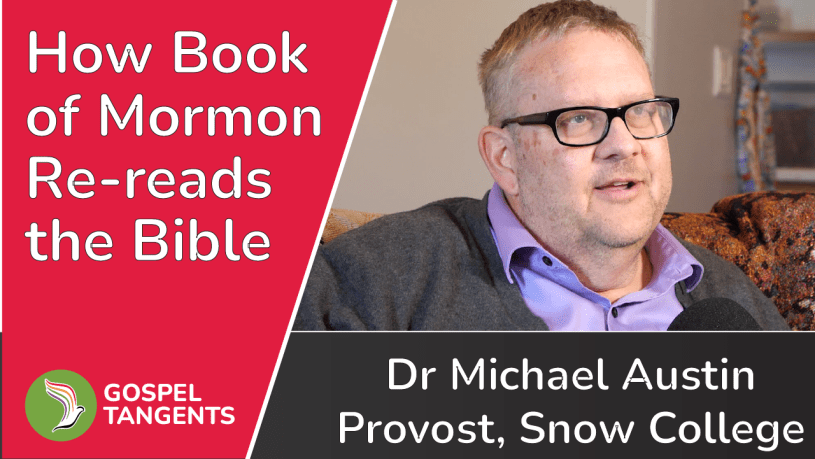
There are many different ways to approach the Book of Mormon. Dr Michael Austin is Mormon Studies scholar and Provost at Snow College. In his new book, “Testimony of 2 Nations,” he discusses 4 ways scholars have approached the Book of Mormon & the Bible. First there is a trickster story (the snake tricks Eve), 2nd is a Jewish story (about sin), third is a Christian perspective (on the fall), and fourth is a canonical perspective, which Michael uses in his book. How does the story fit within the Biblical canon?
In his new book, Michael discussese the above perspectives, and then we move into the Book of Mormon. How does it change perspectives on the Bible? And importantly, do these books need to be historical to study them? (Michael says “no.”
Some scholars have claimed that people like Nephi are unreliable narrators. That is Nephi makes himself look better than he probably was. Dr Michael Austin believes Alma was an unreliable narrator as well. We’ll look further into Michael’s book, “Testimony of 2 Nations.” Do you agree that Alma is an unreliable narrator?
Finally, Michael has been in and out of the hospital these past few weeks. He’s home now, and we hope he stays there! Here’s to prayers for Michael!
 Wheat & Tares
Reading Michael Austin’s blogs on By Common Consent had a fundamental (and positive, I think) impact on my beliefs. I hope he continues to improve.
I think some people stretch too hard to find things that aren’t there, and others lap it up. I don’t see the Sermon on the Mount as a temple text (whatever a temple text might be). Yes, it elevates the law from the Law of Moses (terrestrial?) to a higher law (celestial?), but it doesn’t take us to the veil of the temple, whatever that means. The Book of Mormon is also not a temple text. Yes, it tries to help us follow Christ and to live better, but that doesn’t make it a temple text. Modern temples are a modern creation. Line upon line, here a little there a little, so I have no problem with more light and knowledge coming with time. But neither the Sermon on the Mount nor the Book of Mormon contemplated the temple ceremony or ordinances as we have them. They didn’t have temples like we have.
And no, the molten (or brazen) sea at Solomon’s temple was not used for baptisms. It was used by the priests to wash their hands and feet before entering the sanctuary of the temple. Wrote BRMcK in Mormon Doctrine: “In describing the molten sea the Old Testament record says, ‘The sea was for the priests to wash in.’ (2 Chron 4:2–6). This is tantamount to saying that the priests performed baptisms in it.” I respectfully do not follow. I do not see the “this is tantamount to saying” anything other than what it says: the sea was for priests to wash in.” The ten lavers, five on the left and five on the right of the larger molten sea, were for washing what was to be offered as a burnt offering, and the molten “sea was for the priests to wash in” (2 Chron 4:6). When the explanation in the text is sufficient, I am OK to stop, and not to keep looking for proof of something else. I believe in applying the scriptures to ourselves, but what is happening here is not applying the scriptures of ourselves. I also believe in layers of meaning, and there can be many insights or ways to look at a text. But if one stretches a rubber band too far, it will break. It is what Peter called wresting the scriptures to find something that isn’t there.
Georgis,
Here’s an in depth study by John W. Welch on reading the Sermon on the Mount as a temple text:
https://scholarsarchive.byu.edu/mi/89/