
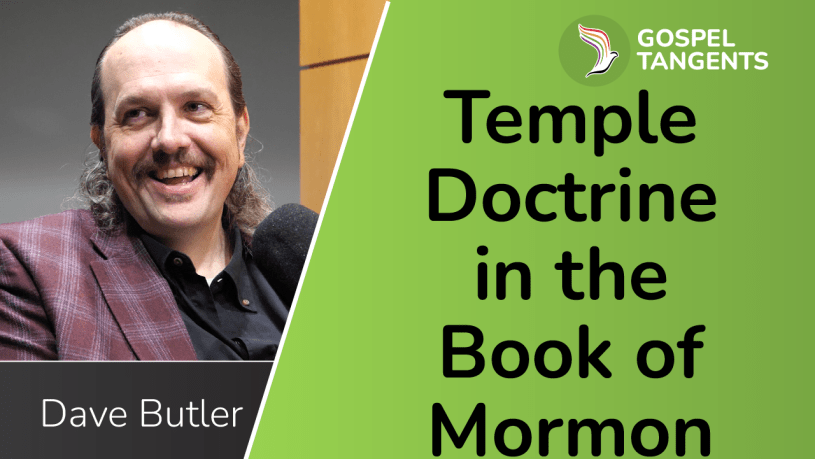
Ir has been said that the Book of Mormon doesn’t hold many distinctive LDS doctrines. like temple ordinances. Dave Butler begs to differ, and says the “Book of Mormon is larded with temple.” He has written 2 books that deal with temple theology in the Book of Mormon: ”Plain & Precious Things” and “The Goodness & the Mysteries.” As we start the conversation, he tells us about the symbolism and secrecy of ancient religious rituals & We get acquainted with Dave and he’ll tell us that temple theology begins in verse 1 of the Book of Mormon.
In Denver Snuffer’s book “The Second Comforter,” Denver claimed he knew how to see Jesus. We also call our temples “The House of the Lord.” Is it possible to see Jesus in the temple, or even outside the temple as Denver claims? Dave Butler weighs in on that. We also dive into why Jesus used parables, and how they relate to temple ordinances.
Dave Butler says the Sermon on the Mount is a temple text! He says it doesn’t work well as a sermon, but sounds more like a temple ceremony, and goes through the Beattitudes. I was surprised when he noted Jacob’s use of “Woe unto…” different groups as an inversion of the Beatitudes. I was surprised when the saying of Jesus about salt having lost is savor was only good for being trodden under foot. Dave noted that the evil character Korihor, who was trampelled under foot, was following this “penalty” of Jesus. Have you considered that Korihor had lost his savor?
Dave also noted that Jesus told us not to swear oaths. Are temple oaths consistent with Matthew where Jesus said we shouldn’t swear oaths? Dave Butler answers that question and discusses veiling at the temple for women, and the significance of temple clothing. He women are actually representing Heavenly Mother when veiled, but because we don’t talk about that, women have felt marginalized instead of empowered by the veil. He feels it is a net loss. Do you agree?
Dave Butler continues to look at the Bible for temple texts, and says the Lord’s Prayer is another example. Why does he think so? He says the words that have been translated as “alms” really represent mercy and justice. He also says that the right hand isn’t supposed to know what the left hand is doing, and compared it to gestures in the temple. He says “our daily bread” should be translated more of as “manna” or the Jesus bread. Jesus did say he was the bread of life, so it is an interesting take.
Are you familiar with Dave’s work? What do you think of his conclusions about the temple in the Book of Mormon?
 Wheat & Tares
Great interview. Dave Butler is an interesting guy who’s fun to listen to. However, the logical leaps he takes to find 19th century and contemporary Mormon temple theology in the BoM and NT are just a bit too much for me. For one, he seems to be playing fast and loose with terminology and using it the same way across time. For example, the use of the word “mysteries” in the NT as well as echoes of something resembling procession rituals is likely the result of the Hellenistic influence on Judaism and early Christianity during this period. Mystery cults were extremely popular in the Greco-Roman world and surely would have been “in the air” as the authors of the NT were writing things down. (How Hellenistic mystery cults relate to the temple endowment, I guess you would have to ask Hugh Nibley 😉 ).
At any rate, all of this stuff pre-dates Nephi in 600 bce and his desire to know “the mysteries of God.” It is more likely that Joseph Smith was thinking of the conventional 19th century Protestant/Catholic definition of “mysteries” (as referenced by Butler) when he encountered /dictated this word.
As an aside, Butler’s reference to Philo of Alexandria as temple-ish was also a bit forced. Philo was a Hellenistic Jew who was highly influenced by platonism, pathagoreanism and the like. He wanted to legitimize Judaism to the educated Greco-Roman elite. Not sure how that relates to temple theology. Anyway, like Butler, I’m just “a guy you know in Elder’s quorum,” so what do I know?
I love worldbuilding fantasy – people that can see a complex plan and system behind the walls of the reality we all live in. I think his ability to see the temple in the beatitudes and even beginning lines of the Book of Mormon is fascinating.
Do I believe it? No. Can I see it even after listening to this whole interview. No. The temple isn’t there when I read it. The LDS temple isn’t in the Bible when I read it either. I am blinded maybe by the mundane world I live in, but I don’t see why it needs to be either.
I find the beatitudes to be beautiful as they are without reading some hidden meaning into them and the Book of Mormon doesn’t tell a story about people who go to the temple with an endowment and sealing. It just isn’t there.
Sorry, academic credentials and training matter. It is likely there is temple mysticism in the Abrahamic religious traditions. I prefer it is described by someone with the bona fides and academic record (expertise) to justify listening to them. This is an obscure and esoteric subject and someone without expertise will likely not know when they have over extended their argument.
Even though the Book of Mormon claims to be a “lesser portion of the word” it is nevertheless soaked in temple theology–if for no other reason than the people who wrote it and compiled it new the mysteries. Not only are there numerous little clues scattered throughout the text–there is also a richness in its various narratives stemming from patterns that derive from the temple–and that includes the entire book as well as individual books and passages within the whole.
Here’s a small example from Alma 33:
3 Do ye remember to have read what Zenos, the prophet of old, has said concerning prayer or worship?
4 For he said: Thou art merciful, O God, for thou hast heard my prayer, even when I was in the wilderness; yea, thou wast merciful when I prayed concerning those who were mine enemies, and thou didst turn them to me.
5 Yea, O God, and thou wast merciful unto me when I did cry unto thee in my field; when I did cry unto thee in my prayer, and thou didst hear me.
6 And again, O God, when I did turn to my house thou didst hear me in my prayer.
7 And when I did turn unto my closet, O Lord, and prayed unto thee, thou didst hear me.
There is a movement from the profane into higher and higher degrees of sacredness. We start in the *wilderness* which is without the precincts of the temple and then move into the *field* which is the outer court. And then we move into the *house* which represents the tabernacle or the Holy Place and finally into the *closet* which represents the Holy of Holies.
The sacred pattern in Zenos’ words does not appear by coincidence. It is purposefully and masterfully set forth by one who understood the meaning of the temple.
Oh my goodness it just warms my heart to hear yet another version of the dreadful “Heavenly Mother and all women are so special and magnificent that we must cover their faces and hide them behind a veil and mention them as little as possible and if only they understood their value they would be so grateful to have no say in anything and fulfill their divine destiny by doing what they’re told and being hidden away until they are called forth by God and men who don’t have to cover themselves up for some reason” trope. Please.
Thank you Dot. My thoughts exactly!
I think sometimes people look too hard and see things that aren’t there. Jack, I don’t see the temple in what you cite. It is stretching too far, or what Peter called wresting the scriptures to find what isn’t there. This is too speculative for me.
Dot,
Once while researching the Kabbalah I came across an esoteric Jewish teaching that a bride veiled her face because she was in communion with her matriarchal ancestors (Sarah, Rachel, etc.). Who could better counsel a new bride? In such an elevated revelatory state the Shechinah, the feminine aspect of God, can show through her face like Moses coming down from Mount Sinai. So like Moses, a bride respectfully covers her face because of the Divine Presence within her.
Unfortunately, my note-taking abilities were lacking the day I read that, and I do not have a reference. Thankfully, I am not a professional scholar, just another guy you know from the Elders’ Quorum.
Old Man, Wait, did Moses cover his face when he came from Sinai? Why don’t men, like Moses, cover their faces then? Wouldn’t that make more sense?
All snarkiness aside, I think that is really beautiful and thank you for sharing. However, even esoteric Kabbalah traditions can be sexist. Men have been coming up with explanations for marginalizing women for a very, very long time.
Dot,
Why don’t men cover their faces? Only those who have been in the Divine Presence need to do so. And only those who didn’t/don’t worship the golden calf can enter into the Divine Presence. Huh. Maybe there is a point with this esoteric stuff.
So, Moses came down from the mountain with his face covered? I’ve never heard that. Joseph Smith? The Q15?
It’s worth noting that the ultra Orthodox followers of Kabbalah are also extreme patriarchal groups who contemporary folks including mainline Jews would most likely think of as misogynist. I’m not sure how much comfort is to be found there for women expecting to be treated with respect and accorded autonomy or to understand archaic holdovers still being practiced in the church.
Old Man: “Who could better counsel a new bride?”
Perhaps I’m a modern, but pretty much anybody.
By this guy’s logic, Green Eggs and Ham is a temple text because of its repetitive ceremonial construction. And the Hokey Pokey is a temple text because it mentions your right and left hands doing different things.
Thanks for that Kirkstall, my sentiments entirely for just about any of this. A nice walk up a hill and my baptismal covenants in mind works about as well for me.
Thanks, Jack.