
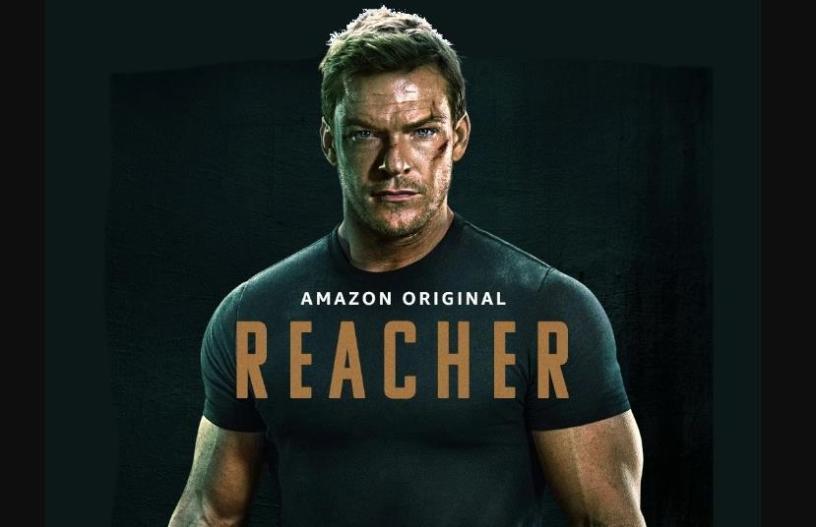
So I came across an entertaining article about “Dad TV,” variously described as “not too heavy, not too light,” with easily digestible plots and “relatable heroes.” Two examples of the genre are Yellowstone and Reacher, so I guess you can throw in some vicariously enjoyable violence and a basket of F-bombs. The one-sentence taglines you could write for these shows (and any other in the genre) applies to pretty much every episode. Reacher: “Hulking ex-Army cop constantly beats people up.” Yellowstone: “Cranky Montana rancher and his posse kill people who mess with the ranch.” Not really family TV. You might or might not watch it with the wife. Readers can weigh in on that. Dad TV is emotionally rewarding, in a shallow sense.
So let’s transplant that genre to … Dad Religion, the domesticated version of Dad TV, acted out (live actors, not video) weekly in your local chapel. It features weekly meetings, kind of like weekly episodes, with predictable plots. So predictable that if anyone goes off script, the audience gets nervous. At times, the Ward Dad might just tap the speaker on the shoulder and whisper a few words of counsel or even just turn off the mic. With Dad TV, you can take a few minutes to make nachos in the kitchen and not really miss any key plot events (there are no such events). With Dad Religion, you can take a few minutes to scan the headlines or check on the game scores on your phone and not really miss any key points in the talk (there are no such points).
Now if you speak four languages or were an English major or spend a lot of time reading non-fiction books, you might be getting a little frustrated at the Dad TV people at this point. As in: “If they spent two hours a night learning Italian instead of watching Reacher, they’d be fluent in twelve months.” Or: “Don’t they know there are dramatic masterpieces or informative documentaries they could be watching instead?” So what’s the attraction of Dad TV? Are we just lazy? Are we entertained? If you like Dad TV, what’s up with you? If you walk out of the room disgusted every time your sweetie brings up the latest episode of Jack Ryan, what turns you off?
But of course what I’m after here is some insight to sacrament meeting, our version of Dad Religion (and, I’m arguing, more daddish in this sense than other Christian worship services). The content is almost always largely (completely?) predictable and forgettable. The only thing that would make you remember a particular meeting is probably when someone went way off script. The Ward Dad and his bros sit on the stand in much the same posture and expression as if they were watching an episode of Justified. The monthly testimony meeting is like the standard sacrament meeting except (1) there is no rest hymn and (2) there are 10 talks with no topic, just personal stuff, as opposed to 2 or 3 talks with a mix of topic and personal stuff. It really isn’t much different. So let’s ask a couple of questions.
First, why are these people here? Is LDS sacrament meeting somehow, like Dad TV, emotionally rewarding, in a shallow sense? I don’t think you can call it entertaining. Lots of adults in the congregation are looking at their phone screen (more entertaining) or reading a book (more informative) or just napping. If the meeting doesn’t check any of these boxes, why do people keep attending? Orthodox answer: to partake of the sacrament and renew our covenants. Secular answer: A sense of duty, maybe? Habit? Path of least resistance (if you have a dedicated spouse or kids)?
Second, the format is remarkably stable and resistant to change. Bring in a guitar or a trumpet for a musical number? Nope. But harps are okay. Put Powerpoint slides or a video up on the big screen? Nope. Narrow the list of speakers to a dozen people who actually want to speak and maybe can give a really good talk, however that’s defined? Nope, most bishops seem inclined (this may be an unwritten rule) to go through the whole ward list. Obviously, Dad Religion hits the sweet spot in some institutional or leadership sense, although I can’t quite put my finger on quite what that is. Senior leadership has fiddled with other aspects of the Sunday meeting schedule, sometimes significantly, such as when the 3-hour block schedule was put in place in 1980 (it used to be Sunday School plus a second hour for Priesthood in the morning, with a separate sacrament meeting in the afternoon) or more recently when Sunday meetings were cut to just two hours. They got rid of Boy Scouts and LDS pageants. But the sacrament meeting script itself has remained almost completely unchanged for a century or more.
So chew on this for a minute and weigh in. What keeps people going? Why were so many people rather surprised that, during Covid, they didn’t really miss sacrament meeting? Or that watching on Zoom was so much nicer than marching off to the chapel? I suppose you could make a suggestion for how to change the meeting (not really what I’m looking for) but also explain why there is not a chance in heck your suggestion will be taken.
 Wheat & Tares
David B has hit the nail squarely on the head. The modern entertainment industry has dumbed things down to the level of the lowest common denominator. Unfortunately, the Church has done the same thing with sacrament meeting.
There should be no surprise that the same people who mindlessly watch Reacher and Yellowstone will mindlessly attend the modern sacrament meeting. Doing any of these things requires no preparation, no listening, no paying attention, and no thought whatsoever. They require no more effort than watching a hot dog eating contest.
There was a time when members were expected to put thought and preparation into giving a talk in sacrament meeting. More talk and preparation than simply reading a conference talk. By the same token, the congregation was expected to pay attention, listen, and use actual thought processes.
The average sacrament meeting of today is full of croc wearing members who are not even listening. They are too busy watching the latest Dua Lipa video or eating a Dairy Queen Blizzard. But truth be told, by dumbing down sacrament meeting, the Church has given them no reason to do otherwise.
As an English major who did (finally) endure all 4 seasons of Jack Ryan, I feel seen. Was it great TV? Nah. Was it good TV? Not really. Was it OK TV? Sure. Basically, the problem with Dad TV as you call it is also a Bechdel problem. It’s a problem with character development. Tom Clancy’s books are guy books, written by a guy, for guys. They have little Cliff Clavenesque rabbit holes into little-known-facts mixed with gruff man-speak dialogue and plots, but there’s no real character depth or deeper truth being explored. That’s not great literature, and it’s even worse religion.
The Covid era was the perfect time to introduce some changes to Sacrament Meeting and General Conference formats. But nope. We’ve gone back to the way it was. Heck, during this era we even saw video taped versions of MoTab at the Conference Center in between speakers who were speaking to an empty room. If they weren’t going to change it then they aren’t going to change it now.
There’s something fantastical about DadTV that speaks to men’s yearning to meet gendered expectations.
Being a man remains confusing as we approach the end of the 21st century’s first quarter- in ways similar but also very different from the contradictions of being a woman today.
It’s a problem largely of our making for sure, but we cannot address it without helping men find security, meaning, and purpose in life- irrespective of ability, income, age, or relationship status.
I haven’t seen Yellowstone or Reacher which means I may have failed as a dad. I liked Jack Ryan but also liked See, Silo, Therhan, and Slow Horses on Apple TV. I love the Star Trek spinoffs and like the Star Wars series and spinoffs but they seem much more Dad-like. I think the Marvel Multiverse is great because there so much to think about. Now granted I don’t think all the shows of these programs are equal in quality. Some are better than others but overall they present the world in a much more realistic view than something predictable like a Sacrament Meeting.
Covid would have been a great time to change things like Sacrament Meeting but also a lot of other things in our society like how we look at healthcare, housing, or education. What we’ve done it seems is to double down on failure and blame the “other” side. Another crisis wasted!
I know people that genuinely enjoy church meetings. I don’t get it but I also don’t get people that enjoy fishing.
I’m more of a Ted Lasso watching male though. So there you have it.
Aren’t scripted religious services more the norm than otherwise? With a literal script. I have only attended a handful of Catholic masses, but it doesn’t take many to learn the routine and anticipate the priest’s words. A few months ago I attended the All Saints service at a Presbyterian church, first time I had been to one; there was obviously an ordered pattern to it that I would encounter again should I return.
I attend Sacrament Meeting (and an occasional Sunday School class) for one reason (and one reason only) to support my wife and family members who still have some belief in “the Church”. Candidly, I love them much, much more than I dislike my own discomfort and a loss of 90 minutes; as I’m forced to endure yet another day of blather and pablum. Yes, a good book (digital or otherwise) is an absolute must.
I don’t think LDS meetings qualify as “Dad Religion” because I don’t necessarily consider all forms of DadTV to be completely lacking in substance (by contrast, LDS sacrament meetings are platitudinous and substance-free, more often than not, and more now than ever). When I was growing up, one of my dad’s favorite TV shows was The A-Team, which certainly delivered hypermasculinity in the form of over-the-top cartoonish violence; in each episode, thousands of rounds of ammunition are exchanged without a single penetrating wound or life-threatening injury. However, beneath the formulaic trigger-happy entertainment value was a show that, at its heart, was based on the core themes of teamwork, creative problem-solving and standing up for the disenfranchised (itself a Christlike virtue). I think this was crucial to the show’s appeal, every bit as much as the attention-grabbing violence.
I see a similar pattern with the Yellowstone TV series. For example, the main character John Dutton is a man who outwardly embodies the “traditional values” of honesty, personal integrity and keeping one’s word. However, he regularly engages in and justifies all manner of immorality (including violence/murder) for the purpose of protecting his ranch and his traditional way of life. That paradoxical internal conflict is a big part of the show’s mass appeal (again, shows like these pull in big audiences but are rarely critical darlings), just as much as the beautiful scenery and physical violence. Joseph Smith and Brigham Young were also men of conviction, but with deeply defective moral compasses and internal conflict that would make the Dutton family look like the Osmonds. I would love to spend an Elder’s Quorum meeting unpacking the moral complexities of early Church leaders, but it’s not likely to happen ever, since in the LDS Church we insist on promoting oversimplified, one-dimensional narratives. Again, no Dad Religion to be found here.
For the people who still regularly attend LDS church meetings, I don’t think it has anything to do with mild, predictable-yet-satisfying entertainment value. Many do so out of habit or obligation or to appease believing family members. And though they will never say it out loud, I think a not-insignificant number are motivated by fear of the consequences of not attending (e.g. the fear of losing one’s eternal spouse/eternal family/eternal genitals, etc.). Temple covenants are also fear-based. RMN knows this and exploits it, hence the “sad heaven” rhetoric. He probably deeply believes in the fear-based teachings himself, which if he does, explains a lot.
There is a pattern that organizations tend to follow: formation, when the organization is launched and the founder leaves a significant imprint; early period, that tends to be high energy and turbulent; normalization, when policies and procedures get established and there is a sense of cohesion; peak period, when the established organization is productive and performs well, new leaders start to rise and internal competition emerges; re-evaluation, when an organization goes back toward the start and cycles through again.
Organizations can become moribund in the late peak period under onerous procedures and rules – it can die of too much bureaucracy. That is how the Church has felt to me for some time now – way too many rules that suck the life out it. I witness current efforts at simplification following decades of building things up, but the richness that was there before feels lost. It seems like we ran out of material some time ago, so now elevate conference talks and rehash/recycle them ad infinitum.
I rather liked Zoom sacrament meetings in early pandemic times. It felt like “early period”, as the bishop would conduct the meeting from his home office, someone else would play the piano in their family room, I would sing in front of my laptop as I followed the meeting at home. Talks were more from the heart. The meeting wasn’t polished, it wasn’t routine. And though I was at home, comfortably attired, I felt closer to other participants in those meetings than I typically do in the chapel. Sadly, a good day at Church now is a day that doesn’t qualify as awful. Kind of a low bar
Totally faking it as an active Brighamite until temple marriages are out of the question for my two kids. Or maybe I will find the courage to live authentically (true to my own spirit, just like Jim Morrison).
I attended a Methodist service a few months ago while in Kansas City, MO, and was pleased to see the casual dress code – lots of Chiefs gear !! We need to loosen up, how about more candy bars and chocolate chip cookies?
I believe in Bon Jovi. If there is anything of good report or praiseworthy happening at my nearest honky-tonk or 7-11, I will seek after those things.
I honestly don’t really know what qualifies as “Dad TV” these days since I tend to find a lot of value in what others call fluff. So much of entertainment and value is in the eye of the beholder.
Warning: The next few lines are probably going to sound ultra “holier than thou,” but that’s not my intent.
COVID taught me that I go to Church more out of concern for others, and not for myself. I really enjoyed home Church, and while there were things I genuinely missed about regular Church, I could have done home indefinitely. My Stake President at the time was very conservative LDS and by the book, but he was actually one of the last people in the Stake with any desire to resume regular Church, and viewed the time as an opportunity for families and homes to grow on their own and develop spiritual self-reliance. Many homes did, but I was almost caught off guard by the number of families in our ward and stake who were anxious to resume regular Church. With all that desire to go back to Church, I felt a pull to go back and help in any way that I could. If God wants me to be part of the organization, then I need it as well.
I can’t speak for other wards, but most people in my ward seem engaged with the meeting, even while being a very young ward with noisy and bustling children. Yes, some talks seem overly recycled at times, but there’s usually at least a line or two that hits a chord in me and allows the Spirit to reverberate that chord for a while. I do feel I’m engaging with a group of people who are genuinely trying to improve their lives.
If I’m selected as a speaker, I try to do my part. I put in some humor, scriptures, modern prophets, experiences (all the same as a lot of people), and maybe some literature now and then, but try to present at least one idea or thought the congregation likely may never have thought of before. I also try to do it in a way in which the message itself takes over, not the one who is giving it. I’d like to think they’ve made a difference overall.
I’m sure there are ways Sacrament meeting can be improved, but I also fear our consumerist-consumed society has infiltrated way too much of our church experience. I no longer try to ask what I’m going get out it. That’s actually made a world of difference. But even with all I try to give, I still come away with more self-motivation, desire for improvement, and optimism. I think my children have felt the same way for some time now.
@John Mansfield In the UMC Church I attend now there are two services each week, a contemporary one and a traditional one. People choose which one they want to attend. There is a pattern for both, but I would say that within the pattern there is a lot of flexibility that means it doesn’t feel predictable in a boring way, more like a haiku.
The contemporary service begins with a welcome by one of the pastors, a time to stand up extend fellowship to people nearby, a song of praise (usually a contemporary song not a dirge), a time for the congregation to publicly share “praises” (good things that have happened during the week they are thankful for) and concerns (sickness, deaths, etc…) and then one of the pastor prays with these praises and concerns woven in and finishing with the Lord’s Prayer (so this is constant every week). Then the reading (passage of scriptural text based on the liturgical calendar) read by a member of the congregation. Then the children’s worship where the kids come to the front, sing a song (they may sing the same song several weeks in a row if they are learning it, but it is often different and related to the reading, and is done with signing) and then the children’s pastor gives a short talk to the kids based on the week’s scripture reading. Then some more music, then the sermon by one of the pastors (again based on the reading and usually 100 times more interesting and spiritually motivating than most sacrament meeting talks, often weaving in modern biblical scholarship), then more music, then communion (so mostly the same words every week, but there are special weeks in the liturgical calendar where it is different) then a final prayer and what I think of as the walk-off music. So yes there are repeated elements, but it feels fresh each week.
DadTV, when I first read that, I was thinking of shows where the Dad plays a prominent role that a Dad like me can relate to and can admire despite their flaws, not being a bumbling fool like the Simpsons. You know, like Kim’s Convenience or Stranger Things or Schitt’s Creek.
ELI: “I do feel I’m engaging with a group of people who are genuinely trying to improve their lives.”
That matters more than anything else. In the community of the saints we should rejoice together in our collective incremental improvement.
And sometimes it doesn’t matter how weak someone’s talk or musical number might be. We’re just happy to see them participating in the program–that’s meaningful enough in and of it self.
I’m here for examination of problems with the depth of LDS meetings. Watch yourselves, and your thoughts, and your words, and your Sunday meeting contents/practices sounds like a gospel of repentance to me, and not only might it be a good idea for such a gospel to become common and vital among Latter-day Saints, it might even lead to better meetings.
But I think it’s probably a mistake to assume that “predictable and forgettable” means *empty*. Predictable is a path worn into the brain, and it actually contradicts forgettable in strict terms except the sense in which attentive awareness sometimes slide off things made smooth with overfamiliarity. What we’re talking about when we say “forgettable” in LDS meetings are things we know are there. And these things probably are carrying implicit but powerful assertions about the way the world is and the way that people should act.
Reacher: there are good guys and bad guys. Justice and order keeping the bad guys contained depends on strength employed in vigilante violence. Heroic status means preparation to engage the world through this lens, in this way, Wild-at-Heart Jesus-and-John-Wayne warrior. See Kristin Du Mez as well as George Lakoff’s strict father metaphor.
Sunday Meetings: there are meetings you can attend to experience connection with God and be part of His People. Dutiful participation cements that relationship and prompts virtue. We learn from one another’s experience when we address each other in these meetings. as well as institutional curriculum and spiritual ambience. Reinforcing specific beliefs and credences is important.
This can sound like nothing more than unremarkable description but I think it’s possible that they’re much more, these messages tread and retread become frames that end up underlying worldviews. And the church (and Amazon series producers) are very successful because they trade at this level.
I don’t see sacrament meeting as a Dad play, or something boring or comical. Sure, there’s repetition, but you get that at a pontifical high mass, too. I find sincere people trying to do good, and I try not to laugh at that. There’s enough finger pointing already, and I try not to mock people who are behaving sincerely. Could we add a rock band? or doughnuts and hot chocolate? or a fancy laser light display? Sure, and people can go to churches with those features if that is what they seek. I try to give respect to people trying to worship sincerely. We don’t have fancy sermons prepared by people with degrees from seminaries, but we have simple people honestly doing their best. I can’t stand book report talks in sacrament meeting, where they summarize a conference talk, but that’s the individual leader asking for that. I try to give the speaker the benefit of fulfulling his or her assignment. What keeps people going? For me, decent people trying to live a decent life.
Are Mormon services like Dad Religion? I don’t really think so. Maybe more like Granddad Religion, if Granddad was a boring bureaucratic functionary. I think Evangelical services are more like Dad Religion, all that John Wayne & Jesus stuff.
Thanks for the comments, everyone.
Angela C, yeah I should have titled it “Grandad Religion.” Or maybe that would refer to General Conference.
10ac, I really enjoyed your summary of a contemporary worship service and a traditional worship service on Sunday — you choose which to attend. What if every LDS stake had two contemporary wards and a few traditional wards, to go along with the young singles ward/branch and maybe a Spanish-speaking ward? It’s interesting that the Church will quite happily make special-purpose units for the singles and for language groups, but NOT for different worship styles or interests. How about blue wards and red wards? That might keep some progressive members from feeling so out of place that they just leave. It’s hard to exaggerate how out of place Trumper talk sounds in a Christian church to those who haven’t drank the Kool-Aid.
josh h, yes Covid was a real opportunity. Some changes were made out of necessity, but you’re right that everything has now gone back to pre-Covid normal, except maybe that some wards (mine does) have kept a Zoom feed going (to access, have to get the code from the bishop in some places).
I go to sacrament meeting each eeek hoping (usually in vain) to hear about how someone in the congregation’s experiences have shaped their beliefs in God and goodness. But it’s usually just a recitation of doctrines and cliches. Most of us aren’t dynamic public speakers, so I try to dish out grace, but it’s so mind-numbing sometimes!