

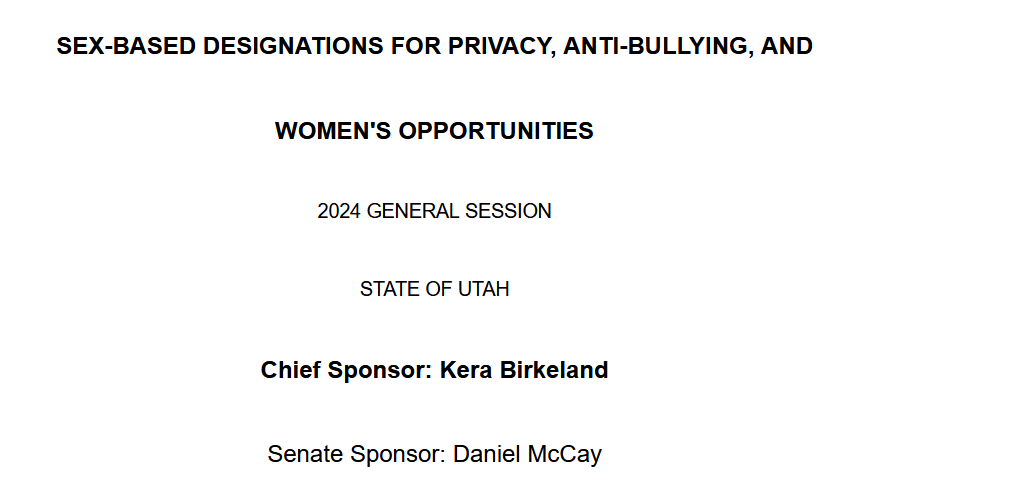
UPDATE: Several hours after I posted this, the Utah legislature passed the bill. I think this is the final text. The changes made before passing it affected students. The focus of this post is adults, not students, so what I wrote in this post is still accurate.
The Utah State Legislature is in session, and one of the very first items they’re working on is a bill to really confuse transgender people.
Before I get into the details, here are some important caveats:
- These rules only apply to government buildings. They don’t apply to stores, movie theaters, or anywhere else that is privately owned.
- The rules don’t apply to intersex individuals.
- I’m writing this Thursday evening, Jan 25, and the bill has not yet passed. The House passed a version. The Senate made some amendments. The Senate sent it back to the House so the House can consider the amended version. You can track the status here.
- The bill bans school kids from playing on sex-segregated sports teams that don’t correspond to their sex assigned at birth. I’m not discussing that in this post.
- The bill also addresses transgender kids and school restrooms, which I’m also not going to get into. It will make the post too long. Let’s stick to talking about the adults for now.
Now, if we’re going to talk about privacy in public restrooms, I think we can all agree that the real problem with privacy is those stalls that clear the floor by 18 inches and have gaps where the doors close. You’ll be happy to hear that this bill calls for new government buildings to include unisex bathrooms that have floor-to-ceiling walls with encased and locking doors. That’s real privacy. In fact, the bill also encourages government facilities to see if they can retrofit some space into unisex restrooms. That would be great!
All right — now onto the parts that are addressed to transgender people. The bill defines “female” to mean “the characteristic of an individual whose biological reproductive system is of the general type that functions in a way that could produce ova.” “Male” has a corresponding definition: “the characteristic of an individual whose biological reproductive system is of the general type that functions to fertilize the ova of a female.”
Your sex is defined by how your reproductive system relates to ova. Intersex people are defined in Utah Code 26B-8-101, and there are exceptions for them in this bill.
The bill originally had rules about both restrooms and changing rooms, and then the stuff about the restrooms got removed. It might get put back in (like I said, this bill has not yet passed as of 10:00 a.m. on Friday, Jan 26), but for now, the rules are about transgender people in changing rooms, like the changing room of the city pool.
The Changing Room Rule:
To preserve the individual privacy of males and females, an individual may only access an operational sex-designated changing room in a government entity’s facility that is open to the general public if:
(i) the individual’s sex corresponds with the sex designation of the changing room; or
(ii) the individual has changed their sex on their birth certificate AND has had a primary sex characteristic surgical procedure.
(There are lots of exceptions — like for children, for people that need help, for first responders, for caregivers and so forth. The bill strives to avoid ridiculous results.)
And here’s the penalty for transgender people:
An individual who knowingly enters a changing room in violation of Subsection (1) [meaning they’re using a sex-designated changing room that doesn’t match their reproductive biology] commits the offense of criminal trespass under Section 76-6-206 if the individual enters or remains in the changing room under circumstances which a reasonable person would expect to likely cause affront or alarm to, on, or in the presence of another individual.
Restating that, I think it says that a transgender person commits a criminal trespass if they use the changing room in a way that alarms a reasonable person. If they aren’t alarming, then they aren’t committing criminal trespass. Right now, “criminal trespass” relates to flying drones and going onto someone’s property to tag it with graffiti (Utah Code Ann. 76-6-206). They’re adding alarming use of a changing room by a transgender person to that, I guess.
If a cisgender person uses a changing room in a way that causes alarm, is that also criminal trespass? I think so. If a cisgender man goes into the women’s changing room and causes alarm, he could also be charged with criminal trespass.
Because of the exceptions for intersex people, intersex people can use either changing room and cannot be charged with criminal trespass, even if they cause alarm. Instead, I assume the would just be charged with the alarming conduct, like voyeurism or public lewdness.
Now we get to the part of the bill that still needs editing because in the penalty part, the bill goes back to referring to “privacy spaces” which includes restrooms.
The bill requires the government entity to call the police if someone makes a complaint about crimes going on in “privacy spaces.” Before this, the person in the main office at the city swimming pool wasn’t required to call the police if someone made a complaint (they could call, but it wasn’t required by law). Now they’re required to call the police.
There are several complaints that require the city swimming pool guy to call the police, not just trans or cis people causing alarm in the changing rooms. For example, lewdness is a complaint that requires the police. If a man is masturbating in the men’s changing room, that’s lewdness and the police get called. If a man is masturbating in the women’s changing room, that’s lewdness AND criminal trespass and the police get called. And vice versa – a lewd woman in the men’s changing room might get charged with lewdness AND criminal trespass.
The bill also has penalties for calling in multiple false reports about criminal trespass. This provision is likely intended to prevent people from harassing unalarming transgender people.
I think the better way to prevent harassment of transgender people would be to throw out this bill as unnecessary. We already have laws about bad behavior in changing rooms. Public lewdness is already a crime. Voyeurism is already a crime. Assault is already a crime. This bill seems to be saying, “if we double the penalty for causing alarm in changing rooms, people will be safer.”
What’s missing from this bill and the discussion surrounding it is facts. How many problems are caused by transgender people using the changing room of their chosen gender? How many problems are caused by cisgender men going into the women’s changing room? How many problems are caused by cisgender women going into the men’s changing room? You would think there would be police reports, or some sort of place where complaints about behavior in pool changing rooms is collected and we could look at that information to see if a problem actually exists. Especially since this only applies to government buildings – government places have to keep records. If you slip and fall at a pool, there’s a record of that. There should also be a record of people complaining about conduct in changing rooms. What problem is this bill trying to solve?
This bill is also too vague to be enforceable. If a transgender person goes into a changing room that doesn’t match their Utah-defined sex and doesn’t alarm anyone, then that’s fine. But if a transgender person goes into a changing room that doesn’t match their Utah-defined sex “under circumstances which a reasonable person would expect to likely cause affront or alarm to, on, or in the presence of another individual” then that’s not fine.
What does that even mean? What if one person in the changing room watches news sources that do a lot of fear-mongering about trans people? If that person gets alarmed because someone they believe to be trans walks into a changing room, is that criminal trespass? Is that person a “reasonable person”? If everyone else is like, “not a big deal, sister,” then is the trans person not alarming?
What if the person who is alarmed is wrong? What if it turns out that the person they thought was trans is actually cis? I have a friend who is six feet tall and broad-shouldered. She’s a cisgender woman. Sometimes I wonder if she gets nervous about going into public restrooms, or if she’s ever had someone be rude to her about being in the ladies room.
The assumption that this bill is built on is that if a transgender person uses the changing room that corresponds to their chosen gender, then we should all be suspicious of them.
KSL quoted the bill’s sponsor as saying, “”It is very difficult, as a woman, to constantly be told that my feelings, my daughter’s feelings … that their feelings don’t matter as much because it hurts somebody else’s feelings,” Birkeland said.
Ms. Birkeland is worried that someone who looks like a man will walk into the woman’s changing room at the city pool and insist he has a right to be there. No one voting in favor of this bill can point to a time that has happened. I’m guessing here, but what probably has happened is sometimes a masculine looking woman is in the woman’s changing room and people who watch fear mongering news sources worry that she’s going to do something alarming.
What I think people who listen to fear-mongering about trans people don’t understand is that trans people (mostly) look like their chosen gender. Birkeland has been listening to news sources that tell her that transgender women look like big, hairy men with beards. No. Actually, transgender men look like big, hairy men with beards. Check out this 60-second video of how much this person changes after starting testosterone:
Under this bill, this individual should use the women’s changing room at the public swimming pool. This person is a “female” according to the state of Utah. I think Ms. Birkeland’s feelings would be alarmed if this transgender man walked into the women’s changing room at the city pool. Yet she’s the one that wrote the law that put him in the changing room with her and her daughter.
What will happen if a transgender man (who has not changed his birth certificate or had surgery) walks into the women’s changing room? How is he supposed to know whether or not he’s alarming? A trans man who has been on testosterone for years likely looks and sounds like a cisgender man. He may or may not have changed his birth certificate or had surgery – it’s the hormones that makes someone’s appearance change. Is he alarming people? Does it make a difference if he has biology that tends to produce ova?
Of course there are trans men who aren’t big, hairy and muscular. There are cis men who aren’t big, hairy and muscular. Judging someone’s right to be in a particular changing room based on their looks is a vague standard that will cause confusion and problems. I bet my cis friend who really wishes she was petite and dainty, instead of six feet tall and broad-shouldered, might make Ms. Birkeland nervous.
Let transgender people live their lives the way they choose to live them. This bill is unnecessary, and it’s based on false beliefs about trans people. The laws that currently exist to prevent alarming behavior in changing rooms and restrooms are good enough.
If you live in Utah, contact your elected representative and let them know your thoughts.
- The bill also uses the phrase “the important government objective of protecting individual privacy”. Should protections for individual privacy be extended to transgender women as well? To cisgender women who have more masculine body proportions than what society decrees is the feminine ideal?
- Typically, support for laws like these splits along party lines, but protections for transgender individuals is becoming more of a bipartisan issue. I read a news report about a poll reporting that a majority of Republicans are wishing their elected representatives would move on from transgender issues (I can’t find it, sorry). In fact, one Utah Republican legislator, Senator Daniel Thatcher, is an outspoken supporter of transgender rights. The majority of comments in the ksl.com news article are things like, “why are we wasting time on laws like this?” Regardless of your feelings about transgender people, do you think laws like these are appropriate, effective, and necessary?
Comment – I’m trying to be less partisan. I tried to write this post in a way that won’t stir contention. My opinion is clear, and I don’t apologize for it, but if you think I attacked the opposing viewpoint or portrayed it unfairly, I will strive to do better if you can point out where I should have phrased something differently.
 Wheat & Tares
Thanks Janey. I only want to add that there are transgender people you aren’t aware of that quietly go about their lives. You know them, but they don’t dare come out to you because the political involvement on the issue makes them afraid of what you would do if you knew. They and their families are terrified of violence all the time. All they want to do is pee when they go to the bathroom.
Also, how are they going to enforce this law? Maybe the cop can carry an ova or sperm detection machine, like a breathalyzer? I think the state could be sued if your tall friend is accused and the cop makes her pull down her pants to prove she is a woman. This is as dangerous for cisgender people as transgender people.
Thx for posting on this topic. As a Utah resident, I am actually accustomed to seeing our fine legislators spend precious time and state funds to “solve” these pressing social issues, while real-world problems go largely unaddressed. [sigh]
A technical observation about the way this bill is drafted, and an observation about the consequences of the way it’s drafted.
The bill defines transgender use of a public changing room as criminal trespass. To establish the necessary state of mind for criminal liability, the bill mentions the reasonable person standard. The criminal trespass statute requires one of three possible states of mind for liability: intent to cause annoyance or injury; recklessness; or knowing that one’s presence on a property is unlawful because notice has been given.
Lawyers who try to implement the anti-trans statute will probably see immediately that relying on the vague, unpredictable, reasonable person standard is a stupid waste of time. Trying to prove a mens rea of recklessness or intent to injure is also laborious, compared to the easy alternative. Under the criminal trespass statute, the easy way to establish a violation of the no-trans-people-in-the-changing-room rule is to post a sign that tells trans people to go away.
So, what we can probably look forward to is a bunch of signs in Utah government buildings singling out trans people as a special menace.
This leaves the problem unsolved of identifying trans people who might be using the “wrong” changing room. But if the goal is to stigmatize trans people, mission accomplished!
You said you weren’t going to discuss the sports issue but I want to address it. Many folks out there want the trans community to be left alone and respected. I’m one of those people. But I make an exception for sports. There’s just no room in my opinion for biological boys to play on girls’ teams. Or to compete against girls.
I’m the father of three daughters who played sports growing up including two at a very high level. Getting chosen to play on their teams was an annual touch and go challenge. To think that on top of that competition they would have been competing against biological boys for spots is beyond my comprehension.
The feminists on this board should be defending girls’ sports, not defending trans girls to play on these teams. That’s what Title IX was all about. It doesn’t take courage to promote trans girls in girls’ sports…that’s in the culture now. What takes courage is to defend biological girls and girls’ sports.
Josh: In 2022 the Utah legislature banned trans girls from playing in girls’ sports. Gov Cox vetoed that bill, and the legislature overrode his veto. At least 19 states have passed similar bans. It is a stretch to say that trans girls playing in girls’ sports is “in the culture”.
The Utah High School Activities Association website lists their mission as follows: “The organization is committed to stressing educational and cultural values, improving the participation experience in activities, promoting life skills and lessons involved in competitive activities, fostering sportsmanship and mutual respect and assisting those who oversee high school sports and activities in UHSAA member high schools”. At a middle school and high school level, I contend that the interests of improving participation, fostering sportsmanship and mutual respect are best served by allowing trans girls to play on girls teams.
Can we support legislation that identifies one small part of our society and then restricts its actions? Should we put a yellow star on their clothes and then restrict where they live? Do we want the government to use its power to divide us and settle issues that could be done in a much more discreet way? I think it’s sad that the very people who constantly talk about small government are so prone to use the government’s power to force us to comply with a moral code they believe in but disregard the rights of some small group’s rights.
I’m a CIS man. A few years ago, I desperately needed a restroom and stopped at a gas station — the men’s room was in use, and I was desperate so I used the women’s room. I hope that didn’t make me a criminal.
I agree, Janey — I am not sure there is a problem that needs to be solved. If lewdness and voyeurism are already crimes, along with assault and so forth, then we don’t need more laws.
Do they really not have better things to debate?
Although one time on my way home from a week camping with the scouts I accidentally used a women’s bathroom. Didn’t notice they were all stalls until someone wearing women’s shoes sat down in the stall next to mine. Nobody saw me but I was appalled once I realized it and maybe shouldn’t have been driving. Perhaps a law prohibiting over-tired high adventure leaders from using women’s rooms.
Sadly, it’s not just Utah legislators who are spending their time (and taxpayer dollars) on all this bathroom nonsense regarding transgender individuals. Right now the only thing holding back passage of bills in the legislature of my home state of Missouri is that the “crazy” and “uber-crazy” Republicans in Jefferson City can’t agree on the extent of this foolishness. They’re equally concerned with how much to prosecute a woman who’s basically suffered a miscarriage.
Rich Brown,
I just saw that Ohio passed the same kind of bill. Actually, they passed it, the governor vetoed it and gave a great reason why, and they overrode his veto. It’s a sad comment on our nation that a political organization like ALEC (American Legislative Exchange Council) has so much sway that it can have a huge conference in a great resort, wine and dine, legislators, pass out model legislation, and have it introduced and fought over all over our nation.
So instead of spending their time on solutions to the Great Salt Lake fiasco, or the lack of infrastructure in the valley given the influx of people, or addressing the housing shortage/cost, or increased homeless population, they choose to spend time on this. Major eye roll.
These people ought to be ashamed of themselves. But I think much like Sally Field, winning their seat at the table has gone to their head and makes them constantly exclaim to themselves “You like me! You really, really like me!”
I hate public restrooms. I really do hope that this “issue” leads businesses and governments to move away from communal restrooms to individual stalls that anyone can use on their own.
@Josh it’s not that simple, either. Trans kids are kids too, and some of them want to play sports. Putting a trans girl on a boys wrestling team or whatever is not a very good idea all around. At the professional level this gets much more complicated and I agree that there’s not a black-and-white answer, but at least up through junior high school trans kids should be able to play with their friends, not be forced on to a team where they don’t fit in.
I have two comments:
1. The real purpose of the anti-trans rhetoric and these anti-trans bills is to rally the religious right together
2. I wish the legislature would address actual problems.
Apparently the bill’s author has never gone to a concert where the line at the women’s restroom, is long while the men’s restroom has no line,
Trans people often have shorter life spans, and aside from higher suicide levels, there are real health issues at stake when bathroom bills are deemed the appropriate solution. When hysterical conservatives (or “reasonable people”) are vigilant for anyone they don’t like the look of, trans people are terrorized. Trans people are often the victims of violent crime, and the bathroom is one such place. If you are a trans woman, forced to use the men’s room by bills like this, you can choose between the fear of violence and the health risks of avoiding going to the bathroom for long stretches of time. A trans person I know and love avoids using public restrooms to a very unhealthy extent, holding it in for hours and hours. That is really unhealthy. But so is the stress of dealing with these shrieking Karens and terrible legislators who want to bully the most vulnerable among us.
And I’ll just add one more comment as a woman who has been dealing with the unfairness of bathroom design in public spaces her entire life. It is patently obvious that the majority of public restrooms were designed by men for men with no regard for the fact that women take longer in the restroom. How often do you see a line outside the men’s room? Almost never, including when there is a line of 20 people outside the women’s room. In Paris, I once had to wait in line over an hour with my daughter who was ready to pee her pants, for a two-stall restroom with a line that wound down several flights of stairs while her brothers and dad walked in with no line to a men’s room with two stalls AND a urinal.
Instead of vilifying a marginalized group of people, we need legislation that converts ALL public restrooms into unisex. The easiest way to do this is to design them, as some places are doing now, with shared sink areas, and individual full privacy stalls in a row that are completely available to any gender.
You know what’s really insidious about this legislation? The definitions reject transgenderism. The law defines “male” and “female” in connection with ova and fertilizing ova, and then defines “man” as “an adult male” and a “woman” as “an adult female.” A transgender woman is never ‘legally’ a woman, even if she changes her birth certificate and has surgery. A transgender man is never ‘legally’ a man, even if he changes his birth certificate and has surgery (and looks like the guy in the video I included).
Those definitions are going to haunt trans people forever. Even if parts of this bill get struck down as unconstitutional, the actual definitions are going to stay. Those definitions can be applied in any future law. Utah has now written biological essentialism into law and it’s going to be there until it gets repealed, which will likely never happen.
Drivers licenses have your sex as male or female. Will a transgender person ever be able to change their sex on a drivers license? In any government issued identification, will a trans person’s identity be respected? Any law that distinguishes between men and women is going to hurt transgender people. Over and over and over.
This law is so cruel.
I don’t live in Utah but I’m assuming they have a lot more important things they could be spending their legislative energy on. However, those issues are probably boring and not as compelling to their MAGA voting base in an election year.
I don’t think I fully understood the impact of these laws until my daughter came out as trans. She was assigned male at birth. We live in a trans friendly state but a few months after her social transition we were traveling through Texas and she had to use the restroom in the airport. About to board and there were no unisex bathrooms near the gate. It’s a lose lose situation, do you risk the safety of a trans woman to go into a men’s bathroom just to follow some law? It’s scary as a parent with real violence and harassment of trans women. Just leave my daughter alone. What does that say about these lawmakers that are so convinced that men will change their gender just to oogle women going to the bathroom.
Regarding sports. I get the biological issues and that will need to be adjudicated by ruling bodies for top level sports. However, I think it’s revealing that many focus on the winning as if that is the purpose of sports participation. I personally feel we need to rethink youth sports if it’s all about becoming high level competitors. My adult boys benefited greatly from participating in healthy sports programs that were about teamwork and personal development. Most trans women aren’t that talented just like most cis women and cis men. But they can participate in a team in a healthy way. Youth sports should be about that. After seeing what kids go through transitioning even in supportive regions and supportive families and friends, I just don’t think there are that many kids that are going to transition solely to win. And if they feel that pressure shame on the adults in their lives for not creating a healthy environment.
Bottom line – these laws and the rhetoric, especially those promoted as a faith, are just unhelpful at best and dangerous. We’ve seen with acceptance of gay marriage how healthy society can be with acceptance. (Hopefully stays that way). We need to create the same world our trans brothers and sisters.
If I as a male went into a men’s bathroom and ogled other people there I would be violating the law, wouldn’t I? Voyeurism is voyeurism regardless of which gender you and the victim are. When I use a public restroom I just go in do my business and leave. I don’t look at other people in there And most other people are like me.
So why criminalize people who look mostly female or male from going into a bathroom do just do their business? Stalls, too, are a mostly private experience.
I accidentally walked into and used a female public bathroom once. I didn’t realize it until I walked out. Some other woman saw me walk out and gave me a bit of a startled look. It was a bit embarrassing, but that’s it.
Brad D,
I agree. It’s already a crime to assault a person any where including bathrooms. Republicans used to object to extra laws when there were already laws on the books. I remember the big fuss made about hate crime laws. Unfortunately most of the fuss isn’t about anything but political signaling.
Back in 2004 or 2005, one of my old bosses was in an all day meeting at NY headquarters with several higher ups. When there was finally a break, he, like the rest of the meeting participants, made a bee line for the bathroom. He was standing there washing his hands when his new boss stepped out of one of the stalls and came over to the sink next to him. She was chatting about the meeting as if there was nothing unusual about the two of them using the same bathroom. That’s when he noticed there were no urinals. This really doesn’t have to be some big deal.
I do understand that women who have been sexually assaulted (25% of women) often have fears of safety, whether these fears are rational or not, but there are other ways to solve this that don’t put trans people at risk. The risk to trans people is actually much higher than the risk to women; there are just more women than trans & non-binary people. The idea that we can’t just change bathrooms to be both more private and non-gendered doesn’t seem to be on the table, and the reason is because this isn’t really about women’s safety–it’s about hating trans & non-binary people.
As someone who spent a career in public ed working with teens, I don’t think unisex restrooms for all in schools is the answer.
I’ve come to understand that this blog dislikes dissenting opinions; especially if they do not totally mirror the predominate liberal theologies of the day; but frankly, I don’t care. While I loathe the Corporate LDS Church, unerringly support Women’s Rights, absolutely applaud Same Sex Marriage and the historical gains of Civil Rights Movement, I’m not traveling any further along the Transgender, Pansexual, Trans-Sexual (or whatever other made up term you want to use) trail. This whole topic has become “squishy madness” with no boundaries, no ceilings and no floors; and is a perfect example of the social movement insanity which has infected our culture. And, while as our society continues to focus on this nonsense (while certainly making some feel warm and fuzzy in their virtue signaling) much bigger problems loom in the background and foreground – which far outweigh this “issue”.
I’m glad to see this Bill; and am happy that it has sailed through the House and Senate. I hope Governor Cox signs it early next week.
Note: I know that a comment like mine makes Liberal heads explode – and may very well put Janey in the hospital; to think that someone has the gall to have a different opinion than hers. So…..here’s some fresh, red meat….feed to your hearts delight. Knock yourselves out. It won’t change a damn thing.
Old Man,
I am interested in an expansion on your comment. You leave things very unclear.
A person should use the restroom that corresponds to his/her physical phenotype. You don’t want a hairy trans man with a surgically constructed penis showing up in a women’s restroom. If it is done that way, it is hard to see why anyone would be upset.
two questions for lhl: where’d lhl come from ’cause it seems like you’re not into inventiveness or creativity? how many kids do you have (creativity)?
lws329,
I’ll be happy to oblige.
Teens are going to teen. They are not adults. They can’t police each other. Utah schools are undermanned and underfunded. Even in the best schools, restrooms are the places students go when they want to be temporarily outside of adult supervision. (For legal reasons, faculty have their own restrooms.). Bullies, gangs, disgusting weirdos and the odd sociopath skipping class hangout in some restrooms. Every high school I know has a restroom or two polite society shouldn’t enter. Some boys’ restrooms you shouldn’t enter if you want to still wear your shoes into your home. In one high school, my AP kids would trek across campus and across the parking lot and use the LDS seminary restrooms. And some of these kids were not LDS!
Now we are taking a contentious social issue and dumping it into the middle of Utah public school restrooms. Unisex restrooms are not the norm in Utah. Conservatives will go ballistic and pass a voucher law like none other, creating a nasty caste system. We can’t provide security for our trans kids nor our girls in any restroom setting. A wall-to-wall approach will not work.
I would support lockable restrooms for individual use only around the building. But that costs money!
lefthandloafer – I live in Utah. If conservative opinions were going to put me in the hospital, I would have been too incapacitated to write this blog post.
The “squishy madness trail” is just letting people live their lives the way they want to live them. As the conservatives have gotten more and more controlling, I’ve scratched my head and wondered about how “liberty” now means “the government has to pass laws about bathroom use” and “insanity” means “it bothers me when people have different experiences with gender and sex.”
lhl,
As a conservative, I always thought that meant the government should butt out and not create problems with regulations. But now I see that our “conservative” party has become authoritarian and if I want the government to butt out I have to vote Democrat to stand up to those who want to regulate who is allowed to pee in public buildings without being threatened.
lhl, Thanks for having the courage to speak truth in a (for the most part) liberal echo chamber. It’s refreshing.
Lhl: I’ve seen plenty of contrary opinions in the comment sections of this blog (from Jack and others) and people generally remain civil. I’m not sure why you felt you needed to include that last paragraph. If you disagree with the substance of the post, then stick by it. No one needs a passive aggressive, ad hominem, fishing for reactions “note” tacked on at the end. You say you don’t care what others think of your contrary opinion, but obviously you do.
lefthandloafer,
“While I loathe the Corporate LDS Church, unerringly support Women’s Rights, absolutely applaud Same Sex Marriage and the historical gains of Civil Rights Movement”
That sounds pretty liberal.
“I know that a comment like mine makes Liberal heads explode – and may very well put Janey in the hospital; to think that someone has the gall to have a different opinion than hers. So…..here’s some fresh, red meat”
So you’re suggesting you’re conservative, here? Maybe libertarian? And you support a bill that calls for increased government intervention into matters of transgenders and public bathrooms? I thought conservatives and libertarians were supposed to be about less government, weren’t they? And that’s what I just don’t understand. I hear all sorts of cries from conservatives for a strong government crackdown against the trans community, using state and federal power to bar them from access to public bathrooms, sports teams, and preferred pronouns.
Brad
Thanks for your questions. Here are some observations I have. It used to be a hundred years ago that Democrats and Republicans had both liberals and conservatives within their parties. For instance, FDR was a liberal in a very conservative Democratic Party followed up by a liberalish Harry Truman. Remember Strom Thurman was also a Democrat and he was extremely conservative. Over time, the parties started to be aligned as liberal and conservative after LBJ’s civil rights legislation. But in reality, conservatives have continued on their march to the right so much so that new labels have been created to express their positions while they have been able to label Democrats as being liberal which means they are to the left of Republicans but they were moderate and not liberal in the classic sense. Carter, Clinton, and Obama while being called liberal by conservatives were moderate in their policies at best. Republicans though have steadily moved to the right, so much so, that Eisenhower is a socialist, Nixion a moderate, and Reagon a conservative, with both Bush Presidencies becoming even more conservative to Trump who has a new label, MAGA, which doesn’t have a definition on the conservative scale but looks a lot like authoritarian/Facishist. Republicans who honor Reagon are now called RINOs pushed out of office by MAGA supporters and are ignored in local-level politics/caucuses. (this is kind of like how Rock-n-Roll became prog rock, heavy metal, punk rock, emo, alt-rock, etc). In this whole process of shifting labels, there has also been a shifting of what are basic principles. In other words, small government, fewer taxes, and law and order can be conveniently forgotten in favor of protecting us from Trans kids or some crisis on the border where human rights can safely be ignored. People can pick and choose their positions and labels and who cares what they mean because everyone is confused anyway because there has been so much shifting and changing over the years.
So how does all this translate to transgender legislation? I believe that whoever picks on the least picks on the most. All the arguments created to justify such legislation are just clouding the water to justify doing something that we wouldn’t want to be done to us. And, it shows how we’ve moved from live and let live to having the government solve our problems all in the name of freedom. To me, that sounds like hypocrisy.
The TN version of the bathroom bill was overturned by a judge. May UT’s bill suffer the same fate.
Similar to what others have said here, it does seem to me that when a person says they are a conservative nowadays what they most often mean is something like: “I believe that government should leave ME alone to do what I want, but government should keep THEM from using MY schools, parks, roads, public facilities, bathrooms, tax-payer’s funds, etc…” The path from Southern segregation laws to anti-LGBTQ laws is pretty continuous.
Reading this from Munich where I spent yesterday at a swimming pool with mixed gender locker rooms. There are also private pods for those that wish to change privately. And everyone goes about their business with no issues.
There is also a textile free sauna open to all and once again – everyone acts normal and just enjoys it.
It is difficult to understand how extreme republicans are relative to the real world when you live in America, let alone Utah. Brad says how Germany lives, and most of northern europe.
I was going to say there are no republicans there, but there are extreme right wing people but the numbers are small. The electable parties are to the left of Burnie Sanders.
The electable parties in Australia are in the democrat range. Again we do have extreme right wing people, but probably in the hundreds.
I do not understand how or why Republicans are so extreme, or so numerous.
Our nation was founded with provisions to keep religion and state separated. The founding fathers were Deists or members of what we’d call today more traditional and older denominations like Anglicans. There were Evangelical citizens (Baptists/Methodists) but they were in the minority. Over time in our nation, the older religions have diminished in their power and influence while Evangelical Religions have grown and flourished. Religions that didn’t exist at the founding also came into being like LDS, 7th Day Adventist, or Jehovah’s Witness while portraying themselves as different, unique, restored, and “true” but essentially were extensions of Evangelical ways of dealing with religion. Over time they rewrote history more to their liking by saying we were founded as a Christian Nation, developing a pledge of allegiance with a nation under God, became very involved in national politics developing power both in the nation and within their congregations. Given all this over time, it’s much easier to see 1. how numbers grew and 2. how their views became more right-wing. We talk about the crazy things that we’ve heard in our sacrament meetings or Sunday School Classes and then multiply it across the church and the nation in similar and like-minded religions, which have grown substantially in the past 50-100 years. Add to that a willingness to rewrite history if not in the textbooks but in popular evangelical culture, disregard any non-religious press, believe proven lies, be energized by cultural war issues centering on “moral” beliefs, and demand group think on political topics and voting. You can see how we got here.