
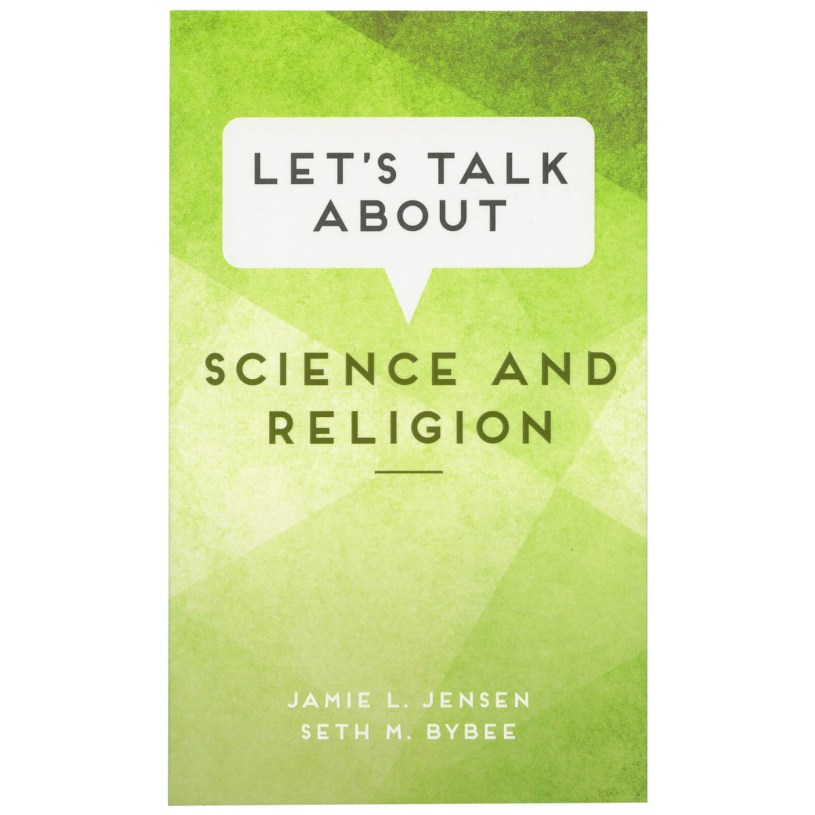
Let’s talk about Let’s Talk About Science and Religion, one of the booklets in Deseret Book’s well-received series. About half of the booklets are successors to an LDS Gospel Topics essay; this is one of the ones that is breaking new ground. I’ll take a look at what’s in the booklet (107 pages of text, plus notes and index) then talk more generally about Mormonism and science.
Unlike the essays, these booklets feature named authors and are published through Deseret Book rather than on the official LDS site. The authors here are Jamie L. Jensen and Seth M. Bybee, both biologists at BYU. Give Deseret Book credit here for getting scientists to write this book, not religion profs. In their discussions, the authors are of course quite deferential to LDS leaders (throwing in quotations when they can) and LDS orthodoxy, but they are relentlessly pro-science throughout the book. Granted, they also emphasize that science and religion, in particular science and Mormonism, can be successfully harmonized and reconciled. You may or may not agree with that approach, but it would be unreasonable to expect a different approach from a Deseret Book publication.
The first half of the book has the theme “reconciling science and religion.” Chapter 4, “Teach True Science, Not Pseudoscience,” should do some good. Quote: “[W]hen pseudoscience masquerades as real science, the unintended consequences can be catastrophic” (p. 32). Yes, there are people who are dead because they avoided getting Covid vaccines. The authors mention vaccines and Covid, with a two-page discussion later in the book (p. 41-42). They also devote two pages to “pseudoscience causes spiritual harm.” With reference to stories they have heard from their own LDS students, they roundly criticize the frequent LDS practice of using pseudoscience as a tool to (somehow) strengthen or defend LDS testimonies from evil science. That is, at best, a short-term strategy, because most (some?) people will sooner or later figure out they were being duped and, as a result, sometimes exit the Church. The authors don’t come right out and say it is LDS leadership that has often used and encouraged this approach (and still do!) but most readers will be able to connect the dots. I hope some senior LDS leaders read the book.
Chapter 5, the last in this section, is titled “Comfort with Uncertainty.” They claim, “Uncertainty is a hallmark of both science and religion” (p. 46). They try to educate the average Mormon reader on two points. First, that uncertainty in science is characteristic of cutting edge science, but that does not detract from the value and the achievements of science in general. Science can’t provide definitive, immediate, shoot-from-the-hip answers to emerging topics or issues. It takes time to formulate questions, collect data, and establish conclusions (then repeat the process again and again).
Second, they try to suggest that uncertainty characterizes religious beliefs as well as science, which may not be a revelation in some denominations but will not be well received by the average Mormon in the pews or in leadership. Quote: “When people are dogmatic, they are drawing a conclusion that is untested and incapable of change. … We should avoid becoming dogmatic (that is, irrationally insistent) about particular beliefs or claims” (p. 42-43). Mormons manage to be dogmatic even without a clearly articulated theology and set of doctrines to be dogmatic about. In any case, the authors are telling Mormons to be more comfortable with uncertainty in both science and religion, and to exercise patience when science and LDS statements seem to be in conflict. They say, “We have a testimony that both religious and scientific truths can exist in harmony” (p. 46).
The second half of the book looks at a few topics in the life sciences: evolution, health and medical science, nature versus nurture, and environmental stewardship. It would be easy to spend a couple of paragraphs on evolution (including two pages the authors devote to Adam and Eve), but we’ve been over all that before. Let me just quote a statement from President Nelson that they give in their conclusion to the chapter:
There is no conflict between science and religion. Conflict only arises from an incomplete knowledge of either science or religion, or both. … All truth is part of the gospel of Jesus Christ. Whether truth comes from a scientific laboratory or by revelation from the Lord, it is compatible.
(p. 63, ellipsis in original) That’s not a quote from General Conference, which is too bad. It’s from the Church News, from remarks by President Nelson at the dedication of the new BYU Life Sciences building in 2015. So the leadership will say pro-science things to BYU science types, but then deliver neutral or even anti-science pronouncements when speaking to the general membership in General Conference or (especially) in LDS curriculum materials. The LDS practice of saying different things to different audiences is not dead. But at least you have that quote to run with.
It’s a good and useful book. It would be a great gift for the high school or college student in your family. It would be nice if the sort of discussions featured in the book were more frequent in LDS Conference talks, sacrament meeting talks, and curriculum materials.
Which brings us to the more general question of science and Mormonism. On the one hand, it’s nice that the LDS Church is more pro-science than the rest of fundamentalist/conservative Christianity. The science departments at BYU teach real science and conduct real science research, even in the area of evolution. In an earlier era, there were scientists called into senior LDS leadership positions. These are positive aspects of the LDS Church.
On the other hand, the general culture of the Church at large leans anti-science, and seems to be leaning more that way in recent years. For evolution, vaccines, and climate change, Mormons are just following the conservative Christian pack. Uniquely Mormon topics like the Word of Wisdom and the peopling of the Americas stand out because they are so uniquely Mormon. At least the authors acknowledge that “research on the health effects of coffee and tea … is still mixed” (p. 66-67, ellipsis added).
So what do you think?
- Have you read the book?
- Do you agree religion and science can exist in harmony, or are they inevitably in conflict?
- Likewise, do you think Mormonism and science can be harmonized, or are uniquely LDS claims even more in conflict with science and history than standard Christian claims?
- Should LDS leaders be more pro-science in their public pronouncements and General Conference talks?
- Why do so many Mormons, even in 2024, feel they are or should be anti-science?
 Wheat & Tares
Religion and science, for me is best discussed by John Lennox, a Christian mathematics professor emeritus at Oxford University Cambridge, UK. He is an excellent Christian apologist.
A few days ago, I used a quote from Brigham Young that said that in Mormonism, science and religion should not conflict. My husband argued against the idea saying we should never adjust religion to align with science. I tried to say that if there is a conflict, we for sure should pray about it and see if our religion needs adjusting. He stuck to his argument that we never adjust our religion according to science. So, I was glad to see the quote from President Nelson. I kind of enjoyed rubbing that quote in my husband’s face. Yes, if there is a conflict, they cannot both be true, so we should research more and possibly find how our religion is interpreting things wrong, or just give it time to see if more research changes scientists minds. If science proves ideas to be facts, we can live in denial or figure out how we are interpreting our religion wrong.
The Church has demonstrated time and time again that its understanding of complicated issues is guided, not by revelation, but by science and trends. And the caveat to that is it usually takes many many years for that to kick in:
1. Evolution: look at what LDS leaders said about evolution back in the day. Somehow we magically moved from Evolution as a heresy to Evolution as something “we don’t take a position on”.
2. Homosexuality: look at what Church leaders have said about homosexuality over time. In the year I was born (1965) BYU was practically rounding them up and kicking them out (see Wilkinson’s 1965 message to BYU students). Granted, homosexuality was considered a mental illness by most of the medical establishment in the US until the early 70s. But the Church is always years behind and LDS leaders still struggle to know what to do with our LGBTQ members. One of the most honest statements Oaks ever made was when he admitted “we don’t know” when asked why there are homosexuals among us. Why don’t we know?
3. DNA: When the Church modified the BOM title page in 2006 from “principle” ancestors to “among”, you knew the science that undermined the historical BOM narrative was just overwhelming. They must have hated to admit that.
4. Kinderhook Plates: As late as 1981 the Church was still holding these up as an example of Joseph Smith’s ability to translate. Electronic scanning microscope 1, LDS narrative 0.
These are easy examples off the top of my head. They demonstrate that there is indeed a conflict between science and religion.
Science and religion can absolutely be harmonized but not in the way the Church wants. Here’s how I see it going in an ideal world:
Religion:
– Expresses devotion to something greater than ourselves
– Gathers community oriented around service and a common purpose
– Encourages ethical behavior, altruism, and self-improvement
– Encourages artistic expression in pursuit of the divine
Science:
– Provides explanation of what the universe is and how it works
– Provides explanation of what we are and why we behave the way we do
– Fuels technological/medical innovation that improves our lives
– Guides public health and environmental policies towards best outcomes
The problem is religion in our current society too often tries to do what science is better equipped to do—explain the universe and human nature and inform public policy. And when religion tries to be science we end up reinforcing pseudoscientific dogma.
For Mormonism to truly harmonize with science, we’d have to relinquish our vice grip on Joseph Smith’s 19th century speculations on the nature of the world and our need to enforce the sexism, racism, homophobia, authoritarianism, and sexual repression that defines our current church structure.
josh h,
I think we have to figure how much the world has changed when looking at how the church has changed its position on one issue or another. In the case of evolution–if we look at the church’s position strictly from a scientific point of view then it really looks like the church came around to the scientific community’s way of seeing things. But the problem is that in those days organic evolution was being utilized by much of the intellectual community to cast doubt on the doctrines of religion vis-a-vis our beginnings. And a lot of Latter-day Saints as well as folks from other religious backgrounds were having great difficulty reconciling their faith with that particular science.
And so when Elder McConkie and others spoke of evolution in terms of heresy–while they may have been wrong about the particulars of the science — which wasn’t their primary focus as they were more concerned about the theological implications of the debate — they were not wrong in correcting the emerging narrative which claimed that humanity had no divine lineage. Now that’s not to say that every one in the scientific community thought along those lines–but there can be no doubt that it was spreading like wildfire through the academy and popular culture of the time. Plus, we have to remember that the Latter-day Saints had a very special interest in refuting said narrative because of our belief in premortal life.
Also, I think it’s only fair to point out that not only has religion modified some of its claims–science has too. Organic evolution seems (to me) to be a lot less “random” than it used to be. It seems like we’re more aware these days of the channeling influences of the various forces, both local and cosmic, on evolutionary pathways.
And so, not only was religion scientifically naive–one could also say that science was theologically naive.
Until pretty recently, I kind thought that the generation of Mormons who still held on to those old anti-science superstitions were slowly being “reassigned” and the younger generations would, if not embrace science, kind of accept it, put it in a corner somewhere, and go about living their faith as they see it.
Well, Covid really changed this for me as all of the anti-vaxers, anti-maskers, Covid deniers, and people who seemed to lack even a basic understanding of how viruses function, came out of the woodwork. Clearly, this was not just a Mormon thing, but it was stunning to see how people who typically proudly proclaimed to “follow the prophet,” so quickly made an exception for themselves when that prophets’ council (to basically follow government Covid recommendations) contradicted their political views.
More recently, two different discussions in Elder’s quorum really shot holes in my general church-wide, science-acceptance thesis. In one lesson, the instructor was simply trying to distinguish between conventional and spiritual “knowledge” – and was actually referring to the latter as “belief” (gasp!). This divided the room with the largest faction concluding that science was basically unreliable. The scary part was, the instructor was an older gentleman (l believe a retired farmer), and the main interlocutor was a millennial chiropractor. In another lesson, a Gen-xer aged brother, boldly proclaimed without a hint of sarcasm, that the Church should pull its sponsorship from BYU because it teaches evolution.
While I give the church and Deseret Book props for publishing this book, I don’t think it is going to reach the group of Mormons mentioned above. The problem is that anti-science has been weoponized by the political Right and has blinded a lot of otherwise reasonable and intelligent people in and out of the Church. Hopefully, as the OP indicates, we’ll be able to reach enough young people to stem this tide of alarming anti-intellectualism.
I think unfortunately that science has become political and associated with the Democrats. As a result conservative people feel obligated to oppose it and not think about it because it now is part of the evil influence of the other side.
I am grateful and excited for this book. It ought to be a required Sunday School, RS and EQ curriculum. I would be happy to teach it if anyone is listening.
My understanding is that:
Science says, “We don’t have the ultimate truth, or eternal truth. This is just the best that we’ve got, and when we find something better or closer to the truth we will drop our old conclusions and adopt our new ones.”
Religion says, “We have the ultimate eternal truth. It will never change.”
The problem is that we keep finding out that many of the “truths” taught by religion turn out to be wrong, and they are changed, and it creates a real problem for them. They deny that they changed, or they hide the changes, or don’t address the changes. Or they say that the changes were revelation and NOW they have the ultimate TRUTH.
I’m completely comfortable with the idea that all of my religious beliefs are wrong, but it’s just the best knowledge I’ve got right now, and when I find something better or closer to the truth, I will drop my old conclusions and adopt new ones. I think it’s a healthier attitude for me to have – and I think it would eliminate many problems that the church faces if they took the same approach (although it would certainly create new problems for them – I think it’s a more honest approach).
(again, sorry if this gets posted twice)
Have you noticed that those who believe in evolutionary theory the least seem to model it in their lives the most? Survival of the Fittest. Think about it. Most conservative thing I’ve ever heard of.
Old Man:
“Have you noticed that those who believe in evolutionary theory the least seem to model it in their lives the most? Survival of the Fittest. Think about it. Most conservative thing I’ve ever heard of.”
One might also argue that the more deterministic liberal approach to meaning is a product of evolutionary science. A sort of–this where evolutionary pathways have brought us and thus we are the way we are.
aporetic1:
“Science says, ‘We don’t have the ultimate truth, or eternal truth. This is just the best that we’ve got, and when we find something better or closer to the truth we will drop our old conclusions and adopt our new ones.'”
As much as I appreciate how science recognizes that it’s always in some degree of flux–I think it sometimes has a hard time admitting that any epistemological approach to knowing outside of its own methodologies can be useful in establishing a reliable perception of reality.
“Religion says, ‘We have the ultimate eternal truth. It will never change.'”
Yes–but since religion predates modern science it is perfectly reasonable for religion to allow the newer, more accurate ways of measuring the natural world to hold sway in its estimation of what I call the “low hanging fruit” of religion. The low hanging fruit being those religious beliefs that overlap with the mechanics involved in physical reality–which purely religious notions are not equipped to accurately define.
But what of the “higher” fruits of religion? The reality of a Living God; eternal life and purpose and so forth? Science cannot touch these–nor does it pretend to (in most cases) much to its credit. And so, while science is useful in giving us a better picture of the earth’s geological history than religion has been–that’s not to say that it has the tools to measure religion’s theological claims vis-a-vis a Divine Creator and our purpose for being here.
A second thumbs up for Kirkstall’s comment. I think science and religion can support each other if the practitioners of each stay with the questions that each can answer. Don’t ask science to prove an afterlife. Don’t ask religion to answer biological questions. There will be some discussion at the boundaries of the questions. But both can and should co-exist.
Great post. I haven’t read the book, but it sounds like a good one.
@Jack, sorry, but I just can’t accept your revisionist version of Church history regarding evolution. From your past comments, it feels to me that you cannot resist making such an explanation because you just simply cannot accept the reality that the prophets of this Church are fallible. That is, you simply cannot accept the idea that our prophets make major mistakes in their teachings. The truth of the matter is that evolution is one of the best “go to” topics for establishing the fallibility of the prophets of the COJCOLDS. Let’s look at a few quotes:
“There is no harmony between the truths of revealed religion and the theories of organic evolution.” McConkie, Mormon Doctrine
“Evolutionary theories assume that hundreds of millions of years were involved, first in the creation of the earth as a habitable globe, and again in the evolution of spontaneously generated, single celled forms of life into the complex and multitudinous forms of life now found on its face. We have rather specific scriptural indications that the creative period was of relatively short duration.” McConkie, Mormon Doctrine
“There were no pre-Adamites. Any assumption to the contrary runs counter to the whole plan and scheme of the Almighty in creating and peopling this earth.” McConkie, Mormon Doctrine
“Of course, I think those people who hold to the view that man has come up through all these ages from the scum of the sea through billions of years do not believe in Adam. Honestly I do not know how they can, and I am going to show you that they do not. There are some who attempt to do it but they are inconsistent – absolutely inconsistent, because that doctrine is so incompatible, so utterly out of harmony, with the revelations of the Lord that a man just cannot believe in both.” Old Testament Student Manual – Genesis – 2nd Samuel
“…I say most emphatically, you cannot believe in this theory [of evolution] of the origin of man, and at the same time accept the plan of salvation as set forth by the Lord our God. You must choose the one and reject the other, for they are in direct conflict and there is a gulf separating them which is so great that it cannot be bridged, no matter how much one may try to do so….Then Adam, and by that I mean the first man, was not capable of sin. He could not transgress, and by doing so bring death into the world; for, according to this theory [of evolution], death had always been in the world. If, therefore, there was no fall, there was no need of an atonement, hence the coming into the world of the Son of God as the Savior of the world is a contradiction, a thing impossible. Are you prepared to believe such a thing as that?” Joseph Fielding Smith, Doctines of Salvation
“I am grateful that in the midst of the confusion of our Father’s children there has been given to the members of this great organization a sure knowledge of the origin of man, that we came from the spirit world where our spirits were begotten by our Father in heaven, that he formed our first parents from the dust of the earth, and that their spirits were placed in their bodies, and that man came, not as some have believed, not as some have preferred to believe, from some of the lower walks of life, but our ancestors were those beings who lived in the courts of heaven. We came not from some menial order of life, but our ancestor is God our heavenly Father.” George Albert Smith, Conference Report, 1925
“Now, we have not been using the Book of Mormon as we should. Our homes are not as strong unless we are using it to bring our children to Christ. Our families may be corrupted by worldly trends and teachings unless we know how to use the book to expose and combat the falsehoods in socialism, organic evolution, rationalism, humanism, etc.” Ezra Taft Benson, General Conference, 1975
“We believe that God is our creator and that he has created other forms of life. It’s interesting to me, drawing on my 40 years experience as a medical doctor, how similar those species are. We developed open-heart surgery, for example, experimenting on lower animals simply because the same creator made the human being. We owe a lot to those lower species. But to think that man evolved from one species to another is, to me, incomprehensible.” Russell Nelson, interview, 2007 (yes, 2007!!!)
I’ll stop there. Google makes it really easy to find these quotes, and there are many, many more.
These quotes by prophets quite emphatically state that it is impossible to both believe in evolution and believe in the gospel. There in no nuance, as you proposed in your comment, in these statements talking about how it might be OK to study or accept the idea of evolution while warning members of taking things too far and completely abandoning the idea of a Creator/God. Sorry Jack, but the past statements of prophets stand for themselves. McConkie, Joseph Fielding Smith, etc. took the scriptures very literally and decided that that meant that any study/belief in evolution was completely incompatible with the gospel. Members who believed in evolution at all were risking their eternal salvation. It is now quite apparent that all of these prophets who made these statements were teaching false ideas. Our Church still hasn’t overcome the false teachings from these prophets as I’ve heard young members decry the evil of evolution at Church meetings in recent years. My daughter, who is serving a mission, has had companions who literally thought she was a heretic because she accepts the idea of evolution.
Please, let’s stop trying to make excuses for the past false teachings of prophets. Let’s be honest and open about these mistakes. Our prophets led us astray with regards to evolution. They’ve also led us astray with regards to polygamy, race, LGBTQ issues, and many others. They are doing their best, but we need to learn from history and deal with the fact that our prophets are guaranteed to teach false ideas from the pulpit in the future as well. I believe we would have such a better, more mature church if we truly acknowledged the false teachings of past prophets and understood that some of the things that prophets are teaching today are also false–and took more personal responsibility for uncovering truth rather than just blindly relying on the Q15 as the source of all truth.
Take exmos out of the equation and the LDS project remains a pursuit at war with itself. No amount of calumny lobbed at the character or intentions of exmos will change that.
mountainclimber479,
Thanks for the response. I have no problem with general authorities having their own opinions. Both Bruce R McConkie and Joseph Fielding Smith took full responsibility for the opinions they shared in their respective works. And I believe their view of how the mechanical aspects of evolution were incompatible with the garden story was wrong. Where they were right, though, is in their refutation of evolution as evidence of no premortal life or divine lineage. So it’s more complex than: they were wrong because they got evolution wrong. There’s a philosophical or theological aspect to this debate that must be considered. Truth be told–they would’ve had very little concern about evolution if the prevailing ideas about humanity’s beginnings had no bearing on Latter-day Saint theology. But as things were in those days, the emergence of evolution as the de facto doctrine of our creation was putting an ax to the roots of *all* of the foundational claims of the restoration. Evolution and premortality were not parsed as neatly as they are today. It was more of an either/or proposition 40-50 years ago–and we have to take that into account in order to understand where people were really coming from on both sides of the debate.
That said, I think the George Albert Smith quote is a great example of what most church leaders were concerned about. He was mostly concerned about not losing sight of our divine heritage. And I think you’ll find that the apostles kept their focus on the theological implications of accepting evolution–as it was thought of in those days–when making pronouncements on the subject through official channels.
And so in saying, “these quotes by prophets quite emphatically state that it is impossible to both believe in evolution and believe in the gospel,” I think we’re failing to account for 1) what the theological ramifications of accepting evolution were in those days and 2) being clear on what the apostles declared on the subject through official channels.
To briefly answer your first questions:
No, I haven’t. Sounds interesting though.
Yes they can.
Yes, eventually.
I don’t necessarily think there is a need, so long as we remain a people who seek wisdom.
It’s this last question that I kind of find the most interesting.
“Why do so many Mormons, even in 2024, feel they are or should be anti-science?”
At face value, that kind of feels like a loaded question. Most Mormons I know don’t feel that way, and I ultimately don’t know what your definition of anti-science is, because I don’t think it is what a lot of people seem to think it is now. I did appreciate the fact that you mentioned the hallmarks of uncertainty in both, which I think is part of it.
I mentioned something similar on one of BB’s post a few months ago, but scientific illiteracy affects Mormon conservatives, conservative Mormons, liberal Mormons, and Mormon liberals.
My conservative friends will reject the latest nutritional study because it’s been upended multiple times before. That shouldn’t stop us from applying what little we know to the best of our abilities.
On the other hand, if I’m suspicious of a study making the rounds on the hourly news, and my liberal friends are touting it as gospel, does it make me anti-science if I follow up on the unreported fact that five studies of greater and more randomized sampling may have failed to replicate the results in upcoming months? I would actually call that a very pro-science attitude, with my liberal friends often taking a more ignorant or selective position at best. Skepticism and verification is an inherent part of science.
If I look at the scientific method, and feel that it was compromised at one or more steps during the process, therefore calling the entire study into question, I call that a pro science attitude. Part of the scientific method does call for developing a valid testing mechanism. In a world full of corporate funding, grants, and earmarks, if I feel that affects a testing mechanism negatively, I feel it very pro science to question the results. I mean, if a huge study came out saying breast milk was bad for babies, and it was even just 49% funded by Enfamil, I think skepticism would be very reasonable. It’s reasonable for a lot less than that actually.
Taking somewhat of a holistic approach to science does not make me anti-science. If you show me a study from scientific field A and conclude we should take a specific action, and I disagree because that action has negative consequences demonstrated by scientific fields B, C, and D, don’t tell me I’m not following the science.
If I plainly can see what the data says but disagree with how we should respond to it, it does not make me anti-science. It just means my methods (or politics, if you’d absolutely prefer) differ from yours.
These are attitudes which make up the majority of Mormons I know who have been slapped with an anti-science label. The number who actually deserve an anti-science label has been greatly exaggerated.
For my own part, I’d say my largest “anti-science” temptation is to try to cherry pick my studies (something I actually pinned on my liberal friends a few paragraphs up). Most studies can’t be replicated. That’s just how science works, not what makes it bad. We need to look at multiple studies. There are so many scientific opinions out there louder than all the others when the most intellectually honest and correct one, more often than not, is “it’s unsettled” or “we still don’t know” for now.
@Jack — if preserving a belief in divine heritage was the truly important concern of men like McConkie & Joseph Fielding Smith, then the foolishness of their choices is even worse. The way they drew their battle lines *constrained* divine heritage to specific literal origin stories, without possibility of escape other than sacrificing some of credibility and authority associated with themselves and their office. It ensured ideological warfare with associated spiritual casualties rather than a focus on divine heritage.
That was how the culture understood the battle lines, you say? These were men who were not only supposed to be educated and wise (and certainly had support at their disposal to become so if they were interested) but were supposed to have had privileged revelatory capacities. Why couldn’t they come up with a harmony transcending the dichotomy?
I was all of *eight years old* when I harmonized evolution and divine heritage in under a minute by allowing it as one of many possible means for mortal creation of life. And I’m old enough that this was within years of the period when McConkie was making his aggressive anti-evolutionary statements. As a consequence, the possibility that life could arise independent of the will of a divine creator has never played much of a role in any of the challenges and renegotiations of belief I’ve navigated or served as a threat to my own sense of divine heritage, but religious authorities insistent about evolution as a heresy and their own authority over scientific claims sure have, along with a sort of reluctance in church discourse to own and account for failures like this in any clear terms, which makes it seem like maybe we don’t *really* believe in repentance or an ongoing restoration, and more often than not we care more about worshipping an idol of authority than pursuing further light and knowledge.
I’d sure like to take this publication by Deseret Book as an indication to the contrary, though.
W,
These days it’s an easy thing for me to say: no problem–the garden story has to do with our premortal life and evolution has to do with the preparation of our mortal bodies. It’s cool that you were able to grasp that at such a young age 40-50 years ago. But you’d be the rare exception, IMO. The vast majority of Latter-day Saints — let alone the whole of Christendom — was not prepared to think of the garden story in such terms that would set it apart from the physical creation. Nor were those who believed that science had proved that the whole story was nothing more than a myth. Folks on both sides were naive vis-a-vis the theology involved.
“It ensured ideological warfare with associated spiritual casualties rather than a focus on divine heritage.”
Maybe. We don’t know how many were strengthened by their counsel. My guess is not a few. Plus, the fact that evolution isn’t nearly as controversial now as it was back then hasn’t prevented people leaving the church in even greater numbers today. There’s always something drawing people away from the Kingdom. And I can give church leaders a pass for getting a little overzealous in their efforts to shore up the church against those kinds of threats–even if it means a misunderstanding on their part of the inner workings of the machine while being correct on it’s destructive capability.
Kirkstall – Brilliant breakdown you did. I have often thought and sometimes said that religion continues to dig its own grave by attempting to make claims about things in which it is ill equipped. As Elder Renlund stated in his GC talk on revelation, “Stay in your own lane”, that would be solid advice for themselves.
I subscribe to a made-up principle called “Fallibleism”, which is, we have strong beliefs and sufficient reason to hold those beliefs, but we hold the strongest belief to be that we might be wrong.
“True scholarship, by definition, must “be conducted without bias, and results published, regardless of whether they confirm any particular hypothesis or doctrine,” If you begin with a desired conclusion, you must ignore contradictory evidence. “That is not scholarship; it is propaganda.” This statement is a stinging indictment against any intellectual or spiritual endeavor that begins with the need to confirm what has already been decided. This problem, in my opinion, not only threatens “True Scholarship”, but also meaningful “Faith”. If my faith is pinned, at every turn, to confirming that “The Church is true”, (the propositional claims) then it already lacks what I think Moroni is teaching us in Moroni 7.
Moroni seems to suggest that faith carries with it an ethical responsibility, which is, a willingness and humility to continually place my beliefs back into the experiment of mortalities crucible, to be tried and tested, to bring forth fruit meet for repentance. For as Moroni says, “Ye receive no witness until after the trial of your faith”.
Faith is not a clinging to what I know, it’s taking the assurance I have and using it to hurl me towards the unknown. It’s exposure to the mystery of what God is and what I am capable of becoming. We might say faith is where rationality meets intuition. It’s when we have enough evidence to make things, not seen, plausible, and our common sense, moral compass urges us forward into the unknown.
I think one of the most bizarre emphases in our LDS tradition is asking people to seek a spiritual confirmation of someone else’s spiritual encounter (ie, Joseph Smith).
The value in these experiences I believe is them serving as inspiration to create one’s own spiritual life and connection to God (or something bigger than themselves). But instead they are used to create institutional power and loyalty. The church should not be about itself, it should be an agent to seek human flourishing.
Shakespeare’s Hamlet says it this way, “There are more things in Heaven and Earth than are dreamt of in your philosophy”. Human beings, and unfortunately, Latter day saints who tout themselves as truth seekers, have instead relegated themselves, without even knowing it, to “Proposition defenders”. We are no better than the corrupt version of science that Terryl Givens calls “Scientism”. Our seeking instinct has been obstructed by our loyalty to truth claims, instead of our commitment to God. And why wouldn’t it be? Why would one seek when what they know seems to be all there is?
Faith is not the willingness to believe in superstitious things where no evidence exists, or more importantly, where evidence exists to the contrary. Faith is more like a decision to act in courage and trust in the face of uncertainty. As Pope John Paul said, “Faith and reason are two wings that a person uses to fly up to the truth.”
Faith is having a high tolerance for uncertainty.
Dave B.,
You anti-church bias is showing, or at least you have sufficiently removed yourself from the LDS milieu that you are now responding to the caricature that exists in your mind rather to the facts on the ground. The teaching that all truth is compatible is a consistent theme in LDS teaching. Just one year before the dedication that was quoted, in the 2014 April General Conference, Elder Nelson, said something very similar:
“Whether truth emerges from a scientific laboratory or through revelation, all truth emanates from God. All truth is part of the gospel of Jesus Christ.”
Mike
Then why do we get the desperate pleas to “never take advice from a non-believer”, or what is posted in every seminary room in Utah, a sign that reads “Divine sources”, followed by a list of divine sources that only include LDS entries. Our leaders regularly use rhetoric that causes members to be suspicious of anything not spoken or provided by an LDS source. What do you think the effect will be when you train people to view the “other”, including science, as a threat?
Todd,
Interesting quote, “never take advice from a non-believer” where is it from?
I don’t recognize the church that you are describing, at best it is looking at the church that I know through a fun house mirror.
Jack,
Are prophets supposed to follow what the vast majority of latter-day saints and christendom are prepared to accept, or are they supposed to boldly point out error and point the way to truth even when it is unpopular or otherwise difficult to accept?
And I also think you overstate the “vast majority” business, there were a number of LDS leaders, academics, and laypeople who were quite sympathetic to the concept of evolution even in the early and mid 20th century (Talmage, Widtsoe, Eyring, DO McKay, BH Roberts, Stephen Richards). If it turned to a vast majority, it was because of poor leadership by dogmatic literalists.
Mike – President Nelson’s “Think Celestial! ” talk in October General Conference included the admonition to “Never take counsel from those who do not believe.”
I vaguely remember similar statements in earlier talks, but that’s the first one that came to mind.
Wow Mike… Didn’t you listen to Nelson last conference? He contradicted what he said the previous conference and said not to listen to unbelievers. I agree with you. It’s inconsistent with the church I was raised in and certainly contradicts missionary efforts, since I was taught in the MTC to listen to investigators and respond to their concerns. And every member a missionary right?
mountainclimber,
I have to agree with Jack on this one. There is so much nuance on evolution in the church. As for Mormon Doctrine, McConkie published it without President McKay’s permission. McKay had him take it off the shelves for awhile (until he got too old to stop him from publishing a revised edition). McKay himself believed in evolution. He, and the other apostles strenuously objected to multiple issues published in Mormon Doctrine. It wasn’t representative of the leadership of the church at that time, just McConkie.
As for ETB, he did all kinds of things as an apostle that President McKay and all the other apostles disagreed with. They tried multiple times to stop him from bringing controversial issues including John Bircher politics into church meetings, and claiming it was church doctrine. It wasn’t ever church doctrine, it was just ETB. Eventually McKay sent him to Europe, hoping to quiet him down. It did eventually work as European members informed him that Socialism was a good and legit political position in Europe and he was misusing the term. By the time he was president he never preached politics again. But it was too late for many members that assumed any statement by a leader is authoritative and represents the church. It doesn’t.
This history is from “David O McKay and the Rise of Modern Mormonism”, Prince & Wright, excellent book.
Evolution was nuanced in the church even when I attended seminary in the 80s. My seminary teacher shared an old anti evolution quote and I asked my father, a BYU graduate about it. He said evolution was taught at BYU and it’s a pretty good theory.
I keep hearing the trope from believers that science is less reliable than traditional religious beliefs because science is always changing and doctrine stays the same.
1) Science refers more to a method than a set of findings per se. In the absence of empirical evidence, conclusions are always regarded as tentative and subject to change. The finding of new evidence should either confirm or change previous conclusions.
2) That scientific findings are in continuous flux is a good thing and a testament to science’s usefulness. The idea that we have a lot of truth still to uncover is an encouraging belief that leads to open-mindedness. The idea that we’ve found everything and there is nothing more to find is closed-minded reaction.
3) Doctrine has changed in the church over time. Blacks used to be unworthy of the priesthood. Adam used to be considered to be God. Additionally some doctrinal teachings have been deemphasized over time. Mormonism has changed plenty.
4) If you look at science over the past 100 years, a lot of the larger findings have not actually changed. The latest nutritional study is an extremely minute part of science. That that study disproves a study from a decade is not reason to reject science and justify a stronger clinging to traditional beliefs. And yet, the throwing out the baby with the bathwater fallacy seems unfortunately endemic in LDS culture especially when it comes to scientific findings that challenge traditional church beliefs.
@lws329, I absolutely agree with you that there have been Church leaders and members over the years who have had open minds regarding the scientific exploration of evolution. That is not where I’m taking issue with Jack’s comments. What I do take issue with:
1. Jack is attemping to excuse false teachings on evolution by some (not all) past Church leaders because they were trying to keep people from entirely losing heir belief in God. There is very little support for that in many of the statements of past leaders. Many of these past leaders were extreme scriptural literalists. The story of the creation given in Genesis was taken very literally by them. A literal interpretation of Genesis is in conflict with evolution. Therefore, evolution–in its entirety–must be false. They were not at all doing what Jack is claiming they were doing. Jack is claiming that Church leaders were trying to prevent people from accepting evolution, and thus deciding that there is no God. No, there were many top Church leaders who were just scriptural literalists and wanted to enforce their (what turned out to be incorrect) reading of scripture on the Church body.
2. Jack is attemping to excuse past denuciations of evolution by past Church leaders to be their “opinions”. He is claiming that all of these statements were made in non-official Church publications while ignoring the fact that many of these statements were made in General Conference and other official Church publications. Yes, there are pro-evolution statements by other leaders in General Converence and Church publications, but the leaders who were preaching anti-evolution ideas in official Church conferences and publications were literally preaching false doctrine in their official capacity as prophets/apostles. While my children were growing up, they frequently brought up issues that they’d encountered in Church/seminary lessons that were backed up by General Conference quotes. They’d been told that since it was said in GC, it must be true. There are many Church members today who believe this. My children had full-time seminary teachers who taught them that every single GC talk should be considered scripture. I feel like the Church ought to highlight false teachings made by prophets in GC in the past as a lesson for members to be aware that since this has happened in the past, it is guaranteed to happen in the future as well.
Recently I’ve seen lots of conversations online with post-Mormons bringing up Nelson’s “Think Celestial” talk and still-Mormons claiming they have no idea what is being discussed.
Either post-Mormons listen to more of GC than still-Mormons do, or GC talks are like inkblot tests where we all just hear what we want to hear and ignore the rest. Or a combination of both.
Most of the Mormons I still associate with (family and friends) are very much trying to marry science with their religious worldview, notwithstanding a few loud wackadoodles. To wit, just recently on T&S is an entire conversation about pre-Adamites, which I find absolutely ludicrous. I think it is evidence they are rejecting Joseph Smith’s 6,000 year old earth and trying to churchsplain Neanderthals as not really human. You just can’t make this stuff up.
“GC talks are like inkblot tests where we all just hear what we want to hear and ignore the rest”
Indeed.
Show me a single person who is not antagonistic to the church that interpreted President Nelson to mean that we shouldn’t listen to Lawyers about the Law, Doctors about infections, Engineers about building bridges, Particle Physicists about High Energy Physics, etc.
Here is what I found from believing members: https://www.reddit.com/r/latterdaysaints/comments/16y9riv/what_do_you_think_president_nelson_meant_by_never/
(This comment seemed particularly prescient, of course betting that haters are going to hate is a gimme)
I don’t see how any reasonable member would interpret it that way [avoid interacting with others who think differently], but unfortunately I’m afraid that many, many people with some level of discontent or antagonism towards the church will choose to interpret it that way.
@Todd,
Perhaps you meant to quote the following?
“As you think celestial, you will view trials and opposition in a new light. When someone you love attacks truth, think celestial, and don’t question your testimony. The Apostle Paul prophesied that “in the latter times some shall depart from the faith, giving heed to seducing spirits, and doctrines of devils.”
There is no end to the adversary’s deceptions. Please be prepared. Never take counsel from those who do not believe. Seek guidance from voices you can trust—from prophets, seers, and revelators and from the whisperings of the Holy Ghost, who “will show unto you all things what ye should do.” Please do the spiritual work to increase your capacity to receive personal revelation.”
Wow, a discussion about pre-Adamites on T&S? I haven’t read their stuff in ages. That place has really changed, last I checked. There used to be fairly open discussion on that blog. Now it seems to be run by apologists who demand that ideas that seemingly challenge the church be argued in a believing framework. Hence “pre-Adamites.” I simply refuse to submit to reconciling everything within the narrow confined of the traditional believing framework.
I have long sensed extreme discomfort in the church when it comes to discussion of human history before 6,000 years ago. Some less traditional still believing folks say that they accept evolution as true. But I think a lot of them don’t either fully understand evolution or its full implications. For evolution shows clearly that humans came from apes and that they emerged in Africa some 200,000-300,000 years ago and that they fanned out across all continents over a period of tens of thousands of years starting about 60,000-90,000 years ago. Humans would reach the Americas some 20,000 years ago, mostly via the Bering Straight land bridge but also to small degree by boat. Once the earth warmed and the land bridge disappeared 10,000 years ago, migrations to the Americas pretty much stopped, with some small exceptions (Pacific Islanders in the 900s, Vikings in the 1000s, etc.).
But the more detailed you get in discussions of evolution and ancient human migration with believers, the more defensive they tend to get. It usually comes in the form of passive aggressive pushbacks. “Well, there’s a lot we don’t know, there’s a lot more to find out.” “Interesting theory, but science is always changing.” “God works in mysterious ways, we’ll find out so many answers in the afterlife.” It is all to suggest, how dare you state the claims of evolution and human migration with such confidence. But there is the problem. The general framework of theories of evolution and human migration are extremely solid and we can and should have a high degree of confidence in those theories. The areas where science isn’t so certain is in the fine details of how, when, and where. Every month there are multiple new findings that keep adding to the picture of evolution and migration, but these findings have routinely confirmed the generally theories. And if anything, new findings often show humans to have emerged earlier than thought or to have migrated earlier and father than thought, adding more challenges to the traditional Mormon belief narratives. New findings have overwhelmingly worked to disprove traditional Mormon belief, not confirm it.
I was very excited for this book to come out, read it promptly, and left a review describing my experience. I felt like our community needed a book like this, presenting the idea that we can be open to science without compromising our faith. I wrote an enthusiastic review on deseretbook.com, not realizing that this book, as well as other recent books in the series, would kick off some rather hostile reviews from folks convinces that the authors were leading their readers astray. It was not long before all product reviews vanished- I suspect they got review bombed by folks convinced they were waging a wars against the insidious corruption of Deseret Books.
Mike –
I can appreciate that you and many members are not triggered by these statements. However, your accusation that these interpretations only belong to ex-mos or members who are antagonistic to the church dreadfully misses the mark. If not for brave and courageous people throughout history, willing to stand up against improprieties, humankind would forever be trapped inside the status quo created by those currently in power. If not for the equal rights movement, I’m not sure if the blacks ever would have received the priesthood; if not for strong women’s voices willing to speak truth to power, as Jesus did during his time, we would have never seen changes, albeit slow, to the temple endowment, callings, etc. If you don’t think the church is trying to control the narrative, by discouraging members from listening to people who offer disturbing truth about the LDS church, then you are not paying close attention. The church has never learned how to incorporate the dark side of humanity into faiths story, so they instead whitewash and suppress, and now the piper has come seeking payment and they don’t like it much.
RMN has vacillated wildly in his messages, from one extreme about being peacekeepers and then 6 months later teaching our doctrine that is just as likely to eternally fracture families as it is to unite them. He also has told some whopper lies, including 2 stories that the editor had to remove from his autobiography because of information showing they were factually incorrect. Am I antagonistic towards him, no, but I find it incredibly odd that he is not held to the same standard of honesty that a lay member like me would be.
In that same October 2023 conference Elder Renlund said the following in his address; “We do not need to labor unsuccessfully, as they did for a time, to find our treasure. Nor need we seek counsel from exotic sources, prizing the novelty of the source and thinking such counsel will be more enlightened than that which we can receive from a humble prophet of God.” These are the little subtle statements to steer members away from sources that might reveal things the church would rather keep locked away. In other words, they don’t believe the complete story of Mormon history will allow faith to flourish, which unfortunately means that the majority of people who say they have a “strong” testimony have their proclamation built on a very pristine but fragile foundation.
Good science and good religion are not in conflict. The LDS church usually teaches good religion, but there have been exceptions, some of which have been mentioned in comments here.
I agree with the authors’ perspective that humility and comfort with uncertainty are key to keeping both science and religion in their proper spheres. Unfortunately, comfort with uncertainty is not particularly valued in current Mormon culture. Some blame might be fairly placed on leaders for that, but it’s so engrained in the culture it would take a lot to change it.
I agree that there does seem to be a difference between what leaders say in general conference and what they say in what I’ll call “secondary forums”. Sure, I’d like to see more pro-science messaging in general conference, but allowing them to be more candid in general conference is a double-edged sword. There are some important things that have been said by general authorities in other forums that I wish were more widely known, and there have been some really terrible talks that I’m glad weren’t in general conference. I don’t know if I’d rather have both of those or neither of those.
I find it interesting that human evolution is getting so much attention on this thread. Its chief importance to the general membership, in my view, is whether it disproves a literal Adam and Eve but as Mormons we have more latitude than most Christians regarding metaphorical interpretation of the Bible so it really ought to be a non-issue (I get that previous church leaders overplayed their hand in condemning evolution but it’s definitely not their worst overplayed hand. The racist stuff definitely tops it).
IMO the more urgent pain points in the science/religion intersection are:
– The WoW. We could help our membership achieve healthier lifestyles by moving the big red X off of coffee and onto excessive sugar intake.
– The BoM as history vs fable. Racism in the church ain’t going away until we have the institutional leeway to disavow portions of that book.
– The psychological detriments of sexual shame.
– The psychological detriments of sexism, homophobia, and transphobia.
– The acceptance of LGBTQ+ as a natural, healthy variation of human experience and the social and psychological benefits of that acceptance.
Thank you Kirkstall. That needed to be said.
Sorry, I’m late to the discussion but I’ve been thinking about it a lot this past week.
Religion and science are a collection of theories that people hold to various degrees as truth. As the comments show, it’s tough to talk about because we can’t see the theories, we end up seeing the actions/applications resulting from the beliefs in the theories. So I’d like to talk about science vs. religion with a little expansion that would include applications.
I’ll start with science. Science doesn’t really “do” anything. As I said, it’s a collection of ideals constantly being tested, changed, and rearranged because science is peer-evaluated and must be replicated to be validated. Scientists study, think, theorize, and postulate and others will test and repudiate. But science doesn’t create anything new. That’s done by engineers. They use science as they build and create virtually everything we use. Sometimes science drives decisions, other times needs drive the decisions. Sometimes there’s a scientific reason behind a choice, other times it’s just trial and error. In the process, sometimes science is validated and other times it might be modified in the process. The technology that engineers produce is often modified sometimes by using increased scientific knowledge and other times just through experience and learning how to create better. So talking about “science” without its application is almost pointless. The application is also where we get our controversy with science. It’s also like science to be conservative and not change because if it’s working, why change? There have been terrible persecutions in science as well, for example, Galileo and others used science to create instruments to see the world differently, pushed back on the prevailing scientific beliefs at the time, and in the case of Galileo, was blinded. Granted it was the church that blinded him but that leads me to religion.
Religion is the same way, a theory, and the application of it is, dare I say, politics. In Galileo’s day, the church and state (politics) were virtually one and the same. But, I contend, today politics is still the application of religion even if it’s done in such a way as to be in the absence of religion.
At the beginning of our country, the Constitution attempted to separate religion from the government but over the years there has been significant pushback to the point where we have many now who say we are a Christian Nation. The bottom line is that our politics in this country revolves around our individual beliefs in religion because politics is the only place where there is a place to manifest what you truly believe. It is the place where you put beliefs into action.
Books can be written about this stuff. So when we talk about Science vs. Religion so many of our examples of the problems come in politics vs. technology (which is the result of engineering) or how we put our beliefs into action. Science and Religion are both conservative by nature because neither wants to change much but politics and technology/engineering are constantly changing to the point of volatility, which stresses everyone. It’s our actions either with religion or science that cause us to rethink who and what we are. The biggest problem I see in the religion vs. science debate is that religion likes to (at least LDS religion) state that God is the same yesterday, today, and forever implying there is and has been no change in the truth. Science on the other hand will change if it’s “proven” wrong but it’s not broke it won’t change.
I just wanted to add these ideas into the mix. You can’t boil down climate change into religion vs. science. Sure religion and science are there but the disagreement comes in the politics vs. the technology/engineering solutions, the manifestations of the actions we take based on our fundamental beliefs in science and religion.
Religion does change. That is reality whether we want to believe it or not.
Instereo –
“The biggest problem I see in the religion vs. science debate is that religion likes to (at least LDS religion) state that God is the same yesterday, today, and forever implying there is and has been no change in the truth.”
Great statement which I’ll take a step further. The religious claim that God is the same yesterday, today, and forever may in fact be true, this IMO is not the problem. The problem is much more insidious. The fundamentalist view on God, which I will lump the LDS in this one, is much worse than just believing that he never changes. It’s the supposition that their understanding is 100% correct. There is a massive tension between believing God never changes and that our human interpretation has no room for error. This not only proclaims God’s omniscience, but arrogantly supposes that God has somehow privileged us with omniscience also.
Early on in my faith / religion understanding, someone asked me:
Are the layers of the earth true to its history?
What do the fossils that are discovered tell us about the evolution of life?
What kind of god would place false evidence in a world he created?
lws329 and toddsmithson:
Thanks for talking about religion not changing. As I reread what I wrote I can see I may not have been clear about what I believe because I do believe religion changes but I also believe there is a group that believes it doesn’t and that we shouldn’t question it. I agree with you taking it a step further because it’s much clearer to talk about the fundamental issues.
I read some of these blogs and think about them for hours in the back of my mind and then when it comes to writing a response, I miss something and it doesn’t come out as clear as I want it to be.
“Yes, there are people who are dead because they avoided getting Covid vaccines.”
And some that are dead because of the vaccine. You make a choice and enjoy the result. I considered the risks and decided the risk of the disease was greater than the risk from the vaccine. I experienced some strange side effects and ended up getting Covid anyway, but probably because of the vaccine the actual disease was mild, not even as bad as a normal winter cold.
TRUTH:
Your the dude who calls me a, moron and a, idiot..
Has a adverture story with a talking snake and a flood that never could happen and you think I’m going to tell you the truth of God.
Just go slaughter a, unblemished lamb but be careful around the Synogoges because I fear that they will be burned down.
That’s not a LOL statement.
Moshe Kerr:
Idiot, the story of Chava, which your worthless silly translations refer to as Eve, & the snake —- first introduces the Central Theme of the Torah NOT of Paul’s absurd “original sin” but rather the concept of g’lut/exile. Idiot, the concept of korbanot, which your worthless silly translations refer to as sacrifices …… NOT! LOL a barbeque unto Heaven. But a oath brit/alliance, which your worthless silly translations refer to as covenant.
Why does covenant fail dismally to define the term ברית, transliterated as brit? Korbanot learns from בראשית\ברית אש. How does אש define ברית? The dedication of a קורבן to HaShem, fundamentally requires the אש of sworn oath(s). False oaths created death – from nothing, through the Floods in the days of Noach! Just as the creation of Life – from nothing, created from the sworn oath during בראשית, creation of the Universe.
Idiot, how does a person swear a Torah oath? Answer: to swear a Torah oath requires wisdom known as שם ומלכות, which your worthless silly translations (translations always lack the power to define the כוונה, (poor translation “intent”). Oral Torah commands that a Torah oath requires שם ומלכות, like as expressed through the verb תפילה, which your worthless silly bible translations call “prayer”. Prayer refers to saying tehillem/Psalms.
Why does prayer compare to homosexual sex: A dick in the butt perversion? Your worthless silly God JeZeus said: “Our Father who art in heaven.” LOL. Idiot, your JeZeus God did not know the oath sworn brit exorcised by Avram at the brit cut between the pieces! Just as the משל משכן expressed in the Book of Sh’mote, the root verb of שכן, itself defined by a precedent infinitive Hebrew verb לשבת, teaches the נמשל, (((Metaphor vs interpretation of the metaphor. Which the mesechta of ברכות, the first Book of the 20 volume Talmud, commands through the משל to the Aggadic story comparison to a “written letter”. משל, a letter נמשל, opened and read.))), of לשכן/the infinitive verb: to dwell. The משל of the mitzva of שבת, teaches this identical נמשל.
This בנין אב\legal common law “precedent”/makes a נמשל interpretation ie reading the opened letter, of שם. Recall that to swear a Torah oath requires שם. This רוח הקודש Name NOT a word. Like the worthless silly biblical translations translate – as “Lord”; the worthless silly koran translates – as “Allah”. LOL Translating the רוח הקודש שם to words, expressed and therefore defined as: Sin of the Golden Calf!
This latter introduced term defines the 2nd Sinai commandment: Do not worship other Gods. The Hebrew – אלהים אחרים. Which your worthless silly bible/koran translations refer to as “idols”. LOL Tits on a boar hog has absolutely no value what-so-ever!
The disciples of your אלהים אחרים asked: “Lord teach us how to pray”. To which your God said: “Our Father who art in Heaven”. But Avram, at the brit cut between the pieces, swore an oath alliance oath – that the שם would “dwell” within the hearts of his future born/עולם הבא Chosen Cohen children! Hence God cannot “dwell” in Heaven, but rather within the oath alliance/brit hearts of the Chosen Cohen children born in all future generations! Therefore tefillah – a matter of the heart and NOT the heavens as your avoda zarah God JeZeus taught.
Your worthless silly translations of the bible, according to your idiotic new testament homo-perversion, says that “prophets” predict the future. The koran repeats the word prophet over and over and over. About every 7th word in the koran – nabi/prophet. LOL Muhammad like JeZeus did not know how the Torah defines the word “prophet”. This classic failure defines: Pie in the Sky … Pie in your Eye — religious rhetoric propaganda.
The verb תפילה does not and cannot mean prayer. Why? Because שם as רוח הקודש, which your worthless silly 325 Nicene Creed translates as “Holy Spirit” Trinity portion of their God. This term שם, which you do not know how to pronounce. Your worthless silly translations say Lord, Yahweh, Jehovah, Allah etc etc etc – all examples of the Sin of the Gold Calf – avoda zarah/strange worship\ie the 2nd Sinai commandment: do not worship אלהים אחרים!
This “Spirit Name” must שוכן within the bnai brit chosen Cohen seed(s) hearts. The essense of the mitzva of keeping שבת. Hence תפילה, understood as a “matter of the heart” and not as: “Our Father who art in Heaven”. LOL Your worthless silly JeZeus did not know the כוונה of תפילה. A specific which serves to define the כלל of the Book of בראשית. This the first Book of the Written Torah teaches טהור זימן גרמא מצוות.
This the opening first Book of the Written Torah commands טהור זימן גרמא מצוות, like as does the Book סידור – the most authoritative codification (something like the Shulkan Aruch codification of practical halachot) of time oriented positive commandments.
The first Book of the Torah employs Aggadic stories [[[(1/4th of the Talmud aggadah.) The stories of the 3 Avot and 4 Emmot: Fathers and Mothers of the chosen Cohen People who live in the world to come future born generations! Your worthless silly translations pervert world-to-come as “life after death”… sitting at the right hand of Father God in Heaven/rapture bull shit]]], the Av/toldot relationship between the Book of בראשית, which commands טוהר זימן גרמא מצוות (positive time-oriented commandments), to the other 4 Books of the Written Torah which command תולדות (offspring) positive and negative commandments know as the תרי’’ג מצוות/the 613 commandments.
The Siddur has the verb root of סדר/order. The Shemone Esrei tefillah rabbinic prayer, adjunct of the Torah tefillah known as kre’a shma שמע ישראל ה’ אלהינו ה’ אחד. These טהור זימן גרמא מצוות, all of them (which includes all the halachot within the Talmud codification of Oral Torah; tens of thousands of commandments NOT simply 613 commandments, which the Order of the Shemone Esrei blessings, which likewise require שם ומלכות, organized into the Order of 3 + 13 + 3 blessings or 613 which defines the Shemone Esrei “standing tefillah”.
According to mesechta שבועות/oaths, a person who swears a Torah oath must “stand” before a Sefer Torah. Hence another name for tefillah, but not of prayer, Amida – or standing tefillah! Covenant does not mean brit because it fails to teach the absolutely required basis of swearing Torah oaths! All טהור זמן גרמא מצוות swear a Torah oath & require שם ומלכות.
Moshe at the end of his life said: “I give you Life & Death. Therefore (the Torah language of swearing an oath) choose Life. The First Book of בראשית, the first two Parshiot of בראשית ונח – The Creation of the world and the destruction of all life – accomplished through Torah oaths. Prayer has no concept of טהור זימן גרמא מצוות & its absolute fundamental binding/Akadah\ with Torah oaths. Yitzak the chosen first-born Cohen seed of Avraham. The term brit, never once brought within the book Koran! Sarah commandment Avraham to throw-out that bond woman mother of Yishmael. That her son would never inherit the oath brit sworn alliance faith.
The Book of בראשית has an Av/toldah relationship with the other 4 Books of the Written Torah which contain the 613 commandments! The Book of בראשית only has a few commandments: Fruitful and multiply, removal of the sciatic nerve, circumcision – all tohor time-oriented commandments!
Your worthless and silly God JeZeus, not only did he NOT understand that the mitzva of שבת requires making the most essential הבדלה which separates forbidden מלאכות from forbidden עבודות – both verbs translated with the biblical broad brush as “work”. LOL The devils’ in the details. A wine-bibber has the wisdom of palate which can discern different wines! The new testament forgery incorrectly understood bibber as “drunkard”. In like manner a person cannot keep the mitzva of Shabbat without discernment between the forbidden verbs of מלאכה ועבודה. JeZeus never kept shabbat! He did not know tohor time-oriented commandments Av/toldot relationship with all other Torah commandments, and how much more so to all other Talmudic halachot!
The mitzva of tefillah stands upon korbanot – which requires swearing a Torah oath which requires שם ומלכות. The latter does not translate as king anymore than ברית translates into covenant. LOL.
Three divisions of Israel: Cohonim, Leviim, and Israel. In the עבודת השם within the משכן (mistranslated as tabernacle of the congregation), the sons of Aaron had the Torah mitzva: known as Moshiach, to dedicate korbanot. The Tribe of Levi: have the Torah mitzva in this עבודת השם of singing Tehillem (Which makes the required הבדלה which separates swearing a Torah oath from saying a non-oath prayers/praises.); the Tribes of Israel designated no less than a minyan (10 men) to read the מעשה בראשית stories as found in the Book of בראשית, to acknowledge that עבודת השם dedicates as its most basic כוונה, time oriented טהור זימן גרמא מצוות.
Your אלהים אחרים Gods JeZeus did not ever teach this Av of all Torah commandments: time-oriented commandments. The story of fruitful and multiple, circumcision, and removal of the sciatic nerve – one and all teaches that time-oriented commandments connected to life & death situations\crisis. If a people fails to reproduce, like post Shoah Torah cursed Europeans today, their civilization dies. The story of the sons of Yaacov utterly slaughtering the inhabitants of Sh’Cem, guilty of the crime – that the Chief of that Tribe of Sh’Cem – raped Dinah – the daughter of Yaacov. The commandment to remove the sciatic nerve remembers the time when Yaacov met his brother Esau who came to him with, according to Targum Uziel (the top talmid of Hillel) Esau came with 400 Officers + their enlisted troops – an Army!
The mitzva to remove the sciatic nerve remembers: the life and death situation which confronted Yaacov when he met with Esau his “brother”. The Aggadic portion of the Talmud understands that prophets command mussar. Neither JeZeus nor Muhammad understood this most basic of fundamentals. Hence both new testament and koran worship אלהים אחרים. Prophets do not predict the future. Rather prophetic mussar applies equally to all future born עולם הבא seed of the chosen Cohen nation of Avraham, who cut this oath brit alliance at the sworn oath-brit between the pieces! Expressed through the word אחד within the mitzva of Kre’a Shma tefillah; the toldot of the Avot accept as “ONE” the oaths which the Avot swore to cut the oath brit alliance with שם ומלכות. This mitzva of tefillah from the Torah requires placing tefillen, the time-oriented commandment which permits the generations of Israel to swear a Torah oath, which requires שם ומלכות. This understanding of שם stands totally apart from the avoda zarah Trinity Holy Spirit established by the Nicene Creed in 325 ce.
The term מלכות, a direct reference to the 13 tohor middot revealed to Moshe at Horev following the Sin of the Golden Calf which translated the First Commandment Spirit Name revelation unto words! The tohor middot of mercy, likewise Spirits – in the image of HaShem. Tefillah remembers the 6 Yom Tov + Shabbat. 3 + 13 + 3. The 13 tohor middot, they define the כוונה of the 13 Middle blessings. תעשה תפילתך במקום קבועה. The language of מקום a סוד reference to השם.
The kabbalah taught by rabbi Akiva which interprets the revelation of the Oral Torah at Horev, 40 days after the Sin of the Golden Calf, known as פרדס. This 4-part concept of Oral Torah logic, divides דרוש ושפט affixed to the warp of Talmudic aggadah; and רמז וסוד affixed to the weft of Talmudic halachah.
The Sin of the Golden Calf not just limited to translating the רוח הקודש שם השם to words; but to ripping the warp/weft fabric of Torah Oral Torah tohor time-oriented commandments apart from one another; halacha requires the aggadah of prophetic mussar – T’NaCH prophets, to define the כוונה of observance of rabbinnic halachic ordanances and rituals, unto mitzvot from the Torah commandments.
The tumah Yad Chazakah avoda zarah perversion of Talmudic common law unto Roman statute law, it up-rooted rabbi Akiva’s kabbalah of פרדס logic; its replacement theology abomination organized Talmudic halachah upon the logic “Order” of how Arab scholars understood the logic of Aristotle. This abomination blew-out the lights of Hannukah. Which dedicates, to interpret the Written Torah only through the logic of the Oral Torah. Which the kabbalah of rabbi Akiva’s פרדס logic sh’itta defines the כוונה of the Oral Torah revelation at Horev. Herein defines the כוונה of מלכות which Torah oaths absolutely and most fundamentally require.