
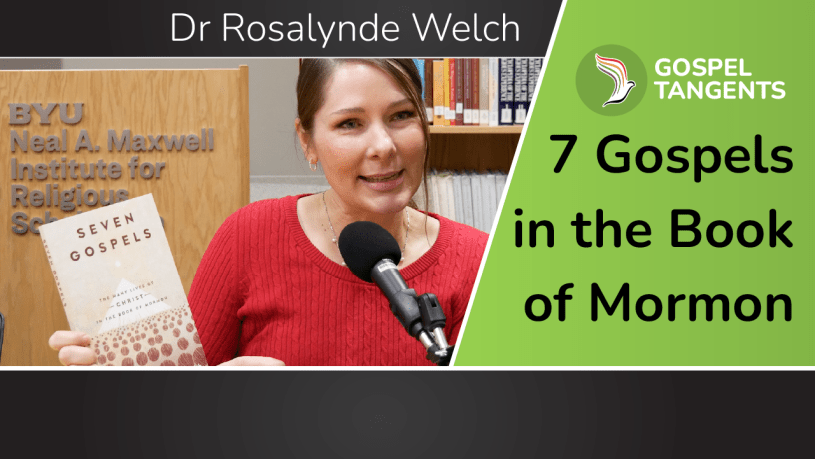
This year we’re studying the Book of Mormon in Sunday School. Here is an interesting book for you. Dr Rosalynde Welch is co-author with Dr Adam Miller of “Seven Gospels: The Many Lives of Christ in the Book of Mormon.” We’ll discuss Christ’s role within the Book of Mormon from the eyes of 7 different vantage points.
The book has 7 gospels: Gospel of Mary (2nd Nephi), Gospel of Benjamin and Gospel of Abinadi (Mosiah), Gospel of Abish and Gospel of Alma (Alma), Gospel of Samuel the Lamanite (3rd Nephi), and Gospel of Brother of Jared (Ether.) All testify of Christ in different ways, and that’s why Rosalynde calls them gospels.
We get into atonement theology (it is more prounounced in the Book of Mormon than the Bible) and whether there is 19th century work in the Book of Mormon. Why are there so few women in the Book of Mormon? (They have to really scrape for Mary and Abish.) Adam & Rosalynde use a lot of the techniques as Don Bradley and Val Larsen to find these nuggets.
We also discuss the Gospel of Abinadi, Gospel of Abish, and Gospel of Samuel the Lamanite. While most are familiar with Samuel and Abinadi, we go into deeper detail in Abish’s conversion and spiritual experiences. We get into Samuel’s prophecies as well.
Finally, we’re talking about the Gospel of the Brother of Jared, and why Rosalynde prefers reading to podcasts! (Read scriptures, don’t just listen.) Rosalynde and Adam hope this is a book you’ll add for both devotional and scholarly reading. Have you read the book? What are your thoughts?
 Wheat & Tares
Thank you. I enjoyed this post.
I enjoyed this interview. I appreciated that Dr. Welch didn’t side-step Rick B’s historicity and pre-Jesus Christians questions – “an angel told them about Jesus” – well ok then, at least we know where you stand. Of course, this approach depends on the assumption that the Bible presents an essentially logically consistent story of Jesus and his message… which isn’t really the case. For example, the Virgin birth, which plays a prominent role in 1 Nephi, seems to be a later innovation and not in the earliest writings (it’s not in Mark and Paul makes no mention of it) – meaning it was probably imagined later to avoid the embarrassment of the Messiah having been conceived the regular old way, and in violation of Jewish law, to boot. Frankly, I find the latter more compelling and more consistent with the true “Condesention of God.” Yet, the BofM insists on the Immaculate Conception. (As, an aside, I find the continued insistence in and out of the Church that Jesus was “born of a Virgin” to be creepy at best, and disgusting at worst. Frankly it’s misogynistic and can only really be described as “s – – – shaming”).
Nonetheless, I appreciated how Dr. Welch attempted draw out and highlight characters from the BofM that aren’t really there (namely, women), and give them a voice.
I also really enjoyed the discussion on Atonement theory in the Book of Mormon. I must say that for me, it’s hard to mine anything other than Penal Substitution theory out of the Book of Mormon, which aligns more closely with the writings of Jonathan Edwards than most of the genuinely Pauline passages in the NT. That’s just my opinion though.
mat, “immaculate conception” refers to Mary’s state of being free of original sin, not the virgin conception of Jesus. I don’t think the BoM has much to say about the former.
your food allergy: I did a quick Google search on Immaculate Conception (as you likely did), and I stand corrected. I was erroneously conflating it with virgin conception. However, I think you probably know this and are being disingenuous with your correction. If you have a constructive critique of my comment (or of the OP), I would love to hear it.
mat, I’m not sure why I am being Google-shamed; I learned about the immaculate conception on a tour of the Vatican years ago, and ever since then enjoy the pedantry of pointing out when I see the term misused. I enjoyed your comment and apologize if my correction felt disingenuous. In the spirit of constructive critique: I find more than just penal substitution in the BoM. At this moment in my life I find the idea of a solidarity or restorative atonement model meaningful, as expressed in Alma 7, “that he may know according to the flesh how to succor his people according to their infirmities.” This to me has explanatory power for this arrangement of things we find in mortality, and the basis for a theodicy.
I think it is important that anyone speaking of the Immaculate Conception understand what it is, and not conflate it with other matters. Clearly, the Immaculate Conception as understood by Catholics (no one else uses the term) refers to Mary’s own birth free from original sin, not our Savior’s birth to a virgin. Learning is good whenever it occurs.
your food allergy: Fair enough. I should have left out that little parenthetical Google-jab and lowered the snark in my response to you. Wasn’t necessary and I’ll take responsibility for it. It was not my intention in my original comment to casually throw around Catholic theology terms. I erroneously thought immaculate conception and Virgin conception meant the same thing. It’s not a HUGE distinction imo, but it is a distinction. To be fair, I personally believe Joseph was the biological father of Jesus. So, there’s that.
In terms of Atonement theory, point taken about Alma 7. That was also mentioned in the interview in the OP. I think that might be the exception in the BoM, though as most other Atonement verses tend to argue for penal substitution or some variant (such as ransom theory). I’m not sure where I’m at with Atonement theory. I’m definitely not a fan of penal substitution. It’s too violent, incoherent, and not reflective of a loving God. I like the idea of a solidarity/restorative Atonement as you laid out, but I’m kind of a Low (ish) Christology kind of guy, so even that is too much for me at times.
I’m not usually looking for devotional approaches, but I generally enjoyed Dr. Welch’s work that I have seen in the past. This was a good interview and a good topic. Thanks for sharing.
Side note: I think it is very common for Mormons (and possibly other non-Catholics) to hear the term immaculate conception and assume that it refers to the virgin birth of Jesus. I certainly thought so until a few months ago when Dan McClellan corrected someone else about it.