

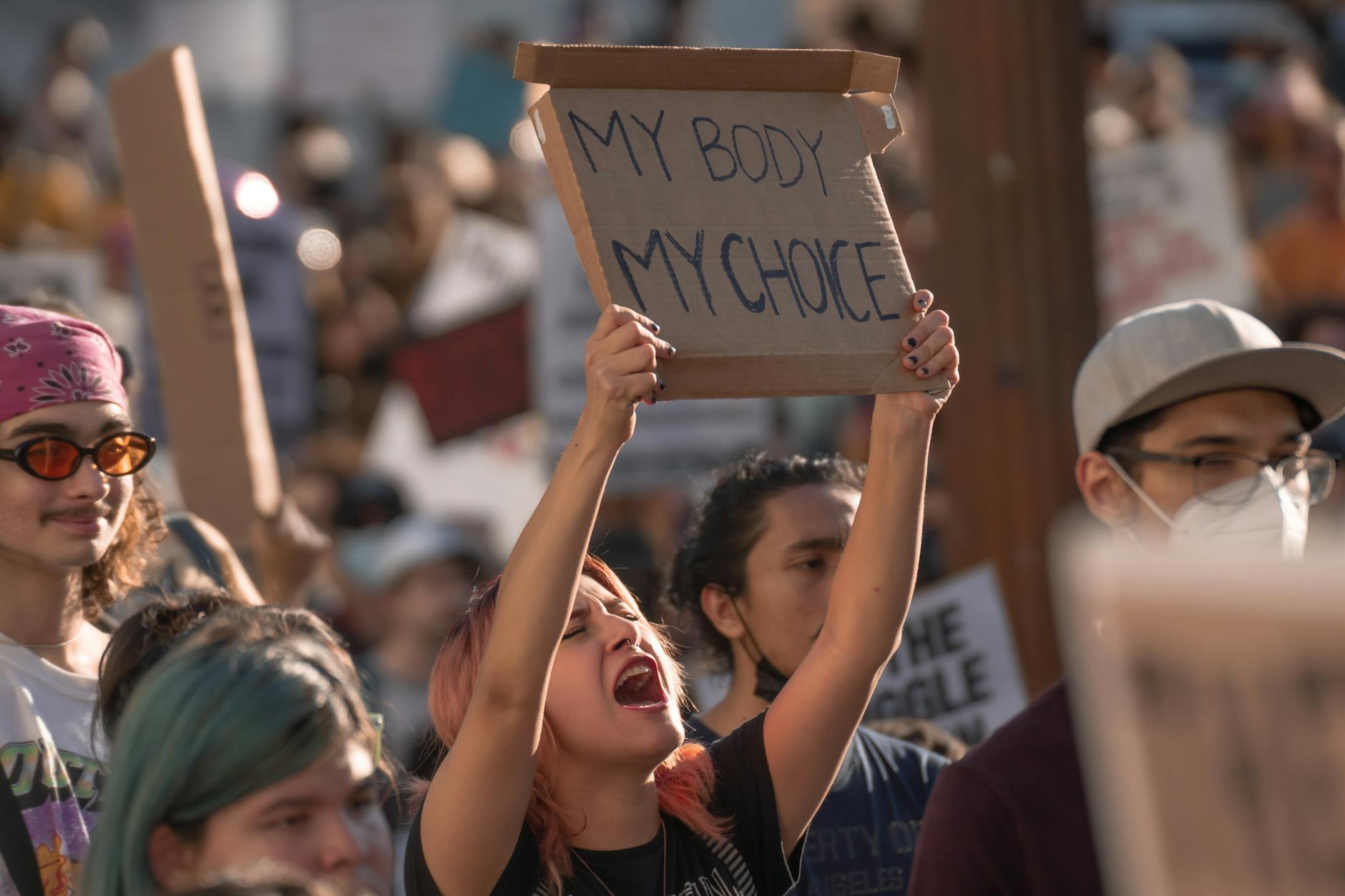
In June 2022, in Dobbs v. Jackson Women’s Health Organization, the Supreme Court declared that a woman’s right to have an abortion was not constitutionally protected, and sent the question of abortion to the states. In the 18 months since then, the personal and medical issue of reproductive rights has been a hot topic in the courts and on the ballots.
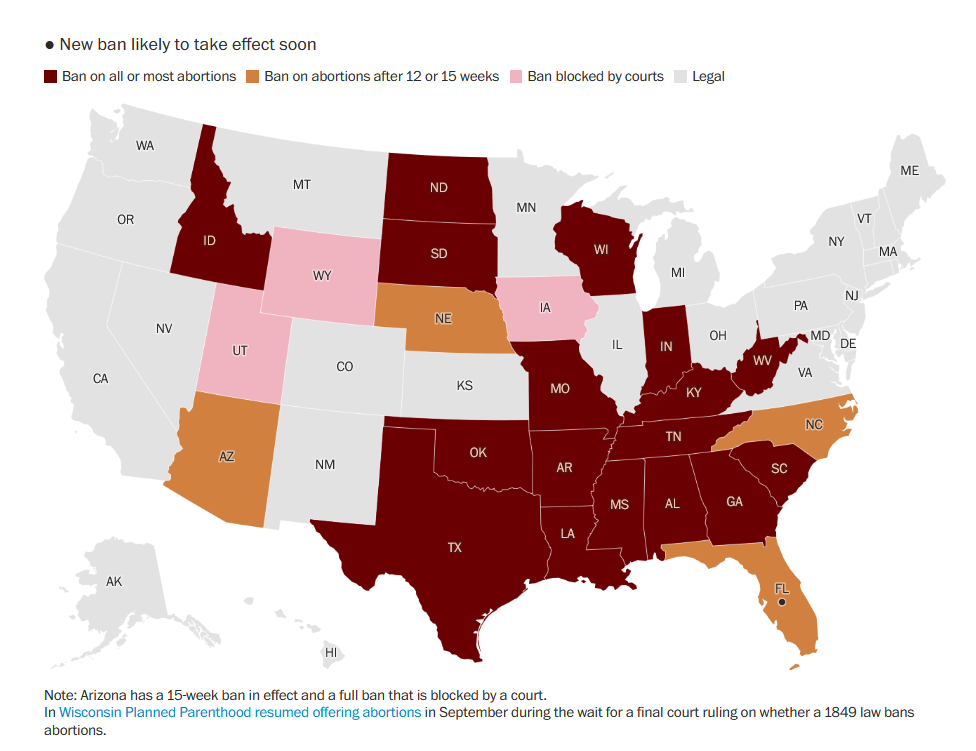
This map shows which states allow or ban abortion. It’s from The Washington Post and was updated on Dec 7, 2023.
In Utah, where I live, the legislature’s near total ban on abortion has been enjoined by the courts, while the issue makes its way to the Utah Supreme Court. In May, 2023, Utah’s governor signed a law seeking to rid the state of abortion clinics. Clinics won’t be able to renew their licenses when they expire, which means abortions will have to take place in a hospital. With the injunction in place, abortions in Utah are legal up until 18 weeks of pregnancy.
Around the country, abortion access was on the ballot in several states. In every instance, the pro-choice position won. Voters want abortion access. Ohio voters added reproductive rights to their state constitution. In August 2022, Kansas voters rejected an attempt to ban abortion. Kentucky voters rejected an attempt to amend their state constitution to ban abortion, but Kentucky’s Supreme Court has allowed abortion bans to remain in effect. I didn’t look up a link to every vote on abortion access; there are more than Ohio, Kansas and Kentucky.
The widely-reported court case in Texas, in which a woman sought an abortion because her fetus has a fatal defect, trisomy-18, that would jeopardize the mother’s health and ability to have more children in the future, basically showed everyone that Republicans don’t mean it when they say that laws allow medically necessary abortions. The Texas Attorney General sent letters threatening to sue any hospital or doctor who helped this woman have an abortion, and then the Texas Supreme Court issued an order with confusing doubletalk about how medical professionals should make healthcare decisions about when to terminate a pregnancy, but the medical professional in this case hadn’t clearly determined that an abortion was necessary (which was a ridiculous conclusion). The woman left the state to have an abortion.
Idaho’s abortion law wrote its medical exception in the strictest possible terms. An abortion can be performed only if necessary to prevent the mother’s death. This conflicts with a federal law (EMTALA, the Emergency Medical Treatment and Labor Act) which requires hospitals to stabilize a pregnant patient. Stabilizing a patient may require an abortion, even if the mother isn’t on the brink of death. So that’s being litigated.
Meanwhile, the number of abortions in the twelve months after the Dobbs decision actually increased by 2,200 when compared to the twelve months before the Dobbs decision. [source and a link to the actual report can be found here.] Abortion rates in states that have banned abortions plummeted, while abortions skyrocketed in states that allow abortion. The obvious conclusion is that people are traveling to get abortions. Or, more accurately, people who can afford to travel to get abortions are doing so. The people who are carrying unwanted pregnancies to term are the ones who are too poor and don’t have the resources to travel.
Something that should shame every pro-life Republican legislator is that NOT ONE, not a single one, of the states that have banned abortion have made any efforts to help pregnant women and new mothers.
“The states that have banned abortion are the same ones that do the least to help pregnant people and new parents make ends meet. Eight of the 14 states that now ban abortion also fail to ensure pregnant workers have the right to workplace accommodations. None have guaranteed paid maternity and paternity leave or paid sick days, and five have refused to extend postpartum Medicaid coverage for mothers in the first year after giving birth — an extremely critical period for parents. Adding to parents’ struggles to provide and care for their new kids, 10 states haven’t raised their minimum wages higher than the federal rate of $7.25 an hour, six have refused to expand Medicaid to most low-income adults, and none give workers the right to humane scheduling practices.” [source]
The utter failure to help pregnant women and new mothers is, in my mind, proof that the pro-life movement is not about loving babies; it’s about punishing women who have sex. It’s about Christian values about sex and motherhood being forced on the entire population. Religious views about when a soul enters a fetus should not be the basis for legislation. Religious views about women’s sexual activity should not be the basis for legislation. The Bible doesn’t disapprove of abortion.
Even in Utah, where more than 80% of the state legislature are members of the Church of Jesus Christ, not one dollar has been spent to help pregnant women cope better with pregnancy. Even though that would result in healthier babies, the religious Republican legislators just wring their hands about abortion (which is still legal here) and refuse to help pregnant women. And have Church leaders called for any help? No. The silence is deafening. It’s all up to God to bless expectant mothers. In other areas, “Jesus has no hands but ours,” but when it comes to helping pregnant women, no hands reach out.
Next up in the national abortion debate is the Supreme Court considering whether to overturn FDA approval of a medication used in abortion, mifepristone. Most abortions are ‘medication’ abortions, which means the pregnant woman takes pills at home that set off contractions and her body expels the fetus. These pills are taken before the 10th week of pregnancy, when the clump of cells is about a half-inch in size. A Texas district court judge suspended the FDA’s regulatory approval of the drug, and then the Fifth Circuit chimed in to require the FDA to take a bunch of unnecessary steps with mifepristone. [source]
Honestly, I’m just tired. I’m sick of Christian men (and nearly all leaders in the pro-life movement are men) telling everyone, whether they’re Christian or not, to live by Christian sexual values. The only thing that brings me some relief is that Republicans are doubling down on restricting abortion rights, and that’s a losing strategy. Go ahead – save babies and get voted out of office.
 Wheat & Tares
While I do not like abortion being routinely used as a means of contraception, I do agree that Republicans who make banning abortion an all-or-nothing issue will lose elections. Worse, prosecuting women who have miscarriages or who travel to another state for an abortion, or forbidding abortions when a fetus is very damaged, is very bad public policy. If Republicans insist on candidates who will vote to ban abortions, Republicans will lose at the polls. I generally don’t favor single-issue voters (honestly, some Democrats are also single-issue voters on the other side of this issue) because a lot of issues need to be weighed and balanced, but it should be clear that banning abortions is not a winning issue for Republicans in most places in our country.
One gentle correction, maybe. Elder Anderson in April 2021 general conference repeated the Church’s position on abortion, but he also gave some tempering counsel: “If an unanticipated child is expected, let us reach out with love, encouragement, and, when needed, financial help, strengthening a mother in allowing her child to be born and continue his or her journey in mortality.” I don’t know if his remarks were addressed to bishops who hold the keys to fast offering funds, or to families of pregnant women, or to the members at large, but we must reduce our condemnation and criticism of members who “fail.”
Members of the Church who think that legislators must vote to ban abortions, or they are not worthy of our votes regardless of their positions on other issues should be aware that the Church’s position on abortion applies only to its members, and not to people outside the Church. The Church counsels its members not to receive or to perform abortions. It makes no statement to the world at large. Individually, any Church member can follow the Church’s counsel by not having an abortion, irrespective of a state’s law on the matter. The Church may not like abortion, but it also doesn’t like gambling or adultery or lots of other things that are legal, and the Church doesn’t call for gambling or adultery to be made criminal. Lots of good members in Nevada not only vote for legislators who support gambling, they make their livings from gambling also (accountants and lawyers for the casinos, for example), and that’s OK. JW Marriott still sells alcohol and sold pornography in his hotels, and that’s OK. The Church wants individual members to make right choices, but we don’t need to impose those right choices on others by legislation. Instead of voting only for legislators who will oppose abortion, how about looking at a candidate’s position on a lot of issues, and pick the one who is best overall? Single-issue voting actually damages our republic.
This particular topic has been on my mind this week. I work in healthcare and provide a particular skill set that puts me into all kinds of medical situations.
In the past, I have been involved in a few cases of elective abortions or very early inductions of labor with the expectation of a fetal demise. Each involved a very much wanted pregnancy— but there were problems with the fetus that were not compatible with life.
Imagine carrying such a pregnancy to term. Everywhere that couple goes, people ask about the pregnancy. Boy or girl? When are they due? Is this their first. Add the expenses of a delivery and a burial.
Contrast that with a couple who decides at 16 weeks to abort. The procedure is quick. It is less expensive. It is much easier on the body than a full delivery. The recovery is easier. It is done before the woman is really starting to show. The situation remains somewhat private.
This topic was on my mind this week because for first time in my career, I was involved in a truly elective abortion at 18 weeks. The fetus had trisomy 21 — Downes Syndrome. The mother was older, not in a stable relationship and she was impoverished . But .. individuals with Downes Syndrome do have a fairly good quality of life. That changed so much about how I felt about my involvement.
I left the hospital that day feeling so many complicated feelings. I support abortion rights — but I want abortion to be legal and rare.
The day after this, one of my patients was a 28 year old woman born with cerebral palsy. She could not provide any sort of self care. Her mother sat beside her and cried. There is no government program to help that mother. For the last 28 years, 24/7, she had provided complete care of her daughter. The daughter had a poor quality of life — and her mother did too.
Statistically, when a child is born with some major physical or neurological disability, the fathers abandon that family and go on to create another family with a younger wife and new/improved/healthier children. The mothers are left to provide full care for those disabled children. That happens over 90% of the time. It is an ugly statistic.
Contrasting those two women this week has given me so much to think about. I would not want to be either one of them. Elective abortion at 18 weeks vs 28 years of hellish servitude to a disabled adult child with no end point in sight.
To tie this into Mormonism, I find it complicated that the disabled are welcome at church just as long as no one outside of their family really has to do anything.
Think of any significantly disabled person you have known through the church. Their families care for them and bring them to church. If there is no family involved, there is no sort of program set up thru the church to help such individuals in any way. The social structure of Mormonism is not set up to do so. Take the sacrament to them? Yes. Collect tithes from them at the same time? Absolutely. Sing Christmas Carols once a year. That is where it ends.
I have no answers, but church organizations are very good at having strong opinions about sexuality, pregnancy and what women should be doing with their bodies, time and talents. Churches universally fail at spending money to take care of those who are most needy.
Janey, thank you for taking on this important topic. I guess my “Blue State Privilege” is showing because I haven’t given the issue much thought since the Supreme Court ruling. What you have described is what happens when culture war, dog whistle, voter-base rallying issues leave the media echo chambers and become law that actually effects the lives of real human beings – particularly women in poverty in this case. It doesn’t surprise me at all that Idaho is the lone western state with a complete abortion ban.
I paid pretty close attention the Idaho State Legislature when I lived there and I have no problem saying that that group of mostly white, wealthy LDS and Evangelical men on that body DON’T GIVE A DAMN about the families who are suffering due to their disgusting, hypocritical voting record on this and other issues effecting the vulnerable in that state. And yes, the minimum wage is still $7.25 an hour. The legislature refused expand Medicaid as part of the Affordable Care Act. They literally refused government funds. It took a voter initiative – which passed by like 68% – to force their hand and expand it. What did they do next? They passed legislation making voter initiatives nearly impossible to get on the ballot.
In Idaho, If it doesn’t benefit the Planter Class (and I really mean that) the state legislature does not care. And these are mostly men – white Mormon and Evangelical men who got elected by running on family “values.” Of course, I guarantee you that if the CEO of Simplot for some reason threatened to pull his campaign funding or move out of the state if they didn’t reverse the abortion ban, these same men would flip-flop so fast, they would have to be treated for whiplash. Which would be fine. They all have great health coverage provided in part by the economically disadvantaged women to whom they are denying reproductive care and autonomy.
Sorry for the long rant. This post really struck a nerve.
I strain to believe it’s even about punishing women who have (the wrong kind of) sex. I am a married woman, and a lifelong pattern card for evangelical and LDS sexual behavior. (Nothing to be proud of, just happened that way.)
I could theoretically get pregnant tomorrow and a host of things could happen due to my age, medical history, etc, that would make the pregnancy dangerous to me and ruinous for my family, including my kids who are already here. If I didn’t live in a blue state, and couldn’t get to one… things could get very bleak, very quickly, and this despite a lifetime of chastity and fidelity in marriage. It’s not even really about the sex.
These laws are about punishing women and girls, full stop. It is hard to see anything here but unvarnished misogyny. Despite their vocal protestations to the contrary, lots of powerful men really do fear and hate women. Or at least the idea of women as fully equal, fellow-humans.
“The Church counsels its members not to receive or to perform abortions.”
Not exactly. I don’t often defend the church, and in my opinion its position on abortion is still too restrictive, but to clarify, here is the church’s official statement on exceptions allowing abortion.
“The Church allows for possible exceptions for its members when:
Pregnancy results from rape or incest, or
A competent physician determines that the life or health of the mother is in serious jeopardy, or
A competent physician determines that the fetus has severe defects that will not allow the baby to survive beyond birth.”
So the law signed by the governor in Utah is more strict than the church’s position. And the law in Idaho, where dozens of lawmakers are Mormons, is also more extreme than the church’s position. It’s impossible to believe that these laws are about protecting life or obeying religious principles—they are indeed about controlling and punishing women.
Thanks, Dot. You are right that many state laws on abortion go beyond the Church’s position. And some churches take different positions. There is no Christian consensus, and our Church has not defined when the spirit enters the body. We don’t know. Our Church opposes divorce (at least the NT and BoM do), but the Church does not discipline people who divorce, nor do we advocate for laws to put divorcees (or adulterers or gamblers) in prison.
The official statement also includes these words: “Abortion is a most serious matter. It should be considered only after the persons responsible have received confirmation through prayer. Members may counsel with their bishops as part of this process.” Note that women members do not require a bishop’s approval beforehand.
This is where it might get tricky. Pres. Nelson has taught members to learn how to receive revelation for themselves. “Confirmation through prayer” is a type of revelation. If a pregnant woman member prays about an abortion, and receives what she thinks to be confirmation through prayer, then should that not be the end of the matter? If we are serious about members being able to receive revelation in their individual lives, then when a person states with sincerity that she has received confirmation through prayer on an abortion, should we not afford her the dignity to respect her decision? She doesn’t claim to receive revelation for the church, nor for her ward, nor for her neighbors, nor for anyone else. She claims it only for herself in a most private matter. I would leave any judgment here to God.
There are general rules and guidelines. One of those is in the Handbook: “The Church opposes elective abortion for personal or social convenience.” From the Newsroom topic on abortion: “the Church opposes elective abortion for personal or social convenience, and counsels its members not to submit to, perform, encourage, pay for, or arrange for such abortions.” Note that the church “counsels its members” and does not compel or demand. After the teaching of the principle, should we not allow the people to govern themselves?
One issue with regard to the church is the messaging that happens in general conference and church publications other than the handbook. I don’t know if I have ever heard a moderate approach to abortion being discussed in general conference other than the one statement from then-Elder Russell Nelson in the early 1980’s where he stated that abortion is not murder. That statement was immediately removed from every published version of the talk. It was not replaced until Nelson became president of the church when there line was inserted back into the talk so quietly that almost no one noticed.
Any conference talks or Ensign/Liahona articles that discuss dilemmas members face in considering an abortion *always* surround situations where members deliberate, decide against an abortion, and the story has a happy ending. The stories where a woman deliberates, decides to obtain an abortion to preserve her life, while doing things completely within the parameters of church counsel and policy, are *never* told in conference or recounted in church publications. Most rank and file members come away with the impression that abortion is never acceptable in the eyes of God. They are then vulnerable to the messaging of extremist politicians who pander to them for votes based on “caring about life” even as they enact policies that result in greater human suffering and premature death of infants, children, and vulnerable adults.
Janey–thank you for this post! So much food for thought. Your insights are helpful as they are uniquely informed by your life experience given additional context by your legal knowledge and ability to research legal matters.
Georgis – thanks for supplying Elder Anderson’s quote about helping pregnant women. I think it’s a very weak encouragement for financial help, however. There aren’t many people who can, for example, pay the medical bills for an uninsured pregnant woman. Nor can people take over living expenses if a pregnant woman is fired because she needs an accommodation – like needing to sit down, or needing more frequent bathroom breaks. It isn’t just love and encouragement that pregnant women need. Most abortions happen because the woman is in dire economic circumstances and can’t afford to be pregnant. Some pro-lifers make the mistake of thinking the expense of raising a baby is the problem. While that certainly is an important issue, pregnancy costs women a lot.
Legislatures in states that have banned abortion need to expand Medicaid. Food stamps should be increased immediately if someone in the household is pregnant. Worker protections need to be passed. There are structural changes in society that have to be put in place to support pregnant women, especially the ones who are most likely to need an abortion. A good neighbor can’t fill those gaps.
Damascene – oh, that’s just heartbreaking. Those are such very good points. The decision about whether to carry a pregnancy to term is so personal, and so many factors go into that decision. Self-righteous politicians can’t possibly know all those factors. I have a friend whose baby was born with a severe birth defect, and the father skipped out, leaving the mother to deal with three children total. It’s such a hard situation.
mat – great comments. Utah also refused federal funds to expand Medicaid. The voters wanted it, but the legislature just sat on the issue and refused to do it. That hit me personally because I couldn’t get health insurance – I just barely missed the Medicaid qualifications. I was divorced, unemployed, and my three young children were covered on their dad’s health insurance, but I had nothing until Obamacare helped me.
Margie – you’re right. Even women who live the sexual values espoused by the pro-lifers are hurt by these laws. It’s misogyny.
Dot – good point. And I’ll add that even when these laws have exceptions for rape or health risks and/or defects, those exceptions are nearly impossible to get. The case in Texas shows that Republicans are going to block those “exceptions” with every bit of effort they can exert.
matiw – it’s interesting that the Handbook has a more moderate position (which Georgis described). I’ve noticed that no stories involve a righteous decision to have an abortion. Those stories should be told. Bloggernacle readers and writers dive into the handbook all the time, but anyone else just hears the “no abortion” line.
I didn’t know that about Elder Nelson’s talk being edited. I found that talk. It’s “Reverence for Life” given in the April 1985 General Conference. Wow. Talk about a battering ram from an avid pro-lifer. The line “So far as is known, the Lord does not regard this transgression as murder” is one faint drop in what is otherwise a polemic against abortion.
I have asked this question before (on W&T) and I’ll ask it again: what do TBMs believe happens to the soul of a fetus that is terminated? I’ve heard two possibilities:
1. this “soul” or “person” is denied the opportunity to have a life here on earth. Therefore, this person would probably be saved since he or she never had the ability to live mortal life and prove worthiness.
2. this “soul” or “person” would be assigned to another mother / family since he/she was aborted the first time. In this scenario, mortal life is restored.
If #1 is true, eternal life is not denied. If #2 is true, mortal life is not denied. Either way, the lost soul/person is given another chance which is only fair since he/she was terminated due to others’ decisions.
I don’t think abortion should be treated casually. It’s often a tragedy for all involved. But life is not lost if #1 or #2 above is true. So the “pro-life” argument loses a lot of it’s appeal. Is there a #3 that I am not considering?
Janey, I had not looked up the most recent revision to the 1985 Nelson talk. Wow I’m pretty sure it’s harsher now than it was when the statement about abortion not being murder was first reinserted; my recollection of the original talk was that Nelson stated simply that abortion isn’t murder (there was a discussion of this edit in the wheat and tares comments a few years ago but it would be hard to find). Referring to abortion as a transgression in this context is problematic. Is abortion a transgression if a woman with cancer terminates a pregnancy? Is abortion a transgression when a woman obtains one because the fetus has a condition that is incompatible with life?
Interestingly, the church doesn’t recognize fetuses. When a baby is stillborn the church will not include that baby in a sealing ceremony along with other children born to a couple. This indicates there possibility that the church doesn’t recognize the fetus as having a spirit. In ways this could be comforting to a woman needing to terminate a pregnancy. At the same time it can add additional pain for couples experiencing pregnancy loss.
I would say that option #3 is that a fetus does not have a spirit and is not a person.
The Church’s position on stillbirths and miscarriages has changed considerably over time. In the past, whether or not a stillborn child was given a name and recorded on a Family Group Sheet was left up to the family or to bishop roulette. Even today, the Church handbook uses words like “may” (not “must” or “should”) and is extremely vague: “Parents MAY decide whether to hold memorial or graveside services … Parents MAY record information about the child in FamilySearch.org … Temple ordinances are not needed or performed for children who die before birth. This does not deny the POSSIBILITY [an interesting word choice] that these children MAY be part of the family in the eternities. Parents are encouraged to trust the Lord and seek His comfort.” https://www.churchofjesuschrist.org/study/manual/general-handbook/38-church-policies-and-guidelines?lang=eng&id=title_number130-p2375#title_number130
In addition, according to the Church handbook abortion is not equivalent to murder. This certainly implies that an unborn fetus is different from a living human. “As used here, murder does not include abortion …” https://www.churchofjesuschrist.org/study/manual/general-handbook/38-church-policies-and-guidelines?lang=eng&id=title_number268-p2798#title_number268
Abortion is just one aspect of the whole declining birth rate issue. Unfortunately, politicians and church authorities are addressing this as a moral problem instead of the cultural obstacle it truly is. Poverty aside, telling women that it is their Godly nature to bear children and then prevent abortions is so much easier politically and culturally than modeling a true partnership where both parents have flourishing careers and collaborative home life. Women will continue to reject parenthood, by using contraception and/or abortion until they have the same opportunities and support that men have been receiving all along.
NYAnn: thank you for your #3, which adds to my point that life is not denied.
TBMs: I ask you, what do you believe? Why is anti-abortion a “pro-life” position?
Janey: I didn’t mean to hijack your brilliant piece above. You weren’t writing about LDS theology on abortion. But I felt the need to add this because most of us here are LDS or post-LDS.
josh h – no worries. If you ever ask this same question over at Times and Seasons, you might get more discussion! I wrote a post on the same question that you’re asking, and we had one pro-life commenter who popped into the thread to point out that, by that logic, parents should kill their child just before they turn 8. I don’t get it, but he thought it made sense and kept repeating it.
the post is here if you’re interested: https://wheatandtares.org/2022/09/09/lds-and-pro-choice-the-pre-existence/ I skimmed through the comments on that post and noticed you participated, as well as some other regular commenters. Interesting discussions.
I had a comment at 3:35 that got caught in moderation I think because autocorrect changed matiw to matie.
Important and well done piece, Janey.
This Christmas Season, I watched several versions of “A Christmas Carol”. One of them starred Dan Stevens as Charles Dickens: “The Man Who Invented Christmas”. I must admit I hadn’t known much about the author and was Not surprised to learn he had labored as a child in an abusive factory for a time. Suffering tends to produce empathy in trapped people.
Scrooge’s disinterested and stingey question, “Are there no workhouses?”, shows his social position, his lack of suffering, and lack of empathy.
Looking at the map you included and considering the history and racial makeup of the most conservative states, I suspect there are also a few self-interested issues on the minds of those anti-abortion legislators. #OrangeIsTheNewBlack
The US has the highest rate of abortion in the first world, at 21/1000. Canada for example has 12. If the US had 12 there would be 400,000 less abortions. What does Canada do better? Not being Canadian, I expect respect for women, comprehensive sex education, available and affordable birth control, and no republicans.
Usually when there is a democrat president the rate goes down, but with the demise of roe, perhaps not. Every election cycle I see mormons saying the have to vote republican because democrats want to kill babies. They are believing another republican lie.
There is another aspect to this that is not seen in the US. When there is a republican president they tie aid to abortion. There are 25.7 million people with aids in Africa 1 million new infections last year. The average aids sufferer is young, black, and female. Now if US aid is used to help these young women, it would obviously include birth control, but it must not mention abortion. The local culture may excuse men from using condoms, and may have allowed for abortion, but there will be no help for these young women from American aid if there is a Republican in power. Birth control and health education are also cut off resulting in millions more abortions.
Republicans have a lot of suffering to answer for.
Sadly, Charles Dickens was, unfortunately, not a gleaming paragon of empathetic virtue when it comes to women. So perhaps not the best example to use here.
EagleLady, I am intrigued and perplexed by your introduction of race into this discussion on abortion. You suggest thsy the conservative states are also the racist ones. You might not know that abortion happens far more frequently among Black people than among White people–at least I have read this claim in seemingly reputable places. The conservative states are actually contributing to Black population growth by banning abortion. One can argue that it is the progressive, more White states that are actually suppressing Black population growth in this country. Abortion is a complex issue, but I do not see how conservative = racist here. Just the opposite. We all know what Ms Margaret Sanger (liberal, progressive?) thought about people of color. I don’t see abortion through a racial lens, unless we’re looking at it like Ms Sanger looked at it, and I reject her views. Seeing conservatives as anti-women is one thing, if anti-abortion is anti-woman (and one can well argue that it is), but it doesn’t make sense to paint conservatives as racists when their policies will increase the growth of the Black population, something one would think racists would oppose. Instead of race-baiting on this topic, I would respectfully point to religiosity as the larger cause over racism. That would explain the anti-abortion sentiment in places like Utah or Idaho, which might or might not be very racist, but they certainly have a lot of religiosity.
“ Georgia’s maternal mortality rate is especially alarming for black women, who have a rate of 66.6 per 100,000 live births in the Peach State (compared to 43.2 for white women), and for women between the ages of 35 and 44, with a rate of nearly 90 deaths per 100,000 live births.
In Louisiana, the racial gap in maternal mortality is even more pronounced, with a rate of 72.6 per 100,000 live births for black women and 27.3 for white women.
But not all of the states with the highest rates are southern. Indiana and New Jersey follow closely behind Georgia and Louisiana, while southern states such as West Virginia and Alabama have some of the lowest maternal mortality rates.
California, Massachusetts and Nevada have the three lowest rates in the nation, at 4.5, 6.1 and 6.2 deaths per 100,000 live births, respectively. ”
(U.S.News and World Report)
“With the injunction in place, abortions in Utah are legal up until 18 weeks of pregnancy”
Wow, I didn’t know. With 90% of abortions taking place before 13 weeks, and 99% of abortions before 20 weeks, that makes Utah a practically pro-choice state. Abortion has clearly shown to be a losing issue for the Republicans since Dobbs. Too many stories of women being unnecessarily forced to suffer all kinds of medical horror, underage rape victims being forced to carried their rapists’ baby to term, and women being charged with crimes for having a miscarriage. Bring the issue of abortion to a referendum and Roe easily becomes law of the land again. Even in the reddest of states such as Kansas, the majority of voters want Roe reinstated.
This is something I wrote during the last election cycle. Fact is most LDS simply do not know the difference between the GOP policy and Church Policy!
Many Christian voters have drawn a line in the sand in their political thought and decision making that is centered on one issue – Abortion. And like most hard questions in life there are no easy answers. I want to address the issue from my perspective as a Christian and a Latter-day Saint.
Let’s start with theology.
When does life begin? I cannot speak for all religious traditions but there is no LDS doctrine as to when exactly life begins. Some argue that it begins at the moment of conception. Neither scripture nor historical commentary give definitive clarity. Scripturally, life begins when the body receives the “breath of life”. Medically that would be at the point that the lungs of the fetus are capable of independent breath. Yet every woman that has carried a child knows that life moves within her much before both the scientific and scriptural definitions. Saint Augustine grappled with the issue, writing that “the law does not provide that the act of abortion pertains to homicide, for there cannot yet be said to be a live soul in a body that lacks sensation.” There is no definitive or official doctrinal policy in LDS theology that informs this most basic question.
Now, let me wander a little into the area of speculative theology. We have a unique theology on what we call the Plan of Salvation. The Plan basically is that we lived a pre-earth life and made choices there that allowed us to come to earth to gain a body and obtain the experiences of humanity. Two plans were presented. One was the plan of Lucifer that guaranteed we would all make the correct choices because we would not have free-will. The Father’s plan was that we would have free-will. And that endowment of free-will guaranteed that there would be suffering in the world. Free-will allows both good and evil choices. Some of those choices cause harm both to us individually and to humanity. We choose to follow the Father’s plan knowing the risks because we wanted a body like our Father-in-Heaven and the opportunity to learn through the exercise of agency. To mitigate those risks Christ would take upon himself, through his Atonement, the pain, suffering (deserved and undeserved), and sins that we would experience. The lynch pins of this plan were agency, receiving a body and the Atonement of Christ.
Would a loving Heavenly Father deny an earthly existence to a spirt that once inhabited an aborted body? Everything I know about the Father and the Son, the Plan and doctrine, informs me that God desires all his children to experience the fullness of joy. As a result, I simply cannot believe that those spirits intended for bodies that were aborted will not have another opportunity. Otherwise it would frustrate the entire purpose of the Plan. God would not be a loving God to deny that opportunity to his children.
Is abortion murder? “So far as is known, the Lord does not regard this transgression as murder.” (Russel M. Nelson, Ensign, Oct 2008). Those that participate in, pay for or perform an abortion can be subject to Church discipline. The Church condemns “elective abortion for personal or social convenience” but permits the procedure in cases of rape, incest, severe fetal defects, or when the life or health of the mother is in serious jeopardy. Make no mistake that the Church condemns elective abortion but at the same time unlike many churches it has not “favored or opposed legislative proposals or public demonstrations on abortions” (Ensign March 1991). In sum, the Church emphasizes its role in “teaching correct principles” and considers the informed judgments of competent medical practitioners, permits compassionate exemptions and ultimately defers to moral agency. This puts the LDS Church at odds with the majority of the pro-life movement, for which it has been criticized. Indeed, some evangelical protestors at the annual general conference of the Church and other venues have accused the Church of not being sufficiently anti-abortion or Christian.
What about those that have had abortions? Over the last 30 years I have held Church positions that have put me in a position to counsel with women who have had abortions at some time in their life. I recall the first time. I was 28 with not much life or Church leadership experience and was serving as a counselor to the Mission President. I asked the Mission President, who was also a General Authority, how to proceed. I was nervous and was sure the woman was as well. The Mission President emphasized it was a time to show extreme compassion and assure these individuals that the Atonement of Christ will heal the pain they have carried, in some cases for decades. In the intervening years I have had many of those meetings as I served as a counselor to 4 mission presidents and as a mission president. I can recall the face of every woman I have met with and the joy they felt at having someone offer them words of love and compassion. There is one that is especially poignant. It was with an elderly woman in Santiago, Chile that had carried the heartache with her for 60 years. These women made painful choices and deserved compassion not condemnation and that is exactly what the Church offers.
Legislative efforts to end abortion? For those that call for an end to all abortions and the overturning of Roe v. Wade, the question is what result do they seek? Do they want to return to the days of criminalizing abortion? Some do. Do they want to put women in jail? Contrast that with a true compassionate Christian response. In the 50 years since Roe v. Wade both liberal and conservative courts have upheld Roe. They understand that when abortion is legal, abortion rates fall. The LDS Church has never called for or proposed banning or criminalizing abortion.
Reducing abortion should be a common goal? The best approach is to reduce the incidence of unintended pregnancy. Half of all pregnancies in this country are unintended, and, of those, half end in abortion. Unintended pregnancy could be reduced significantly if we showed true commitment to: 1) comprehensive education that includes medically accurate information about abstinence and contraception; 2) insurance coverage of and public funding for family planning services; 3) greater access to contraception 4) programs that curb domestic violence and sexual abuse; 5) public need-based funding for adoption services.
Clearly, women who can avoid unintended pregnancy do not have to make the difficult decision of whether to have an abortion. Unfortunately, even with the supports listed above, there will always be some unintended pregnancies; birth control methods are fallible, as are human beings. Therefore, once a woman finds herself with an unexpected pregnancy, a second positive way to reduce abortion is to ensure that she has the means to have and raise a child in health and safety. One of the most common reasons women choose abortion is because they feel they cannot afford a(nother) child. By providing young women from all income levels with genuine education and career opportunities, health care, childcare, housing, services for disabled children, and other basic supports, many would have the resources they need to fulfill the serious obligations that parenting brings.
Lastly, where are the men! A woman cannot become pregnant on her own. I am astounded that the focus is always on women and rarely on men. Men need to be held accountable. It’s not that hard to prevent pregnancies. Men need to share in the consequences. Though it might seem strange to talk about men and abortion, it’s stranger not to, since women don’t have unwanted pregnancies without them.
Conclusion – Sadly, the abortion question is heated to a degree that there seems to be little common ground or even a willingness to have a discussion. The LDS Church from a policy and doctrinal standpoint does not fall in either the extreme Pro-Life camp (criminalize all abortions) or the unfettered Pro-Choice Camp. Calling all Democrats baby killers or Republicans anti-woman are wrong. As LDS Christians, we need to be part of the solution to reduce abortions not by criminalizing but by compassion. That is clearly what the Gospel teaches. So my plea is, stop the loud rhetoric. Stop dog whistle politics that takes such a complicated issue and turns it into a campaign slogan. What informs me most on this issue are the dozens of women I have talked with over the last 30 years and the joy they felt as someone listened to them without condemning them. I hope we all can come down on the side of compassion, not legalism and ill-informed rhetoric.
I think there is more hope politically than you all know on this issue. Let me share my perspective.
My husband and I are registered Republicans who have been too sickened by Trump and the Republicans to vote that way for a couple years. We are very pro life in the sense that with my oldest child we did an ultrasound at 8 weeks and we’re amazed to see a baby jumping around in there. It was hard for us to begin voting Democrat because of this concern. However, after Roe vs Wade was no longer in place we discovered our point of view had changed. We found that in spite of our pro life feelings, that we didn’t want the government making this decision for women and doctors.
We have kids with disabilities. While we hope couples can care for disabled children rather than having abortions, this isn’t the government’s decision. Only the doctor, and ultimately the mom, can decide what to do in this difficult situation. With all my son’s surgeries I can’t think of anything worse than having a politician tell us what to do with his care. And yes, it’s sadly accurate that many marriages with disabled children end in divorce. When the dad doesn’t run it’s also very common that he gets fired because employers don’t want to be responsible for insurance and time off.
I don’t think my husband and I are the only pro life Republicans who have changed our point of view about abortion. Many pro life changes have failed when put in front of the electorate. Even Trump is talking in a more pro choice way. I just don’t think this issue is going to help Republicans much anymore.
Georgis, EagleLady is not wrong, and is not race baiting. There are lots of glaring contradictions in reproductive rights rhetoric and legislation.
-The same thinkers that are anti abortion are also anti contraception.
-Being pro conception and pro life does not extend past birth. When the fetus becomes a baby, concern about their wellbeing vanishes.
In my understanding, the motivations are deeper than the logic that antiabortion policies increase minority populations. You may have noticed that states that restrict abortion also go to extremes to limit voting – they do not want minorities to be represented.
It is an aspect of patriarchy, which not only harms all women, but also most men. The first targets of domination policies tend to be the most vulnerable, then the policies become more sweeping.
For many resources that explain this far better than I can, type
“how abortion restrictions harm poor & minorities“
into your search bar.
A while back I found an article about how a Colorado effort to make birth control accessible to teens increased high school graduation rates. Presumably, improvements could extend throughout a person’s reproductive years.
It was in a Colorado.edu publication, republished by the NIH.
Link to follow.
Colorado.edu article:
https://www.colorado.edu/today/2021/05/05/greater-access-birth-control-boosts-high-school-graduation-rates
One more thought (it’s a tangent):
What would happen if a progressive state passed legislation exactly mimicking Texas’ subversive (and effective) anti abortion law, substituting the guns that are most used in mass shootings for “abortion”? CA’s Dem governor Gavin Newsom once mentioned the possibility.
Could it get the Texas strategy to the Supreme Court? This legislation tactic is a dangerous ploy that could be used for control elsewhere. In Texas it was passed while Roe was still the law of the land. It circumvents established law.
Another one more thing: the large cities in Texas are largely progressive. There are lots and lots of rural counties that are able to impose their minority views in the Texas legislature. Like in Utah.
Georgis, according to a report by the APA, anti-abortion policies in the South will have a domino effect on the overall health and well-being of women of color. The new policies will lead to an increase in levels of anxiety, stress, and low self-esteem that will only compound the problems they already face due to poverty. Anti-abortion policies won’t necessarily increase the black population, for these don’t necessarily stop abortion but simply make it more dangerous. I’ve never heard a conservative say that they support anti-abortion policies because they want to increase the black population. If anything the southern states have routinely shown how little they care for their black populations. They afford them extremely few state protections for their overall healthcare. These states rank the highest in poverty rates and crime and the lowest in education, infrastructure, and public safety. These are states where there are plenty of white folks who continue to worship their Confederate monuments, the Confederate flag, and can’t even bring themselves to acknowledge slavery as the leading cause of the Civil War (which many still call the War of Northern Aggression and War between the States). Politicians like Nikki Haley and Tom Cotton know this and know they need their votes, hence their very dodgy and mealy-mouthed claims about the cause of the Civil War.
Sorry, but the idea that white southerners are motivated to impose draconian anti-abortion measures by some sort of anti-racist sentiment that favors an increase of the black population seems incredibly absurd. That these measures might lead to an increase in the black population seems to be pretty far from their minds.
Growing up I *mostly* liked the church’s more nuanced stance about abortion, that it is OK in cases of rape, incest, fetal abnormality, or life/health of the mother. Of course, I could see it that way given that birth control has been widely available my entire life. Without birth control access being completely open, the church’s policies would be far too strict (stricter than historical pioneer precedent as well as the Old Testament). Abortion has historically always been the purview of women. Men deciding they need to control and legislate it is where the mischief always starts. If you try to create a legislative version of the church’s guideline, you get this ridiculous morass of male oversight that isn’t required by the church policy (ht to Dot). You get a requirement for a police officer to agree that the rape happened rather than believing women and acknowledging that police oversight of rape is completely inadequate and full of victim blaming and dismissive attitudes. You get bishops inserting themselves in front of the advice of doctors and between married couples during their most difficult decisions. You get people who were trained by It’s a Miracle if You’re Forgiven, a book that has been very very quietly set aside, so quietly that most bishops missed the memo (there was no actual memo), to blame the victim, at least if the victim is a woman, and to interrogate women as to the degree of their culpability in their own rape or incest.
When I was traveling in Brasov, Romania, a tour guide recommended we visit the Communist Museum which contained personal stories of those who were forced to live under the dictator Ceausescu who outlawed abortion. He was finally overthrown when I was on my mission in 1989. It is a common saying there that the children who would have been aborted are the ones who overthrew his evil regime, or in other words, he got what he deserved. Every gynecological exam included police officers in the room with the woman. These stories are horrific. Women were also raped by police officers and forced to carry the pregnancies. Men need to get OUT of women’s reproductive rights. They only seem to get involved so they can control and punish women.
dicroc58,
Maybe the church is as kind as you describe to women who had abortions years ago. However it isn’t all about women. I have a friend who got pregnant at 16. Her father took her to get an abortion. He was excommunicated for this action.
Parents get little compassion in general from the church and lots of blame. As the mother of five people who are very unique from each other and different from what I imagined and tried to raise them to be in their childhoods, I really think free agency and genetic differences have a greater role in outcomes than nurturing. And still ETB claimed a mother can save her children, as if she were Jesus Christ. The pressure is toxic. But that’s another post.
Abortion is not a national evil; on the contrary, it is a national benefit. The wealth of the country is found in those states where abortion is liberally allowed. A great portion of the revenue of the government is derived from the products of abortion—Abortion exists in some form everywhere, and it is not of much consequence in a philosophical point of view, whether it be voluntary or involuntary. In a political point of view, abortion has the advantage, since all who enjoy political liberty are then, in fact, free.
dlcrock58, you said that women who can avoid unintended pregnancy do not have to make choices about abortion. Unfortunately that is untrue. And one reason that abortion needs to remain legal. There are several reasons a woman may get pregnant, on purpose with a child she wants and still end up choosing abortion as the best option. Something can go wrong with the pregnancy, her health, or even her life between conception and birth that make having the child dangerous, or mean the child cannot survive long after birth, or will be born with some abnormality that the parents feel they cannot deal with.
I used to do counseling at an army women’s center. I had a few women as clients who were considering abortion, and although the military will not do the abortion, we did counsel with the women to help them decide what was best for them. Now, keep in mind that an ethical counselor will keep their personal opinion to themselves and allow the client to decide because it is their life. One woman thought her marriage was fine, until she got pregnant, then suddenly (to her at least) her husband became abusive. She had to decide, ruin her husband’s military career by reporting the abuse to his commander, leave him and figure out how to get back to the States from Germany and be a single mother with permanent ties to an abusive man, abort the child and end all ties to the abuser, some other option. How serious should she take his threat that if she reported the abuse or left him, that he would kill her, and how would she get back States side without reporting the abuse. The husband certainly wasn’t giving her money to fly home, so she needed to report her reason for needing his commander’s help getting home. And legally, he would have a right to visit any child they shared, and so if there was a child, would she ever be safe from him?
Another woman I counseled had been informed by her doctor that there was a 50/50 chance the baby’s birth would kill her because of a heart condition that had never been detected before she became pregnant. Another had severe pre-eclampsia and it was too early in the pregnancy to induce labor and hope the child survived. That was exactly my situation with my first child. While both myself and my first child had survived, there was no guarantee she would be as lucky. My doctor had shared after my baby was born, that she was one baby he never dared hope to see born alive, that he had just been praying he could “keep mama alive.” Both of those cases would not qualify under the law of Texas or Idaho to receive an abortion because neither was an “emergency” in which her life was in danger, but allowing the pregnancy to continue would produce that emergency, but then it would be too late and mother and baby might both die.
What is the source of this chart and what is the information that it is trying to convey?
What does the gray “legal” category mean?
Just a quick look:
Washington: Abortion is restricted after viability
Oregon: There are no restrictions on abortion at any time in pregnancy
California: Abortion is restricted after viability
Nevada: Abortion is restricted after week 24
Kansas: Abortion is restricted after week 22
New York: Abortion is restricted after week 24
Anna, I agree with you. I certainly did not mean to imply that all of the other scenarios you address are not choice some women have to face. Yes it should remain safe, legal, and rare. Thank you.
“ Unintended pregnancy could be reduced significantly if we showed true commitment to: 1) comprehensive education that includes medically accurate information about abstinence and contraception; 2) insurance coverage of and public funding for family planning services; 3) greater access to contraception 4) programs that curb domestic violence and sexual abuse; 5) public need-based funding for adoption services.”
Right
Where do young people get educated about the various methods of birth control and their success rates?
There is no way legislators—primarily men—without any medical experience or training in obstetrics or gynecology should be making laws regarding women’s health.
(If it were men getting pregnant and giving birth very likely abortion clinics would be as ubiquitous as grocery stores.
Mike Sanders – right above the chart, the words “The Washington Post” are a link and that takes you to the article where I found the chart. The chart itself has a key that tells you what the color of each state means. If you want more detail, click the link and read the article. The Washington Post let me read the article for free.
In regards to the point about none of the state legislatures doing anything to help the woman, I do remember that Utah passed something to help. It’s pretty pathetic, and I am sure difficult to enforce, but I hope that it’s better than nothing.
https://www.npr.org/2021/04/07/985089967/utah-law-requires-biological-fathers-to-pay-half-of-pregnancy-related-medical-co
Janey – Thanks for pointing out the link to the source. If you notice, I did read the key, “What does the gray “legal” category mean”
After reading the source, it is still not clear what they mean by “legal”. Although they helpfully include the state of abortion law in each state, they never define what they mean by “legal”. Almost all of the “legal” states have restrictions in place on or near the time of viability. If I were to guess, I think that their definition of legal for the purposes of this chart is that the state’s abortion laws would be compatible with pre-Dobbs jurisprudence.
And what is the point of that not entirely arbitrary line in the sand. Is having some types of abortion restrictions moral or desirable? Was the pre-Dobbs jurisprudence ideal? What would an ideal abortion law look like?
I just wanted to clarify that under federal law all states are required to provide child support enforcement services to custodial parents. I worked for the State of UT Office of Recovery Services in the 90s as a Child Support Enforcement Investigator.
By the time I left Recoveries, every divorce or separation order required automatic child support withholding from the absent parent through Recovery Services. We also established administrative paternity orders, child support modification orders, and enforced health insurance support by absent parents. Originally this was a way to reimburse public assistance and Medicaid, but under the law it is available to all absent parents.
Personally, I liked Mitt Romney’s idea of giving all parents a few hundred dollars a month per child starting when the mother is 4 months pregnant. This was a budget neutral idea (using the child tax credit money) to help parents feel more supported and able to care for children. I believe it would have offered an alternative to abortion to some women in some instances.
However, the Republicans objected to giving out this money independent of work (even though the child tax credit was independent of work). The Democrats objected to giving out this money independent of putting children in daycare (Mitt made the mistake of suggesting it could help one parent stay home with their children if the couple wished). Now there’s no tax credit at all regardless of the fact people are having fewer children. Unless we admit immigrants to replace our workers who retire there will be no workers to tax to provide Medicare and Social Security.
lws329, your story struck a chord with me and I appreciate your journey concerning your pro-life vs pro-choice stance. I’m curious how you see yourself now. Do you consider yourself solidly pro-choice or does that term still carry negative connotations? I’ve sometimes said I’m “pro-life of the mother and her family” because the term “pro-choice” is often cast as the evil position in this discussion, which is kind of funny because in LDS theology choice is the only reason for this life to begin with, but I digress. Would you still call yourself “pro-life” with a different understand of what that term means or have you embraced the term “pro-choice” entirely? For me that step was akin to allowing myself to question the authority of the apostles. It felt like crossing a boundary but I quickly saw it was the more just position.
Corou,
Honestly, in my heart I feel the same conviction that the fetus is a small person requiring care, as I have always felt. If that means I am pro life, I am pro life. Still, I am against the government getting involved in this area of medical care. Perhaps you could call that libertarian. I struggle to take the label pro choice even though probably anyone else would label me that way.
Dr. Julie Hanks says she is pro life and pro choice. That’s as close as I can come to embracing the pro choice label.
I actually have a son that the doctor assumed I would abort. He has a series of defects that have required 14 surgeries. We love him. Even though his life is different and requires more medical care daily, he has a happy life. More children are aborted for their disabilities than for any other reason. I am an advocate for people with disabilities. I want families to know that people with disabilities actually have good lives, even though they may look different from yours.
I wouldn’t encourage anyone to abort, however it is medical care that’s sometimes desperately needed. Laws shouldn’t prevent a woman from accessing this care in a timely way. The government should butt out.
My discomfort with the label of pro choice has to do with my deep inner feelings about nurturing children. I think to myself, what about the child’s choice? For instance, if raped I believe I would carry and raise the child. They are a person. What happened to me is not their fault. Still these decisions are not for the government to make and are for women and medical professionals to make. A doctor shouldn’t be afraid to go to jail for offering this care.
I don’t think my resistance to the pro choice term has anything to do with the apostles, but it’s possible it has to do with my family culture and experiences as a mother. I do not see it as more just. I see it as practical. I don’t see the woman’s choice as more just than the child’s life. Still, there is no one besides the mother, in a better position to make this hard decision.
I don’t think either politicians or the apostles know better than mothers do in making this difficult choice .
I live in Australia. We do not have pro life or pro choice. Abortion is between a woman and her doctor, and can be provided by public hospital if past the pill stage.
We do not have republicans or anything as extreme or contentious either. Our right wing political party supports universal healthcare, abortion on demand, our electoral commission (sets electoral boundaries, organizes elections and counts votes) and introduced gay marriage. But during the last federal election they were seen as not women friendly. A group of business women stood in safe conservative seats, and beat them.
America is ripe for a moderate group to stand as an alternate to the present people. Surely there must be Republican voters who don’t want to vote for trump or any of his supporters, like lws above, who would prefer to vote for a reasonable person than than a democrat particularly a doddery one. And likely democrat voters who would like a younger candidate too.
At present Australia is playing on the third day of the third test match against Pakistan. It is called the pink test. Many of the people in the stand wear pink, The grand stand holds 48,000, but they have sold 180,000 virtual seats. It is in support of breast cancer research, and specialist nurses. The wife of a cricket player from 15 years ago, died of breast cancer, and he started this in her name.
Things like this are more likely to be possible when people are not divided by culture wars, and politics.
Hi Geof-Aus,
Not Australian, so only working with the knowledge granted by Google and Wikipedia.
When you say, “I live in Australia. We do not have pro life or pro choice. Abortion is between a woman and her doctor”
As far as I can see you mean, “There is no federal law governing abortion, it is up to the state governments to set the law. Most states do not restrict abortion before 22 weeks, some government do not place restrictions at anytime during gestation, unless the abortion is sought for the purposes of sex selection in which case it is disallowed.”
Let us consider the church’s position on abortion. In short, the moral acceptability of abortion depends on one’s reasons for having an abortion. While my personal views probably don’t 100% line up with the church on this, in principle I think I agree with the sentiment that it’s morally complex and that the underlying reasons matter. So, for anyone who believes that abortion is acceptable at least some of the time, where that leaves us is that someone must determine whether any specific abortion is acceptable. From a legislative point of view, as I see it we have two options. One is to ultimately leave that choice to the mother, accepting that there may be some who make decisions we personally might find morally objectionable. Alternatively we must create a system, probably involving the courts, that adjudicates such questions as whether or not a pregnancy resulted from sexual violence, how far the pregnancy has progressed, whether a mother’s life or health is in danger. It must do so quickly and efficiently, and at a pretty large scale. Is that latter system really what anyone wants? I know I don’t want that. I have therefore concluded that if I think abortion is even sometimes acceptable, it needs to be legal and mothers should be the arbiters of morality based on their own situations. I think I am open to some restrictions late in pregnancy, but really, even there I’m not so sure. Contrary to the bad faith arguments often made by anti-abortion activists, those cases are quite rare and often happen under difficult circumstances. Once again it sounds like a mess getting the state involved. So I find that I’ve argued myself into a pro-choice position based on the LDS church’s position on abortion.
I am with you Quentin. You say it very well.