
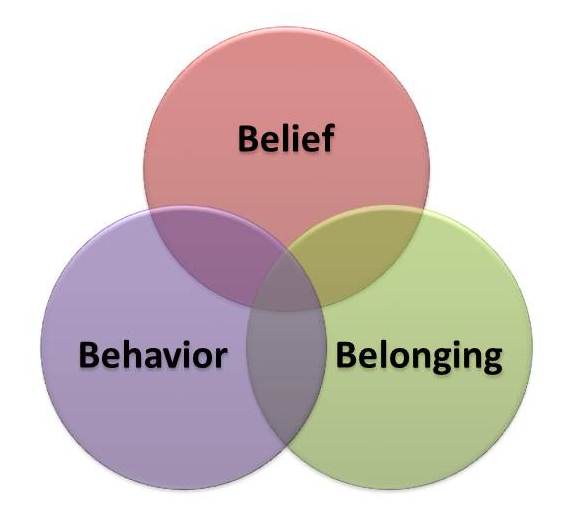
I read an overview of a study that talked about the importance of these three facets on religious life: belief, belonging, and behavior. In terms of participation in a religious group, people tend to be motivated by the combination of these three things, which reinforce each other.
Here’s how belief, belonging, and behavior relate to churches:
- Belief: Churches typically have a set of doctrinal beliefs or teachings that define the faith and guide the worldview of their members. These beliefs often center around the nature of God, the purpose of life, moral values, and other theological tenets.
- Belonging: Members often identify themselves as part of a larger religious family, sharing common beliefs, values, and practices.
- Behavior: Behavior within a church is guided by the moral and ethical principles derived from religious teachings. Churches often provide a framework for ethical conduct and moral decision-making based on their doctrinal beliefs. Church communities have norms and rules that govern behavior and result in social cohesion.
These 3 facets work together to reinforce involvement with a church, but a breakdown in any of the three can also cause a split from that church. Here’s how they work together:
- Belief Shapes Behavior: The doctrinal beliefs of a church influence the moral and ethical behavior of its members. Religious teachings provide a moral compass that guides decision-making and daily conduct. Individuals with shared beliefs also share the behaviors that are a byproduct of these beliefs.
- Belonging Reinforces Belief: The sense of belonging within a church community reinforces and strengthens individual beliefs. Shared experiences, communal worship, and fellowship contribute to a collective reinforcement of faith. People are surrounded by individuals whose lives and experiences confirm the beliefs of the community, and church attendance provides space for these stories to be shared.
- Behavior Expresses Belonging: The rituals, ceremonies, and ethical practices within a church are not only expressions of individual faith but also manifestations of belonging to a larger religious community. Behavioral norms and rules in the community reinforce “insider” status which increases commitment to the group.
First let’s talk about belief. Mormons, like all congregations, are expected to share a set of beliefs. The reality is that every church contains people across the belief spectrum, and every “believer” is a cafeteria Mormon. Nobody believes everything the same as everyone else, or even has the same understanding of what that belief entails. Pres. Hinckley was once in a conversation with another faith leader and admitted (with a twinkle in his eye) that he couldn’t tell the difference between a believer and a non-believer just by looking at them. Sometimes, a ward member who makes challenging comments in classes or talks is considered by others to be lacking in belief, although given how much appreciation is expressed when someone does this, it seems more likely to me that it’s only a minority who believe the party line, and the rest are yearning to be able to be more authentic but feel they cannot. These are all feelings related to belief.
When someone leaves the Church, they are often seen as “wanting to sin” becaused others see a shift in behavior, but the reality is that behavior is just the most visible difference. Belief is often private. People refer to being PIMO, or Physically In Mentally Out, meaning that they attend church but have cognitive dissonance and don’t share the beliefs other congregants express. Behavioral changes generally follow belief changes, not the other way around. We make sacrifices we believe are important and that have a reason, but why sacrifice for something you don’t believe?
The more we are asked to do things that only exist to provide group cohesion, the more our “belief” is tested. The more we have to defend the indefensible, the less goodwill we have left to accept more arbitrary rules. As members, we have to determine if a rule is arbitrary or provides value. If all the value is in making us a peculiar people, that’s not a good long-term reason to do something. For example, a generation ago, garments were seen as supernatural protection from harm. The church has since distanced itself from this claim, instead focusing on the idea that they are a reminder of covenants. But are they a necessary reminder of these covenants? What about all the Catholics wearing a simple piece of jewelry? Isn’t that a better reminder? For women, isn’t the real reason to enforce a very specific standard of modesty, making it nearly impossible to find acceptable clothing choices that don’t look like you’re wearing pajamas underneath? What about living in a hot or humid climate? What about the health impacts? What about mental health? Sexual attraction in marriages? The cost of the garment? The fact that they originated as a way to distinguish practitioners of polygamy from others in the community? All of these are objections I’ve heard people ask.
But the rising generation seems to have the ability to discard behaviors in ways that people my age did not. There are many young people in the Church who just don’t wear garments, who drink coffee and roll their eyes at the idea that it matters (that’s another one that’s hard to defend on any scientific grounds–pun slightly intended). And yet, it doesn’t always appear to be linked to their beliefs. Given that, it’s possible that within a decade or so, these rules will simply relax to match the normative behaviors of the group.[1] Behaviors can reinforce belief, but they can also undermine belief when they are onerous and don’t make sense to the individuals under the behavior code.
Likewise, someone can believe and follow all the rules, but still feel that they don’t belong. Aside from the deliberate anti-LGBTQ actions the church has taken that have chased so many out of our congregations, there are many more ways people can feel they don’t belong. My guess is that more than half of the people in any group at any given time feel like they don’t truly belong on some level. That’s just human nature. We have insecurities, and we also judge others from the outside (while, I’m told, the Lord looketh on the heart). A woman with a career might feel she doesn’t belong. A man who is a stay at home dad might feel like an outsider, not included in “mommy” support groups. Divorced or single people often feel like they don’t fit the narrative or that others are viewing them as potential seductive threats. Childless couples may feel pitied or ostracized from friendships with those whose kids share interests. Older couples whose kids have left the Church may feel they don’t belong, particularly when talks blaming them are rehashed and tutted about. As I pointed out last week, those who don’t support Trump or who aren’t social conservatives currently feel like we are being (have been?) pushed out, or have voluntarily stepped back to avoid this association.
Taking a step back, it seems to me that the Mormon church is taking some hits on all three fronts, and that it’s contributing to the loss of membership in the rising generations. Here are some thoughts about each of these:
Belief. The Church is distancing itself from some of the unique beliefs that set us apart from other sects, including Heavenly Mother and exaltation (meaning godhood). At the same time, beliefs (or interpretations of belief) that are being reinforced are not wearing well: obedience and authoritarian attitudes about leadership, social conservatism masquerading as doctrine, patriarchy, not loving our neighbors too much, and historical claims that are being effectively challenged on the internet.
Belonging. Many of the activities for adults have been curttailed or correlation committee’d to death. This isn’t necessarily recent, but it’s not reversing. Fifteen years ago, our Relief Society started a book club reading novels until the bishop intervened and insisted that all the books had to be Church books published by Deseret Book. That was the last month the book club met. That’s just one example, but it won’t be unfamiliar to those who have been in Mormon congregations.
Behavior. There are many behaviors that are the norm in the Church that appear to have one purpose: making us weird. A new member approached me once in the grocery store to ask why we weren’t supposed to drink tea, and there was literally no real scientific answer I could give her. The real answers are 1) because Mormons believe in doing what leaders tell them without question (which is not a virtue), and 2) it reinforces our belonging to the community by making us sacrifice something that is normal in other social settings. So long as we persist in requiring community behaviors that aren’t supported by beliefs, this is going to be a problem.
- Among the people who have left, which of these do you see playing a role?
- Have you seen how these three things interplay in your own life?
Discuss.
[1]Of course, this is something progressive Mormons online have been predicting for a long time, without much to show for it except Coke being sold at BYU.
 Wheat & Tares
Were garments peculiar to people in the 19th and early 20th centuries?
I’m supposing that as styles started changing, underclothing changed, too.
Pioneer underwear just doesn’t work under a flapper girl dress (late 1910s to early 1920s).
Nylons came about in the mid to late 1930s, which further changed dress norms.
Love the venn diagrams. I used a similar illustration to describe my thoughts why we left the church.
http://graduategrumblings.blogspot.com/2022/09/18-months-later-update-after-leaving.html?m=1
My three categories were community, world and self and the church and our belonging to it was an intersection of those three things. Where the church is failing is when I was a youth I felt a deep connection and debt to the community of the church that helped me push through my doubts to BYU and then on a mission and 40+ years of devoted membership.
I began to feel that the intersection of those things didn’t or shouldn’t include the church. My beliefs meant I no longer felt like I belonged in the church. My children especially felt like as lgbt youth there wasn’t a home for them any longer. The church’s finance leaks in 2019 were the last straw for me and i realized that what I believed was right and wrong was in conflict with the church. It took another year for us to fully pull away but a year of Covid induced separation broke many of our community ties
As my faith broke I did relax some behaviors. While on a business trip to UK I stopped wearing garments and had a cup of tea with my breakfast. I didn’t drink coffee or alcohol for two more years but that has relaxed. I don’t really like alcohol but drink a glass of wine occasionally.
I wrote another post about the missing circle – God. I think this fourth circle is also an intersection of belief and the community of the believers – belonging. Ideally the circle for deity would intersect with all three. Or encompass all three of your circles. Certainly the belief in the Mormon church as the one true church would mean this. But I don’t believe that anymore.
I am not an atheist, but dont believe in the God I yearned for as a member. Basically where I am now is my faith is the universe wants or is a beautiful and complex place and that is either what god wants pr what god is and we are a part of that. But I don’t believe any more that we are a separate and consecrated people or that god will intervene to have a prophet or a one true church. I don’t believe that there is an afterlife. This is all we have and we need to make the most of it and staying in The church was holding us back and separating us from our kids that had already left.
I’ve long followed the ex-Mormon community online, and know several people who have left the church, and have found that usually once someone stops believing, they also stop belonging and behaving. They stop going to church and associating with believers (except believing family, although more distanced), and will start drinking alcohol and having more sexual partners (if they’re single). Believers are somewhat vindicated in saying that those who leave “want to sin.” Yes, they typically begin to engage in acts that are considered sinful in the Mormon church. However, the question is do these “sins” ruin the individual’s life?
As for myself I don’t hold the traditional beliefs, but still belong in a lessened capacity, and behave on many fronts. I don’t drink alcohol. I don’t even drink caffeine. I don’t like the feeling of needing substances to change my moods. If anything, I believe that physical exercise is the main thing that I need for a mood change. Living in Utah, and having an active spouse, my main friendship networks include lots of active members. I’ve never made it an issue to question or challenge their beliefs.
Mormons love to proclaim their exalted status as being God’s chosen people and the sole purveyors of truth. Like it or not, Mormon beliefs and behaviors share elements of the bizarre. To me, the only redeeming feature of the current Church is the opportunity of belonging to a community of friends – although status in that community is conditional.
I enjoyed attending my ward’s Christmas Eve program because it consisted of music and brief readings of scripture related to the Savior. No mention of worshiping RMN or JS, no criticism of LGBT, just straight up worship. If only that could be a weekly occurrence (careful, activity levels may soar).
This year, we gave family and friends a copy of Carl Sagan’s book, “Pale Blue Dot: A Vision of Humanity”. It is an excellent reminder of our relative place in the vast cosmos. I particularly like his quote: “…so the idea that we are central, that we are the reason there is a universe is pathetic”. I highly recommend viewing the entire context of Sagan’s one minute excerpt at: https://www.tiktok.com/@jeschneiderx/video/7238292420675374379.
In the new year’s GD discourse, I look forward to quoting Sagan and discussing the fact that humans exist on the “obscure outskirts of a galaxy with 400 billion other stars and are part of a Universe with over 100 billion other galaxies”. Nothing like an unscripted discourse an an LDS setting.
In my opinion many TBMs “believe” in “behavior” more than doctrine or theology. This is a learned characteristic. A young person in the Church can spend the first 18 years of his life focused on the Law of Chastity and Word of Wisdom and that is all that is needed to serve a full-time mission. In other words, a mission is a behavior more than a product of belief in many cases.
One thing I’ve noticed in my lifetime is that when you try to give “Mormon” explanations for things that are just weird Mormon rules, those reasons are transparently false to outsiders. They might work in Utah, but they don’t really work anywhere else where people are surrounded by contrary evidence. For example, you can’t say that drinking tea is part of an ideal health guideline when tea drinkers are among the longest-lived humans on the planet. Some things play as more defensible than others. You can make a case for genealogy being of value to humans, but actual temple work doesn’t really make any sense to outsiders. At some point, when insiders try to explain these things to unconvinced outsiders, they see how silly they sound, and they stop believing the things that are not well-tested.
Honestly, the outright lies make the best defenses, until you realize they are simply lies, such as the idea that polygamy was only done because there were more men than women, and to increase fertility, neither of which is borne out by the facts.
I attended the Christmas Eve sacrament meeting program and missed very little of the LDS package. The one thing I missed was the community – Ive had virtually every calling and worked with many people in the ward. A few approached and seemed to genuinely miss us rubbing shoulders.
I’m still trying to build a new community and it’s hard as a middle aged man. Some days I think the LDS community was real and other days artificial. Maybe it was “real in the church.” I guess there’s a reason people statistically live longer in tight knit religious communities.
In my observation, very few members leave the church because they want to sin. Other factors are at play, leading to the exit. When a person no longer believes church teachings, their choices are not restricted by what church leaders proclaimed as sin.
People I am close to put a lot of thought into behaviors they formerly regarded as sin. Much does not hold up. Much is recognized as controlling.
Psychologists are finding more and more that behavior drives beliefs as much if not more than beliefs drive behavior. It is simply too hard to deal with cognitive dissonance, and belief is often easier to change than behavior. Say someone “sins”. They have three choices, 1. Repent and change the behavior. 2. Accept they are just a bad person. 3. Decide it isn’t a sin.
#1 is often difficult depending on the reasons for the “sin” in the first place. #2 remains painful and doesn’t really solve the cognitive dissonance. #3 is easiest, depending on the community and results of the behavior. #3 is especially easy when the recommended behavior has no value to the person or is illogical, or even has negative consequences. For example, estrangement from family, skin infections from garments, or loss of 10% of income.
Let’s pick a sin for an example. Drowning puppies. So, if you dislike your sin, say you really like puppies and so does most of your community, it is easiest and best to change your behavior. Unless you have many more puppies than you can feed or stand to have underfoot. Then you might decide, well, I am just a bad puppy downing jerk and keep right on tying puppies to big rocks and dumping them in the lake. But if you hate puppies, can’t feed as many as you have, and your community really doesn’t care, you may change your belief to “killing puppies is a virtue if you do it as kindly as possible, the cruelty of drowning is the only sin.” And you change your belief.
Take another example. A dude listens to the missionaries and believes it all, even when told coffee is a sin. If our dude never really liked coffee, a change of behavior is easy. But more commonly, they love coffee and it is a big part of their community. So, they secretly stop at Starbucks on the way to their baptism, then fib to the missionaries and say they quit Their behavior, plus the added sin it led to in lying to the missionaries makes him decide he is just a bad weak slob who can’t give up the vice of coffee. He swears he has a testimony, but COFFEE! Or choice three, is they stop at Starbucks on the way to the baptism, decide they really don’t want to give up coffee, look around at the others in Starbucks and wonder what the blank kind of God forbids coffee? Thus, the new church is just full of Bologna and they change their new beliefs back to match their behavior. They fail to show up for baptism and when the missionaries check back to see what happened with their golden investigator, they tell the missionaries that they do not believe after all.
On the other hand, not fitting in is a way bigger driver of leaving the church than the church authorities are willing to accept. In the “leaving the church website” that I am a part of, we have discussed the idea that many of us didn’t fit in, and so when we hit things that made us question our beliefs, we had an easier time deciding to search for evidence of the church being what it claims it is or not. The not fitting in made changing our beliefs into welcome relief. Some even went searching for evidence that the church is false, so we could justify leaving. Our relatives look at our “evidence” of falsehood and shrug because they fit in and are not looking for an exit ramp.
I have to add to my comment above that changing our beliefs to match behavior is not really that common in the internet world of post Mormonism. Most of us here change our behavior long after leaving, if at all. And I must admit here that I could still pass a temple recommend except for beliefs, if I keep my medicinal use of coffee as medication. Which it really is as I still hate the taste of coffee.
On my mission I realized, to my surprise, that Mormon doctrine is a macguffin. Sure, the fact that we have unique beliefs is important, but those beliefs could be completely different and Mormonism would still be essentially the same as long as it retained its culture, organization, and praxis.
Please forgive this “orthodox” Saint up front…asking for grace (and giving it). These sorts of posts have a bunch of moving parts and I wonder how constructive they could be if the parts slowed down a bit? For instance, setting LDS “culture” aside would slow down the conversation to a point at which answers would be closer to commensurate for active Saints. So, do 17 million Saints have 17 million differences and many more opinions about all sorts of things Yes. Obviously…so why is that a point of interest? Here’s my orthodox-guy view of these sorts of posts: Believe what you want to believe and then own it. Don’t like garments? Own it. You like coffee? Own it. Want to go to the temple? Own the answers to the recommend questions honestly. Why parse? Why split hairs? Are you honest in your dealings with others? “You mean completely? Including sins of omission?” No, just asking you if you’re an honest person. Oh, then yes, I am. Do you believe the FP and the 12 are prophets, seers, and revelators? “Well, are you really asking me if they are infallible?” No, I wasn’t asking that. Just asking what I said. “Oh then, yes.”
Why make being a Latter-day Saint so hard? If you don’t want to go to the temple, don’t go. If you do, answer the questions…yes or no. Simple. Do you have other questions for local church authorities? Ask them…but own the answer you’re given. That doesn’t mean what you were told is correct…it just means what you were told is what you were told. Leave it. You don’t like the answer? Either live with it or don’t…accept the “authority” or don’t. But to constantly entertain grievances is unproductive.
I once attended a solemn assembly back in the 1980s in Utah…the Salt Lake Temple, top floor. Topic: the difference between inquiring and questioning. Inquiring is invited in our church…questioning not so much. The “September Six” and all sorts of other folks weren’t inquiring about the church. They were questioning…even the best of them. There is no reason to have the slightest angst about a person asking why we don’t drink coffee. The answer: It’s a commandment we’re asked to obey. I don’t understand the “science” behind either but I don’t care, I just don’t drink coffee. Everybody has their moral agency…younger generations as much as me. If they don’t want to obey the “rules,” fine don’t. Find happiness elsewhere. Have a nice life. I respect their agency. Does bad history bother you? Then fix it constructively, not destructively. Or let it go…most of it doesn’t matter anyway. Was Brigham Young a racist? Evidently…much the same as every American in 1850. Does that mean he was not the Lord’s mouthpiece? Nope, doesn’t mean that at all…not unlike all of the bad examples throughout the scriptures from the Lord’s anointed. Let it go…or don’t…just accept it as proof that none of these people carried the mantle of the Lord…and don’t support them. Go be happy elsewhere. Me? I know they are all human beings, living in historical context, with moral agency. I accept that and live with the consequences…I support them nonetheless.
Just saying with all of this, if you desire to be faithful, then act like it. If you desire to be right, the rest of the world is your oyster.
Robert:
“Sure, the fact that we have unique beliefs is important, but those beliefs could be completely different and Mormonism would still be essentially the same as long as it retained its culture, organization, and praxis.”
I don’t think the church would’ve survived without a belief in revelation. Of course, we can talk about what beliefs mean relative to practices and so forth. Even so, some beliefs must remain in order for Latter-day Saint praxis to survive–and the most important of all of those practices (IMO) is the seeking and receiving of revelation. And that particular element (revelation) makes all the difference with respect to whether the church is merely rolling forward by virtue of a cultural momentum of sorts or impelled in a certain direction by the charismatic qualities of the Spirit of Truth.
Hawkgrrrl, you state the Church has been distancing itself from the doctrine of exaltation or godhood. Can you or anyone else cite that? I’m not doubting, I’m just curious where that has been said or hinted at.
Thanks.
Interesting discussion in the OP — I like the interaction between belief and belonging. Let’s note that “belonging” can mean two things: (1) A sense of belonging to or with the local congregation. You can be anywhere on the belief spectrum and still feel a sense of belonging to the local ward. You can have a complete absence of belief and still belong to the local ward, although serving as a bishop in that scenario might be tough (but just about any other calling can work).
(2) A sense of belonging to the Church as a large institution. This seems more tightly linked to belief. The less you believe, the less your sense of belonging to the big-C Church. You can feel no sense of belonging to the big-C Church but feel a lot of belonging to the local ward. You can inversely feel little or no sense of belonging to the local ward for various reasons, but still feel a lot of connection to the big-C Church.
If you have little belief and little sense of belonging to the big-C Church but nevertheless remain active in the local ward (with some degree of belonging), we sometimes call it PIMO (physically in, mentally out) but a more general term is alienation. It deserves a full post. Let’s just say there are lots of alienated Mormons.
The temple is inexorably turning into a test of obedience. It could have been so much more. One more instance of telling people that they exist for the church, when it should be the exact opposite.
“Once someone stops believing…they will start having more sexual partners.”
Is it possible to learn this power?