
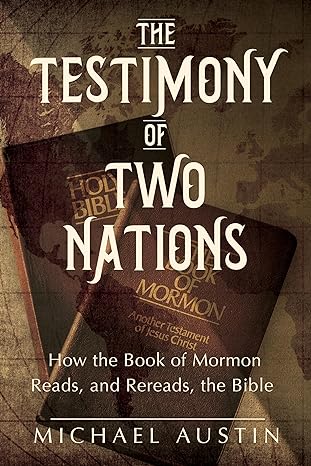
Besides new socks, Christmas ties, and various knick-knacks, did Santa bring you any Mormon books yesterday? Me first. I received The Testimony of Two Nations: How the Book of Mormon Reads, and Rereads, the Bible (Univ. of Illinois Press, 2024) by Michael Austin, regular blogger at BCC and Mormon public intellectual. This book made my Santa list based on Austin’s earlier book Buried Treasures, a collection of essays on various Book of Mormon episodes. Testimony of Two Nations (“TTN”) is a more scholarly inquiry. Here’s a quick preview.
First, the substance of the book. Austin notes that “the Book of Mormon narrative mirrors the overall structure of the Bible,” and that in TTN he will “focus on the larger narrative patterns that define both books” (p. 10). There are seven of these narrative patterns, covered in chapters two through eight, starting with a tree and fruit that people find desirable and ending with a cataclysmic event that changes everything. The Book of Mormon doesn’t just mirror the biblical pattern in these instances, it throws in a twist to each. So a deep look at the similarities and differences in how the Book of Mormon and the Bible employ each of these narrative patterns is the heart of TTN. This is a great study guide for LDS adult Sunday School 2024, which covers the Book of Mormon. When you raise your hand to make a comment, you will astound listeners with your insights.
Here’s the problem. Austin is a literary scholar. He is concerned with words on the page and the various literary tricks the authors, whoever they may be, use to tell their stories. He quite explicitly notes, “I take no position on whether any of the events described in either the Bible or the Book of Mormon actually happened.” That admission appears in the “Some Choices Explained” section of the 16-page Introduction. Would that all authors included such a section in their introductions. Earlier in the Introduction, Austin devotes a couple of paragraphs to the pros and cons of “bracketing.” So right up front, you know what you’re getting and what you’re not getting in the rest of the book. Specifically, what you’re not getting is a discussion of the most relevant and salient issue regarding the Book of Mormon: Is it an authentically ancient text or is it a 19th-century text?
There are two ways to look at this omission. First, it is an eminently pragmatic choice for an author to make. You want people to read your book and take it seriously. If you start out your book pledging fealty to the orthodox LDS account of the book’s origins, just about every non-LDS reader will not take your book seriously. If you start out your book rejecting that LDS account and endorsing some variation on 19th-century authorship, few LDS will read it. So to give your treasured book the reading it deserves by people in both camps, you can either declare authorship to be an open question or you can bracket the whole question. So I understand the choice. Who knows, if I ever write a book on the Book of Mormon, I might make the same choice.
But a second way to look at this choice is through the lens of a historian or attorney. Someone wrote the book. Who? If you want to understand the book, the identity of the author(s) and their historical location is obviously relevant. A historian might review the evidence around disputed authorship of a certain document and declare that a definitive determination of authorship is not available, but they are likely to make a tentative choice for the purpose of their analysis. You probably expect them to. It’s part of what historians do, isn’t it?
Even more so for attorneys, who don’t just throw a bunch of facts into evidence and hope a jury can make sense of it all. There is an opening statement where, for example, a prosecutor lays out the case she will present, not just the facts but the story about the crime and the defendant that they claim the facts will support and that they want the jury to accept. It’s called the “theory of the case.” In a sense, if you don’t have a theory of the case, you don’t have a case. And if a prosecutor doesn’t have a case, she doesn’t file charges. If you can’t stand up in court and say, “the facts will show the defendant committed the crime, and here is how it happened,” you don’t go to court in the first place. My sense is that you need a “theory of the book” if you are writing about the Book of Mormon.
Now don’t get me wrong. I am going to read TTN. And, as noted, I understand why the author takes the bracketing approach to the question of Book of Mormon authorship. But personally, I incline more toward the historian’s or attorney’s approach to the big question. It should be addressed, must be addressed, in any book-length treatment of the Book of Mormon. Maybe you give two pages to ancient authorship and two pages to 19th-century authorship, then declare it an open question, presently unresolved, then proceed with the balance of the book. That at least acknowledges the importance and relevance of the question.
I hope to return to TTN in a few weeks after reading the full book. Perhaps there is discussion later in the book that provides further insight into this authorship question, which to me seems rather relevant to how the Book of Mormon quotes and uses the KJV Bible. There is certainly going to be fruitful discussion on the Book of Mormon’s appropriation of various Bible events and passages. I’m looking forward to reading the rest of the book.
So that’s my Mormon book for Christmas. What about you? What Mormon book did you happily unwrap after eating two or three Christmas waffles? What Mormon book did you *not* find under the tree but you will buy with your Amazon gift card? What Mormon book did you yourself gift to nieces, nephews, or siblings?
 Wheat & Tares
I asked for and received I Spoke to You with Silence: Essays from Queer Mormons of Marginalized Genders. I’ll be buying myself Michael Austin’s Buried Treasures.
I agree with the author of the book you received. I personally find the historicity of the Book of Mormon to be an irrelevant point. One way or another, it came through Joseph’s brain. Either way it can be filled with inspired content that you can apply in your own life according to your own portion of the Spirit.
To me the point of the Book of Mormon is to show people a way to follow Christ. That’s what matters, in my opinion, not whether anything is “true” or not. (Yup. That’s me distracting myself during sacrament meeting because comments about things being “true” bore me to tears.)To me that takes the focus off of the real point of religion which is changing your own behavior. We can do that best by following an excellent example of compassionate behavior and thought, which we have in Jesus Christ.
This year I gave my loved ones “The Book of Mormon for the Least of These” by Fatimah Salleh and Margaret Olsen Hemming, and “Living on the Inside of the Edge” by Christian Kimball.
I am in the middle of “David O McKay and the Rise of Modern Mormonism”
When I finish I plan to order “Gay Rights and the LDS Church” and “Rough Stone Rolling”. We can get into my political reading another day.
For purposes of the church and the church community, I like the literary approaches where we try to derive morals and lessons based on the stories and not whether they were historical or not. In that sense, I commend Austin’s work. It is good for the believing community to be less literal. Were Austin to take a position of the Book of Mormon being non-historical, there is no way he could conceivably reach the believing community. He knows that, hence his reticence on the matter.
Personally, however, I find history and historicity to be of tremendous value, and highly relevant to the BOM and Bible. With the Bible, I know that the narrative is ancient and reflects the cultural knowledge of Iron Age Israelites as well as Greco-Jews and other Jewish sects around the 1st century AD, even if the stories contained therein are mostly objectively unverifiable, with the exception of a few corroborated historical figures, peoples, and events mentioned in them. I simply enjoy reading how some ancient Israelites processed real provable events such as the Babylonian captivity and Cyrus the Great’s repatriation and seeing how the Israelites conceptualized nation, conflict, god(s), self and other, etc. I feel that I can take the Bible seriously because there is enough history and historicity there. With the Book of Mormon I have a hard time taking it seriously since the narrative overwhelmingly appears not to predate the 1800s, with the exception of passages taken from the KJV, and just seems so out-of-place with what we know about the ancient Americas.
Additionally, if I were to write a book about the Book of Mormon or Bible, history and historicity would be a priority concern of mine. For I think that historical context really brings out literary value. And I see the BOM as having come from a 19th-century historical context and that that is where we look to make the most sense out of its narrative.
Thomas Shepherd said;
“Strength of reason would commonly convince my understanding that there was a God, but it was utterly insufficient to persuade my will, except by fits and start.”
In other words, I get the facts, but they don’t transform my heart, and please, God, allow them to transform my heart.
I have often wondered why the Book of Mormon promise is not on the first page instead of the last. We would never read any other book, let’s say, a book like Steven Covey’s “7 Habits of highly effective people” and then debate whether or not Stephen Covey was a real historical person. The truth of those principles are found in Alma’s experiment, planting the seed, implementing them in a life, and then nourishing them and waiting to see what fruit is born.
Our discussion around “truth” often reminds me of the inevitable arrival of the “fact checkers” following every blockbuster hit that contains “Based on a true story.”
I think it’s fair to say that artistic liberty ought nought to be license to completely fabricate lies, however, the purpose of creating the movie, from the producers and director’s standpoint, is not merely to document history. There are always the backward looking “facts” that seem to be provisional and subject to angle of sight, and then there is the forward-looking truth of inspiration. The story is primarily being told to offer a values-based truth, NOT a historical truth.
The historical facts of the Book of Mormon aren’t irrelevant, but they are the least compelling part in its capacity to change hearts and transform lives. Truth has become such a moralized and weaponized term. Our use of the term seems more interested in being right than the willingness to participate in the fragile pursuit of discovering things “unseen”. Joseph Smith once said, “We should be a receptacle of truth than merely a dispenser of it”.
Jesus said, “I am the way, the truth and the life”. He uses an active, forward moving tense of “I AM”, he doesn’t say “I have the truth”. He seems to suggest that the truth is more something to be lived than something I set on my desk.
Unfortunately, I think we tend to view truth as absolute certainty which then sets us up in need to defend our precious possession. This is a forever backward looking position, always seeking to recover the certainty lost, “Eden” and ” Egypt”, the places of no possibility and tyranny, instead of the progressive nature of God’s developmental plan.
When we stand and say, “I know”, I think what we are trying to convey is, that I have experienced something within the confines of my spirit that gives way to a conviction, born of something unseen but nevertheless evident, which motivates me to act in a way that supports that conviction. I don’t think the strength of religion or the Book of Mormon in general was ever to document facts, but to provide meaning to those facts, in such a way, to help motivate people to enlarge their personal tents of compassion. Religion, like LWS says, is the practice of being better people, not being the “right” ones, which ironically jeopardizes the primary goal.
I neither gave nor received any Mormon books this Christmas, though there are a few (including the one referenced) I wouldn’t mind picking up.
I think it is perfectly reasonable for a literary scholar to remain agnostic about the authorship of a particular work. He is not a historian or attorney, after all. This wouldn’t be without precedent. There is no consensus on whether a poet named Homer actually existed and wrote (or recited) the Iliad and the Odyssey. I wouldn’t expect a literary critic to take a definitive position on the matter – or even give it much of a mention really – before giving an analysis of the text as literature. (I acknowledge of course, that the works of Homer – though very fictional have long been seen as windows into the culture of ancient Greece, and there is no definite historical culture connected to the BofM). Still, I think bracketing the historicity/authorship elephant in the room was probably the best choice for a credentialed academic.
That being said, I would probably push back on to the assertion in the OP that taking no position on BofM historicity would have the effect of not alienating potential believing members. By not taking a position, most traditional Mormons are going to assume you think JS made it all up. So if that was the intent (and I don’t know if it was), mission not accomplished, IMHO.
I gave my very orthodox new DIL who is doing her first stint as GD teacher “The Book of Mormon Made Harder” by James Faulconer. She gave a wide-eyed gasp when she opened it.
OTOH, I gave all my college kids Lin Manuel Miranda’s “G’Morning, G’Night.” Not a Mormon book, but I think it has a lot of accessible wisdom.
I would tend to disagree with the OP. Maybe because I assume that JS wrote it, I am much more interested in what Michael Austin finds valuable for the reader in considering the BOM as having taken the stories of the Bible and adding a twist. Because as I look back now, despite having read and taught the BOM numerous times, I no longer see it as really adding much to the discussion or to ways if thinking about God . So I am curious what value others see in it. Even it it turned out that a guy named Mormon really wrote the BOM, what do they have to say about God that I might find meaningful?
Currently, I struggle to see what the BOM brings to the table that is of value to Christian thought and worship, so I am deeply curious to hear Michael Austin’s evaluations of the BOM as reimagining the Bible stories because I have a lot of respect for him.
About whether or not it’s important if something really happened, it looks to me like it is.
Deuteronomy 32 came to my mind –
“Remember the days of old.
Consider the years of many generations.
Ask your father, and he will show you;
your elders, and they will tell you.
When the Most High gave to the nations their inheritance,
when he separated the children of men,
he set the bounds of the peoples
according to the number of the children of Israel.
For the Lord’s portion is his people.
Jacob is the lot of his inheritance.
He found him in a desert land.”
Also, Paul makes a big point about the Resurrection actually happening
“If Christ has not been raised, then our preaching is in vain, and your faith also is in vain.”
– 1 Corinthians 15
Thank you for the OP!