
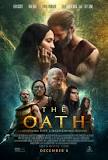
The Oath is the latest effort to capitalize on Mormonism in a mainstream way, this time in a $24M budget box office flop. It debuted with $112K in ticket sales across 640 cinemas on Dec. 8. As of Dec. 18, it has garnered $404K total [1] in sales, with diminishing sales each day as more and more theaters pull it. The movie is considered in the action / adventure / drama genre and stars Billy Zane and Darin Scott (who also wrote and directed it).
400 A.D., in a forgotten time of Ancient America, a lone Hebraic fugitive must preserve the history of his fallen nation while being hunted by a ruthless tyrant. But rescuing the King’s abused mistress could awaken a warrior’s past.
IMDB
The reviews are bleak, and what’s interesting is that the film has made the mistake of alienating both its theoretical Mormon audience, as well as its desired larger, secular (?) “action movie” audience. Here’s a review from someone whose movie opinions I would never consider in choosing what to see:
I’ve never took it upon myself to write a movie review until after seeing this film. I didn’t even have an account on imdb and made one just to write this.
The trailer and the little messages by the director (and main character) before and after the film seem to have nothing to do with the movie. In his messages he is talking about how the film is about the book of mormon love, peace, christ, and that it can change peoples lives. So that’s what I expected when I sat down in the theatre.
Instead, I was utterly disappointed and confused. The show was not about christ and barely mentioned things from the Book of Mormon. It was a strange love story with a lot of strange components. Like neither the way they kept switching from whatever ancient language and english made no sense, and I don’t know why the girl was speaking broken english at first (which the actress did pretty bad at).
Also so many scenes seemed to just be the director/main character trying to show off his muscles. Why is he curling the golden plated and the camera zoomed in on his biceps? Why was there a random part of him doing pull ups on a tree? Very weird.
Just everything about this movie was horrendous, it felt like watching a roughy draft/failed project.
Some Mormon dude who wanted to see a movie about the Book of Mormon BUT dislikes Arnold Friburg apparently
To be clear, I have not and will not see this movie, but that doesn’t mean I can’t enjoy dragging it here. Even my movie popcorn addiction is insufficient to get me to waste an hour and 44 minutes of my life on this stinker. But if any of you have seen the movie and want to do a guest post, please submit!
Here are a few more of the reviews. First, I’ll start with an ostensibly positive one from a real movie reviewer, although take this with the grain of salt warranted by the name of the publication which is the Epoch Times. Hoo boy:
At various points resembling “Gladiator,” “The Passion of the Christ,” “Dances with Wolves,” “The Last of the Mohicans,” and “Braveheart,” “The Oath” mixes elements of drama, action, romance, and fantasy to stirring effect.
Blurb only, from reviewer Michael Clark, because the Epoch Times apparently has a pay wall!
While that’s a pretty positive take on the film, closer reflection makes me think it’s a bit of a backhanded compliment, reminding me of the Stefon character on SNL, played by a breathless Bill Hader: “This film has everything!” Saying a movie is like a mish-mash of a bunch of other, better movies isn’t exactly high praise. Here’s the only other positive critic review on Rotten Tomatoes, where the film has a bleak 26% squishy rating.
It’s certainly no sillier in any way that I could see than, say, Conan the Barbarian or the Lord of the Rings flicks. And it’s at least as heartfelt.
Review by (and I’m not making this up, I swear) M.V. Moorhead, aka Less Hat, Moorhead
Honestly, the rest of Moorhead’s review is worth reading, and he does a great job explaining the movie. The first paragraph makes it a little more clear to me why Billy Zane, who plays the villainous fiance in Titanic, would take this on. It’s basically the same role.
The (underdog hero Jack) warrior Moroni (is in steerage on the Titanic) lives in a cave in a primordial forest. The strapping fellow is the last surviving member of his clan (Jack has no wealth or connections), exterminated by Aaron, the King of a rival tribe (capitalism, as personified by bad boyf Billy Zane, aka Cal Hockley, amiright?). One day he comes across Bathsheba (the winsome Kate Winslet, aka Rose), a beautiful concubine (fiance, but marrying for money at her mother’s insistence, so she might as well be a concubine) who has escaped Aaron’s clutches (and is literally dangling off the side of the ship!). He gives her shelter from the storm (rescues her from a watery grave), and they gradually bond (while he teaches her to spit, disgustingly). But of course, the cruel Aaron isn’t done with either of them (that dastardly Billy Zane, jealous and dangerous to the last).
Mad Libs script? based on Moorhead’s review recap of the film The Oath
And here are some of the reviewers who are decidedly not impressed (just a quick compendium of soundbites):
- This tedious drama is actually very soulless. The characters, story, and filmmaking are woefully generic, while the acting performances are dismally substandard (Carla Hay)
- Pledging to watch ‘The Oath’ may cause severe regrets (Jeff Mitchell)
- The fact that in terms of subject matter this is an unusual film doesn’t mean it’s a good one… it’s solemn, repetitive and unexciting. (Frank Swietek)
- Clunky, dull and undercooked while very low on thrills, suspense and emotional depth. (Avi Offer) Honestly, this one sounds a bit like the Book of Mormon to me.
- A limp, underfinanced Pre-Columbian “Last of the Mohicans” action adventure…and a dull MesoAmerican thriller built on Mormonism’s foundation myth, with just enough magical thinking thrown in to make everything presented here play as eye-rolling hokum. (Roger Moore)
And just to keep perspective, here are some reviews from non-professional audience members.
- I love that Billy Zane used all his screen time to roll his eyes at Moroni and basically go “is this guy for real?” That’s how we all feel, Billy Zane.
- It turns out, ‘The Oath’ is partly inspired by the last part of the Book of Mormon (a cornerstone in a faith I knew little about), seemingly random people throughout the Bible, other works, and other folks in history who played a part in the founding and “restoration” of the Mormon faith. . . ‘The Oath’ definitely feels like it was made by believers who naively think they know how to convert others. Honestly, what we have here only makes sense to people who are Mormon or who already know enough about their literature and beliefs. There’s very little here that arises emotions beyond boredom, confusion, and resignation.
- Had time to kill after I had watched a movie & this was playing in the auditorium next door. What I saw looked really bad, like “worst movie of the year”-worthy
- The first 20 some minutes are mostly montages of Scott, who stars as Moroni, working out, looking stoic on a cliff, and wandering about. I couldn’t tell you anything I had learned about Moroni from the first 20 minutes aside from his being a former general, his being alone, and his near Marvel-ized muscles. Scott reminds the audiences as often as he can that he is, infact, very muscular.
- I don’t think anyone who hasn’t read the Book of Mormon is going to really get what is going on, and even people who have read it are going to be confused.
- I hope he never makes another movie.
- If this is the vanguard of LDS cinema, prospects are bleak! Absolutely threadbare… about five things happen in this movie, and none of them are particularly interesting.
One of my very first blog posts was about the difficulty Mormon authors face at creating anything on par with what is considered to be the “great Catholic novel,” The Power and the Glory by Graham Greene. I wrote that in 2008, partly in response to the Twilight series (which I have not read or watched). Since I wrote that post at Mormon Matters in 2008, there have been a lot of fairly good additions to the Mormon literary canon (most of the BCC Press stuff is worth a read, for example). There were two issues that I identified at that time that get in the way of creating great literature that also fills a “devotional” or “faith-friendly” niche: (self-)censorship and superficiality. I wrote about those in 2008, but having written a Mormon book since then, I’ll add another: finding an audience.
In my case, the problem with a mission memoir is that your target audience is either anti-Mormon (Orgasmo comes to mind) or Mormon (Way Below the Angels). As soon as my book came out, there was a woman I did not know on a Facebook group of people who served in the same mission I did (we didn’t overlap) who immediately said, “Don’t read this! The author is clearly not faithful! She’s being critical!!” Fortunately in my case, a bunch of my mission friends came to my defense, and she took her comments down. Critical or no, the book was well-reviewed by the people I served with, many of whom said it was eye-opening, and one BYU professor used it in his class as text for discussion about missions. Even so, I have always been beyond surprised when some of my never-Mormon friends have chosen to read it. There’s a lot of inside baseball, and you can’t really spend your whole book explaining things that are patently obvious to the insiders. And yet, that limitation is what makes the book unmarketable. There aren’t enough people in the target audience. A movie about a two-dimensional Book of Mormon character and a bunch of made up characters to create a plotline is going to have even more problems like this, especially when the author / director / actor asserts forcefully that this is a true story. I didn’t even claim that in my memoir! (Or I at least disavowed its reliability tongue-in-cheek on the cover).
In the Broadway musical [title of show], the characters sing about the problem with creating when things get in your head, like insecurities and criticisms from others. The song is called Die, Vampire, Die, and its about overcoming these obstacles to creativity. In one verse, creators are cautioned about the “air freshener vampire” who wants you to avoid writing about “bad language, blood, or blow jobs,” and if you cave in, you will eventually end up with “two tight paragraphs about kittens that your grandmother would be so proud of.”
Based on some of the reviews for the Oath, this movie has an element of that, as does the Book of Mormon. We can tell you that people were beheaded, raped and possibly canibalized, but we can’t show you that because we won’t get the faithful rating of PG-13 or less, so instead, we’ll just keep it light and superficial with scene-chewing two-dimensional villains (apparently Bill Zane has a wandering, part Irish, part Pirate accent). Likewise, there is scant character development of Moroni in the Book of Mormon, and this movie appears to fill in the gaps with workout vids in the forest, abs that would make a Hemsworth jealous, and gazing at bald eagles.
In addition to the problems I identified back in 2008, a new issue has emerged in faith-promoting movies, which is the “passion project.” This is definitely one of those. While it’s great to explore your passions, the resulting art can feel a bit like reading a thirteen year old’s journal. Just because you have feels doesn’t mean they constitute great art or that anyone else is interested in them. Back in 2008, I didn’t expect the surge in Christian-themed movies, but here we are. In these films, the director has a mission, and seeks to inspire the audience, also making a plea for audience members to buy a ticket for someone else, to spread the word / artificially boost sales. That seems to be a tactic that immediately brands the film with the taint of faith-promoting schlock, relying on grass roots campaigns to get the word out, rather than creating a compelling piece of art that will sell itself or draw an audience naturally.
It seems that “passion project” has an audience of one: the writer / director / star in this case. And I say this as someone who wrote a mission memoir! It’s certainly possible that something can start as a passion project and actually find an audience by being good, but apparently this isn’t an example of that. The church failed to endorse it (despite the author hoping for an endorsement), and has mostly pretended it didn’t happen. Maybe they were gunshy after the Tim Ballard debacle. Maybe they just thought “WTF did I just watch?”
- Have you seen this film or any of the other faith-promoting films of this type? What was your impression?
- Do you think it’s possible to create a good film in this genre? What are the pitfalls to avoid?
- Is it possible to make a movie that is good, that has both a secular audience and a faithful LDS audience, using LDS content?
Discuss.
[1] See this link for updated box office numbers.
 Wheat & Tares
Perhaps you haven’t read the review at Meridian Magazine, titled “New film winningly captures Moroni’s courage and hope.” I know with every fiber of my being that if you read and ponder this review, you will immediately ask yourself two questions: (1) Where can I buy tickets? and (2) When will the sequel come out?
https://latterdaysaintmag.com/the-oath-new-film-winningly-captures-moronis-courage-and-hope/
“The Oath: A Workout Video Masquerading as a Feature-Length Faith-Promoting Film”
Hey, wait, I thought that was Arnold Friberg’s job.
(p.s. for all you young-un’s, Arnold Friberg was the illustrator for the blue paperback copies of the Book of Mormon that your missionary parents and grandparents passed out in abundance long ago. It served as evidence that the Nephites – even the children – had a serious steroid problem and hung pin-up pictures of Arnold Schwarzeneggar in their cement bedrooms).
Radio Free Mormon did a podcast after watching this that is worth listening to.
Apparently Darin Scott recently had a near death experience (NDE) which seems to be all the rage in the faith these days and is used by those with NDE as a marker of credibility. His NDE led to this film. My dad’s NDE in the early 80’s colored his entire outlook on life which was not great. So I’m not usually impressed by NDE but YMMW.
Apparently Darin Scott also made a post chastising the institutional church for not using their war chest to buy tickets to his film.
You just can’t make this stuff up.
Interesting that the viewers score at Rotten Tomatoes is 86%. In glancing at a a few of the positive reviews, they seem to be more a matter of supporting entertainment that aligns with their faith than an objective review held to the standard by which they’d judge secular movies. I think this holds for all the faith-based movies that have been released recently – they’re held to a much lower standard with respect to their movie-making/entertainment value but are upvoted because they promote God’s work.
Also, I had to laugh when I saw the part in the trailer about Moroni rescuing the King’s mistress from “abuse” – a clear attempt to trade on the Tim Ballard / OUR mission and success (now a quagmire of course).
Wonder if anyone will ever leak the result of Project Icon, the Jesus film M. Russell Ballard convinced the church to pay $20 M to film on Malta under the direction of excommunicated Gordon Bowen (male prostitution / child molestation). Screened for the twelve in a private home showing and thrown in the trash can.
Where can I get a copy of your mission memoir?
I watched the trailer and about spit out my drink when I heard Billy Zane’s amazing choice of accent. I can just imagine Zane getting pitched on the film.
Casting: You’re supposed to be an evil king
Zane: ok sure
Casting: You’re somewhere in Pro-Columbian America
Zane: Cool cool
Casting: You’re trying to kill the star of the film – a rival general
Zane: Nice, I’m getting some Mayan Gladiator vibes here.
Casting: The writer (who is also the director) describes your rival is described as “a lone Hebraic fugitive”
Zane: umm, Jews in America in 400 AD…k.
Casting: He’s also a Christian.
Zane: Uhh…hmmm. So, the last surviving Christian Jew in Pre-Columbian America?
Casting: Yes, and he’ll be played by a lily-white pro-Trump Utah boy who still has a God complex from when he played Jesus in a couple of short films…oh and he’s also the writer/director..and really likes to talk in a quiet voice about Mormony things.
Zane: Ok well, I don’t know if this is the right film for me I think maybe…
Casting: OH!And the guy you want to kill runs around the woods with a book made of gold…it’s his dad’s diary or something, but neither of you really care about it – he mostly just uses it for bicep curls. Mostly you just are mean to the girl he likes, and chase him around a bit.
Zane: Hmm…and I get complete creative control of my character?
Casting: Yes, nothing less for the guy from Titanic.
Zane: So if I went with a big Amish beard and a West Country accent like Captain Barbossa in Pirates you’d be cool with that?
Casting: Oh man, that sounds amazing. Billy Zane, you are an acting genius!
Zane: Ok, I’ll do it.
I just watched the trailer. As noted previously, filmmaker/lead actor Darin Scott claims a near-death experience and attributes his future work on this film as the reason that God saved him. And therein lies the problem for me. I refuse to be emotionally blackmailed into watching a film. And I highly doubt God ever saved a human life so they could inflict their own worldview upon others, an imaginative worldview with values that need questioning. We all know that God asks his children to endure much in this life. But I refuse to believe He wants us to endure bad art. I’ll take a hard pass on this film.
Now I do like Arnold Friberg’s work, but I am old enough to enjoy looking at classic illustrators’ work (N.C. Wyeth, Greg and Tim Hildebrandt, etc.). Friberg also worked on Cecil B. DeMille’s “The Ten Commandments” (1956).
Is it possible to create a good film in this genre? Yes.
I think The Saratov Approach was pretty good but I think it worked because A. It was based on a true story and B. Its messaging wasn’t overly preachy. The movie’s themes were more broadly accessible than faith in one particular religion.
I don’t, however, think it’s possible to make a good Book of Mormon movie for one simple reason: It’s too racist. The central narrative of the book is that God favors white, fictional native Americans over the real ones and replaces the actual history of real people with a racist fable. Secular audiences are basically guaranteed to recoil.
Someone could, perhaps, make a good movie deconstructing the BoM narrative and interrogating how racist and ahistorical it is, but that wouldn’t fit into the genre we’re talking about. And LDS audiences would hate it, like you mentioned.
Dave B: No, I definitely didn’t see that one. Yikes.
Pirate Priest nailed it.
Linda Furness: Here’s a link to Amazon for the Legend of Hermana Plunge (my mission memoir): https://www.amazon.com/Legend-Hermana-Plunge-Angela-Clayton-ebook/dp/B07NQ4CXFB/ref=sr_1_1?crid=PIABS5FX6PJI&keywords=legend+of+hermana+plunge&qid=1703094639&sprefix=legend+of+hermana+plunge%2Caps%2C191&sr=8-1
Jake Christensen did a really great Goodreads interview with me here: https://www.goodreads.com/author_blog_posts/18046754-wheat-tares-interview
Re: this movie, I’m not really sure why anyone would think Moroni was interesting enough as a character to create a movie about him. Honestly, Nephi’s probably the most likely, and he’s completely insufferable. There’s a problem in nearly all religious storytelling, whether purportedly scriptoral or just about Christian characters, that the stories are too often morality tales, and morality tales are both boring and didactic. You can tell a story that’s uplifting, but if there isn’t enough depth, it feels predictable like a Hallmark movie (another criticism of this one was that it had Hallmark movie elements). I think part of the problem is when the author takes himself or the material too seriously.
While you’re at it why don’t you review the COJCOLDS’s official temple movie (or to be more accurate its slide show). Because you’ll be forced to admit two similarities between that presentation and The Oath:
1. boring
2. very little to do with Christ
I issue my strongest possible condemnation to this so-called film. A much higher sense of enlightenment could be obtained by watching a Soviet-era farm tractor rusting away in a field. For those who doubt that Western society has reached its nadir, this is proof positive.
Josh H: If life is too short for this 1 hr 44 min snooze fest even WITH movie popcorn, there’s no way I’m going to sit through that WITHOUT it.
This isn’t the first time this has been tried. Someone made “The Book of Mormon Movie Volume 1” in 2003. (I had to look that up–I remembered reading about it at the time and forgot it was so long ago). That would have been during the Mormon cinema renaissance started by God’s Army in the late 1990s. Like The Oath, it was panned by critics. There’s a bit of a pattern here.
I’m sure there are many Mormons who believe in the dream of great film adaptations of the Book of Mormon, but I think we have to be honest with ourselves that the source material is pretty weak cinematic material in its raw form. Honestly that’s probably true of nearly all sacred texts of all religions. Scripture is a genre of writing that doesn’t lend itself to dramatic tension or character development. I’ve not watched but hear good things about The Chosen. From what I hear it sounds like it’s good TV not because the New Testament is good source material, but because good writers have taken a good deal of liberty to do their own character development that goes well above and beyond anything they started with. The idea of writing a speculative drama based on Moroni isn’t necessarily a bad idea on its own, but the execution matters a great deal. I think religious people trying to make art can let their deeply held feelings about the source material cloud their judgment about the quality of the art they have created. Just because it was based on something that has had profound importance in your life doesn’t automatically create great art.
My wife and I actually saw The Oath yesterday. Admittedly, I’m pretty easy to please when it comes to movies. It was almost worth it for the cinematography alone. The acting was decent, if a couple of minor cringe moments. It did take a lot of liberties with speculation, which bothered my wife more than me. I realize Darin was trying to give the movie “The Chosen” treatment but probably went too far. I think there are plenty of other BOM stories that could decently be done with much less speculation. It’s not the greatest LDS Cinema, but certainly not the worst. I hope it does a little better. If he learns from this experience and is somehow miraculously able to raise the budget, I really do think he could eventually give the BOM the same treatment Peter Jackson did for Tolkien.
I saw Angel Studios “The Shift” opening night. I went in with the impression it was a sci-fi movie first, and a faith-based movie second, but faith was much more emphasized than I expected. I was surprisingly a little disappointed by that at first. Production values and acting were great, and it’s a movie that stays with you. In researching it even more, it’s a deeper and more layered movie than I realized—nearly every frame is intentional and with meaning. I plan on going again with the older kids to see what I missed. I generally have to do that with Nolan films as well.
Most critics are panning it, and even a fair number of audience reviews. In reality, I think a lot of it is because this movie simply went over their heads, which is understandable and not something you’d expected from faith-based movie that are so easy to ridicule, so it simply came across as jumbled and unintelligent instead. Personally, I think it’s destined for cult classic status. I hope Brock Heasley is given the chance to do more films in the future.
Both The Oath and The Shift had Pay it Forward messages. These don’t bother me. I don’t feel the least manipulated or inclined to pay it forward but have nothing against those who do, and have read quite a few reviews from people showing gratitude for being able to see a great movie they wouldn’t have been able to afford otherwise. In the end, it’s as much or more about kindness as it is marketing.
I do think there is potential for crossover with LDS cinema, but it would be rather tricky.
Gosh darn. I had no desire to see this film and now I want to see it. When considering cost, how much worse can this be than a Zack Synder film?
If I was going to make a BofM film, the main character would be Amalickiah, and I would cast Joaquin Phoenix.
I think you would have to go pretty far back into Hollywood history to find a faith-based epic film of this nature that enjoyed commercial success. I mean, we’re talking the Greatest Story Ever Told, The Ten Commandments, Ben Hurh, and the like. There are plenty of epic Christian fables or films where you can easily read the Christianity into it. The Lord of the Rings trilogy, obviously Narnia (though the films were not great), and if you really try, the Star Wars trilogy (didn’t you know Lucas based the Force on the Priesthood and Yoda on pres. Kimball??).
There are a few less epic “Christian” films that come to mind such as The Day the Earth Stood Still (second coming fable?), Chariots of Fire (the guy refuses to compete on Sunday), and On the Waterfront. Yes, on the Waterfront. Not only do we have the Social Gospel oriented priest (“Boys! This is my church!” [goosebumps every time. highly overlooked scene]), but we have Terry as sort of a Messianic figure who puts his body on the line to wrestle control of the docks from the mob – including an obvious “cross-carrying” final scene. You can also make a pretty strong case that Clint Eastwood’s character in Gran Terino is a Christ type figure. Of course, most of these are not overtly Christian or faith-based, but it doesn’t take too much work to get there.
As far as quality Mormon-themed cross-over films …… sigh …. Does Napoleon Dynamite count?
Mat
What counts as commercial success?
Two films from 2014 while not commercial blockbusters, did a hunk of change.
The box office for Darren Aronofsky’s film “Noah” starring Russell Crowe was $359.2 million.
Ridley Scott’s “:Exodus: Gods and Kings” starring Christian Bale as Moses, the Box office was 268.2 million.
By contrast Transformers: Age of Extinction made 1.104 billion.
I have seen none of these films. Don’t know what that says about my beliefs, but for the life of me, I don’t see why anyone would see a Michael Bay film
Maybe for his next project Darin Scott can adapt for the big screen John Pontius’ book, Visions of Glory, that chronicle Thom Harrison’s personal revelations. There is plenty there to work with: near death experiences, portals, folding space-time “like a taco” (without even needing Spice), hearing rocks and other inanimate objects testify of truth, knowing which nurses are having affairs with attending physicians, identifying light and dark in people, including children… There is a lot of material there to develop. I’m thinking something epic along the lines of Battlefield Earth. Perhaps John Travolta would be available to play Spencer. And think of the sequel possibilities with stories inspired by VOG acolytes like Vallow & Daybell, Tim Ballard, and Hildebrandt. Talk about an opportunity in the Mormon faith promoting and proselytizing motion picture genre to further develop rich characters all channeled from Harrison’s spiritual gifts to Mormonism. Scott could try his hand at something more contemporary.
Or maybe this pestilential entertainment genre can go away forever….
What Kirkstall said. The problem with movies such as this and other “faith-promoting” works of LDS art is that they seek not to reveal truths about human nature and about Mormon doctrine, but rather to obscure the more disturbing parts of the Mormon religion. That’s not art, that’s propaganda. And it’s incredibly disingenuous to promote it as art. Where did all of these Mormon grifters come from, all of a sudden? I mean, I know we’ve always had them, but it seems we’re seeing more mainstream notoriety generated by these crackpots lately. One wonders if this is all just the next logical step of trying to monetize one’s faith in order to profit from it. Not dissimilar to that “ponderize” marketing ridiculousness a short while back.
Now I want to see the Hallmark version: Jezebel, a successful scribe living in the big City of Bountiful, decides to head home to folksy Zarahemla for pre-christmas. Outside the city, she almost drives her chariot directly into a herd of holiday cureloms, and shouts obscentites at the hunky curelom herder. Boy is her face red when she arrives home and her parents introduce her to their local holiday curelom herder and it’s the same guy! It turns out Jezebel was in YW/YM with this guy, Kishkumen, who is actually waaaaay hotter now. But Kishkumen is sad because he’s going to be put to death with the rest of the Christians if Jesus isn’t born this year. Can Jezebel win over this stone cold bronze age hottie? Can Jezebel and Kishkumen convince the leaders of the Nephites not to put the believers to death? Can they also save Kishkumen’s holiday curelom business?
“To be clear, I have not and will not see this movie, but that doesn’t mean I can’t enjoy dragging it here.”
Regardless of whether the film is even any good or not, I find it odd that you would post such a lengthy negative review of of a film you haven’t even seen. Were you personally slighted by the writer/director at some point in the past?
Sea Urchin: I have no idea who this guy is, but all the actual negative review content is from other cited sources since I have not seen it; the part of the post that relates to this specific film is just a compilation.
The part that I wrote about (my contribution in the post) is the broader topic of faith-based media. If you read past the compiled reviews, you’ll see that starting in the paragraph that opens “One of my very first blog posts was about the difficulty Mormon authors face . . . ” While this movie is certainly an example of an unsuccessful effort (a box office flop, widely panned), the fact that negative reviews are coming from both the faithful audience and the secular audience is the material point and why it’s illustrative of the problem all faith-based media has to overcome. Doing faith-based content is difficult, yet many people seem to want to do it or perhaps think it’s easy; doing it well is nearly impossible. Frankly, a compilation post like this one is easy to put together, and it illustrated a point I’ve blogged about before which is why it felt like a good post to do during the busy holiday season.
Also, whether you think re-posting about this very niche film is in some way harmful to the author, he apparently would disagree. In a YouTube video he posted, he called out the church for its lack of support of his effort, and didn’t seem to mind revealing the fact that they weren’t impressed with his finished product. As they say, there’s no such thing as bad publicity.
Wow, $24 million to make? The average Indie film costs about $2 million to make. Seriously, who would invest in this kind of a project? Did the producer and director lie to investors in their prospectus about what the movie was going to be? Guaranteed flop. Mormon-themed movies have almost never been successful. The Highest Grossing film was Meet the Mormons at $5 million. (Are we supposed to call that Meet the Members of the COJCOLDS now?) I thought the Other Side of Heaven was alright. They got Anne Hathaway to play a role. But even that cost $7 million and made only $4.5 million. The opening 10 words of the description of this movie made me cringe already. No, I don’t think it is possible to make Mormon-friendly movies with Mormon themes in the least bit palatable. The most successful Mormon-themed production, but not Mormon-friendly, utterly lampooned and ridiculed Mormonism to no end: the Book of Mormon play. And it was absolutely hilarious. Crass, oh yeah. But absolutely phenomenal.
I’ll add one more thing: Mormons are extremely sensitive to how people portray them and their beliefs in media. They demand a high level of protectiveness to their faith tradition in representations of them. To make a script believer friendly and faith-promoting and faith-reinforcing is to sacrifice its integrity completely. To make it pleasing to Mormons is to walk continuously on egg shells the entire time. Non-believing viewers generally see these productions as extremely bizarre. Believers, even the most friendly, often see these scripts as OK but still disingenuous and in bad taste. The producers of the Book of Mormon play went straight for the jugular. They didn’t care. And they were massively praised for it. One of the most successful Broadway productions ever. 5th highest grossing ever.
I’ve always thought a good war in heaven movie could attract both the faithful and a secular audience. Something along the lines of Memnoch the Devil or his His Dark Materials with more direct LDS themes. I could see an LDS audience really being attracted to something like Lucifer or Evil if it was written by an LDS author. I would not have guessed that an LDS audience would dig the vampire genre but it happened.
Suzanne: I suppose making any kind net profit would be considered a commercial success in the movie business. I guess my point was 50 or 60 years ago the equivalent to Transformers and the like were those larger than life Bible epics. They were immensely popular to a wide audience. Whereas today, many of these Bible pieces – whether on the big screen or streaming – seem to appeal to a niche -albeit enthusiastic – Evangelical audience. The Bible continues to provide rich source material so I don’t see that slowing down. There is no such exclusively Mormon plot building source material, and there’s a much smaller interested audience.
I don’t know Corou. The Mormon War in Heaven account isn’t exactly fodder for compelling cinema. I might be up for a two hour philosophical debate around free-will, maybe in a “12 Angry Men” jury deliberation setting but I don’t think this would be appealing to most movie-goers – Mormon or otherwise. Besides, both Henry Fonda and Lee J. Cobb are sadly unavailable.
“To be clear, I have not and will not see this movie, but that doesn’t mean I can’t enjoy dragging it here.”
Reminds me of the main character in Arsenic and Old Lace. He’s a drama critic by profession–and he writes his critiques before he sees the plays be cause it saves time.
“…your target audience is either anti-Mormon (Orgasmo comes to mind)…”
Orgazmo wasn’t aimed at anti-Mormons, just normal people who like crude humor (think college audiences) and think Mormons are kind of amusing, like nuns.
Jack: A classic film for sure, and yes, that was a great line. It would have been even better if he had been convinced by his own critiques not to see the films.
Cary Grant: I always write my reviews before the movie even comes out. Saves time.
Aunt Martha: Well, don’t you think you should go to see the movies?
Cary Grant: Are you kidding? Have you seen the reviews?
I think that Mormon cinema has yielded, does now yield, and will yet yield many great and important films pertaining to Mormonism.
First off, I thought God’s Army was a very good film, and lined up with most of my actual mission experiences. There was another film, Out of Step, which tackled the challenges of member/non-member dating in college. It told an interesting story with good acting and fair-minded writing. Would that it had caught on. I thought Brigham City was a pretty good murder mystery. And Gods Army 2, retitled States of Grace, has some great moments as well. I think the best episodes of Big Love, especially the Hill Cumorah Pageant road trip episode, are as good as Mormon cinema/tv has ever been, and as good as Sopranos ever was.
What do all these have in common? Good, humanistic writing, restraint where devotion would get out of hand, and a story that got me caring early and kept me caring until the closing credits. I plan to see this film when it becomes available via streaming rental. Yup, I’ll fork over as many as $4 to rent it.
Lastly, while I was disturbed by the director’s self-exalting description of the film and its power to change lives, my heart aches a little for the artist. I have professional experience as a film/stage critic. And I’ve been a professional actor in both artforms. Many of these reviews are hatchet jobs; they are worse in their genre than the movie could possibly be onscreen. And anyone who has what it takes to get a story all the way from empty page to cineplex distribution has accomplished something incredibly difficult. Just sayin’, a little empathy here and there, perhaps
Mel Gibson’s movie Apocalypto is the best rendering of the Book of Mormon “was scenes” I have seen. With very slight edits to the Apocalypto script you could have a story of the Jaradites or a story of the collapse of the Nephite civilization.
The Apocalypto movie is intense. It is not easy on the eyes. It pulls no punches (and literally pulls hearts) in showing the depravity of cultures that have rejected God.
No way would the church fund a production that portrayed such human depravity. Which begs the question of whether a “real” full feature, dramatic Book of Mormon movie can be made.
The writers of the Book of Mormon thought it necessary to mention violence and human depravity. I don’t necessarily want to see this on film, but then an accurate portrayal of events must somehow convey these dark elements of the Book of Mormon people. It takes skill as a director to do this well.
From where I stand, “the depravity of cultures that have rejected God” is manifest in hungry children, most wars, governments coddling the wealthy, vilifying immigrants, underpaying employees, and other such stuff.
Frequently, it stems from “othering” others.
It is shown in movies, books, and news reports. Maybe it’s easier to cross the street.