
The LDS adult Sunday School class has studied the New Testament this year. Earlier this year, I wrote a series of posts on Paul and his letters. I had hoped to do a similar series on the gospels and maybe a post or two on Hebrews and Revelations, but there were other topics to blog about and I did not follow through with that plan. This last look at the New Testament is to sort of make up for that lapse, by listing some books that cover various areas of the New Testament, along with a paragraph or two of commentary on each. Readers are welcome to add a book or two they like that didn’t make my list. I’ll link the title of the book to the Amazon page or the publisher page for those who want additional bibliographical info (publisher, date, number of pages, and so forth).
New Testament in General
The New Testament: A Historical Introduction to the Early Christian Writings, by Bart Ehrman. The link is to the newest edition, the 7th, published in 2019. I picked up a cheap older edition for $10, the 3rd published in 2004, a few years ago. There are dozens of Introduction to the New Testament books, generally written as textbooks to accompany college-level Intro to the New Testament courses. Besides looking at the content of the biblical book itself, they give historical and cultural context to each book, talk about authorship and intended audience, and so forth — all the stuff you don’t get in the LDS curriculum. You get some of it in LDS courses at the BYUs, but even then I suspect it’s fairly superficial as opposed to the serious critical reflection you get in Intro to the NT books. Study bibles give a page or two of this kind of info before each book as well. I have enjoyed every Bart Ehrman book I’ve read. I’ve got half a dozen on my bookshelf.
Who Wrote the New Testament? The Making of the Christian Myth (HarperCollins, paperback ed. 1996) by Burton L. Mack. The best book I’ve read for putting New Testament writings in the context of the developing early Christian movement. In particular, there were several different communities or types of community that carried on the message and work of Jesus and his first disciples. Modernly, Evangelicals like to label their local congregations “Bible churches,” as if they base their doctrine and practice solidly on the Bible. Historically, of course, it’s the other way around: the church preceded the biblical writings. The Christian writings that circulated and were later canonized were produced within early Christian communities. In particular, oral stories and fragmentary sayings documents circulated for decades before the anonymous author of the first gospel, referred to as Mark for convenience, collected, selected, and edited some of them into the first written narrative gospel around 70 AD. You don’t have to agree with all of the author’s ideas (many of which would make the average Mormon reader recoil in pious horror) to benefit from the overall view that Mack presents.
Paul and His Letters
I already linked to my earlier posts on Paul, which reference several good sources. If I had to choose one, I’d go for Paul: A Very Short Introduction by E. P. Sanders. He wrote several longer books if you have the time. Sanders was a pioneer of the New Perspective on Paul scholarship.
Here’s an LDS book with some good material: How the New Testament Came to Be (Religious Studies Center, 2006), from the 55th annual Sperry Symposium. It features 18 chapters by BYU scholars, including three on Paul.
Jesus and the Gospels
The Historical Figure of Jesus by E. P. Sanders. This is an accessible one-volume treatment of “the historical Jesus.” Sanders spends a lot of time discussing the sources we have and how to evaluate them before presenting his outline of what Jesus of Nazareth taught and did in Galilee and, in his final week, in Jerusalem. And “what Jesus of Nazareth taught and did” is not simply gathering all the info in the gospels and creating a single composite account, as LDS treatments typically do. That’s the evaluation part of the historical Jesus scholarship: trying to distinguish authentic early material that likely went back to Jesus from later additions. That’s what every author of a historical Jesus book tries to do.
Another one-volume treatment is Jesus: Apocalyptic Prophet of the New Millennium, by Bart Erhman. The central point Ehrman makes is that John the Baptist, the immediate predecessor and mentor to Jesus, was an apocalypticist. After Jesus was gone, his disciples were apocalypticists, expecting the “end of the present age” and an imminent return of Jesus. Therefore Jesus, the link between the Baptist and the disciples, was almost certainly an apocalypticist as well. You might think that Mark 13 and Matthew 24 show that point without any need to argue it, but in fact there are many different scholarly views on what exactly “the historical Jesus” was about. An apocalypticist is only one of a dozen alternative views of Jesus that are defended by various scholars.
A couple more. Jesus: A Revolutionary Biography, by John Dominic Crossan. He brings in a lot of sociology and anthropology, trying to understand what was going on in first-century Galilee and Judea in order to properly appreciate the social and cultural context in which Jesus operated. You would enjoy this book. This is essentially a slimmed down version of his longer The Historical Jesus: The Life of a Mediterranean Jewish Peasant that came out a few years earlier. For what it’s worth, Crossan came and spoke at Sunstone in 2015.
It’s not the case that all “historical Jesus” scholarship and books lean towards the liberal or progressive end of the theological spectrum. One last book I’ll throw out there is The Historical Jesus: Five Views, which features five scholars each presenting a short essay on their view of the historical Jesus, followed by short rebuttals by each of the other four. They cover the whole theological spectrum. This is a good read if you want to avoid getting sucked into one particular view articulated by just one scholar (and any one scholar’s book on the subject tends to be fairly persuasive taken in isolation).
Other Stuff
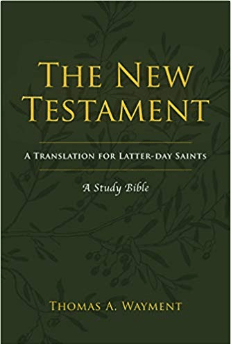
For individual book outside the gospels and the letters of Paul, I’ve just used chapters in the various Intro to the NT books and the material for each book in study bibles. I have a hard copy of the NIV Study Bible and the Kindle version of the New Oxford Annotated Bible, which uses the NRSV text. And for a Mormon reading the New Testament, there is Wayment’s The New Testament: A Translation for Latter-day Saints: A Study Bible, as shown at the image at the top of the post.
There is a New Testament Commentary series sponsored and published by BYU Studies. It doesn’t get a lot of attention, but it should. Seven volumes have been published, with about a dozen more planned. Check the website for more details. I own a couple of them, but these are not short books and I haven’t read through them yet, so I can’t really give a thumbs up or down on any of them, except Julie Smith’s contribution on the book of Mark (thumbs up).
Revelations: Visions, Prophecy, and Politics in the Book of Revelation, by Elaine Pagels. If there’s one book that the LDS NT curriculum thoroughly screws up (for various reasons), it’s gotta be the book of Revelation. Go read this book by Pagels to get yourself straightened out.
And with that I’ll wind things up. So long, New Testament. See you in four years.
 Wheat & Tares
Excellent recommendations. You’ll learn a lot by reading Ehrman for sure. I must say that the NT year is my favorite of all Sunday School years.
Years ago while attending Ohio State University, I took an individualized institute class from the LDS Institute director at the time, Dr. Stott. Since he was the only teacher at the institute and I had taken virtually all of his classes, he put this study for me where I went through 15 or so New Testament Commentaries. I had read Jesus the Christ by Talmage 3 or 4 times and thought I was an expert but what I ended up learning was that there were conservative to very liberal commentaries and Jesus the Christ was very traditional and conservative. I was amazed at how many interpretations there are of the New Testament and how little we were aware of in our studies in the Church. Through the years I’ve noticed that we don’t even approach the New Testament with the conservative outlook from “Jesus the Christ” but end up studying it from the perspective of the Book of Mormon, D&C, and Latter-day prophets and less and less from the Old and/or New Testament.
I really enjoyed the comment about how one scholarly view of the New Testament read in isolation is very persuasive, however reading 5 different scholarly views brings greater understanding.
This concept applies to many areas of life and study including news. If you get your news from one source, you’re stuck believing whatever they tell you. Getting your news from multiple sources on the political spectrum will widen how you see news in general. You not only encounter different slants, but different information is brought out more by different sources. In general you come to understand more clearly that things you may have perceived as facts, are in fact interpretations. All of us, including reporters, see the world through a lens of our own education, society, and history.
Theology is similar. If you only ever study it from the controlled positions of one church, it’s easy to believe that view. But studying from more views brings perspective, depth, richness and understanding.
Thank you for taking the time to share these sources on the New Testament
Nice run-down, Dave B. I’m embarrassed to say that while I’m familiar with several of the authors you mentioned, it’s mostly through the podcasts I listen to, rather than actually reading their stuff. I did pick up a book on Revelation, recently though: “Revelation for Normal People: A guide to the strangest and most dangerous book in the Bible,” by Robyn J. Whitaker. It’s scholarly enough for theology nerds, but straightforward enough for, say teenagers who have questions about the book of Revelation to which their seminary teachers have no real answers. As far as Sunday School, I’m a bit sad that we are soon entering a two-year period where we are going to hear little, if anything, about the Bible in church, except maybe in derisive terms (you know “a bible a bible, we have a bible”). Oh well. I guess I’ll have to do the New Testament again for my “home centered” portion of Sunday School.
I’ll throw in another plug for Bart Ehrman. I love his podcast, Misquoting Jesus (named after his book).
Studying the New Testament this year has been a delight. I really do think the plethora of amazing scholarship makes it much more engaging compared to something like the Book of Mormon where you just don’t have the history (or someone would say historicity) behind it to do much more than create fanfiction about the settings and supposed authors/editors. We even had a great discussion in Gospel Doctrine where the instructor had us read the four Gospel accounts of the Resurrection to compare and contrast them and discuss why they were different. Maybe it was just me, but the class was a lot less defensive about multiple accounts than I gave them credit for.
I have just finished reading Wayment’s study guide to the New Testament.
I found it very helpful.
Thank you,
Taiwan Missionary
Thanks for the comments, everyone.
Brad D, I like the NT year too, because there are so many good accessible scholarly books to draw on. When we move to the Book of Mormon next year, there is nothing. Yes, there are LDS books aplenty on the Book of Mormon, but an entirely different approach than we get with NT studies.
Instereo, I agree. The LDS curriculum doesn’t really study the NT. It uses NT books and verses to teach Orthodox Mormon Behavior and Thinking (OMBT). That’s what all the courses do.
lws, yes that Five Views book was a real eye-opener. Those guys really went after each other (in a scholarly way).
mat, thanks for the reference. I’ll confess that most of my books are from 20 or 30 years ago — not that they aren’t still good books, but I’m sure there are more recent books that cover the same topics with perhaps some updated ideas and data.
Not a Cougar, I almost threw in a suggestion in the post for readers to just ignore the Book of Mormon and do their own second year on the New Testament.
One book I really enjoyed was Jesus, the Jewish Theologian. It is a great perspective on the New Testament from the context of where the audience was at the time and the background others would have had.