
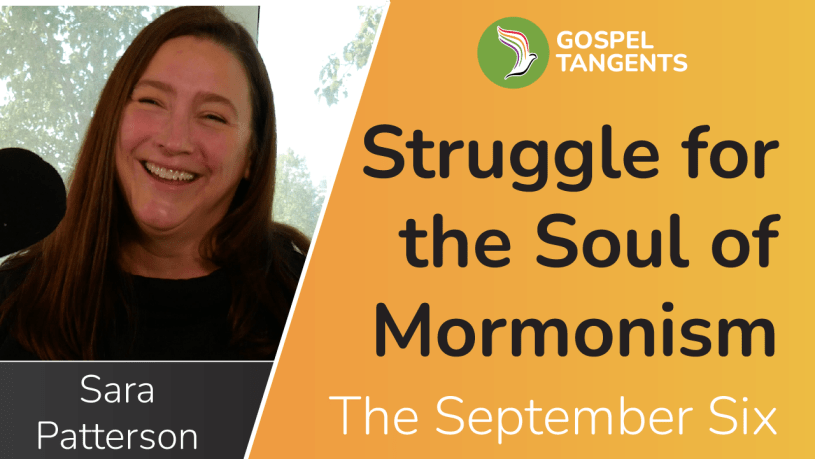
Dr Sara Patterson knew Michael Quinn, one of the Sept 6, and is the author of “The Sept 6 & the Struggle for the Soul of Mormonism.” She thinks we should think about more people than just the 6 excommunicated in September of 1993. We’ll look back at Michael Quinn’s life and ask if he is a hero or a tragedy. Overall, do you think we discuss Michael Quinn’s life as a triumph or tragedy?
Dr Sara Patterson discusses the tension between academic freedom and professors denied BYU tenure. While many focus on just the September Six, Dr Sara Patterson thinks some others should be included in the story. She discusses the dismissal of several BYU professors who were let go for from BYU not being orthodox enough. We’ll discuss the stories of David Wright, Ceclia Conchar Farr, David Knowlton, and others. It can be difficult to get BYU tenure. Is history repeating itself?
If we take an expanded view of the Sept Six, we’ll find others excommunicated for not being orthodox enough (or too orthodox.) Sonia Johnson, Brent Metcalfe, Mark Hofmann, and Avraham Gileadi are some of the people we discuss with Dr Sara Patterson. Should all of them be included in conversations about the September Six?
Have the Sept Six & other intellectuals nfluenced LDS Church leaders with their arguments? Dr Sara Patterson weighs in on that question. Do you think there has been some influence by any of the September Six on LDS leaders?
What are your thoughts on the September Six? Should it be expanded to include others who were fired/resigned under pressure from BYU?
 Wheat & Tares
Avraham Gileadi never fit with the others, for better or worse. During the 1980’s I was familiar with most of these folk – and I include Janice and Margaret – through attendance at Sunstone Symposiums (and I was good friends with Paul’s brother Joe Toscano, so I met Paul and Margaret once). But I knew of Prof. Gileadi through his writings, owning four of his books and attending one lecture. I was floored by his being X’ed. I mean, he had Hugh Nibley writing forwards on his books, for heaven’s sake. That’s like getting an Indulgence from the Vatican. And, of all things, being called on the carpet for teaching about a human “Davidic King” in the last days, which he comfortably backed up by scripture. I mean, do you know all of the whacky things that were printed in the 1960’s through 1980’s by Duane Crowther and others about The Last Days that got a pass by the Brethren?
Anyway, I like them all (what little I know of them) and even now, despite the attempt to come to grips with controversial topics at LDS.org at Gospel Topics Essays by the Church leadership, it is still a sensitive issue.
Interestingly, I was just writing about Quinn in an anecdote for my latest book. Briefly, Quinn was doing research out of Yale, after he was ex’d and after BYU, part of which included a survey for any LDS missionaries who had homosexual experiences on their missions. I asked for a copy of his survey. He sent it to me. And then I asked the brethren if they wanted to see it. President Packer asked to see it and Elder Holland called me about it. Don’t know what happen after that.
I got the book today and have had it all but chained about my neck. It confirms suspicions that I began to have in the 1990’s about the authoritarian direction that the church was going in. At the time of accounting Boyd Packer is going to have to answer for a great deal as will DHO. The author is 100% correct in saying that the push for extra purity and purity tests within the church along the correlation program have landed the church where it is right now with regard to the doubling down by the leaders on one hand and the mass exodus of members on the other hand.
I forgot to mention the telling detail that 2/3 of the September 6 were women. This fact, which had never even occurred to me before, says a lot about the men in power at the time. The fact that Lavina Fielding Anderson went to church faithfully for the rest of her life, in spite of her excommunication, was still refused readmittance into the church in spite of her bishop and SP pleading on her behalf 3-4 years ago tells me that attitudes towards women by the hierarchy are still back in the Dark Ages.
A Poor Wayfaring Stranger,
From my point of view it feels like there is a different implicit standard for women vs men in the church. The feeling I have had is that to be a good woman, a woman should defer to others rather than speak up. A good woman submits to her leaders and doesn’t disagree. If a woman does speak up and someone disagrees or is unhappy, this is her fault. She should have been silent, or said it so carefully that everyone magically agrees with her.
I think men in the church have more respect for the different opinions of other men than they do for women. Men, to an extent at least are allowed to speak up and disagree disagree without being automatically seen as insubordinate and out of control. A man’s opinion is generally considered and listened to. A bold woman sharing her opinion is often seen as out of place and broken, even sinful.
Women are more prone to discipline by our bishops without excommunication because we are taught from a young age to defer and submit. So we generally submit and no one hears about it. But those of us that choose not to submit, that is seen as more egregious than when a man doesn’t.
I have been reading “David O McKay and the Rise of Modern Mormonism”. There are many discussions of excommunications for heresies in this book. It’s interesting to me that referring to someone as insubordinate has only been mentioned once so far, and it was in reference to a woman.
We are vulnerable to whatever our leaders decide, benevolent or otherwise. Often we find things go better if our man steps forward on the same issues, with us or instead of us. If our man can’t do this, or we don’t have a man, we are even more vulnerable and disregarded.