
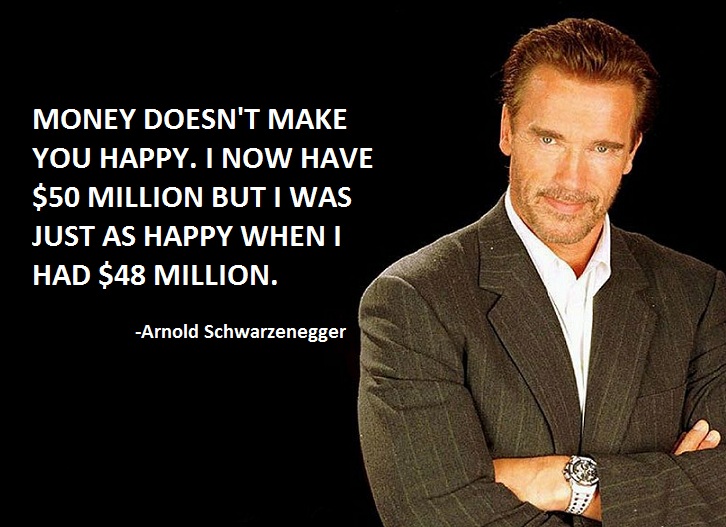
Today we have another guest post from Pirate Priest. Enjoy!
We’re in that “most wonderful time of the year” when we’re simultaneously focused on that unique blend of family, faith, and rampant materialism. There’s the old saying that “money can’t buy happiness,” but is that really true? The essence of the proverb is to denounce the quest for fulfillment via materialism – while I agree with this sentiment in
principle, does it hold true at a more literal level? Is it actually possible to buy happiness (or get close enough)?
Money can’t buy you happiness, but it can buy you a yacht big enough to pull up right alongside it.
David Lee Roth
This is funny and unsurprising advice from a rockstar with a net worth of some $60 Million. Someone mentioned popstar Cardi B in the comments a few weeks back. Here’s what she said about money and happiness in a recent interview:
Interviewer: Do you feel like you’re happier now than when you were broke, or not really?
Cardi B: Sometimes…it makes me happy that I’m able to afford what I want, and it makes me happy that I get to treat my family. But I feel like the way that I have money kind of took away a lot of my happiness.I didn’t grow up with much money. My parents were frugal and careful with their finances – they made sure we had food and a roof, but sometimes that was about all. My dad, a second-generation immigrant, worked very hard to provide for us, but there wasn’t much luxury in our lives. My first bike was found behind a dumpster and fixed up
by my dad. My mom learned to cut our hair from library VHS tapes. Sizzler was the fanciest restaurant my brother and I could imagine, and we only saw the inside once every year or two for my mom’s birthday. There were some exceptionally hard times when my dad was out of work and we quite literally lived on the food storage my
parents had tried to set aside. My mom spent hours grinding wheat stored in the basement for bread, and I’ve never met someone more creative with canned soup. If anything, my childhood taught me that happiness wasn’t necessarily related to having lots of money. I had good friends, a good community, and caring parents. It was never
glamorous, but I also never felt that we were anything but normal, which is exactly what my parents wanted.However, as I’ve grown older and have kids of my own, I can recognize and appreciate the hardship and stress my parents endured to create a bubble of normalcy for us kids. I recently had a conversation with my mom about those
Interview with Cardi B.
difficult times – she visibly shuddered and said, “I’d almost forgotten about all that…that was so hard. I think I’ve tried to forget it.” Money could have solved a lot of the problems they faced and could certainly have impacted their well-being.
$75,000
The best-known study on money and happiness is probably the 2010 study by Daniel Kahneman and Angus Deaton (both Nobel prize winners in their respective fields). The study is usually summarized like this: more money buys more happiness until you hit an income of $75,000/year; after that, money doesn’t make you happier. Dan Price, then CEO of Gravity Payments, famously read about the study and raised the salary of all his employees to $70,000 while cutting his own salary to the same level (don’t ask me why $70k instead of $75k…I guess you can’t have those employees being too happy). So does that settle it? All we need is $75,000 to have maximum happiness? Sort of….
Deaton and Kahneman measured happiness by looking at “emotional well-being.” This measurement uses questions like “Did you experience enjoyment yesterday? What about stress? sadness?”, etc. This essentially tracks the day-to-day moods and feelings of a person. However, this isn’t the only measure of happiness. Another measure looks at “life satisfaction.” This uses the Cantril Scale to rank people’s satisfaction with their life overall. The two seem similar, but are distinct – how you were feeling yesterday, is different than how you feel your life is generally going. Deaton and Kahneman examined both.
The study indeed found that people’s day-to-day moods stop improving beyond that magic $75,000 threshold. However, they also found that there is no upper limit to buying life satisfaction. It’s not a linear relationship (i.e. adding $1000 has more impact if you’re making $40,000 than if you’re making $400,000), but regardless, life satisfaction still never stops increasing as income increases. There have been studies done by other researchers that have reproduced this effect.
Intuitively this makes sense – there’s a point where we have enough income that money has less impact on our day-to-day moods, but emotions will still fluctuate. However, while rich people will still have good and bad days, they also have more resources to directly impact their overall life circumstances and satisfaction. (Scroll back up to the Cardi B. interview excerpt and you can see that she actually mentions both phenomena.)
How to actually buy happiness
While the research by Kahneman and Deaton is interesting, it’s also not particularly practical at an individual level. If a sad and stressed friend came to you for advice, you probably shouldn’t respond with, “Have you tried having more money?” If money truly can impact happiness, let’s focus instead on things we can control. How can we extract
maximum happiness from whatever financial resources we already have?
In the book Happy Money: The Science of Happier Spending, behavioral scientists Elizabeth Dunn and Michael Norton discuss their research on this topic. Their research began with a simple experiment of handing cash to random people on a college campus, instructing them to spend it in different ways, then asking them how happy they felt the next day. Their results led them to scale up their research to much larger and more diverse populations around the globe. They summarize how to buy happiness from money with 5 principles:
- Buy experiences
- Make it a treat
- Buy time
- Pay now, consume later
- Invest in others
Buy experiences
Material things don’t provide nearly as much happiness as experiences. There is lots of research done on how experiences are much more memorable and enjoyable than stuff. That concert or weekend road trip will provide much more happiness and lasting memories than a bigger TV or fancier car.
You can also make material goods more enjoyable by turning them into “experiential goods.” We tend to expect a new purchase to provide a lot more lasting enjoyment than it actually does – the stuff we accumulate quickly fades into the background of our daily lives. For example, you can spend weeks researching and test-driving cars to find the perfect one; you may enjoy the car at first, but it will usually quickly fade back to just being your ride to work. However, you can reinvigorate your material purchase by turning it back into an enjoyable experience – which can be as simple as a Sunday drive just for the sake of enjoying the drive.
Make it a treat
Have you ever gone to a store like Costco and seen a bulk case of your favorite treat on sale for a ridiculously low price? These deals are hard to pass up, but the second half of that case always seems to end up abandoned in the back of the pantry. This phenomenon is both the blessing and the curse of the human senses – we tend to adapt
to unpleasant things (e.g. the damp brown smell wafting from your teenage boy’s bedroom), but we also adapt to the things we love, blunting our enjoyment of them. Making things we enjoy a treat will give us much more happiness and enjoyment than if they become routine.
This principle immediately brought to mind the religious idea of fasting. I remember many times suffering through 1 pm church on Fast Sunday with a growling stomach, then rushing home to find something to eat. That first bite of food was always blissful – even something as simple as a saltine with a slice of cheese. Similarly, my sister has adopted the Catholic practice of Lent, and each year she abstains from something she enjoys for 40 days (chocolate, caffeine…she changes it each year). At the end of the 40 days, that item brings with it a flood of pleasure, happiness, and endorphins. Even a short break from something can reinvigorate our enjoyment of it and help us to
appreciate it more.
Buy time
This is undoubtedly my favorite and has had the most impact on my life. The phrase “time is money” is capitalist scripture at this point. However, this equation is commutive–money is also time. Meaning we can spend some of our money to buy back time and use that time in ways that bring is happiness. We all have chores and tasks that we hate (taxes, yard work, cleaning, etc.) We often complain about never having enough time for people and things we love, so buying time is one of the best ways we can increase happiness.
Laundry was ruining my family’s lives. Between clothes for work, school, barn, and kids playing multiple sports, we could never seem to dig ourselves out from the ever-growing mountain of laundry. If I end up in hell, it’ll be in the laundry room. In fact, I’m convinced that in the tale of Sisyphus, the Greek king cursed by Hades to spend eternity
rolling a boulder up a hill, the hill was a pile of dirty clothes. Laundry was sucking the life out of the little time we could spend together as a family. In a moment of providence, I heard an interview with Elizabeth Dunn shortly after seeing an ad for a local laundry service. I decided to put her research to the test – I bagged all the laundry, set it on the porch – like magic, it reappeared the next day washed, dried, and neatly folded. I nearly cried. The laundry service now comes each week, and it has more than paid for itself in terms of time and happiness.
This principle is my favorite because buying back time with money can also facilitate virtually all of the other ways to increase happiness with money:
- It gives us the time to plan and enjoy experiences.
- The time we buy back can be spent on health and personal care.
- Indirectly, buying time can force other purchases back into the second principle of “make it a treat.” Allocating your Starbucks or Swig budget to buying time instead, can automatically make them more of a treat. (for those outside the Mormon belt, Swig sells delicious, ridiculously overpriced customized soft drinks).
- In some cases, we can even spend that additional time earning more money.
Pay now, consume later
This one is something of a Jedi mind trick, and is related to the first two principles on the list. According to Dunn and Norton, “Delaying consumption allows spenders to enjoy the anticipation (think of the enjoyment you experience ogling the dessert case or thinking about the upcoming trip) without the buzzkill of reality.”
Some research has shown that people often enjoy the anticipation of a planned trip as much or more than the trip itself. Buying something in advance, then consuming it later allows us to soak in that dopamine hot tub for even longer.
This principle has interesting implications in religion. Religions have long preached the virtues of delayed gratification – if we can learn to control the tendencies of the “natural man” we’ll experience more happiness than if we give in to temptation. Generally, religion is referring to eternal happiness and salvation, but there seems to be some scientific basis to the argument that delayed gratification does indeed lead to more happiness.
Invest in others
This one is probably the least surprising – it feels great to give to other people. The spirit of giving is was makes the holiday season so special. Giving to others is a great way to improve one’s sense of happiness and well-being. Research in the book suggests that spending as little at $5 to help someone else can measurably increase your own
happiness, and that this principle holds across cultures and for people who are young, old, rich, or poor.
Marcus Aurelius, the 2nd-century Roman Emperor and stoic philosopher, wrote in his Meditations that the true measure of wealth was to see someone in need and have the means to help them. This is a man who was born into one of Rome’s great families and who was surrounded by all the luxury the Roman Empire had to offer, yet he wrote that his favorite luxury was to help others generously while knowing he would never need to ask for a favor in return.
There is a catch however: the giving must be voluntary. When people choose to give it makes them happier, but when giving is mandated (more like a tax) it decreases the satisfaction of giving and can sometimes cause people to feel less happy. The obvious religious implication here is in giving aid to the poor and needy, but tithing comes to mind as well. Is it possible that the blessings mentioned in Malachi 3:8 are more emotional than physical? It appears that paying tithing could increase a person’s happiness, if that person does so willingly and believes they are helping to build the kingdom of God. So while I may not personally subscribe with the LDS church’s current narrow interpretation of tithing, I can see how the practice may be viewed as a blessing for many members. Willingly allocating a percentage of our income to a cause we admire is a reliable way of buying happiness.
Mormons and money
Mormons have always had an interesting relationship with money. At one time the LDS church was insolvent and faced crushing debt. Now the LDS church has vast wealth, yet insists that even the poorest members need the “blessing” of paying tithing. In General Conference leaders hold up stories of faith and sacrifice from the church’s poorest members, but we also tend to sidle up the Prosperity Gospel and view financial success as a sign of righteous living (as long as the wealthy person has a temple recommend). This is a topic of its own, but it’s interesting to superimpose religion and academic research about money and happiness.
What about you?
- Do you believe it’s possible to buy happiness?
- What ways have you used money to try to buy happiness? What worked and what didn’t?
- Can wealth be a sign of righteous living?
- What other parallels do you see between the research and longstanding religious principles (Mormon or otherwise)?
Discuss.
 Wheat & Tares
In the book, “The Broken Ladder: How Inequality Affects the Way We Think, Live, and Die”, Keith Payne (a college professor and psychologist) concludes that one of the key factors of “happiness” is “how we compare against everyone/anyone else” and “how we think we compare against everyone/anyone else”.
I think it is important to include that the “bang for the buck” being used to buy happiness is a relative moving target (subject to the law of diminishing returns) that is based on “what everyone else is doing” in our group.
Along the line of buying an experience, my daughter and daughter in law got together and decided that rather than exchanging gifts as an extended family, we should do something for a shared experience. But finding an experience at Christmas time gets you into huge crowds, cold, expense, or walking (I need surgery on my foot and so walking around a Christmas village is out.) In the past, we have tried temple square where you elbow your way through huge crowds and lose children in a solid mass of people. We tried the drive through lights at Willard bay, and we were in separate cars by smaller family group, so not together as an extended family, and it was decided it wasn’t worth the cost. We have considered things like The Nutcracker, but the expense of getting a family in is too much for some. Many things just feel too commercial or just too common. Lights are just not that special in today’s world. So, the daughters are searching for an experience that isn’t beat to death by commercialism, out of price range, or ruined because to thousand other people want to do it too.
Meanwhile, my husband and I are stressing because we have to plan travel, 5 hours to get to where our children live, coordinate with my two never married siblings and pick up my disabled brother, figure where to stay, how long we will be in a motel at $150 per night between the activity, then Christmas Day, and get to my surgery which is not even close to where we live and two days after Christmas. I want to tell them to forget the experience, and let’s just have a nice quiet supper.
Or just skip Christmas. Bah Humbug.
So, my point in all this is that experience also has diminishing returns, the same way buying treats does. If the stress of planning gets too much it can ruin the fun or cause fighting, and things that you have done many times just stop bringing happiness because they become normal.
Money solves money problems. I live in LA, the sixth most expensive city in the world (er, I live LA-adjacent but my wallet doesn’t know the difference). When you talk about well-being, having less money problems is huge. And whether it’s 2010 or it’s 2023, $75,000 is NOT the magical number. Was this study conducted in Oklahoma?
My family is HUGE on experiences, deferred enjoyment, and buying time. Travel and experiences bring us joy.
But as Anna rightly points out, I have friends who cannot enjoy my way of life. Experiences require planning, waiting in virtual queues, finding a parking spot, finagling crowds, dealing with scarcity, and sometimes dealing with airports and hotels and the like. The recent Taylor Swift brouhaha really illustrates that experiences are not for the weak or poor unfortunately. A lot of my friends don’t even know what they are having for breakfast today. They would get no joy in experiences.
From a church angle, I really took Hinckley’s no debt admonition to heart. I only had a modest mortgage and never had a car loan or student debt even. Looking back on some lost opportunities as a result, I now view debt as something that can be extremely helpful if you understand how to use it and not let it use you. But the church isn’t big on moderation in their binary-thinking model. Building individual wealth requires debt for most of us. I’m trying to teach my kids the nuance.
Wealth is not a sign of righteous living. I repeat, wealth is not a sign of righteous living.
I am with you Anna. Disabilities really change the value of experiences and travel. We have to travel to Stanford every year for surgery or follow up on surgery on my son. It isn’t a pleasure trip.
For me at least pleasure trips have been a burden, particularly when my son was younger and required more rigorous daily medical procedures to live. To travel we have to pack all the medical equipment, supplies and medication he requires. At home these are arrayed easily to hand. When they run out we can order more that come to our door. To go anywhere we have to make arrangements in advance to be sure we don’t run out on the trip. Otherwise it can take most of a day to transfer a forgotten prescription.
On a trip we struggle to find and organize medical care in a different situation. It takes more time. It’s more likely there will be mistakes that can impact health negatively. Meanwhile, all the family without disabilities are doing enjoyable things without you and telling you to hurry up. They literally have more time than we have available and we aren’t going to explain our gross medical procedures so they can understand.
Meanwhile, they think it’s fun and exciting to walk huge distances we cannot walk because of our disabilities, and wait in long lines. We just long to get back home where we have more free time.
My mother in law once offered my husband free air tickets for us hoping to ease his depression. I asked if she would feel comfortable to perform the medical care our son needs while we were gone. She said no.
My son has grown up. He does his own medical care now. My husband and I have started taking little trips together, leaving him home.
It’s nice to get out a little, but I find it overrated. I would rather stay home and read a book, make phone calls or work in my garden.
And I want to say a car of any kind is valuable to get you to work or to that doctor’s appointment. It’s nice if it’s reliable.
Yes. I want more money but not for experiences or stuff. I want it for security for my children with disabilities. I don’t see either our country or our church providing that or even understanding the need.
It feels sometimes like we live in a different reality we can’t explain to anyone.
The interesting thing to me about the amount of money it takes to buy happiness is that it’s all relative, not absolute. And that’s because we all compare ourselves to those around us. If I live in a 3000 SQ Ft house but all my buddies live in 4000 SQ Ft, I may feel a little short. But if I compare myself to virtually any other group of people in history I may feel like a king with 3000 SQ Ft. Most of us probably live better today than almost anyone in history, yet we wish we had more because we see folks who have more. That’s how people process what they have and don’t have.
I tend to agree that money can in fact make people happy – to a point. My most stressful, anxious times were when money was tight. Also interesting, sometimes over dinner we talk about the best and worst superpowers. My family has voted fabulous wealth as the best superpower- just consider how Ironman and Batman can beat any other superpowers because of their wealth. That reasoning of course is unassailable.
My children are now old enough to appreciate family vacations – I’m one of *those people* who took kids to national parks instead of Disneyland. Nowdays one of my main sources of happiness is splurging on an annual family vacation and paying for the kids even though most of them can afford to pay. I speculate (and hope) that after I’m gone they will look back and remember our vacations with great fondness.
To me the BofM scriptures that say if you are righteous you will prosper in the land is a near-official declaration of the prosperity gospel. My father and other local leaders have stated along these lines: “Heavenly Father is the most wealthy being in the universe; He is a perfect steward of financial wealth, can you imagine Him not paying His bills.” Our church leaders are clearly stating that $$$ is as important as everything else when tithing is preached constantly and is a temple recommend question that keeps way more people out of the temple than “Do you have faith in Jesus Christ?”
It’s not hard to find a copy of the Kahneman/Deaton paper online, and I read through it quickly, but I didn’t see any explicit explanation of accounting for vast cost of living differences in the US. As Chadwick rightly points out, $75k in OK is not the same as it is in LA. But, since their survey data was all from 2008-09, I did plug that into an online inflation calculator, which spits out that $107k is the new $75k (in 2023).
I’ll answer only one of the prompt questions: No, wealth can never be a sign of righteous living. Even if, on occasion, it might be true, there are so many vile rich people and so, so many saintly poor people, that using wealth as a proxy for righteous living is completely useless.
Considering this thread and the other one about sizes of stakes: It’s interesting that the one thing the church explicitly requires in counting the number of leadership-material Melchizedek priesthood holders to form a stake is that they are tithe payers. Is the assumption that if someone is a tithe payer, they are more likely to fulfill important callings? Is this really the marker of devotion that they think it is?
@Anna – I also have a hard time with the crowds during the Holidays. Just this summer we were supposed to attend a family reunion, and it was day after day of planned events in big crowds. I appreciated the attempt at shared experiences, but the itinerary became so overwhelming that we decided to pick one or two of the big family events and then enjoy the rest of the time quietly relaxing. Navigating Temple Square during Christmas while needing foot surgery sounds memorable…but not in the good way. I hope your surgery goes well and that you heal up quickly!
@lws329 – I think your experience is important to highlight. When my wife was having very serious health issues, the idea of a big vacation was entirely out of the question financially and logistically…and the idea of planning a big thing like that just seemed overwhelming. My $10/month membership to the local botanical garden was worth much more to me than any big expensive vacation because it offered a little slice of peace and calm during a time when I didn’t know if my family would remain intact much longer.
I feel like “buying experiences” often gets interpreted as spending big money (and/or time) on big experiences. While those types of capital-E Experiences can certainly be fun and could fall into that category, I think the idea of “buying experiences” is best interpreted much more broadly. Individual needs matter greatly, as do tastes and preferences. Broadly, the principle from Dunn and Norton is that if equal money is spent on experiences or stuff, the experiences generally bring more happiness that the stuff. That doesn’t necessarily meaning spending tons of money on it, and what those experiences are can vary greatly from person to person.
@josh h – Yeah, this was an interesting part of the research too. There wasn’t any real difference in happiness between people who had more basic or expensive cars, houses, etc. (even though people generally predicted that they’d be happier with the more expensive versions.) People who rented vs owned their homes also didn’t have any meaningful difference in happiness scores. People are absolutely prone to compare themselves to their immediate peers and gauge their happiness accordingly, which is a difficult trap to avoid.
These studies are so interesting, I love that people are trying to quantify the impacts of things like wealth of the quality of our lives. I tend to think about these things from a slightly different angle. Instead of getting more money to increase happiness, my experience has been that once I find happiness money is one of the most common things to derail that happiness.
So having more money has been able to sort of insulate me from things that would take away my happiness. It’s not that having enough money doesn’t impact my ability to find that happiness – I love going on little road trips with my family and gas, a hotel room / camp site, a cooler full of food, etc. isn’t free – but things that have made it hard to enjoy or hold onto that happiness have often been an unexpected doctor bill or car repair or job loss or a landlord raising rent or whatever when I haven’t had enough money for it. As my saving account has grown, those little financial pot holes keep arriving but it takes 3% of my savings not 100% so I no longer have to worry before or during those times.
I remember paying tithing once knowing that if I didn’t get another 2-3 sales at work by the end of the month I’d be out of my within 3 weeks. I was supposed to close those sales, but the stress of having absolutely to deliver was all I could think about. And, yes, I could then tell one of those stories about how “I paid my tithing and then got the sale I needed”, but the stress fair outweighed the spiritual angle I could hold onto.
Cardi B living on food storage sounds very Mormon, especially the grinding of the wheat!
@DaveW & @Chadwick – The specific number of $75,000 absolutely isn’t universal- it was an aggregated number at the time they did the study that was easy to pop into a headline. It will for sure fluctuate based on cost of living, inflation, etc. $75,000 in LA or NY is much different than $75,000 in most other places.
The Kahneman/Deaton is the most famous, but other research has been done to reproduce and refine their research. The general principle holds true that there’s a threshold where money stops having a significant impact on a person’s natural moods and and emotions, even though that actual dollar amount can fluctuate based on a number of factors.
Hats off to Bishop Bill for making me spit out my drink laughing.
Thanks for the great summary of this topic. I’ve seen a lot of this before here and elsewhere and I think it all points to the struggle the world in general is going through now. For most of human history, the average person never had enough. Scarcity was the rule. Economics developed entirely around models of scarcity. Most forms of government, religion, etiquette, negotiation, and interaction have revolved around the idea that everyone can’t have everything that they want. If they can’t have what they want, what can they have?
The world is changing, though. The levels of scarcity are diminishing worldwide. In many cases, we have overabundance instead of scarcity. I groan inside whenever I get a free t-shirt. Our behaviors are also wired to think of scarcity. We need to adapt our behavior and interaction exactly like the OP was hinting at–we have a surplus of resources (money in general), what is the best way to use it. I like the 5 categories that are proposed. I think they provide a good framework for an individual or family to decide how to use their abundance. I’m going to try to be more conscientious about touching each of these categories in my decisions.
Mainly I’d like to just jettison 75% of the stuff that I’ve accumulated over the years.
These studies are so interesting, I love that people are trying to quantify the impacts of things like wealth of the quality of our lives. I tend to think about these things from a slightly different angle. Instead of getting more money to increase happiness, my experience has been that once I find happiness money is one of the most common things to derail that happiness.
So having more money has been able to sort of insulate me from things that would take away my happiness. It’s not that having enough money doesn’t impact my ability to find that happiness – I love going on little road trips with my family and gas, a hotel room / camp site, a cooler full of food, etc. isn’t free – but things that have made it hard to enjoy or hold onto that happiness have often been an unexpected doctor bill or car repair or job loss or a landlord raising rent or whatever when I haven’t had enough money for it. As my saving account has grown, those little financial pot holes keep arriving but it takes 3% of my savings not 100% so I no longer have to worry before or during those times.
I remember paying tithing once knowing that if I didn’t get another 2-3 sales at work by the end of the month I’d be out of my within 3 weeks. I was supposed to close those sales, but the stress of having absolutely to deliver was all I could think about. And, yes, I could then tell one of those stories about how “I paid my tithing and then got the sale I needed”, but the stress fair outweighed the spiritual angle I could hold onto.
As I get older (and have aging family members), I see how much health and fitness factors into happiness, not just wealth, but in the US since our healthcare system is so expensive, these also intersect.
Every time I step into a hot shower, I remember how much better life is for me, a middle aged middle class woman in 2023, than it was for the kings and queens of previous centuries.
I’m definitely one who prefers experiences to things. Everyone has their achilles heel when it comes to purchases.
With the couple of comments straightforwardly denouncing the use of personal wealth as a righteousness thermometer, I just can’t help but post this quote from RMN back in 2018. He said the following about preaching to the African people. “We preach tithing to the poor people of the world because the poor people of the world have had cycles of poverty, generation after generation. That same poverty continues from one generation to another, until people pay their tithing”.
WOW!, All I can say is, Wow. We could take that quote in isolation and the church, as a corporate entity, deserves every ounce of criticism it receives, just for that one diabolically insensitive statement. Why in the hell (pardon my language), is the burden of solving poverty directed at the impoverished. How does extracting money from poor people, in the name of tithing, cure poverty? I hate to say it, but if Jesus came right now, I doubt he would be lecturing the poor on the reason they are poor. Rather, I think the critique would be squarely placed on the multi-billion-dollar LDS organization who take from the poor, make them promises, but never use the tithing to do exactly what Jesus asked them to do. Lest we forget what Jesus said in Matthew 25:34-40.
34. Then the King will say to those on his right, ‘Come, you who are blessed by my Father; take your inheritance, the kingdom prepared for you since the creation of the world.
35 For I was hungry and you gave me something to eat, I was thirsty and you gave me something to drink, I was a stranger and you invited me in,
36 I needed clothes and you clothed me, I was sick and you looked after me, I was in prison and you came to visit me.’
37 “Then the righteous will answer him, ‘Lord, when did we see you hungry and feed you, or thirsty and give you something to drink?
Instead of giving the hungry food and drink, we are asking them for money, truly strange.
38 When did we see you a stranger and invite you in, or needing clothes and clothe you?
39 When did we see you sick or in prison and go to visit you?’
40 “The King will reply, ‘Truly I tell you, whatever you did for one of the least of these brothers and sisters of mine, you did for me.’
Good gosh, if this isn’t crystal clear as to where the burden of solving poverty lies, then I don’t know what to say.
The reason people are poor is NOT because they are not paying their tithing, it’s because those who have the money are not using it to actually solve poverty.
That statement and question needs to be directed at the “Have’s”, not the “Have nots”.
toddsmithson: That’s definitely a version of a conservative talking point. If the poor don’t contribute, they don’t deserve. Until the poor “lift themselves” they don’t deserve. No mention of the fact that tithing as it is done in practice (vs. what the D&C actually says) is a regressive tax. The poor pay money they need; the rich pay money they don’t need.
Money buys peace of mind. Last month, the car was making a funny noise and when the mechanic said it would cost $500 to repair, my only question was if they could do it the same day. Back in my poorer days, that $500 repair would have ruined my peace of mind for a month.
I love being able to buy all the food my teenagers want to eat. That’s a real source of happiness for me, compared to the years when I had a hard time affording food. When they outgrow their shoes, I don’t even have to wonder if I can afford new shoes. My kids are probably going to need financial support well into adulthood due to some challenges, and I’m relieved/happy that I’ve got resources to help them.
As for experiences, I don’t like traveling. We buy family passes to places with wonderful experiences. Thanksgiving Point in Lehi was worth every penny of the annual pass, and we went two or three times per week when the kids were little. We got passes to all the children’s museums and swimming pools within driving distance. Day trips work lots better for us, and we do stuff during the off-season. Having a pass meant we could just go for an hour and leave when someone got tired rather than trying to stay long enough to get our money’s worth.
I buy time as well. I pay someone to clean my house, and I tip generously. I order my groceries delivered and tip the delivery driver. I always tip at restaurants, even if it’s one of those places where you order at the counter instead of a sit-down restaurant. Anyone who saves me some time gets a generous bonus.
And one of my favorite sources of happiness that money can buy is for my artwork and hobbies. If I want paint, brushes, fabric, a book of new techniques, anything at all, I can buy it. I love creating. I love art. This is my real “buy a good experience.” If I got to choose between a weekend vacation and buying supplies for my next art project, I’d buy my art supplies.
Fabulous post🧑🎄
The prosperity gospel is alive and well in the church. Wealth is seen as a blessing and as a sign of righteousness. The wealthy in Mormonism are extolled as virtuous people who must have acquired their wealth because of their wise decisions and religiosity. No wonder MLM scams thrive in Utah. What an unfortunate reality. I’ve often skeptical of the wealthy. Whose back did you step on to get that wealth is a question that often comes to mind.
I still can’t figure out how wealth-worship squares with what Jesus said in the 4 Gospels. Jesus was a champion of the poor, homeless, sick, and downtrodden. Not of the wealthy. You give your wealth away. Not use it for self-glorification.
In a deep historical context, I can’t really see a story of collective wealth acquisition that didn’t involve enslavement, brutal conflict, serfdom, overworking and underpaying the poor, and outright theft. Maybe not all those factors at once, but at least one of them. Sorry Adam Smith. The wealth of nations comes from war and exploitation. The victors of the wars can then practice their free enterprise among their own kind, while exploiting the ones who are ethnically and racially different from them, and pretend that that is what created the surplus of goods and not some previous wars. History is a sad story. But what made the US wealthy was winning lots of conflicts, battles, and wars. And finding cheap, or even free, labor to do a lot of the grunt work. Your cheap vegetables you enjoy are thanks to extremely underpaid undocumented migrants doing probably one of the hardest jobs I can imagine.
Amen toddsmithson.
I recently listened to an interview (can’t remember the citation) where the guy called poverty a sin, which startled me. But the sin wasn’t on the impoverished, rather on the wealthy people of a society who allow it because they (we) benefit from it.
In my recent memory new topics for how we comfortable folks benefit have come into our political discourse: the exploitations of wage theft, underpayment, sinfully low wages for poc, &etc. All of these are ways to maximize the profits of an enterprise, what we unironically call The Bottom Line. I don’t think capitalist accounting practices habe an entry for the financial health of the laborer.
And I agree, the scriptures from Matthew 25 are clear in their edict to alleviate the suffering of poverty, without becoming policy, that part is up to us. But whenever there’s a policy discussion about mitigating poverty, someone always asks “can we afford this?” And that part is where the sin begins. We definitely have the resources, we are only lacking the will to allocate them.
@Todd Smithson – I find that whole line of thinking from some LDS leaders completely antithetical to Christianity. Elder Bednar’s public comment that, “The church doesn’t need their money, but those people need the blessings…” made me angry and disappointed. It’s a perversion of already-questionable ideas about money and blessings from 16th and 17th century Calvinists – wealth is a sign of God’s favor, so the poor need to pay the church to get into God’s favor and get out of poverty…oh, and you can’t get into the Celestial Kingdom without temple ordinances, but you gotta pay that tithing to get a temple recommend.
@Janey – Hobbies are a great example of buying experiences. Art supplies, a fishing license and a rod & reel, a cooking class, or even a video game. It doesn’t necessarily have to be thousands of dollars spent on trips and concerts. I’m also with you 100% on the peace of mind as well – even having the option to pay someone fix a car is a luxury that hasn’t always been in reach for me either.
Ha, I just noticed a funny error in my post. It looks like I accidentally combined the Cardi B snippet with my own personal story.
Cardi B:
My own life:
That changes things a bit, haha. Sorry about that!
I wonder if the Matthew 25 citations might be misunderstood. In the gospels, rarely if ever does Jesus tell organizations such as the Roman or Herodian governments what they should do, nor does He really tell the chief priests what they should do. His criticisms of the Pharisees are generally based on individual behavior, such as individuals being hypocrites and making burdens heavy. Most of Jesus’ teaching is directed to individuals, not to organizations.
If that is correct, maybe Matthew 25 isn’t a charge to government or to churches to eliminate poverty. Maybe the charge is to individuals to find ways to do good and to reduce suffering. In other words, while states and churches may certainly decide to use their funds gathered through taxes or tithes to help the poor, maybe Matthew 25 targets individuals with their post-tax or post-tithe resources. I am not sure that a church or a state will receive the words, “Verily I say unto you, Inasmuch as ye have done it unto one of the least of these my brethren, ye have done it unto me.” I think that this reward will be for individuals.
A lot of us want the state or church to do good so that we don’t have to, individually, and I understand that. Maybe using Matthew 25 against a state or a church, or a 4-H club for that matter, wrests the text inappropriately, Maybe when we cite this teaching, we should ask not for whom the bell tolls, and point the finger saying “over there.” Maybe the bell tolls for each of us, individually.
4 Nephi might be on target about building a Christian society, and there was no poor among them. I don’t see such a society in the New Testament. And in Acts the church at Jerusalem did try to relieve the suffering of the widows who were too old to remarry (but I am not sure that they did that much for men and younger widows). Still, I return to the point that maybe, just maybe, the counsel to provide for the poor and naked, and to visit those in prison (where they didn’t have organized meal services) was given to individuals, so individuals should be careful about asking why others aren’t doing more. Maybe we should only look in the mirror and ask the person we see there.
@Georgis – This is a bit off topic, but that logic really doesn’t hold up at all. Yes, Christ told individuals that they should care for the poor and needy. But suddenly things change when those individuals form club that meets on Sunday mornings and Wednesday night and start collecting dues? No way.
If anything, the organization allows resources to be aggregated and used to be even more effective and efficient at alleviating poverty. There’s also that pesky Sermon on the Mount bit about not being able to sidestep the spirit of the law – Jesus wasn’t exactly doling out spiritual tax loopholes to corporate churches.
This doesn’t give individuals a loophole either, and to say that people are refusing to help the poor because organizations are doing it doesn’t make sense either. Where are those organizations getting their money from? Many individuals are giving their hard earned money to these organizations in good faith so that they can be used to do good in the world more effectively than they could do individually. If anything these organizations and their leaders are even MORE responsible for using their accumulated resources for good.
There’s going to be FIVE temples in southern Nigeria…where the people are literally starving. It has one of the highest population densities of underweight young children in the world, yet the LDS church is building temple after temple. Now does the LDS church have the resources to both build temples AND do a lot to alleviate poverty? Sure, and they do a lot of it. But it’s also telling those people that they must take 10% of their meager income out of the mouths of their starving children if they ever want to see the inside of those temples and get the ordinances they need for eternal salvation (i.e. pay to win).
“President Hinckley stood at this pulpit in 2000 and made reference to the law of tithing. I remember watching him teach in impoverished areas of the country and promising the people: the pathway out of poverty is keeping the commandments of God, including tithing. The Church doesn’t need their money, but those people need the blessings that come from obeying God’s commandments.” -Bednar to the National Press club last year
This is insane. IMO this is where Jesus shows up in the temple with a scourge and a heart full of righteous anger.
Pirate, I agree that churches and states, and all manner of organizations, can and should do much, and they are very well situated to do good on a large scale, and people working together can do more than scattered and unassociated individuals. In the United States, with social security for the aged and SSDI for the infirm, and with food stamps and many other programs, including vocational and educational programs, that poverty hardly exists in the country to the extent that it did not that many years ago, and to the extent that it remains in many other countries. My comment is that the Lord’s words in Matthew 25 are targeted, in my reading of this text, more to individuals acting individually or in small voluntary associations than to churches and states. Individuals who give tithes to the church and taxes to the state may deceive themselves if they believe that by their tithes and taxes they have wholly checked the box and adequately done the deed on caring for the poor and needy. Whether five temples in Nigeria is too many is a fair question, and we can complain that the church can spend that money elsewhere, but that complaining does nothing to alleviate poverty in Nigeria. Each of us can control and direct what we do individually with respect to the teaching in Matthew 25. I send some of my post-tax and post-tithe dollars to groups who do good, and I try to help people closer to home in other ways. I hope that I can be found to be a worthy and faithful servant irrespective of what my church or government does or does not do with my taxes and tithes.
As for tithing particularly, I think that the destitute have no surplus from which they owe any tithe, and teaching tithing on the gross is a grotesque perversion of truth. Teaching that people are poor because they do not tithe is wrong, for the Lord makes his rain to fall on the just and on the unjust. No farmer can economically survive who tithes on the gross (the full amount of grain that God allowed to grow) for much gets eaten by birds and rodents, some blows away in the wind, and some might be left in the fields for other to glean. A goat farmer may have 1000 goats born to his flock in a year, but his increase isn’t 1000. He eats some of these goats, some get eaten by wolves or get stolen, some die in weather or from disease, some get bartered for other supplies, and he might trade a few to buy a little present for his wife. 1000 goat kids might result in an increase of 10 at the end of the year, or in a bad year he might have a loss. I’m good with teaching tithing as a true principle, but we refuse to teach what an honest tithe might be. I think that we should loudly teach what the First Presidency under Joseph Fielding Smith said about tithing in a 19 March 1970 letter sent to stake presidents and bishops, which letter Victor L Brown, then presiding bishop of the church, had printed in the Ensign in April 1974 during President Kimball’s tenure as president of the church. It almost seems that we’re trying to erase this letter and it’s good teachings from the church’s memory. The basis for tithing is beyond the scope of this discussion, but I think that some, particularly the less educated, might be paying more than the Lord asks, and they’re doing with a good heart and with a desire to be obedient but also out of ignorance, having never seen the 1970 letter or the 1974 Ensign article, and having been taught to tithe on the gross and to tithe immediately and frequently, and before we pay other necessary bills. Are we in some ways making the Lord’s commandments a heavy burden for our neighbors? A proper understanding of tithing might reduce church income, but it might leave individual members with a few more dollars, pesos, rubles, yuan, or whatever, and that little difference might allow a couple more meals to be put on a table. That might buy happiness.
Thanks, Pirate. You’re right: the Lord expects states and churches to do good, and He will hold them accountable if they do not.
Thank you Pirate, for your reasoned reply to the notion that Christ did not intend to direct governments or churches in the scriptures in Matthew 25. I found the ideas edifying.
My position is simple. Individuals who are inspired by and obedient to those directives in Matthew will form governments that will marshall their collective resources to mitigate the causes and effects of poverty. Compassionate-hearted voters will elect representatives who have the political will to work on these goals, and create ongoing policies that are realistic and helpful to all members of the electorate.
There’s no need for me to post paragraphs of hypothetical scenarios or theoretical solutions. I will only state here that I’m worried about conditions for our middle- and working-class citizens, which is by far the largest part of the economic engine that drives our ability to weather the financial storms that we experience. We should take better care of them, and ease their economic hardships where possible. The upper classes and super wealthy will always take care of themselves — and the prospects for that are better if the vast middle and working-classes have adequate discretionary income.
Regarding the 2010 paper that theorized that “happiness” was not increased beyond the mid point of $60,000 – $90,000 USD, set at $75,000, more studies have been performed on this. In the original study they separated “happiness” or utils of happiness into two concepts: emotional well-being and life evaluation. Emotional well-being appeared to max out between $60k and $90k USD while life evaluation was not impacted by income level.
There is an adversarial collaboration by Kahneman and Killingsworth and Mellers (https://www.pnas.org/doi/10.1073/pnas.2208661120) that found that what Kahneman and Deaton originally analyzed was actually more of an instrument of unhappiness than happiness. Instead of the original conclusion that “Happiness rises with income, but there is no further progress beyond $75,000,” it more accurately showed that an increase in income staved off unhappiness for a while but not after the flattening point. This is the missing life evaluation component.
For the most unhappy of the respondents “This income threshold may represent the point beyond which the miseries that remain are not alleviated by high income. Heartbreak, bereavement, and clinical depression may be examples of such miseries.”
This is very interesting since the original study has been used by politicians and think tanks to show that paying people more (most of those that promote the limiting of income also forget to increase the amounts used in the study by the rate of inflation) does not increase happiness, when it is more accurate to say: If you are unhappy, money will help alleviate misery only to a certain level, but people that are less unhappy can receive increased utils of happiness with increased income.
Some people have interpreted the study to point to a maximum of $500,000 a year where it stops alleviating miseries amongst the happiest of people.
Either way money can buy happiness but it depends on where you are emotionally, psychologically, physiologically, spiritually, etc. It would be interesting to see as people have their needs and wants met if that could change the baseline of happiness or if that is a longer timeframe that would be generation to generation.