

It turns out the answer to the question above is complicated, according to a new Gallup poll.
Gallup World Poll data from 2012-2022 find, on a number of well-being measures, that people who are religious have better well-being than people who are not.
Gallop Poll findings
Below is a chart from the study
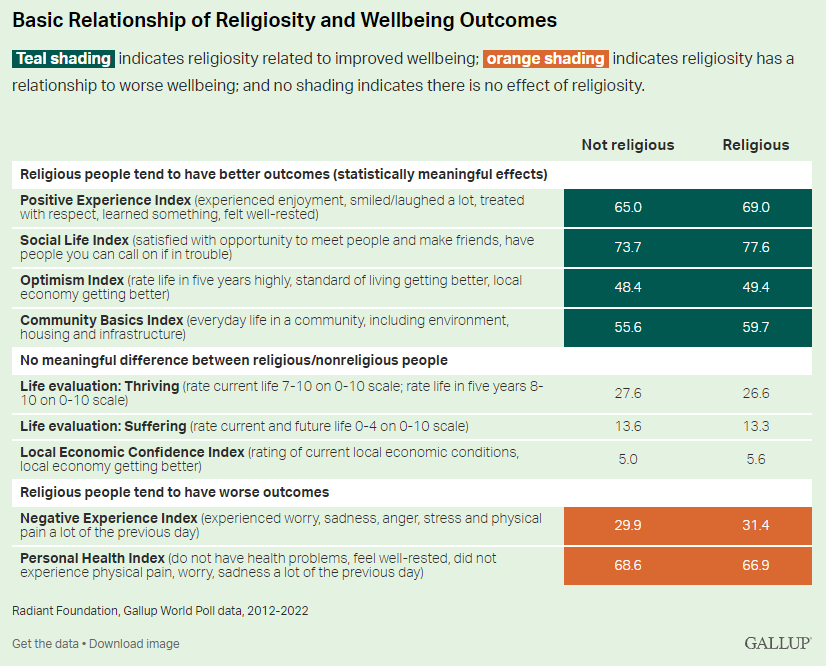
For the nine areas they polled, religion had a positive impact on four of them, no difference on 3 of them, and a negative impact on two of them. They also pointed out that each one-point difference in scores between religious and nonreligious people represents an effect for an estimated 40 million adults worldwide.
I find that the positive aspects of religion found above are similar to what people that have left the Mormon church will say when asked about the good things in the Church. The Church provided a good community, easy to make friends, etc.
The study also found that religious people were much higher on the “civic engagement” index, particularly in North America (58 vs 48.5). I do not see this for Mormons, but the study was for all religions, not just Christianity or Mormons. Outside of the Mormon Corridor of Idaho and Utah, I see Mormons as less engaged in civic engagement, for no other reason as they just have no time for such after they do all their church duties.
It is also very interesting that the two negative aspects of religion involved worry, sadness, anger, stress, and personal health. Not sure why the personal health is there, but the others could all come from guilt and shame for not living up to the expectations of your religion.
Do you see Mormonism aligning with the above results? How different would the poll outcome be if it was just Mormons vs non-religious people? What about a poll of Mormons vs other Christians? My guess would be that the Negative Experience and Personal Health index would be be higher (worse) for Mormons, but the other aspects like community, social life would be even better for Mormons than the chart above shows for religious people in general.
What do you think?
 Wheat & Tares
I don’t have a link or reference at my fingertips, but a different study of an analogous question cross-tabbed by the version of God/deity portrayed or understood. There was a significant difference between reported religious experience with an affirming, comforting, welcoming, god-image vs religious experience with a demanding, distinguishing, judgmental, god-image. That there is a significant difference is intuitively validating to me.
I know Church members in both camps.
On the civic engagement front in my experience you are mistaken. Being Mormon really increases civic engagement. I was raised in a small Wyoming town which was 25 percent Mormon. We still managed to dominate the school board with more than 50 percent members so we could have released time seminary.
I now live in Nevada where it’s about 10 percent Mormon. We don’t have half the school board, but we have the president, and a couple other members. Since the superintendent and a couple other principals in the district are members we have a strong civic influence on the area.
In my experience being a member was great until the theology shamed me for how my kids turned out after I dedicated my life to raising them
I suspect that most Palestinians would not be impressed with the affect the Jewish religion was having on them.
lws329, in my city in Southern California, there is zero LDS members in any elected city position or school board. 10% in Nevada is a lot compared to my city, which is probably less that 1 percent. Wyoming and Nevada (LV), along with Gilbert/Chandler area of AZ are “mini-Jello” belt areas, so I would expect more. Although I believe LDS are over represented in Congress for all states together.
I would like to see a measure of critical thinking skills between religious and non religious. Superstition score? Gullibility score?
And, since one of the reasons I dropped out of religion was because I just didn’t fit socially, I would like to know if religious people are religious because they are more extroverted, or if introverts, especially extreme introverts are still feeling socially isolated even f they are religious.
This shows correlation, not people are happier because they are religious. Does being religious lead to better social outcomes, or do people who just malfunction socially leave or not interested in religion? While extroverts are happy in the social aspects of religion so they tend to stay religious.
And I wondered if religious people have worse health because they tend to be older now that younger people are leaving religion.
I want to separate cause and effect on all of these.
I can’t make a determination about Mormonism in general aligning with the above results. It is interesting that even where religious people are ahead of non-religious people, it certainly isn’t by much. In fact, going by the numbers, it really looks like it’s almost a tie taking all 9 categories into account. I don’t want to denigrate the faith/worldview of true believers, but just IMHO, I’ve always valued the actual truth over perceived, hoped-for, or religious “truth”. That means that the truth, as far as I’ve been able to determine it, is that the Mormon Church is no more “true” than any other religion (and may, in fact, be less true, considering the con artistry and general falsity of a lot of early church claims) and therefore isn’t as useful as it claims to be. On the other hand, having once been a true believer myself, I certainly understand the appeal of a worldview that offers comfort, hope, and the promise of eternal life.
To answer the question asked in the title of this post, I think the jury is still out. Confining my assertions to Mormonism, I think there are a number of positives, many of which have already been mentioned: community, friendship/fellowship, service, etc. But I also think the negatives are pretty huge: A LONG history establishing and maintaining the second-class status of women, racism/white supremacy, LGBTQ people being not only ostracized but actively and vigorously discriminated against, anxiety and guilt in our young people, particularly many missionaries, extremely questionable financial (and other) dealings on the part of the church leaders, the awful ostracizing of individual family members who no longer believe, etc. I mean, that’s a lot of negatives. And those negatives aren’t temporary; they cause permanent and lasting damage most of the time. Families are torn apart by children deciding not to follow the “covenant path”, e.g. In the end, I feel like if the totality of Mormon belief works for you, then good for you. But also, if so many people who have left are cut off from family/friends, or if women, single people and LGBTQ people are seen as inferior (and according to church doctrine, they ARE inferior), then shame on Mormonism for being so broken that it may ultimately do more harm than good.
I want to second everything Anna said and add to it that it seems sometimes that there is a certain type of person that can better conform and be supported by the church. That type is early birds (not night owls), healthy, athletic extroverts that aren’t critical thinkers or questioners.
People who keep late or irregular schedules, that are less athletic, that genuinely question, and/or struggle with health or disabilities at a younger age, seem to struggle more to fit in and conform at church. But then maybe such people struggle every where? But I suspect the church’s leanings towards a prosperity gospel tendency in our teachings or culture sometimes results in judgement of people that don’t fit in, and less compassion. Just how it feels.
this is kind of a pointless question to ask, for two main reasons.
1) people of different religious traditions have different ways of conceptualizing the world and their interactions with civic society. I’d imagine you get very different answers on questions about ‘optimism’ and ‘suffering’ from buddhists and christians.
2) How do you even define “religion” in any mind of meaningful way to detect who is and isn’t religious? I think boiling “religion” down to “I do/don’t believe that there is a supernatural force out there that I cannot prove exists” is much too simplistic. Religion is also comprised of social structures and personal and social behaviours. Choosing to believe in some abstract concept doesn’t actually *mean* anything important. It’s what you do, and how you choose to dress up the motivations for your actions.
These days we hear a lot about people (in the US at least) at getting less religious. I’m not actually sure that’s true. Rather, I think that the nature of “religion” itself is changing. People are still generally “religious” but religious behaviours and social structures shifting to being organized around different signifiers.
A very obvious example of this are the so-called Disney Adults. When you think about it, what they do is pretty identical to what medieval christians did. They make pilgrimages to holy sites (Disneyland/world), decorate their dwellings with, and wear specific iconography (t-shirts, funko-pops, etc), attend mass (watch the latest movie/show/whatever), and use a set of canonized stories and characters to interpret the real world (ermahgad, Trump is just like Voldemort!).
There are some differences of course, there is less salient or less involved clerical structure at the local level, and communities of believers generally interact online rather in the person.
But generally, it’s the same sort of thing. People aren’t necessarily less religious, it’s just that the signifiers are changing. Instead of the bible and Jesus being the signifiers around which social structures and behaviours are organized, it’s a bunch of competing brand names and intellectual properties.
Direct quote from someone a week ago in 5th sunday discussion – “many people are leaving the Church and it’s hard to understand why”…facilitator of same discussion (but different person) once stated from the pulpit “there’s no such thing as a faith crisis.” My ward is full of blind guides…
Three days later the missionaries asked me to join an appointment with them, based on my mission language. I declined “due to personal reasons” but offered up a few names of dudes who maybe could do it. Maybe I’m on a rescue list now or maybe I can continue to fake it in my 1.5 assigned church callings.
I agree with most of the comments, though I want to push back on the position that religious people are not critical thinkers. I think this is as a harmful stereotype as non-religious people can’t really be moral. There are plenty of non-critical thinking non-religious people.
Jason,
While I agree with you in your comment, I think you will find that sharing your critical thoughts about anything President Nelson or Oaks says at church won’t go over well. You will immediately be contradicted if you say something honest about that publicly. Everything is supposed to be faith promoting in our church culture. So the solution is generally to be silent about things that are real or troubling to you.
The consequences of being silent means that we remain alone in a pseudo community. People may say they love us, but we don’t really know if they would if they knew some of the things we are concerned about.
Probably religious people do think critically more than we know. But often we aren’t brave enough to speak up for fear we won’t fit into our community. Speaking up WILL make it harder to fit in.
Jason, you are 100% correct about critical thinkers and I suggested a stereotype that I don’t even believe. Because we all have things we refuse to dissect logically. And just because I picked apart the religion I grew up in, I shouldn’t look down on someone who doesn’t agree with me as lacking the ability to do the same. They have the ability; they just choose not to for reasons that are important to them.
Religion failed me emotionally, so I picked it apart and found it logically inconsistent. All organized religions have problems and all religious philosophies have logical issues, that is why all religions disagree. But logic isn’t the attraction of religion and it isn’t what keeps people there. The emotional stuff is what keeps people there.
Under the idea of we all have things we refuse to apply critical thinking to, I think about my own kids and their spouses. Very intelligent, all of them. Totally not religious, but they each have their own “hobby” that has become a religion to them. As Maynards above talked about, adult Disney fans are kind of a cult and they refuse to give up the Disney fairy tales they grew up on and their whole world view is a fairy tale. They refuse to apply critical thinking to realize that “happily ever after” is only in kids stories. These people may not be religious at all, yet they are worse about their “cult of Disney” or Star Wars or whatever they have replaced religion with. For one of my children, it is a dress up and pretend we live about 1300 ad, and it became her main world she lived in. Some Trump followers are like that, good thinkers about everything but their cult of personality. We could pick many things that have replaced religion with a cult of (fill in the blank).
And us people who pride ourselves on having “debunked” our religion have our own blind spots I am sure. I just refuse to see what my own is. And please don’t tell me.
But I would still like to see it as a statistical percentage.
I was happy and productive as a TBM and I’m happy and productive now that I’m out. I think growing up Mormon made me a better person in a lot of ways but not all ways (acceptance, tolerance, etc.). I hope that being x-Mormon x-religion is making me a better person now too. I guess my point is that the population is a bell curve of people and most people are who they are independent of religion.
Honestly I don’t see a big difference in the outcomes of wellbeing between the religious and non-religious. But that lack of difference runs counter to the claim that I hear from the religious that you need religion to be happy.
It should be noted that being religious really doesn’t tell us too much. Religious how? In Orthodox Judaism, in liberal Protestantism, in spiritualism, in Jainism? I don’t think that religion or the LDS church is inherently bad or good for people. There are many other factors at play.
I grew in the church and felt that religion had a generally positive effect in my life. Now I am only slightly active, but realize that I can be happy without the church. I could see where people might not be happy leaving the church if they have judgmental family members trying to incur some kind of social punishment on them. Even something as small as people treating you differently, not being as inviting as they used to be, acting more awkward around you, and generating a feeling of intention to exclude unless some sort of condition of reactivation is met can be a source of great happiness. Having a spouse go frigid on you or threaten divorce can be misery. This doesn’t mean that one cannot be happy outside the church. It just means that church members will make it their business to try to make you unhappy because they cannot psychologically accept someone leaving the church and feel threatened by it.
“they cannot psychologically accept someone leaving the church and feel threatened by it”. This X 1000. When my son stopped going to church, his only real complaint was how people from church treated him when they ran into him in non-church settings. He could immediately tell that they were both uncomfortable and overly-solicitous. He, in turn, was irritated by the fact that they seemed unable to just treat him as another person; they instead could only see him (as an “inactive” person) through the lens of their own religious ideology, which meant they almost feared him. Quite strange and another sad consequence of the importance of so-called “church community”.
Geoff-Aus, most Jewish Israelis are not religious.
And many ultra-Orthodox are pretty opposed to IDF and war.
Your argument doesn’t add up.
Since my kids left the church I’m very tuned in to how they are described by active members. It’s often said that they’re not happy. Who are you, random member on any given Sunday, to tell someone whether they’re happy? (And yet, this is something I might have said twenty years ago and not felt arrogant and judgmental.)
My kids, and not because I emphasized it, experienced the negatives of membership. They truly are happier out. More loving, less afraid, less stressed and discouraged, more in the moment, more open. That’s just them.
I wish Sunday discussions of this would start with, “No one should assess others by extrapolating from their own unique personal experience.”
As an active member, I used to see many of the benefits of the gospel—healthy living, large families, etc.—as a positive thing. In some ways, this was “proof” of the truthfulness of the gospel.
As I’ve made my way out of church, however, it has become clearer that there are a lot of drawbacks. Here are a few examples:
— I now see that I suffered from scrupulosity. On the surface, I was the model Mormon, but my religion caused me great mental pain. Religion was not good for me.
— My never Mormon friends and colleagues often have closer family ties and they show up for each in ways I don’t see LDS families supporting each other. I think there are several reasons for this 1) smaller families leave them with more time to focus on fewer individual relationships 2) grandparents are not off serving missions 3) a lack of an “eternal perspective“ focuses them on the moment. It seems that religion may not be good for families.
— Many of the most religious people I know are apathetic. They are focused on Jesus’s return rather than fixing political, economic, environmental, or social problems around them. In contrast, my nonreligious friends are active in all of these areas. They realize they have a role to play in making the world a better place. In general I’d say religion is not good for the world.
If Gallup had been allowed to conduct such a poll in the USSR during the 1980s, they probably would have found similar effects for Communism.
Geoff-Aus, I usually appreciate your comments. I am very pro-Palestinian as you are, but I disagree with you here. I’ll respond with a simple analogy. Much like the overwhelming majority of Muslims denounce radical violent jihadism, the overwhelming majority of Jews denounce radical violent Zionism. Islam is almost entirely peaceful. Similarly Judaism is almost entirely peaceful. Violent extremists are in the minority, even if they can be very vocal and attracting of attention. All Jews I’ve interacted with and heard from about the violence in Gaza differentiate between Hamas and regular Palestinians and denounce the violence against the regular civilians. All Palestinians I’ve heard from and interacted with denounce Hamas. There are crazies out there, sure. Some of them are influential, yes. It is very unfortunate that Itamar Gen Gvir, a radical violent Zionist, is the Minister of National Security. But it is not right to denounce an entire religion based on the actions of an extreme few.
I’m heartened by the results and find it interesting that they are so similar. Attending church, you’d think that the only way to be happy is to be religious, and all people should join the church immediately.
If you look on the ex-mormon reddit you’d think that it would be impossible to be happy if you’re religious, that religion is inherently destructive and that all people should leave religion immediately.
When you zoom out and look at it you realize- oh, it doesn’t really matter one way or the other. You don’t have to be religious, and you don’t have to NOT be religious either, it’s going to lead to similar outcomes. Some things work better for some people, and other things work better for others. Find what works for you.
Another idea that I just thought of. Where surveys come up with Utah being the happiest state in the whole US, I have always wondered if people who are really miserable, think they are supposed to be happy because they are good Mormons, so they rate themselves as happy, then go take another antidepressant. How can Utah be the happiest state when it also has one of the highest levels of anti depressant use. Maybe miserable people only think they are happy because they know they are supposed to be happy.
I knew Mormon women like that. They put on a happy face and told you how happy and blessed they were, but as you got to know them, you could see how miserable they really were. They had everything that is supposed to make a Mormon woman happy according to the men who ran the church. They had a temple marriage to an active priesthood holding husband who was gone all the time with his job and church calling. They had four children under six. They stayed home all day with small children, hardly seeing another adult except at church, where they taught even more small children. They had everything except a fulfilling career, self worth, and respect. They hardly remembered having anything in life except for the roll of wife and mother, they can’t remember when they weren’t either pregnant or nursing, and they cried a lot. But they had been taught that what they had was exactly what made women happy and they were supposed to want. So, they wondered what was wrong with them that they cried so much. Because they were *supposed* to be happy. So, the fact that they have what is supposed to make them happy means they are happy doesn’t it. I mean, they love their kids and wouldn’t trade them away, so they must be happy, right? If you don’t get this dynamic, read The Feminine Mystique.
And the husband feels similar. Too many babies too fast and he doesnt know how he is going to support them all. He has no free time between work and church calling, and comes home to a miserable wife who just wants an adult to talk to, only he is too tired to meet her emotional needs. And he just wants to go fishing. But he is supposed to be happy because he is doing everything the church tells him to so he must be happy, right?
Anyway, just something I have wondered about.
There is definitely an issue with self-reporting when it comes to well-being. When you are experiencing cognitive dissonance, part of how you manage your well-being is pretending you are fine.
I just watched a movie on a flight called What’s Love Got to Do With It? It’s a rom-com about Pakistani arranged marriages. The premise is that everyone accepts and agrees that their parents love them best and can be trusted to choose their life partner for them, but the documentarian reveals that nearly everyone is pretending to be content for the sake of others, the system, the culture, the faith. It’s a rom com, so it’s not like this is a real documentary, but it’s still an interesting examination (as was the Big Sick) of the interplay between freedom and happiness. There is a lot of anxiety to please parents so you can remain in the system, but you might give up on allowing yourself to know what you want or to want what others don’t want. Yet everyone agrees how happy they all are, until you scratch a little deeper.
jpv, Not sure where you get your information.
This article https://www.jcpa.org/dje/articles2/howrelisr.htm
says there are 4 jewish groups in israel, ultra orthodox (8%), religious zionists (17%), traditional jews (55%), and secular (20%)
This is their description of the traditional and secular jews which are the 75% I assume you think are not religious.
“Many of these “traditional” Jews differ from the Orthodox only because they will drive their cars on the Sabbath, use electricity, watch television, or go to a soccer game or the beach, frequently after attending religious services in the morning and the evening before. Many of the men don tefillin every morning, others cover the spectrum of observance. What is critical is that all are committed to a major religious component in the definition of their Jewishness and the Jewishness of the Jewish state.
The fourth and second smallest group consists of those who define themselves as secular, some 20 percent of the Jewish population. These are people whose beliefs are secular. Their practices, on the other hand, may be quite similar to those of many traditionalists, only they maintain those practices for family and national reasons rather than accepted religious ones. The fact that Jewish religious observance has such a strong national component makes it a major component of Jews’ national identity even if they no longer see themselves as believers in the Jewish religion.
The Guttman study shows that three-quarters of the 20 percent follow the most common traditional religious practices. Only a quarter, or 5 percent of the total Jewish population, say they observe no religious practices whatsoever, a figure which is belied by figures that show that 98 percent of Israeli Jews have mezuzot on the doorposts of their houses and 92 percent circumcize their male children, to mention only two of a number of observances that are so deeply entrenched in the culture that hardly anyone thinks of them as religious observances.”
We have a jewish family in our ward, and have celebrated passover with them.
To a palistinian being driven out of their home, or shot, by a zionist settler; their attacker would look like a jew. I was surprised to find there are only about 16 million jews throughout the world. Similar to mormons.
I think the present leaders of israel are doing their cause a lot of damage, and I do not support them in their oppression and abuse of the palestinian people. I realise there are israelis who voted against the present leader, but enough voted for his extreme positions. In Aus it is reported that many people (not just muslims) are protesting the excesses being perpetrated by the Israelis supposedly in self defense, including killing 400 children a day. Hamas committed war crimes on the 7th, but they were provoked, and their behaviour does not justify the response. Note Hamas offered to set free their 200 prisoners if Israelis would release the 10,000 palistinians they hold.
As far as I can see the jewish state is destroying any residual good will they had left, except perhaps among the extreme righ.
They are not doing the reputation of religion much good either.
On a different note we are having an extreme fire season, already more homes have been lost than in the whole of 2019, which was the worst year on record. Predictions are that it will continue to get worse.
I’m generally a skeptic about science by survey for a lot of reasons. I’ll just assume the hypothesis posited is correct: “Religious people are happier”, and question what that would really mean. If religious people are happier, why is that?
1. Religion does something to make them happier
2. Unhappy people drop out of religion
3. Lack of religion makes people unhappy
I’d lean towards 2>1>3 as likely causes, but I think the conclusions one can reach from a survey are really stretching credibility.
Sqidloverfat, yes studies have been done on the accuracy of self reporting surveys, and they tell you next to nothing. So, with this exact kind of survey, the first problem is over half of the people called by phone refuse to take the survey. And you get exactly zero people who block unknown callers, who are too poor to afford a phone, or dislike their personal telephone being used for profit by some survey company. So, you end up with skewed data before you even start. Second huge problem is they are asking a question that is very subjective. How happy are you on a scale of 1-10? I have trouble with the doctor’s pain question when the levels are clearly outlined and that is way less subjective. Happiness is too variable and too subjective. Did you catch them at a good moment or a bad moment? Do they tell you what they think you want to hear? Do they lie to themselves about how they feel? Are they a born optimist or born pessimist? Are they introverted or extroverted? A thrill seeker, or anxious and careful? They cannot judge their happiness compared to others because it is impossible to know “average happiness”. You only have yourself to compare to.
One example of people do not know how unhappy they really are, is when I was in college, I took a self esteem test that the professor had researched and standardized. I thought I had good or at least average self esteem, but I totally flunked the test. Only test I ever came out in the bottom percentile on. I was so shocked by the fact that this test was so against what I believed about myself that I muttered something about “this can’t be right.” The professor asked for my raw score, and I told him, and he demanded I talk to him after class. He was concerned that I was suicidal because he said he had never run into a student that scored so low who wasn’t. Well, I was suicidal *then* so I thought I was doing great. My subjective belief about life was so warped by years of childhood abuse that “not suicidal this week” was deliriously happy.
In the same way, someone who was raised in a guilt inducing religion can hate themselves because of the tremendous guilt, but they don’t know they are miserable because they have never been without that guilt as long as they can remember. They don’t even know any life without crushing guilt and the small Relief religion gives them, so they THINK they would be totally miserable without their religion, when really the religion causes the guilt as well as giving a small amount of relief.
The whole method of doing this study is so flawed that their conclusion is pretty worthless.
They need to sit people down in a lab and give them a standardized test on how happy and fulfilled their life really is. And they need to do it several times throughout the subject’s life, then compare those who leave religion to those who stay and those who join to those who are never religious, then analyze their data.
I bet those who join have an increase, and those who leave show a decrease while deciding then an even bigger increase, and those who are excommunicated show a decrease.
Anna and Squid – great observations.
I think a more interesting question or study would be. Is your religion (religious experience) providing you opportunities to make the world better? And rather than focusing on a subjective emotional state, find out if their religion is objectively expanding their pro-social efforts. The problem, among many, with religion is it’s largely a self-consumed project, a sales pitch that begs the participant to ask, What’s in it for me? Then, the trouble with pitching something like “Tithing” as a principle that somehow “enables” God to be more generous to the tithe giver, is that it creates a system of “control”, rather than a system of “Care”. A study which focused on whether individuals religion is objectively causing them to “participate” in make the world better, would likely show just how myopic religion is.
Re: Problems with self-reporting wellbeing. How else would this be measured? There’s no other method to measure someone’s internal sense of well-being other than asking them. And what’s the incentive to fake it on an anonymized survey from an organization like Gallup? I’m sure it happens to some degree, but there’s just no better proxy that can measure a person’s personal sense of well-being…especially on a large scale.
It’s worth noting just how huge this study was as well:
-10 years
-152 countries
-1.5 million people
In the world of survey data, this is probably as close to the objective truth as we can reasonably get.
The report did a good job of acknowledging the nuances, but this takeaway stood out to me:
“…the four-point difference between religious and nonreligious people on the Positive Experience Index means that an estimated 160 million more adults worldwide have positive experiences than would be the case if those adults were not religious.”
Also, the section on implications and the apparent paradox between the potentially positive effects of faith while religious identification is on the decline in many parts of the world was interesting.
Mormonism is a religion…so chances are that it lines up pretty well with the rest of the data and is subject to all the same nuances of region, age, etc. I’m sure that Mormons were represented in the data.
Aside: I’m not going to wade further into Israel/Palestine or any of the politics surrounding it, but a thoughtful friend of mine pointed out that the conflict is Zionists vs Jihadists, not Jews vs Muslims. I know both Muslims and Jews who are mourning the loss of life & destruction, denouncing the violence from both sides, and praying for peace. The political elements of the media feeding on the conflict and pressing a thumb into the bleeding wound for ratings is disgusting.
Pirate Priest, Anna pointed out a number of the issues with self reported surveys. There are some methodologies that can help alleviate some of the issues (and we are definitely deviating from the topic of religion and happiness here 🙂 ). For instance, to address the problems of honest answers (people tend to answer dishonestly in a survey in that they say what they think they are expected to say or what they wish was true), you could do something like have a randomly generated number pop up for each question and 50% of the questions would get that random number and 50% would get the true answer. Statistics can then tease out the random number. Similarly, a lot can be done to standardize the responses to the questions. “How happy are you on a scale of 1-10?” needs mileposts for a few locations on the scale to calibrate it–but there is still a lot of difficulty as happiness is not well defined.
What I really value is not a study of self-reported happiness, but a study of results or outcomes. What are some positive/negative outcomes that we associate with happiness and what does religiosity do to those outcomes? For example, we could look at addiction rates, crime rates, suicide rates, lifespan, divorce rates, etc. as outcomes we associate with happiness. This is where I think the ideas of “prosperity gospel” have some merit. Does religion reduce negative outcomes and increase positive outcomes? That should be the emphasis, not on self-reporting happiness.
Squid has a good point that it is the outcomes we should measure. Utah’s suicide rate is much higher than average. Utah’s child abuse rate is higher than average. Utah’s rate of anti depressant use is above average. Utah is NOT a happy state. Yet, Utah rates the very highest on self reported happiness. Thus the self reported rate of happiness is a big fat lie that people in Utah tell themselves. Period. End of that discussion. And we don’t even have to sort the religious from non religious or Mormons from non.
So, now Pirate priest, why do Utahns lie so much about their real state of happiness when you claim there *has* to be some truth to it? Nope. Not for Utah. By all objective measures, Utah is a pretty miserable state, yet they claim to be the very happiest. I would suggest that the Mormon church tells them they are happy, and they believe it over the objective evidence.
I could go into a long discussion of other ways to measure happiness, but it is hard for a huge survey, so of course the survey people won’t do it. But when a study does a small scale more accurate study, they get different results. Most show no difference, except for the social benefits and many people get those elsewhere. And then what do you do for the many religions who reject gays, discriminate against women. They *cause* more misery than they cure.
Anna and I are in strong agreement on the fallibility of survey based studies. I’m going to differ with her on the conclusions she is drawing for outcome based damning of Mormonism.
You can view the CDC suicide rates data here: https://www.cdc.gov/nchs/pressroom/sosmap/suicide-mortality/suicide.htm
Utah is slightly higher than the national average (varies a bit by year) and slightly lower than states of similar geography and demography (Mountain time zone).
Binge drinking in Utah is significantly lower than its neighbors and low in general: https://www.cdc.gov/alcohol/data-stats.htm
Child abuse is in the lower half of the US states in Utah
https://nyrequirements.com/blog/which_us_states_have_the_highest_rates_of_child_abuse_cases
As far as I can tell, the high anti-depressant claims about Utah are correct.
There are a lot of outcomes we should look at before saying “Utah is an unhappy place”. I say this as someone who is not a Utah apologist and who doesn’t really like it much. Happy to have lived in many other places, including now :).
Anna,
Would you care to elaborate on the scientific/unscientific nature of the following statements “…Thus the self reported rate of happiness is a big fat lie that people in Utah tell themselves. Period. End of that discussion. And we don’t even have to sort the religious from non religious or Mormons from non.” And then this one: “I would suggest that the Mormon church tells them they are happy, and they believe it over the objective evidence.”
Utah is 60% LDS. Of those, roughly 40% would be considered active by traditional standards. If I did my math right, that means that 24% of Utahns would be deeply influenced by what the Church said. The others, not so much. And many of the non or ex-LDS are constantly describing how happier they are without the Church. I think you see my dilemma. I associate and enjoy the company of a broad spectrum of Utahns. They really are a pretty happy batch of people. Of course, you can’t take my word for it. The only other place I lived for a significant period of time was New York!
Utah’s suicide rate is relatively high, but happily improving. (Suicide is always tragic.) Utah’s child abuse rate is roughly average. “Child abuse” can include neglect, sexual, physical and emotional types of abuse. So it is complex issue. You seem to suggest religiosity is in some way a cause of these tragedies, or that tragedies somehow limit or challenge one’s overall happiness. Hence, an entire state must by lying? But I don’t think the data suggests that your interpretation is correct. For example, Israel is consistently listed near the top of list of countries in the annual World Happiness Reports. I think that country has seen tragedy over the years.
Just a thought.
@squidloverfat: Sure, the questions need to be structured in a way to avoid leading people to a particular answer…this is part of any good survey design. Gallup is a reputable organization that is surely aware of how to correctly structure a survey and avoid potential pitfalls. Their world poll has been been running continuously since 2006. Statistically speaking, their sample size is large enough to represent ~98% of the world population. The religion/spirituality questions were formulated as yes/no questions to try to isolate the specific construct of religion, versus the concept of faith or belief in God (e.g “Is religion an important part of your daily life?” yes/no).
All the details about their methodology, variables, etc. can be downloaded as part of the full report from the Gallup site. It also includes a laundry list of PH.D. researchers from many of the best universities in the world. So, while I agree in principle that wellbeing is difficult to measure and that self-reporting certainly has pitfalls, a reputable organization like Gallup conducting well-designed research on a huge scale spanning decades is probably the best we will ever get. It’s worth acknowledging the inherent challenges, but this isn’t shoddy research that can be dismissed out of hand.
These things are certainly worth studying, but they aren’t good proxies for measuring wellbeing directly – all of them need to be studied independently and together. Gallup and other organizations have been looking at how the wellbeing data interacts with virtually all the things you listed (one off the top of my head from a few years ago was on how divorce more negatively impacts the wellbeing scores of women more than men).
Your “prosperity gospel” comment brings up a great point. None of this research is establishing causality – we can’t say that religion CAUSES better wellbeing scores, just that the two appear to travel together. Does religion cause wellbeing to go up? Maybe. Or are people with high wellbeing just more likely to stick with their religion because it’s working for them? Also maybe. Establishing broad scientific causality is a high bar that is probably impossible to meet on this topic.
Back to the questions in the OP, while it may be impossible on conduct causal wellbeing experiments on a global scale, the internal and subjective nature of wellbeing means we can pretty safely experiment on ourselves. Does religion (or even a particular ward, or Sunday School teacher) increase or decrease your sense of wellbeing? Does making a change make it better/worse or do nothing? What if you keep the religion, but forego a particular calling that is causing you undue stress? What if you leave religion alone and join a pickleball club to make new friends? We can do all sorts of one-person wellbeing experiments on ourselves – we just need to be careful not to generalize our results to others.
Wasn’t that “study” that said Utah is the happiest state done by WalletHub.com…the online personal finance company?
iirc, they didn’t even survey people…they just aggregated a bunch of different data sources and assigned each dimension an arbitrary weight.
E.g., they took existing data then arbitrarily gave “Career wellbeing” double the statistical weight of things like “physical health” and “social wellbeing”…They also gave “ideal weather” triple the weight of “separation and divorce rate”…
Despite the obvious red flags, this “study” was picked up by major news outlets…THIS is the sort of thing that is a huge problem. A website that lets people compare credit cards throwing a bunch of random data into a pot, and then stirring it around to make some ridiculous ranking for publicity. (Then having major news outlets pick it up).
Pirate Priest, I think your comments draw me in more than any other contributor. Where I disagree with you, I understand where you’re coming from. Where I agree with you, you state things better than I do. Thank you.
Your comment really sums up the difficulties with this topic:
***These things are certainly worth studying, but they aren’t good proxies for measuring wellbeing directly – all of them need to be studied independently and together. Gallup and other organizations have been looking at how the wellbeing data interacts with virtually all the things you listed (one off the top of my head from a few years ago was on how divorce more negatively impacts the wellbeing scores of women more than men).***
I particularly liked your recommendation to try things out and reflect on what it does for our happiness. That’s precisely what we are taught in the scriptures, but so often neglect to do. When I tried wearing a white shirt to church, it made me unhappy. When the bishop asked me (the EQP) to wear a white shirt, I told him no because I had tried it. Our happiness is a good internal calibration metric for “should I keep doing things the way I do them now”. Great topic and I enjoy your comments, even though I suspect we have very different confidence levels in Gallup surveys 🙂
All this talk of happiness.
A year ago or two got a new computer. And I dumped Years worth of photo’s on it. Some vague idea I would organize them. Like how many unique bird species(never been into lists) vs the same 20 species.
And hey, darned if the computer didn’t make it’s own list called Smiles. Lots of pictures of me smiling and laughing. And almost every picture (other than a handful camping)to my surprise, was at a funeral. And it wasn’t just me “enjoying” the funeral. Lots of smiling people sitting around eating funeral potatoes.
I can only conclude, based on the visible evidence of smiling, funeral potatoes are just that good.
I tend to agree that we can’t assume causation = correlation with Utah and happiness being the result of the church (either that people are happier, or that they are lying to themselves and surveys about it. Data like child abuse and suicide rates are (to me at least) probably more valuable than self-reported happiness. I do wonder a bit about the impact on these results from other factors on suicide rates like Utah’s lower average age (more teen suicides when you have more teens), political leanings (more guns? less LGBTQ support?). Anyway, not sure I’d lay it *all* at the feet of the church, but I wouldn’t exonerate them either.