
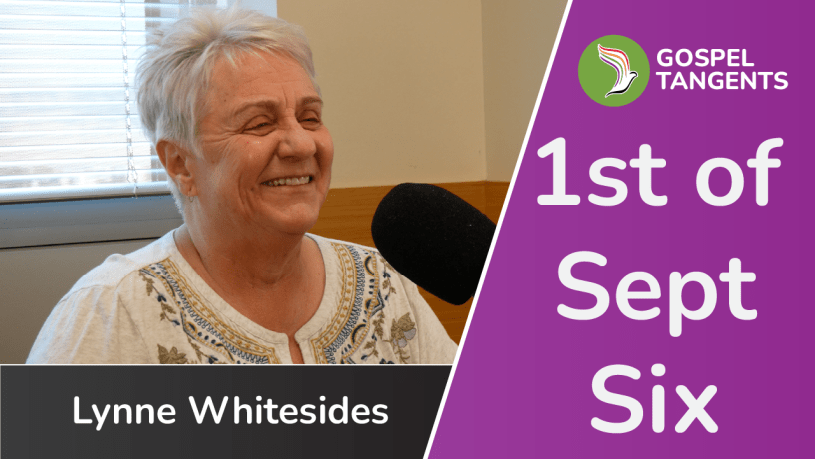
Lynne Whitesides was the first person punished in the September Six. She shares her story of why she wasn’t excommunicated, who was involved, and where she is on her spiritual journey now. It turns out she told her bishop that she didn’t feel welcome, just as he called her to punish her. He just didn’t have the heart to excommunicate her.
The strange thing to me was the fact that she has never been excommunicated. I asked her why that was, because her friend Janice Allred was put on probation and then excommunicated a year later. It took the Church 7 years to go after Margaret Toscano, but they finally excommunicated her. Why haven’t they touched Lynne? I can’t say for sure, but Lynne basically left the church alone. She attends a South American religion and basically ignores all things LDS now. I’m guessing that’s why she’s been left alone. She isn’t making waves.
In part 2, we learned that Lynne Whitesides is a convert to the LDS Church and has a different perspective on things than a lifelong member. She discussed hitch-hiking to church at BYU and was told that she should probably attend a different university! As a convert, she just didn’t fit into the BYU culture. However, her extended family followed her example and joined the LDS Church. As she learned more about the Church, she became the chair over the Sunstone Symposium under Elbert Peck and became disillusioned with the racism, sexism, and homophobia she saw in the Church. While she appreciated the 1978 revelation, she wondered why the ban was there in the first place. She also supported Sonia Johnson’s fight for the ERA Amendment (against Church leaders wishes), and she had a lot of gay friends that she defended. When they Church came after her, she knew it was time to move on to other interests.
As we conclude our conversation with the first member of the Sept Six, Lynne Whitesides, I asked her about her spirutality now. It’s a long way from Mormonism. She is now a personal coach and works with people in a South American (non-Christian) religion. She’s “crazy about God,” and thinks Mormonism was part of her spiritual journey, but is glad the LDS Church is in her past. We also discusses her family’s reaction to her church discipline. (It wasn’t good.)
Are you familiar with Lynne Whitesides? It’s interesting to me that she really has no interest in the LDS Church anymore. I know some people move on, but many people still seem to carry a lot of angst against the Church. Why do you think that is?
 Wheat & Tares
Whenever I review the stories of the September Six, I get this great feeling of sadness. I see elements of what those 6 individuals wrote and said in current LDS thinking. I see similar faces and similar ideas numbered among the LDS intellectuals of today, and there is always that fearful question: Will we see another purge?
Why do we care about a purge? if the Church doesn’t us, goodbye. I’m in Trujillo, Peru. This is a very poor area. Yet there is a temple here. Members and neighbors need help overcoming poverty, not extraordinary edifices. HELP THE LIVING, por favor.
Members need to spend their 10 percent on humanitarian project.
Rick B.: This series has been very interesting to follow. I just read the 1993 New York Times piece about the September 6. (Sometimes links seem to end up in auto-moderation, so I’ll just give the reference:
“As Mormon Church Grows, So Does Dissent From Feminists and Scholars”; NYT; Oct 2, 1993)
One interesting quote from Whitesides in NYT article: “If you excommunicate one of us, there will be 10 more to step up and take her place…Excommunicate those 10 and there will be 100 to take their places.”
Do you believe that the Sept. 6 disciplinary actions backfired as Whitesides said they would? Or did it work how the church wanted and effectively quash that type of dissent amongst members (at least open dissent)?
—————————————————————————————————————————————————————–
As unfortunate as it is, I tend the think the at the latter is more true. We revisit the anniversary of it every ten years or so, but they Sept. 6 have otherwise pretty effectively been silenced. More recently we could look at Kate Kelly, she’s still active in the human rights sphere but since getting exed in 2014 she hasn’t had a real voice in the Mormon community. Sonia Johnson is the same thing…she got some media attention in the years after getting exed, but they her voice just sort of faded away in Mormonism (oddly both Johnson and Kelly were exed by wards in Virginia).
My guess is that next year Kelly will get some press for the 10-year anniversary of getting excommunicated, then will fade away from the thoughts of mainstream Mormonism for another ten years.
Like it or not, excommunicating someone really does silence them in the Mormon community – they may get a short-term media spotlight and get discussed in places like W&T, but by and large excommunication is a power play that works.
Whether they fight to eventually rejoin or just go elsewhere, they all pretty effectively get silenced.
Set the religion part aside, and this is textbook power dynamics:
-If you have the power, use it against people who want to encroach on your power.
-If you don’t have the power, break the rules keeping you from getting power and avoid the hammer until you’re the one holding it.
…Excommunication just happens to be a very effective hammer in the LDS church.
Whether the disciplinary actions worked or back fired could be a matter of definition and perspective. Excommunications effectively silence the excomminicaee to faithful members. Even in forums such as this, they don’t come up much, except in passing reference.
But…..I think the bloggernacle has increased in size. A few years ago I made a list of where to find questioning-Mormon community and discussion. As I made it, it became readily apparent that the community is large.
One starting place I I found is at the end of https://zelophehadsdaughters.com/
@Roger Hanson: I agree that the living should be a priority, especially those living in poverty. With respect, however, a purge matters because it’s impossible to make changes to virtually any organization from the outside, in particular, an organization structured and governed like the LDS church.
Another public purge sends a message – remember that LDS excommunication doesn’t just revoke formal membership, but also nullifies the saving ordinances needed for exaltation. So the message is that they are so far out of line that they are no longer worthy of entering the celestial kingdom…so when there is a purge over something like womens’ place in the LDS church, it’s sending a very specific message.
More purges mean that us on the LDS side are stuck hoping and praying for someone like Wallace B. Smith from the CoC to get called to the Q15 then outlive 14 other old guys before the needle will move meaningfully.
The church is quite literally organized to move as slowly as possible…this gives stability, but also impedes things like abandoning racism or sexism.
“I know some people move on, but many people still seem to carry a lot of angst against the Church. Why do you think that is?”
When I was a bishop I always thought it was interesting when someone would make the comment that people can leave the church but they can’t leave it alone. I thought to myself, I can show you hundreds of people that leave the church and also leave it alone – they are all the ones on our ward list who don’t come, don’t want a visit, and don’t appear to care what the church is doing anymore. My general policy was to just leave them be like they wanted.
That being said, there are obviously lots of people who leave but don’t want to give up on discussing the church and why they left/why it is wrong, etc. (see, the internet). I think there are a lot of reasons for this; too many to really parse out in a comment. But I think many (not all) of those reasons arise from the same idea that was expressed by Fatimah Salleh and Margaret Olsen Hemming in The Book of Mormon For the Least of These (pg. 40 fn. 30). In reference to the story where Nephi is bound by his brothers and beaten on the ship that Nephi built with the Lord, they say this:
“This is one of the most harrowing stories in this family’s journey. Nephi is bound and beat up by is older brothers. He gives us, the reader, a detailed description of this episode of abuse. The details of the violence are symbolically destructive to the soul. As if Nephi being bound for days is not bad enough, the fact is that he is bound on his ship, a thing he created in partnership with God, and bound with cords that he most likely placed on that ship. To have those things he has built and prepared in faith and hope be later weaponized against him seems particularly cruel. [FN 30 then adds this:] It is worth considering how we take what other people have created with God and turn it around to hurt them. Churches have at times done this with LGBTQ people who have done missionary work, sung in the choir, taught children, and done other work to build the community. That same community then turns around and preaches limits on God’s love and harms the people who helped build the church. This weaponizes people’s own work against them.”
It’s hard to completely walk away from the ship you built with the Lord when you see something you once loved and helped to create, something that is (like it or not) a part of you, being wrongfully used to harm you or your loved ones.
In times of rapid change, moving slowly doesn’t lead to stability. For example, the internet made the Church be more honest about its history. Members left when they heard the real story. The leader were slow to give the Blacks the priesthood, members left. The hoarding of money and crazy temple construction is causing members to leave. The Church is NOT headed in a Christlike direction.
And I don’t believe for one minute that simple excommunication leads to loss of saving ordinances. Maybe murder and other varieties of serious lawbreaking does, but certainly not some forms of alleged apostasy. I don’t believe that Lavina Fielding Anderson’s saving ordinances can be canceled.
In times of rapid change, moving slowly doesn’t lead to stability. For example, the internet made the Church be more honest about its history. Members left when they heard the real story. The leader were slow to give the Blacks the priesthood, members left. The hoarding of money and crazy temple construction is causing members to leave. The Church is NOT headed in a Christlike direction.
And I don’t believe for one minute that simple excommunication leads to loss of saving ordinances. Maybe murder and other varieties of serious lawbreaking does, but certainly not some forms of alleged apostasy. I don’t believe that Lavina Fielding Anderson’s saving ordinances can be canceled.
I think Roger’s second comment reads better.
@Roger Hansen: I also have a hard time believing that someone like Anderson would actually be locked out of the pearly gates. I’ve also seen frivolous excommunications firsthand in other countries over trivial offenses where local leaders simply blew trivial things out of proportion (e.g. I once saw a brand new member get exed shortly after baptism for having a sip of champagne at his niece’s wedding). I seriously doubt these would actually hold up in the afterlife.
Regardless, the LDS Church claims the authority to block someone’s exaltation – the current LDS doctrine is that EVERYTHING is canceled except their temple sealing.
Also, the paths to excommunication and reinstatement are not symmetrical – local leaders are trusted to issue excommunication, but reinstatement requires personal approval from the First Presidency…and they will deny people in spite of local leaders’ recommendations to reinstate (this happened to my own father for years).
Conveniently, top leaders never comment on specific excommunications because “it’s handled at a local level.” There is a mechanism to appeal, which appears to have been used in the case of Avraham Gileadi. We don’t know if any of the others tried…maybe Rick B. can ask them? In general, the church takes the word of local leaders unless there is an appeal.
Whether it’s actually coming from local leaders or from the very top, the message is quite clear in cases like the Sept. 6: “Speak up too loudly on this topic and you won’t see heaven…get back in line or take it up with God when you get there.”
Helmuth Hübener. Never forget.
Looking at the details — the actual conduct and details of each church trial rather than all six lumped together as a single event — it’s clear that LDS bishops at the local level are not equipped to handle an “apostasy” charge. LDS doctrine on most controversial issues is so ambiguous, how is a bishop supposed to figure out which side of a hypothetical doctrinal line the person is on? Is just discussing a controversial issue like Mother in Heaven or female ordination grounds for excommunication? Most bishops in these “apostasy” cases know a lot less about LDS doctrine and history than the person they are holding a court on.
Some prudent bishops might have a conversation or two, then decline to take action. But fools rush in where angels fear to tread, and there are plenty of foolish bishops, as well as some foolish LDS senior leaders who will encourage local leaders (with under the table communications to those local leaders) to take a particular action without regard to the niceties of clear evidence and justification for the action. There might have been September Twelve, with six wise bishops (who declined to take action) and six foolish ones (who did take action, giving us the September Six). It’s more like the Parable of the Foolish Bishops than a tale about LDS apostasy.
Bottom line: it’s a problem of a poorly designed church court system that is run by poorly trained local leaders who get little help from senior leaders.
Interesting never exed, but one of the only ones who’s not a believer in Mormonism (I’d let Paul speak for himself, but even he seems to believe in his own way).
Thank you. This was a thorough interview.
I only knew of her bec a friend wrote a beautiful tribute in her social media page re her passing.
In reading/listening to her journey, it makes me realize how churches &/or religions are one of the primary projections humans go through — parents top that list. (Been there, done that.) Fortunately (& inevitably) the wonderful line fr Scripture summarizes it all, “…for those who love God, all things work together for good.” Her life most assuredly attests to that.