

Recently, I rewatched Cinema Paradiso after work. Even picked up movie-style popcorn, Cherry Pepsi, and Reeses Pieces (my holy trinity of movie snacks). This was my third time watching this film.
Cinema Paradiso is an Italian-language film that depicts the main character at three different pivotal ages in life, adolescence, early adulthood, and middle age. His pivotal experiences in each time frame are informed by his bond with the local movie theatre projectionist, his love of movies and a particular girl, and the evolving moral climate of the town. Here is the official trailer
The first time I watched Cinema Paradiso was at the Egyptian Theatre in Ogden, Utah in college (early 2000s). The screening came complete with a pre-film lecture by a professor from Weber State University. He teed the movie up wonderfully, including spoiling the oh-so-obvious-and-yet-absolutely-wonderful ending montage. On that first viewing, I identified mostly with the protagonist as a young boy—jazzed by getting to help the film projectionist, but also portrayed as a teenager experiencing first love before getting called away to the service.
Whatev… That was then, and my head was in the clouds.
The below GIF of the protagonist as middle-aged man sums up my second viewing, a few years ago. We see him at the climactic moment of the movie, watching a special reel of film gifted to him. On second viewing, I found myself a 30-something alone in my apartment and totally in the mood to revisit the Cinema Paradiso. Less interested in the young boy, more interested in the problematic man he becomes. I bawled my eyes out during the closing montage, just like this guy.
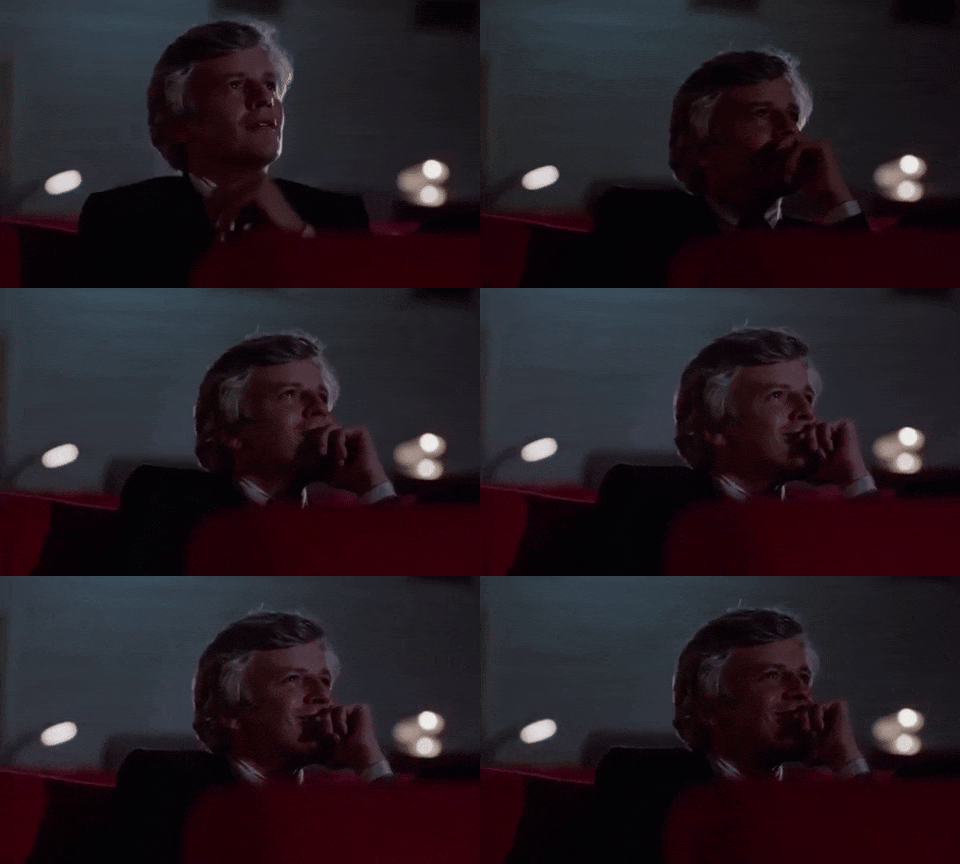
Whatev… That was then, and my head was in the clouds.
This week, I was looking for things to calm my anxiety. Cinema Paradiso’s main title theme by Ennio Morricone popped into my mind and did the trick. Such a beautiful score! And some serendipity: I noticed YouTube had the whole movie free with ads. Hence my late-night viewing last night. Gotta catch these freebies before they get tucked back behind a paywall.
On this viewing, I mostly failed to suppress my sense that the Act Two young-love subplot is schmaltzy BS. This time I felt the greatest tenderness for Alfredo, the aging film projectionist who can’t deny the little boy a chance to explore his dreams. He wants to leave the boy a treasure, secreted away, to be found at the right time when he is beset by the storms of adulthood. The closing montage didn’t make me bawl this time, but charmed me reliably.
Wonder which character I will connect with when I watch Cinema Paradiso again in a few years. Will I sympathize with the abandoned mother, who lies about accepting her son’s choices for the sake of avoiding an argument? Or will I identify with the Village Idiot, raving around the Town Square homeless and delusional, to the amusement of a community full of bad Samaritans.
Whatev… That will be then, and my head will be in the clouds.
Have you watched Cinema Paradiso? If so, what was your reaction to the story? Did you catch where I likened the story to the visit of the Angel Moroni to Joseph Smith? What other relevance might the story have for Mormons?
 Wheat & Tares
Will post a longer comment later, but just wanted to quickly say 1) I adore this film 2) you should never, ever watch the Director’s Cut. The “special edition” adds shocking revelations to the third act that make you A) loathe a character you previously loved B) completely lose the sense of mystery and spontaneity of love that the theatrical version leaves you with, and replaces it with bitterness and cynicism. Seriously I regret that it exists and I’m just pretending I never saw it. I can describe it later if you like with spoiler text around the comment.
I love films like this. I’ll for sure be catching this one before it sneaks back behind a paywall. I haven’t watched a lot of Italian film, but have always loved watching old French crime films, heists in particular. They’re always about much more than the heist while also being loads of fun.
I really liked this film – until the end. Couldn’t grasp what it was trying to say. All that build up to a successful career but an unhappy life with unstable relationships. So ai’d be very interested in what the director’s cut added.
Thanks for the comments! Great to get a variety of reactions, folks.
Laurel, I can sympathize with getting to the end of a story and feeling the point is beyond my grasp, for whatever reason. And it’s important that storytellers recognize that not everyone likes or connects with their plot choices. Owing largely to the professor I mentioned in the OP, I have a specific take on the ending. It’s kind of in the neighborhood of A Christmas Carol, where Scrooge is presented with a series of images (some real, some hypothetical) which teach him he is on a bad path, but it’s not too late. A course correction to goodness and emotional health is possible.
Similarly, in Cinema Paradiso, the protagonist has grown too distant, living a life of superficial romance and avoiding those who could/should have been his closest loved ones. I don’t remember the original cut of the film vs the director’s cut I watched most recently. But the director’s cut makes VERY clear that Alfredo is guilty of overreach. He sends Toto away with the goal of never coming home, never staying in touch with friends and family. In my opinion, that is bad mentoring.
When Toto watches the montage of censored kissing footage at the end of the film, it sparks emotions he has been avoiding. It is Alfredo making amends, showing the younger man the joy and fulfillment to be found in human connection. To me, Cinema Paradiso’s climax is meant to be a happy ending, or at least a hopeful one. We don’t get to see who the protagonist becomes after the credits roll, but hopefully he resumes staying in touch with his mom and sister, and maybe becomes capable of long-term companionship and true love. Maybe…
Jake C, THANK YOU. The movie has stayed in mind for probably over a decade, mostly because when we see Alfredo sauce either me or my husband imitates Toto saying “Alfredo! Alfredo!” So my puzzlement over the ending was like a wound that had never healed — until now.