
I read an interesting article about how billionaires are able to insulate themselves from interacting with the publics. One particular example is flying a private jet. From the article, quoting another article
“A big selling point is the ability to minimise what are known as ‘touch points’: the individual microinteractions that take place as we move through the world, like saying hello to a gate agent or asking a fellow passenger to switch seats,” New York magazine explained. “When you fly commercial, there are more than 700 touch points,” Alexandra Price, a brand communications manager at the jet-charter company VistaJet told the reporter. “When you fly private, it’s just 20.”
The Guardian [1]
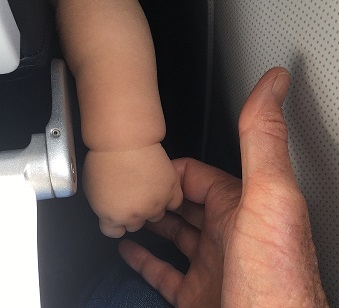
Having spent the last 40 years flying quite extensively for my job, I can vouch for the 700 touch points when flying. The photo above was from a recently trip I took. There was a baby sitting in front of me, and he kept putting his little hand between the seat and the wall of the plane, extending it back into my area. I never saw his face, just the hand. I finally reached out, and he latched on to my finger for several minutes. The best kind of touch points!
The article goes on to list all the ways we are losing touch points, from interaction with bank tellers, gas station attendants to ticket agents at a train station.
I thought about the touch points (or lack thereof) that the Q15 get when they are in public. Do most of them drive their own car? Do their own shopping? When I last attended a Stake Conference with an Apostle visiting, we were instructed to stay seated until he left the chapel. No reason was given, but it obviously reduced the touch point for this man.
With the Church so big, the touch points for our Q15 have to be reduced out of necessity. But what harm is that causing themselves, and to the members of the Church? What is lost by not interacting with the members at a low level?
When I was in high school, our ward took a youth trip to Utah from Clovis California. For some reason I didn’t go, I think I was working. But when the group got back, the big talk was how they got to meet two GAs. Our Bishop (from whom I take my nom de plume) took 15 YM/YW and marched into the Church office building (the old one). They sat in a conference room, and our Bishop went looking for somebody. First he came back with Paul H Dunn. He spoke only briefly to the kids, and then had to leave. Our Bishop then went to find somebody else. He next came back with N. Eldon Tanner of the First Presidency, who walked around the table and shook everybody’s hand, then talked to them for awhile. This would have been 1974.
While we can all agree nothing like that could happen today, some of which is complete out of the control of the leaders of the church, what have we lost by not having these touch points with our leaders, particularly the Q15? What have they lost by not meeting on a regular bases with the “rank and file”? Is there anything that could be done to change the current situation, or has the size of the church made it impossible to regain those lost touch points?
Your thoughts?
[1] Link to New York magazine cited in quote here.
 Wheat & Tares
I recently flew to Kenya business class on Qatar airlines and realized it was very posh in my little suite but kind of lonely. I was able to sleep well and arrived refreshed – but my most memorable moments of the actual journey were talking to a woman on the walk to our seats about her upcoming trip to visit her family in India and watching this Kenyan family say goodby to their German foreign exchange students on my way home.
I have felt the same about working from home vs going to the office or in person. So many small interactions that make a whole experience and a full life. Maybe for others they don’t need it but I feel like this is such an important part of our human experience that in the US we lose the richer we become.
No exception for the church leadership. Isolated because of security and surrounded by people that work with or for you only it is so easy to see the world and yourself in a distorted way.
I’ve read something similar about how billionaires are more and more isolated from the rest of humanity. It skews your worldview to lose connection like that.
I take public transit to and from work, and have had lots of interactions with people I wouldn’t normally talk to. I enjoy my “train friends” and have several stories about random encounters, most of them good. There’s the occasional outlier, but most of the people in the shared space of public transit have decent manners and the connection is nourishing. Just a brief chat with someone about the weather while standing on the train platform, or having someone ask me for directions and being able to help, means something to me. The missionaries now take public transit to the airport in SLC (when I was in the MTC we got a chartered bus), and every so often I arrive at a train platform just as dozens of missionaries with their huge suitcases are transferring trains to get to the airport.
Unscripted interactions while we’re all equal and anonymous, just trying to get from point A to point B, help with perspective. Everyone is the star of their own story. I’m no more important, or less important, than anyone else on the train.
It is unfortunate the Q15 don’t have those experiences anymore. I’m sure they feel the loss too. I can understand why they are whisked away so quickly. Even if they were able to linger after stake conference, they would mostly be encountering people who wanted to say they’d shaken hands with an apostle. It wouldn’t be a change from the echo chamber. Could they even have an “unscripted and equal” interaction? They’d have to be around people who don’t know who they are, and in SLC, that might be tricky.
As for what we’ve lost, it’s the chance to see Church leaders as just ordinary human beings with extraordinary responsibilities. When I was in my 20s, I was an interpreter for some visiting dignitaries and they had a lunch scheduled with several apostles. I was staring at this one man, trying to figure out why he looked so familiar, when someone rescued me with an introduction to Elder Joseph B. Wirthlin. I had no idea he was so short! Elder Holland towered over me about as much as I towered over Elder Wirthlin. We don’t see their height on the Gen Conf screens. There aren’t many opportunities to see Church leaders as regular people.
I guess I’d tweak the premise of the OP slightly. I think in certain situations the Q15 get lots of touch points, but they are not random but quite one sided and adulatory.
The last stake conference I attended was presided by Elder Quentin Cook. He spoke for 30 minutes and even told us about his 2nd anointing (of course in oblique verbiage) and basically told us he had met Christ. People around me were in tears. Afterwards he was mobbed by average stake members but they were all doing things like introducing their kids and telling him what an honor to meet him, etc. I was assigned to take down the chairs and lock up the building so I observed from afar while waiting for the uproar to calm.
If the Q15 and billionaires and celebrities only see an adoring public they will get an inflated sense of their importance.
I agree. The current Q15’s isolation from the rank-and-file membership also contributes to the growing culture of celebrity GA worship, I think. The current apostles are as distant from us as our favorite movie stars and sports heroes–we will only ever really see them on a screen, and we are more likely to mythologize them into inflated, superhuman versions of themselves.
By way of contrast, though, there are many celebrities in entertainment and sports who make an effort to be accessible to fans, such as through convention appearances and social media interaction. I don’t see the Q15 doing this in any meaningful or authentic way, aside from maybe hanging around after a stake conference to shake hands with attendees (which seems to happen less and less nowadays).
I grew up in California where GAs were just old men, mostly indistinguishable from one another, who appeared on TV every 6 months and gave boring speeches. My wife, however, was born and raised in Utah, and has all kinds of family stories about personal encounters with GAs, both in official capacities and unofficial chance brushes (at the grocery store, etc.). When we sometimes compare notes, it’s hard to believe that she and I grew up in the same Church. But when a GA delivers a cringe-worthy talk in GC these days, my wife is much more charitable and understanding of his flawed humanity than I am.
I’ve had the opportunity to meet several “famous” people in my life and one thing you pick up on after a while is they are just like everyone else. I’m pretty sure that if we were able to interact with the Q15 we’d discover the same thing. Perhaps that would be a reality check for those who think these guys interact with God.
“Perhaps that would be a reality check for those who think these guys interact with God.”
On the other hand it might give us hope. If God speaks to his imperfect mortal apostles he might speak to the rest of us imperfect mortals as well.
Most of us have seen or experienced how corporate leadership can be out of touch with lower tier employees and the public in some of their decision making. The best example I have seen, who bucks the trend is Mattress Mac. He sits at the front door of his store and gives a signed volleyball/basketball or a widget to the customers who have not even purchased anything walking in and he greets all of them. He is also simultaneously watching his employees and knows what is going on in his business. He is a celebrity in Houston, but still shakes the general public’s hand everyday.
In medicine, historically touch created a healing bond and accelerates healing. Few are the practitioners today who still touch their patients, but those who do are connected to their patient more than the electronic chart. We also know that physical contact is essential for child development. Even with strangers, expect for those with haphephobia, touch matters in social interactions.
From my reading of Christ, he was also with the people and not isolating himself behind a glass wall or with a chauffeur. He physically touched the people and the people touched him.
I grew up in Utah and lived there for a small portion of my adult life. I had several interactions with church leaders as a result.
One that sticks out is when we were hiking in big cottonwood canyon one Saturday. We got lost but there was a family speaking German quite loudly behind us. We waited for them to come into view to ask for directions. Turns out it was Elder Uchtdorf and his family. He gave us directions and we didn’t linger.
Later we saw them again at the lake at the end of the hike. I wanted to go say hi again but something told me to leave the poor guy alone so I did. I’m sure he appreciates a bit of privacy
Had I encountered him at the airport for example I would have tried to talk to him. But I figured he was in the wilderness by intention.
I do agree that working from home for people like me has changed my social dynamic in some negative ways. And I do think personally interacting with service workers is important.
Interesting about the planes.
Brings to mind, Hrdy book, “Mothers and Others The Evolutionary Origins of Mutual Understanding” and her thought experiment of Apes on a plane. Not a pretty sight. Yet Billions of Humans every year go through crowded terminals, lose luggage and cram onto planes. No other species can manage that.
Could go on about with idea’s of Alloparenting, Cooperative breeding and cooperation, but I’m now intrigued by what what it means evolutionarily to fly private.
Goodbye social intelligence. Guessing we are becoming just another ape.
There’s a lot of hay made in the series Succession about a business deal the family tries to make in which the company they want to buy insists that they give up their “PJs” (private jets) in the purchase, which honestly makes them recoil and almost sinks the deal. One of the chief criticisms of Elon Musk since the purchase of Twitter/X is that he has fired everyone who wasn’t fluffing him up and also in the process ended up firing most of the experts. Now he needs to hire some of them back, if they will come back, which mostly they won’t if they have any self-esteem. Another interview I’ve listened to talked about this meeting with a bunch of billionaires in the desert with a consultant. They were (in total seriousness) talking about the inevitable world collapse, their own plans for isolationist survival, and asking how they were going to retain the fealty of their employees once money lost its value and the world had descended into civil war and chaos. Okey-doke.
We do a lot to reduce our touch points with others, and various things have created more isolation: self-checkout at the grocery store (so I don’t have to talk to the cashier or wait in line with others), buying everything online (so I don’t have to go to the store with other people), working from home, telehealth, global warming which makes us stay indoors more, etc.
As for Church leaders, I don’t think it’s promising that when someone objects to sustaining them at General Conference, that person no longer receives an audience with them, nor that they don’t respond to correspondence from members, instead referring them back to their boot-licking stake presidents, which amounts to quashing whistleblower feedback; local retribution is more likely than actually getting feedback up to the leaders in this scenario. But on the upside, the Church will eventually be small enough if they keep going as is that they won’t have as much difficulty fielding personal contact requests.
Completely out of touch, and deliberately so, since 1997 when one takes the First Presidency, and Presiding Bishopric’s involvement with the SEC scandal. The only thing that they want to touch is the money, and not small change either, but $BILLIONS.
When you think about where “touch” happens in or with the church, it’s pretty plain to see that the world is touched by 19-year-olds, members of the church by local leaders, and “ministers” (the old home teachers but without monthly reports), and very few by upper church leaders unless they are a business or political leader. I’m just speculating on the last part but it seems like there is not really access to senior leaders like there used to be 50 years ago but they must be talking to someone because the church seems to get its way so much at least in Utah.
Maybe the upper leadership doesn’t have as much touch because the church is too big, they are worried about security, and they are so old they may have health issues. It could also be there are so many questions now about everything from finances to old theology that they really can’t answer so it’s better to leave it to the Church PR department. Come to think of it, members of the church get as much or maybe even more information from the news media, television, and social media as they do from their own local leaders particularly if the information is controversial in any way.
Finally, when you look at good touch and bad touch, there is a lot of bad touch going on in the church when it comes to private interviews with teens, relationships with the Boy Scouts in the past, or celebrity media, YouTube, or TicTok influencers.
Once I saw a current member of the FP navigate the crowded, disorganized chaos of the old airport in New Delhi. This would’ve been fifteen or so years ago.
Now admittedly, India can be a lot. But I don’t think I’ve ever seen anybody so stressed out. He was with a group of fellow whiteshirts for the chaos outside the airport, but we entered the airport around the same time, and it was ticketed passengers only. The number of touch points in an Indian airport is kind of impressive, especially back then. Even traveling in the upper classes. He was so clearly exhausted, flustered, and overwhelmed. I felt bad for him, honestly. Part of me wanted to ask if he needed any help. But he eventually made it through security okay just ahead of me, and I figured he didn’t need any fangirl attention. In hindsight, a friendly word and a reassuring smile might have been welcome. But maybe not. Who knows. That’s part of the problem with the bubble. If he’d been just an anonymous septuagenarian fellow American traveling alone, I almost certainly would’ve engaged.
I don’t think that the Q15 are in those kinds of situations frequently. They can be trying for anyone, but when you live an insulated life, I imagine that the rare times they have to be out anonymously (or nearly anonymously) navigating touchpoint-heavy terrain are doubly difficult. And the poor man was already in his mid-to-late seventies and all alone in the chaos once we were inside. My dad is that age now, plenty sharp and capable, and yet I would never want him in that situation.
The whole bubble situation kind of stinks for everyone.
At the risk of threadjack: Folks tend to downvote Jack a lot in these parts—often with good reason—but I’d actually like to take seriously his comment, “If God speaks to his imperfect mortal apostles he might speak to the rest of us imperfect mortals as well.”
Because let’s just say for the sake of argument that, say, Quentin L. Cook (who’s been cited a lot here lately) really has seen Jesus Christ in vision, like Joseph Smith in the sacred grove or Saul on the road to Damascus or what have you. That for me might be even more depressing than if Cook were being coyly dishonest, because the implication would be that one can see the face of Christ Himself and still not be any the better for it!
Seriously, Cook, despite hinting that he’s seen the Savior’s face, still has not given a single memorable or inspiring talk; now, Moses and Enoch were supposedly slow of speech too, but they also reputedly performed mighty miracles—Cook by all evidence hasn’t even performed minor ones. He has spearheaded no sweeping projects to help the poor, he has accomplished no great missionary work, he has launched no bold new leadership initiatives, he has published no exciting new revelations. Beholding the face of deity has not apparently made him any more insightful, intelligent, compassionate, honest or interesting than when he was just another corporate lawyer. The thought that you could finally see God Himself and not have it change your life in any meaningful way depresses the hell out of me.
Or maybe Jack is right, and it’s the exact opposite! Maybe my takeaway should be that if even a boring, flawed, unremarkable lawyer can see God, then maybe we all can. Certainly I wish that’s what Cook would emphasize instead whenever he insinuates that he’s seen the Almighty. Claiming you’ve seen Christ—even if it’s somehow 100% true—doesn’t pack much punch for me if you have nothing to show for it.
Thanks, JB, and thanks, Jack. I don’t think that Saul/Paul or Moses were ever coy about having seen God. They were bold in declaring what they saw. Moses wrote about it in what we now call Moses, and Paul wrote about it in his letters. They boldly declared what they saw. No hinting, no suggesting, no coy word with a wink. Either (a) one is silent because of commandment of because the even is too sacred (and in both cases, there should be no hints, no suggestions, no coy words with winks), or (b) one is bold in declaring what one has seen.
The brethren are too insulated. Maybe the use of “too” is too strong, so I will rephrase. The brethren are more insulated now than ever before. The church is larger, and we make a much bigger deal than in the past about security, so maybe more insulation is unavoidable. I have a proposal. There’s no reason for the Q12 to be SLC all the time except for occasional stake conferences somewhere. They are the travelling high council. How about send them out to live for six to nine months to twelve different places around the world (OK, maybe 9 or 10, given that some will be always be too old to travel), and they can travel to stake conferences in their areas. Let them travel and preach the word. Let them declare both the resurrection of the Lord and the restoration. Let them minister, and let the FP administer. Joseph Smith was able to send most of the Q12 to England, and others apostles on long missionary journeys at different times. They can have weekly meetings by Zoom or MS Teams if needed. If there is no stake conference one weekend, they can go to a regular ward, where they can sit and visit the SS or EQ class, but not take over. For security purposes, no one need know where they’re attending–they just show up, and their name isn’t even on the printed program, and no one gets advance notice, including stake presidents. After the two-hour block, then let the apostle preach to the congregation. This proposal won’t be adopted, but it would help the Q12 get in touch with the people, and that is lost at present. The gospel in Alabama, Québec, Ghana, Taiwan, and Belgium looks different than it does from the windows of the Church Administration Building and the Church Office Building.
JB,
Abraham was known as the friend of God. What great miracles did he perform? I suppose his rescue from the altar might be considered a miracle–but what else? How about Isaac? Or Jacob? They were the fathers of Israel. They knew God intimately–but they aren’t known for the kinds of miracles that were performed by Moses or Enoch.
Georgis,
There are times when prophets declare what they see and other times when they are expressly forbidden to share certain sacred experiences and/or knowledge. We see this pattern in the scriptures. Nephi is a good example of one who had great visions but couldn’t share everything he had seen. Neither could he share everything that he knew–and he mourned over the blindness of his people. In 2Nephi 32 he says:
7 And now I, Nephi, cannot say more; the Spirit stoppeth mine utterance, and I am left to mourn because of the unbelief, and the wickedness, and the ignorance, and the stiffneckedness of men; for they will not search knowledge, nor understand great knowledge, when it is given unto them in plainness, even as plain as word can be.
Jack, if God has commanded Elder Cook not to reveal that he has seen God, then I think that you would agree that Elder Cook should probably not suggest otherwise with hints, coy words, or winks.
Georgis,
In 2Nephi 32 Nephi tries to bring his readers along as far as he can before he draws the line. I see Elder Cook doing that same sort of thing. He wants to share with us everything that he can–right up to the point where “the spirit stoppeth [his] utterance.”
That sad, I agree that many folks have received knowledge that is too sacred and personal to even be hinted at. Even so, Alma (in Alma 12) seems to imply that there’s a spectrum of knowledge going from lesser to greater–and that those who would share sacred knowledge must not cross the line of the hearer’s level of preparation to receive it. And so, if we are responsive to heaven’s guidance we’ll find that the mysteries will be self-regulating–that is, in terms of what to share, where, when, and with whom.
I have a hard time thinking that all GAs are disconnected from the regular folks when Uchtdorf lives in my community and the darn fool just about ran me over on that blasted mountain bike he pedals around up above Mueller Park. He is also notorious for shouting instructions to his soccer-playing grandkids at games (in German, of course) and a week ago I saw him joking with the cashier and allowing several star-struck members shoot selfies with him at Costco. I still think he would look better with a groomed beard rather than that silly clean-shaven style all the GAs are required to run with.
Eyring also lives in my community and about a decade ago I saw him on repeated occasions at Home Depot. (This was before his wife got so ill.) Apparently he is a DIY kinda guy. I did feel sorry that the man couldn’t buy a new faucet without several members butting into the conversation he was having with the store clerk to inform him that they really liked his last conference address. He seemed embarrassed.
My mission president is current Q15 and his wife is basically his handler – discouraging him to have too much public contact. She has her favorites among their crowd of RMs (she refused to shake my hand l and many times is absent at official events and it’s noted that she is “resting.” Sorry for the cynicism but it feels like she campaigned for her husband to get the calling but can’t deal with dealing with the hoi polloi.
she refused to shake my hand a few years ago and is noticeably not warm and welcoming – but she was extremely young when they led the mission so maybe she is just fed up with the common folk.
Old Man: Your Uchtdorf story does my heart good as another aging person who bikes daily. I’m sure he’s not perfect, but he’s head and shoulders above the rest of these guys. He seems to me to be the only one who actually understands the gospel.
I once sat behind Oaks in a Shakespearean performance (and also saw him speak in Singapore, which I blogged about at the time). He laughed and covered his face in the show, and talked warmly about the importance of women’s equality when he spoke in Singapore. And yet, he seems to be the force behind almost every change the Church has made that contradicts the gospel. People contain multitudes. They can have a sense of humor and still be a bigot. They can be progressive in one area and regressive in another. They can be arrogant while also being warm and charming at times. Nobody is Mr. Smithers.
I think the leaders of the church do a much better job at maintaining touch points than other commenters are giving credit for. I have never had a leadership role of greater significance than EQP (briefly). Yet I have had a General Authority visit my family (in China, not Utah) and give my son advice on his mission prep and listen to what our challenges were. More recently, I had an issue with inane mission policies in our area and was able to call up the mission president and invite him into my home to air grievances and eventually get the policy changed.
I think that random touch points are intentionally reduced for church leadership, but where they shine is in generally realizing this and trying to get out to meet with individual members. As the general public, we are on the other end of that equation. We see that we don’t have interactions with them because, well, we don’t generally. They are likely trying to meet with a sampling of people in limited time. I don’t see this as any different from political government or corporate government. My senator doesn’t call me personally and ask my opinion on upcoming tax law. If if wanted to I could write him a letter, but it wouldn’t really matter either. The CEO at my company will nod his head at questions that come up from the hoi polloi at an all-hands meeting, but he can’t listen to everyone equally.
Rather than obsess over the fact that everyone can’t be heard all the time, I’d ask what are some things that could be done to increase the touch points or to increase the effectiveness of the touch points. Nobody wants leaders who are out of touch. One Method that I see used less effectively is the “Ask Me Anything” forum where the leader is put on the spot with a series of “tough questions” that he does his best to answer without really answering. Think political debates or questions about raises at an all-hands at work. I’d be curious at what others think would work to keep in touch with the masses.
MAJOR THREAD JACK.
“He spoke for 30 minutes and even told us about his 2nd anointing (of course in oblique verbiage) and basically told us he had met Christ.” I want to know what he actually said. I have a real problem with the “2nd anointing” crap. Maybe a post on that someday?
My relevant comment is this: I watched a TED talk a couple years ago where the researchers had taken all the medical/health results they could find a listed the most important factors for good health, in order. 1) was lots of interactions with other people, 2) was having deep meaningful relationships. What struck me was QUANTITY was more important than QUALITY.
So yeah, I think they are very out of touch. Almost nothing I hear at conference has anything to do with my circumstances, nor does it help.
Yes squidloverfat, that is what I was looking for, solutions to a system that is not working. I work civil service for the Navy, and recently we started the Ask Me Anything (AMA) with our Commanding Officer. They are live, so he is getting the questions without preparation. They are very well attended and liked by my command. The Church has tried this with the “Evening with Elder X”, where questions are read to the Apostle and then answered. But, the questions are all correlated ahead of time, and the answers are probably also ran through correlation also. But what a great idea to have truly live questions thrown out to a Q15 member, with their on the spot answers,
My guess is that it’s people from the Mormon Corridor (Utah broadly, but Salt Lake/BYU in particular) who have noticed fewer touch points with top leadership. It’s probably even more noticable by people of a certain age who are used to occasionally bumping into a member of the Q15 from time to time.
In the last couple decades the church has really shifted its tone from being “a Utah church with Utah leaders and international membership” to an “international church with headquarters in Utah.” There’s nothing wrong with this, but Utah locals will surely notice that they’re no longer the focus.
Years ago I happened to attend a birthday party with most of the Q15 in attendance. Elder Holland introduced himself to me as “Jeff”, we spoke for a bit and he never once mentioned the church or his position in it. I met or was introduced to most of the rest of the Q15. If I hadn’t been from Utah I’d never have known who they were other than friendly people named “Jeff”, “Tom,” etc. doing normal party things. It was refreshing to see them in that atmosphere.
Bishop Bill says he is looking for solutions, so I’ll propose something more radical:
1. Every 3 months, on a rotating basis, a member of the Q15 is randomly (and I mean truly randomly–use computers to achieve this) assigned for 3 months to a ward/branch anywhere in the world and given a mundane calling (primary teacher, Sunday School presidency, etc.). They are required to move to this new location with their wife (and any family members living in their household). No assistants may accompany them. Other members/Church leaders in the area are also instructed to stay away from the assigned branch while the Q15 member is there. The Q15 member is required to live in average housing and live off of an average income for the area while they reside there. They would also be assigned to work an average job (with a non-member as their manager) while they were in the area so that they can comprehend how too much church service can detract from a good life balance. They would absolutely be required to clean the chapel just like other members when it was their turn to do so.
2. Every 3 months, on a rotating basis, a member of the Q15 is randomly assigned to a mission anywhere in the world. This is not a senior mission assignment. No, they are assigned to be a regular proselyting missionary with an 18-20-year-old companion. The Q15 member’s wife is assigned to the same mission, but in an area far away from her husband’s area. They are allowed to video call each other once a week on P-Days for no longer than one hour, just like other missionaries. Like all young missionaries, they are allowed no other video calls or even text messaging with anyone else at all (this includes children, grandchildren, etc.) because they need to “consecrate” themselves to “the Work”. They live with their assigned companions in the existing missionary housing and live on the standard missionary stipend (they cannot use any additional personal funds). Again, they serve alone with no assistants, and local Church leaders and members from nearby congregations are told to stay away. They must be “exactly obedient” to all the mission rules–even the ridiculous ones–just like all the young missionaries are told to be, and if they break any of these rules, they are excused from the Q15.
3. If any member of the Q15 is unable to fulfill their obligations under #1 or #2 when it is their turn, they are immediately granted emeritus status and a new, younger person is chosen as a new Q15 member. If a Q15 member isn’t healthy enough to obtain the touchpoints of a normal rank and file member or a young proselyting missionary, then they are simply considered too out of touch with reality, and they need to be replaced by someone who is getting these touchpoints.
Under this system, each member of the Q15 would need to both serve as a both rank and file member and a proselyting missionary at a random location in the world for 3 months each approximately every 4 years (we’ll just make #1 and #2 be on a 4 year cycle to make the math easy). In other words, for 6 months out of every 4 years, or 12.5% of the time, each Q15 member would be on assignment as a rank and file member or a proselyting missionary. During these times, they would temporarily stop their Q15 duties (they would be completely cut off from Church HQ) so that they could have the full experience of being a rank and file member or a proselyting missionary.
I think the lives of proselyting missionaries would change dramatically almost overnight if a system like this were to actually be put in place. No Q15 member is going to want to live by the ridiculous rules the missionaries are required to live by these days. I think those would be changed very quickly. Likewise, I suspect that when the Q15 members see the futility of knocking on doors or contacting people on the street in many parts of the world today, they would make very significant changes to how missionaries spend their time. I also think that the Q15 would make significant changes to how local wards/branches function if they actually participated like a rank and file member from time to time and could see how bad things are sometimes.
As far as solutions, it’s just not feasible for 15 old men to be very personal with 17M people spread across the planet (not to mention security concerns that arise), so thoughtful use of technology is the key here.
I like the idea of the “Ask Me Anything.”
Also, little two-minute podcast episodes with a short friendly message from various top leader. It feels much more personal than a conference talk.
Arnold Schwarzenegger wanted to do a daily uplifting podcast but is far too busy to do recordings every day. He used AI to build a model of his voice that’s almost indistinguishable from him speaking. He’s very open about using a machine for help and why – something similar could be used as long as they’re honest about it. This may not fly with some people, but it definitely an option tbat exists today.
It’s been decades, but my most memorable experience with a touch point and a General Authority was when our Young Single Adult ward went as a group to Lagoon, the amusement park just north of Salt Lake City. There was a very tall, well built man who was obviously there with his kids and grandkids. At one point he was near the front of the line and one of the grandkids came up and wanted to get on the ride. Tom Monson reached over two lanes of the winding line to the ride, picked up the kid, and lifted him over the two lines of people and set the kid down next to him. It was smooth and effortless.
I was more surprised by the sheer physical strength of the man than I was with the relative anonymity that he enjoyed spending time with his family.
I can’t imagine many of the Q12 or 15 doing the same thing.
I recently read a fascinating article from “The Atlantic”’s July/August 2017 issue about the latest brain research into the effects of long term power and leadership on the brain. The findings were astounding, but as a member of the church I could see the findings born out by most of the Q15, especially RMN, DHO, Holland and Bednar. If Packer were still alive he’d be the poster boy for Hubris Syndrome which is best described by the historian Henry Adams as “a sort of tumor that ends with killing the victim’s sympathies.”
What researchers discovered through brain scans of powerful people vs regular folks, especially those who’d been in power for a long time was that these individuals had lost the ability to mirror other people which is the cornerstone of empathy. Subordinates and toadies don’t provide the emotional cues that “normal” people who aren’t in positions of power do. Power appears to lessen the need for a leader’s nuanced reading of other people below them because being at the top of any organization can give the leaders access to money, people and other assets that they once had to rely on or work with others to help them get what they needed. To quote the article “Less able to make out people’s individuating traits, the more they rely on stereotype. The less they’re able to see, the more they rely on a personal ‘vision’ for navigation.” Another important quote says “Hubris Syndrome is a disorder of the possession of power, particularly power which has been associated with overwhelming success, held for a period of years and with minimal constraints on the leader(s).” Signs of Hubris Syndrome are 1)contempt for anything who thinks or feels differently than the leader, 2)loss of contact with the daily realities of life-especially other people outside of their own families’ lives, 3)reckless actions, and 4)displays of incompetence of which no one is allowed to ever mention. The researchers concluded that the only way that leaders could undo some of the damage as a result of power was to think back on times when they made mistakes, especially ones that negatively affected others and also reading the letters and truly listening to the concerns of the people that they have power over. However, this doesn’t always work.
I’m sure that most of you could come up with examples of the corrosive effects of being in power for decades has had on the Q15 and other church leaders who’ve been in the “Priesthood Power Pipeline” for a long time. It explains to me why the church still refuses to apologize for terrible decisions that they’ve made in the past (and that they continue to make), why the poor and others are vilified for “bringing their troubles upon themselves and why they don’t ‘deserve’ our help and compassion”, why women and girls are still second class members, why singles are still treated as pariahs even though they constitute more than half of church membership, and why the LGBTQ+ members are treated with such a lack of empathy. Limits on consecutive years of leadership, doing away with sycophantic workers at the Church Office Building and elsewhere, and putting an end to nepotism and “The Good Old Boys” system used to call men to leadership would be a start, but the best thing that could happen would be to make women an equal part of the non Primary, YW and RS leadership at ALL levels. Until that happens I fear that the situation will get increasingly worse while more and more members head for the exits ASAP.
BTW Hubris Syndrome affected women much less than men.
In the Jerusalem of Jesus’ time, the priests/Sadducee’s had their lavish homes built on the level above the city and marketplace, with a special pathway that allowed them to reach the temple without ever having to interact with the lower caste below. In contrast, the Pharisee’s would fast on Mondays and Thursdays, which coincided with the chief days at the marketplace. They would then walk among the people in the marketplace with “a sad countenance: for they disfigure their faces, that they may appear unto men to fast” so that people would say that they were great, righteous men.
I think that in both cases: “Verily I say unto you, They have their reward.”
p.s.: Is there truly a connection between faith and touch. Ask the woman with an issue of blood who “she said within herself, If I may but touch his garment, I shall be whole.” This is just one example – in scripture and daily life – of the connection between the tangible and the spiritual.
Thanks Mountain Climber and Bishop Bill for the practical suggestions. I mentioned the Ask Me Anything as an example, but I don’t really like them. Rarely do I see any practical “touching” done in those meetings, but see them more as a chance for “gotcha” questions and grievance airing. A better meeting (that still has its own problems) is the round table with a handful of participants brought together to share questions and concerns on specific topics. That allows for a more mature and candid discussion.
I liked the ideas about letting Q15 be regular members in a random location frequently. The execution portion could be adjusted, but living in a place is remarkably different than visiting a place. It would also do a lot to remove the filters that happen where a leader thinks his system or vision or law is accepted and embraced when in reality it just doesn’t work. Instead of assuming that “No Cooking is Happening in the kitchen”, they will see the Activity Day boys learning to make omelets on the stove in the kitchen as a good thing.
My cousin once found himself passing the sacrament to one of the GAs, I think it was maybe Elder Tanner, and he motioned for my cousin to lean in and proceeded to whisper something in his ear. Of course, my relatives in the congregation were eager to hear what the apostle had to say. Something along the lines of, “Your zipper is down.” Awesome.
President Monsen, before he he became prophet, attended my daughter’s piano recital to hear his granddaughter perform. After the recital he was working the room and shaking hands. My daughter leaned in and said, “Who IS that man??” Awesome.