
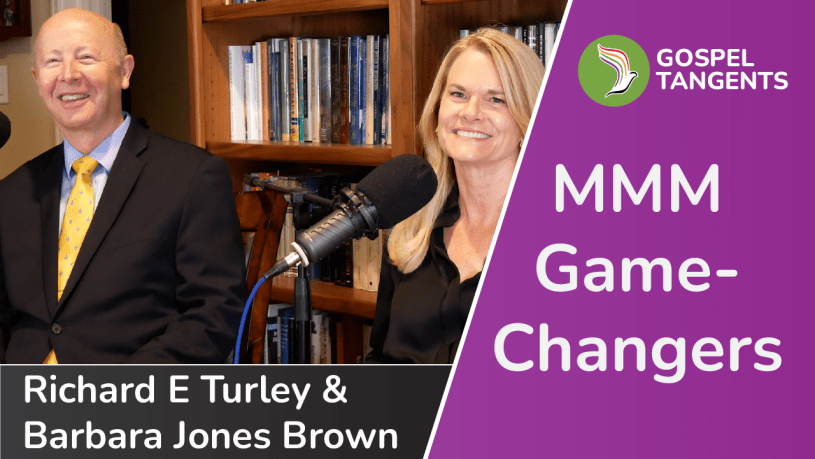
The Mountain Meadows Massacre is the worst event in Mormon History. For a century, the LDS Church has tried to cover up the terrible event. There is a game-changing book that sheds new light on the prosecution of John D Lee, the only man convicted of the massacre. The authors conclude the massacre was covered up from the beginning, but was Brigham Young involved? “Vengeance is Mine” is the newest book on the event. Check out our conversation with Barbara Jones Brown & Richard Turley.
In part 1, I was surprised to learn that “Mormonism Unveiled; or The Life and Confessions of the Late Mormon Bishop, John D. Lee (Written by Himself)” was NOT actually written by John D Lee. Brown said it was written posthumously by Lee’s lawyer, William Bishop and is basically a forgery and should not be used by historians. When she learned this, she had to remove all references to it in “Vengeance is Mine.”
I was also surprised to learn that Lee’s first trial was a sham, but not for the reasons typically given. Turley said that U.S. prosecutor Robert Baskin, a non-Mormon, wanted a hung jury in order to go to Congress and ask that all Mormons be disenfranchised from both voting and serving on juries. Baskin did this because he wanted to be elected in Utah, and knew that as a non-Mormon his chances were zero. Having a hung jury would help him get elected, or so he thought, by not allowed Mormons to vote. Baskin didn’t even find a witness who saw Lee kill anyone, proving the prosecutors weren’t interested in a conviction. But Congress balked and replaced him with a new prosecutor, Sumner Howard.
For the second trial, Lee’s lawyer, William Bishop expected another hung jury, and didn’t even offer a defense in the second trial. However, Sumner Howard was a much better prosecutor than Baskin, and Howard accepted Brigham Young’s offer to find witnesses. The second trial in 1877 was a slam dunk, and this caused Lee’s lawyer (who wasn’t paid for either trial) to forge Lee’s confession to implicate Brigham Young in the massacre since Bishop was angry the Brigham had indeed helped convict Lee by finding witnesses. (Young had offered to find witnesses as early as 1859, because Young didn’t want to be blamed for the massacre.) Brown and Turley also described some folklore that Juanita Brooks had put in footnotes in her “Mountain Meadows Massacre” that didn’t hold up to scrutiny. They also rejected Will Bagley’s assertion that religious fanaticism led to the massacre.
Blood atonement has been another theme in Will Bagley’s book, and the two authors said that there is a misunderstanding about what blood atonement is. Signature Books has asked Michael Homer to write a book on Blood Atonement and he will discuss the controversial doctrine more in depth in the future. Blood atonement shouldn’t be used as simply a euphemism for murder, and it completely wrong to call the massacre an example of blood atonement. Barbara gave an example of a man who asked for blood atonement under Isaac Haight’s tenure, but the massacre participants were not “blood atoned.”
Finally the subject of blame came up. The authors said Brigham deserved blame for creating the environment which allowed the massacre to happen and his policy to allow the stealing of cattle from immigrants. Isaac Haight, William Dame, John D. Lee, William Higbee, Philip Klingonsmith, President James Buchanon, and others also deserved blame. They called it a perfect storm of events in which many played a part, and there was plenty of blame to go around.
I thought the book was meticulously researched, and does indeed change the narrative on the massacre. Have you read it? What do you think of their conclusions?
 Wheat & Tares
This book and its predecessor “Massacre at Mountain Meadows” are profoundly painful books to read. I approach these books not only as a believing Latter-day Saint but as a descendant of one of the planners and participants. My parents were friends with Juanita Brooks. My mom grew up in Southern Utah. I recall my parents visiting Juanita. I did not read much as a kid. Just was not my thing. But I did read parts but of her groundbreaking book on the Massacre and loved to pepper my Sunday School and Seminary teachers with questions about Mountain Meadow. I didn’t know “jack” but it seemed on this issue I knew more about it than most of my teachers. Never got a straight answer other than the standard decades old lie that blamed the “Indians” and that some of the victims were perpetrators of the Missouri persecutions against the Mormons. Yup, I was an obnoxious kid. Sorry to my teachers.
Just a little background to give color to my reading of this book. My great great grandmother’s husband Francis Jorden, struggled to make a living in the harsh conditions of Southern Utah. Going against the counsel of Church leaders, he decided to try his luck as a gold miner in California. He wrote loving letters to his wife during his absence. The postmaster, Richard Harrison had eyes for Jordan’s wife Jane, so he held all the letters from Francis to Jane. She assumed Francis either died or abandoned her. Upon Jorden’s return he learned that he had been excommunicated and that Jane had been “reassigned” as a plural wife to Harrison.”
Frank Jorden, the son of Francis and Jane, became aware of the planning of the Massacre through conversations he overheard that certain perpetrators were aware of. He began to fear for his life. Both his mother and Father who encouraged him to leave. Under cover of darkness Frank left to join his father, never to return. Many of the perpetrators of the Massacre were from Cedar City and worked at or supplied raw materials to the ironworks where Harrison was superintendent. It was at the ironworks where some of the killers mustered. John D. Lee (the only perpetrator executed for his crimes) identified Harrison as a participant.
Now to the review. Full disclosure, I know Rick Turley and Barbara Brown well. I consider them friends. Rick was a year ahead of me in law school and a true genius. Barbara likewise is brilliant and fearless. This book, like “Massacre at Mountain Meadows”, is meticulously researched and a comprehensive account of one of the darkest chapters in American history. It is a gripping narrative that delves into the complex events of Sept. 11, 1857, shedding light on the motives, actions, and aftermath of the evil acts, including the wrongful blaming of the Piute tribe.
One of the hardest things in telling history is to place it in a historical context. The book absolutely excels in this respect. The details of the tensions between the US Government and the Mormons are gripping. It is a history that is mostly lost on later generations. The Republican Party prior to the Civil War essentially declared war on the “twin relics of barbarism, slavery, and polygamy” and disenfranchised the Mormons while sending and Johnson’s Army to quell the “rebellion” of the Mormon people. By examining the perspectives of multiple individuals involved, the authors paint a nuanced picture of the psychological, religious, and societal factors that contributed to the atrocity.
What sets the book apart is the authors’ commitment to presenting a comprehensive view of the events. Turley and Brown leave no stone unturned as they meticulously dissect the evidence, including court records, diaries, letters, and oral testimonies, to piece together the sequence of events leading up to the massacre and its aftermath. They separate fact from conjecture, offering a well-reasoned analysis of the motivations and decisions made by the various parties involved. They focus on the human element with a keen understanding of the players, portraying them as complex, flawed human beings rather than mere archetypes. This approach allows readers to grasp the moral and ethical dilemmas faced by those caught up in the events, adding depth and empathy to the narrative. And indeed, in my case a righteous indignation and anger.
For a casual reader, the sheer amount of information and detail might overwhelm those unfamiliar with the historical context. Despite these minor drawbacks, “Vengeance is Mine” as well as “Massacre” are important works that shine a light on a dark period in American and LDS history. It serves as a reminder of the potential consequences of religious extremism, fear, and violence when mixed with political tensions. Turley and Brown’s dedication to accuracy and their portrayal of the victims, perpetrators, and native peoples make this book the essential resource for anyone interested in understanding the complexities of this horrific event.
Further recognition should be given to Elder Marlin K. Jensen, who served as Church Historian and was the impetus for this project. Without him I am not sure either book would have been written. Full disclosure, I consider him and friend and mentor for over 40 years. Many years ago, after the Church opened the archives to scholars and issued formal apologies to decedents of those killed in the Massacre, President Gordon B. Hinckley endorsed the project and the apology. One of his sons told me that he had visited the massacre site with his father. They were alone. His dad looked over the site and with tears his eyes said, “I have done everything I know how to do to try and heal this ugly wound.”
Lawrence,
I appreciate your insight, but my understanding is that the Church issued a letter that included the word “regret.” It then blamed the massacre on local leaders, never taking institutional responsibility. Many insist there never was an apology.
I’m in the middle of the book right now. I may have had family members who participated in the massacre – one great-uncle denied having participated, but there were many perpetrators who escaped justice by denying involvement, and he was one of the men who went and collected the surviving children shortly after the massacre. I think it’s important for anyone with ancestral ties to that part of Utah to be familiar with what historians uncovered for these two books.
I particularly appreciate the authors’ pointing out that there are similar political tensions in our country today. When we allow fear and anger to rule us, misinformation and violence can both quickly follow.