
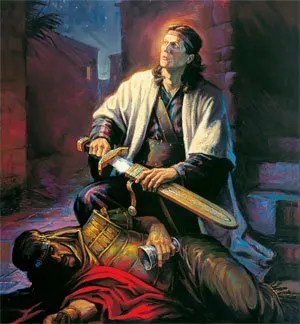
A friend of mine on Facebook recently made the following comment.
I’ve often thought about the “first dilemma” of the Book of Mormon being the Nephi/Laban slaying. It has struck me for decades that those who continue reading the book and ultimately embrace Mormonism have passed over a threshold where the end justifies the means. I think it could be argued that this “rite of passage” can give weight to all manner of problems, evils, and indignities from the Mountain Meadows Massacre to the genocide associated with the migration of pioneers into the American West.
Regardless of truthfulness of the story of Laban [1], if the person sitting next to you in church believes the Book of Mormon is true, and has no problem with God commanding Nephie to kill Laban, do you feel safe sitting next to this person? What if God commanded them to kill you?
How does this “first dilemma” of the Book of Mormon manifest itself today? While the Mountain Meadows Massacre happened a long time ago, Lori Daybell was convicted of killing her kids just this year. Knowing the reasons behind the killings (she thought they were zombies), is if far fetched that she and her husband thought “It is better that one man should perish than that a nation should dwindle and perish in unbelief person should live inhabited by a zombie” ? In Lori’s final words before being sentenced, she said her kids spirits have visited her and are happy.
“I know for a fact that my children are happy and busy in the spirit world,”
“Tylee has visited me. She is happy … and free now,”
“Jesus Christ knows that no one was murdered in this case,”
words of Lori Vallow Daybell at her sentencing
Is it a stretch after hearing her speech, to think that she believe she was doing God’s will?
What are your thoughts on the killing of Laban as told in the Book of Mormon? What problems do you see coming from believing that God can command somebody to kill another person? Is this problem of the “end justifying the means” worse in the LDS church than it is in other religions?
[1] Much has been written about the improbability of beheading Laban, the amount of blood that would have been on all the clothes than Nephi donned, and why a simple stab through heart wouldn’t suffice.
 Wheat & Tares
There is also the example of a Utah County man, who made threats against President Biden, and who then sparked his own death by drawing on FBI agents. I am saddened by the likelihood that there is more than one LDS person in Utah County who would consider President Biden’s death a positive. Heaven help us!
We have had more than a century to cope with the violent elements in our history and faith. Yet I see no evidence that pacifism or non-violence will ever take root among LDS people as it has in some other faiths. We collectively are a violent and harsh people.
This is the Mormon version of Abraham and Isaac. I think we could learn a lot from Jewish and Christian philosophers, who have reinterpreted that story several ways and use it as a prompt for questions instead of just answers. I tried to do that in my story Sacrificium Nephae: https://irreantum.associationmormonletters.org/20-2-sacrificium-nephae/
There are four recent Mormon fanatics: 1) Daybell, convicted in Idaho of killing her kids and her spouses’s wife (she is now being sent to Arizona to stand trial for killing her husband), 2) Chad Daybell for the kids and his wife, 3) Robertson who fired 5-6 shots at the FBI before being taken out and 4) Ammon Bundy who was arrested on Friday for contempt after a hospital system was awarded $52 million after he and his followers tried to prevent feeding of a child that was starving to death.
If Nephi had been arrested and I sat on his Jerusalem jury, I would vote to convict on capital murder (murder to get gain, the plates), and if the Lord wanted to bust him out of prison, that would be His business.
I guess I passed that test because I didn’t get far into the BOM before things sounded funny. Nephi was just too much like Joseph Smith wanted to be, and then I hit the killing of Laban and it just smelled like some dude’s fantasy and there were holes in the story, besides that I just couldn’t swallow God commanding Nephi to kill Laban. But I stuffed all my doubts inside like I had been taught and tried to believe the unbelievable. Like a good LDS kid, I doubted my doubts.
So, onto the holes in the story, besides the moral problem.
Laban was passed out drunk, so Nephi could have just taken his clothing and left him there passed out drunk, naked in the gutter. Laban would have taken hours to sleep it off. Nephi could have impersonated him and been long gone by the time Laban woke up and got sober enough to realize what happened. So, his death was not necessary and neither was making Nephi a murderer.
Not to mention all the logistic problems in the story. First, that a man that rich would have gone about the city with body guards or servants who would have carried their drunk master home. One bit of evidence that Joseph made it all up was that Joseph being a poor villager in a small town, does not understand the behavior of the very rich in big cities. The risk of being robbed, or even passing out drunk and then being robbed was simply too great for a powerful and wealthy man to go out and get drunk all by himself. A second problem that was mention is there would have been blood. A third is, isn’t it amazing that those clothes fit. Nephi was supposedly just a very young man, who are usually skinny, and here Laban is a middle aged rich man, who in that time, were generally heavy. It just would not be possible that all the servants were fooled by Nephi pretending to be Laban.
I grew up LDS and don’t remember a time in my life when I didn’t know the story of Nephi killing Laban. It was part of the fabric of my morality from earliest childhood, along with the story of Abraham and Isaac. (I’m glad Tygan already mentioned the other readings of the Abraham and Isaac story. The first time I read a bit about how the Jews interpret that story, I immediately discarded everything I’d learned about it in Church.)
The best I remember about how I justified the God-inspired-murders moral dilemma is in believing that those types of situations were confined to prophets. I was never going to be inspired to kill someone because I was not prophet material (I’m a woman). The lessons that told those stories were about absolute and unquestioning obedience, and were tied more to the Church’s rules. “If Nephi could be obedient to this prompting, then surely you can follow the Church’s modesty rules.” Or paying tithing, or taking a calling you don’t want. The obedience required of us got watered down into things that were socially acceptable to do.
Joseph Smith wrote this declaration of belief in 1835: “We believe that religion is instituted of God; and that men are amenable to him, and to him only, for the exercise of it, unless their religious opinions prompt them to infringe upon the rights and liberties of others;” That’s a really reasonable boundary. Obviously, the biggest infringement of someone else’s “rights and liberties” is to murder them because God told you to do it. Probably no one asked Joseph Smith about the conflict between D&C 134:4 and Nephi’s assault on Laban, but that would have been a really interesting question to ask.
The story of Laban. The Happiness Letter. What’s really “wrong”?
When discussing modern Mormon murderers, don’t forget the Laffertys.
The Church continues to have a problem with personal revelation. Not only with murders committed by religious zealots, but also with the increasing number of restoration churches that claim a connection to JS.
Nephi would have been tried for murder then, just as anyone would be tried today, such as the “Zombie mom.” No dilemma,,,especially for people who do not believe the Book of Mormon to be the word of God. If you do believe the BoM to be the word of God, the experience was an act of faith…and any faithful member would know that they and the person sitting next to them at church would not be justified to experience what Nephi experienced. And to compare the experience of Nephi to the Mountain Meadow Massacre is only from a mind that desires to compare them…as if there is some moral equivalent when there is not: the former an act of God and faith, the latter neither. But, yes, I know, many people believe the conspiracy theory that Brigham Young ordered it all. So, believe away! Exercise your faith in speculation driven by hate.
Paul Mero, the belief that Nephi was wrong to kill Laban is not speculation driven by hate. It is applying for ourselves the things that even Joseph Smith taught about when religion goes wrong.
Do you think that the Catholic inquisition was wrong? Do you believe that Lori Daybell was wrong? Do you believe that the Puritans and their witch trials were wrong? To me they are very similar to Nephi killing Laban. Yes, I know he believed God told him to. So did the Lafferty brothers. So did Lori Daybell. Just exactly what is the difference except that you believe that God really did tell Nephi, while the others were just delusional. Why not conclude that Nephi was delusional?
This is really an honest question, because I don’t see a difference except that you and others believe one but not the others.
I understand your point…as you understand my point. Can two actions be the same and one justified and one unjustified? Of course they can. Where we disagree is exactly where you know we disagree. I see the Book of Mormon as the word of God. If you do, your comment makes no sense. If you don’t, your comment makes tons of sense to you…and really is “speculation driven by hate.” You do, after all, compare Nephi’s experience to awful historical episodes that I am sure you hate.
Paul, I base my disbelief in the BOM several things like on the fact that I just don’t think God ever commands us to break what are after all God’s commandments. I believe the Bible is people writing down their experiences with religion. And when you consider that they based “inspiration” on drawing lots or throwing dice, well, it might have been a throw of the dice and not inspiration. But they believed it was straight from God and I just don’t think God works that way. Besides, the pagans did the same things to get “inspiration” and they believed it came from God too. So, how do we know that what you believe or Lori Daybell believes is worse or better than what I believe?
Let me put this another way. If I cannot imagine Jesus doing something, then I don’t think his Heavenly Father would do it either. Jesus said that to know him is to know the Father. So, somehow I just can’t imagine Jesus telling some guy to kill another human. He even stopped Peter from defending him. He wouldn’t even let Peter hurt another human being.
I appreciate your perspective about what Jesus would or would not do. Clearly, Jesus had a specific mission from Heavenly Father. He was not asked to overthrow Rome and kill people…nor position His Gospel in any way that would create Rome and the corrupt Jews to harm Him or His people — until it was time to atone. We also often forget that the God of the Old Testament is Jesus.
I think an assessment of Nephi’s options demonstrates that there was no other viable way. Meaning, both the Holy Ghost (who was talking to Nephi directly) and Nephi acted as rational actors in their story.
This statement is based on two assumptions: i) it was critical to get the Brass Plates, and ii) Laban was a thief and a murderer… he had murdered before, and would do so again without a thought about it.
If you disagree with either of these assumptions, you might land in a different place relative to Nephi’s actions. But if they hold true, there was no other action that was possible.
The best alternative that I have heard of to Laban’s killing, given these assumptions, is that Nephi could have left Laban passed out, taken his clothes, and still done his Laban impression to obtain the plates from Zoram. It sounds OK on the surface, but neglects to take into account what happens when Laban wakes up. He would have known who had taken the plates, based on Nephi and co.’s previous two attempts. He would have also suspected they would have fled the city, given that he was now the owner of all of Lehi’s possessions. It would have been in relatively short order that the 50 under his command, and likely many more, would have pursued Lehi’s family, found them, murdered them all, and reclaimed the plates.
Laban was and is a very wicked man, and Nephi’s supreme hesitation and desire to not have to kill him given the bind he was in is a testament to his character. I believe there are those in heaven that give as much thought to the act of killing Laban as you or I would give to cutting the head off a snake that was attacking your children. I understand that comment will set some people off, but just ask yourselves why are your sympathies lying with Laban? I think the true nature of Laban, and all of his evil, will be one day fully known.
As to why beheading (mentioned in the footnotes as an example of why the story is not believable), my own current believe, which will make sense to no one at this point, is that the method of Laban’s killing (beheading) was symbolic of other treacheries Laban was responsible for.
And as for any blood on the Laban’s clothes and armor, since it was also mentioned in the footnote, it doesn’t seem difficult to imagine that Nephi would have simply removed them before beheading Laban. Easy fix to the problem – he knew he needed to use the clothes, so it would make sense to remove them, right?
In any case, whatever spirit is filling the OPs head with the notion that Nephi’s story is equivalent to the example he gave of sick and evil people killing their own children, and also that people who see his story for what it actually is are also psychotic and prone to violence, is not a good one. My advice, for what its worth, would be to let that spirit know, if he can, that its services are no longer required.
Prior to Laban falling into the hands of Nephi, Laban first threatened to kill Laman. Then when the sons of Lehi returned to Laban with a financial offer to purchase the plates, Laban stole Lehi’s property and sent his guards to chase them down and kill them. And yet when Nephi encounters Laban and has superiority over him, Nephi expresses great misgivings about exacting revenge.
On the one hand Nephi tells us he is not bloodthirsty or disposed to violence. On the other hand Nephi slays Laban and uses subterfuge to steal the plates. And Nephi says this was what God wanted him to do, even though Nephi didn’t want to do it.
Is there a larger moral to this story? Does this story message that it is ok to kill if we think God is telling us to do so? I personally do not think so. I don’t think Nephi was happy with what he did. I think he wrestled with it the rest of his life, and this is why his account of the episode is so tortuous.
Consider that Nephi was nearly killed by his brothers multiple times, and he “frankly forgave them.” Nephi was then so mortally threatened he separated his followers from those of his brothers. If Nephi was blood thirsty I think he would have demonstrated violence in eliminating the threat of his brothers.
Also recognize that the Book of Mormon promotes pacifism as much as it justifies violence. Mortality is complex and the Book of Mormon does not shy away from exploring complex themes. Perhaps this is why the conclusion of Mormon and his son Moroni is the preeminence of Charity and the need for individuals to seek and obtain the Light of Christ and to follow the Holy Spirit. And even after all that we are dependent on the Atonement of Christ to save us as we otherwise are unworthy creatures.
Many more murders are committed each year by non-Mormons. Do Catholics have a murder problem? Do atheists have a murder problem? When an Islamic terrorist kills in the name of Allah the do-gooders rush to inform us that Islam is peaceful. There does not even exist a pattern of Mormons killing others and yet we are told a pattern exists because of Brigham Young and Missouri and other long ago history that the church itself avoids teaching.
If the Book of Mormon taught violence then “Mormon murderers” would exist beyond the Wasatch front – the Book of Mormon is distributed throughout the world. But no. All examples of such “Mormon murderers” are from areas where “Mormon culture” is dominant. This points to it being more likely that sociopaths who commit murder are everywhere and sometimes these sociopaths are Mormon or have Mormon background. There is no causality that being Mormon and reading the Book of Mormon leads one to be a murderer.
I find it interesting that Nephi doesn’t draw back at the idea of breaking the commandments. Rather, he winces because–as he says–he’s never killed anyone before. So I think his fears have more to do with the severity of the action than with whether it’s right or wrong.
That said, my guess is the reason the record is silent on the morality of incident is because Nephi was justified according to the laws of the time to take that action against Laban. And even if an argument could have been brought against him by the people in Jerusalem–his family had broken away from those them. His father’s interpretation of the law was *the* law.
The more I read up or hear about some of the scholarship surrounding the Laban story, the more complex it is, though a little more clarifying at times as well. Jewish law at the time obviously wasn’t as we know law today. Also, although applicable, most everything in scripture takes into account the most exceptional and extraordinary of circumstances, not the norm. I suppose reading about Nephites praying to find lost saddles so they could get to work on time could have made them a little more endearing though.
By bringing up Daybell, I think you’ve brought in a subject that changes the whole dynamic of the discussion. I’ve had more encounters with mental illness (not personally) over the last year than I would ever expect over a lifetime. I think it affects members of the Church just as much as the rest of the population. I’m not convinced Church teachings necessarily make it worse. In fact, in those I’ve dealt with, I think it’s actually helped. I just think the Daybell types get a lot of attention because they take the parts of Mormonism most easily sensationalized by the media, and amplify it. I imagine for every Daybell, there’s at least half a dozen members fighting mental illness in which Church teachings help the coping, not the manifestation.
I’m not convinced by the political arguments either. I’m a conservative and conservative member of the Church, and I eschew war and violence now more than ever. I largely credit that to Church teachings and promptings from the Holy Ghost. The Provo man is another exception, not the rule.
I guess a lot of it comes down to the Holy Ghost, which I see no mention of in the OP, though I guess it was pretty clearly implied. My life, learning, and choices thus far have led me to accept the reality of the Spirit and the ramifications thereof. I’ve found it a reasonable position. With one or two exceptions, these promptings immediately satisfied my initial understanding of what was right and wrong with any given situation, and even with the one or two exceptions, understanding and satisfaction came shortly thereafter (thank goodness). I suppose to an outside observer, nothing about the exceptions would make sense without more information. It still doesn’t change the fact that I’m just trying to do my best to do what’s right with the best understanding of reality that I can find. I wouldn’t expect less of anyone else with sincerity and a firm mind.
Even with all that said, I doubt the average member expects to be in the extreme situation of Nephi. I doubt any member would ever expect that situation to happen to the member sitting next to them at Church, and I doubt Bishop Bill expected that from the majority of members he once presided over and may or may not still enjoy association with. It still obviously makes good blog post material.
Paul Mero’s points highlight a greater problem associated with W&T at large over the years. It’s a blog that focuses on Mormonism, though there is no mention of Mormonism in the blog description. It’s a blog that frequently criticizes the Church and the beliefs and/or actions of its members, though there are few permablogger descriptions that highlight that aspect of the authors (and names like “Bishop Bill” understandably give the opposite initial impression to the average believing member who may make her or his way over here unassumingly). And it’s a blog that makes very little effort to acknowledge the fact that whether or not you are a faithful member, notwithstanding a few nuances, totally changes how you approach 90% of the topics brought up here. Not acknowledging that more regularly adds an element of superficiality and wasted time to nearly every post.
I get that the average person is smart enough to figure out what W&T is really about after hanging around for a few days or posts. I’d also by lying if I didn’t admit I’ve learned a good thing or two from W&T over the years. It still doesn’t change the fact that a slight vibe of deception darkens the overall vibe of the blog.
I mean, if W&T wants to keep inviting unassuming believers here, only to lay on the down votes every time they disagree with them, keep doing what you’re doing. If W&T wants to maintain the slight elitist, liberal Mormon country club vibe, you may want to update the blog description with that expectation and avoid the real or apparent intrusion of Meros, Jacks, or the occasional likes of me. Again, not doing so only adds a deceptive vibe to the place. If nothing else, it may be a great time saver for all involved.
A few thoughts. Nephi’s experience with God was unlike most people’s. Previous to the Laban situation, he saw an angel in the presence of three other individuals who could verify what he was seeing. Most people don’t get that caliber of reassurance that God does in fact exist and is actually communicating with you.
Is killing someone never justified. Self-defense? Defending someone who is helpless? Defending your country during wartime? What if the Lord had you go back in time and kill Hitler? Would you do it, knowing how many other lives you would spare? In Nephi’s case we are balancing the spiritual lives of millions (No plates then records. No records then no righteous Nephite nation and no Book of Mormon in modern times.) with one persons’ physical life. Is a physical life more important than a spiritual life? It’s probably tempting to see it that way from a mortal perspective. But God obviously always sees the eternal perspective.
Did Nephi actually have to kill Laban? Well, knowing how tenacious and ruthless Laban was, if left alive he very well could have hunted down Nephi and his family and had them killed for taking the plates.
Why did Nephi have to do the killing? Perhaps the Lord needed for Nephi to have this extremely difficult experience. You know how when some individuals go to war and have the terrible experience of killing an enemy, they end up having a new respect for human life because of how bitter it is to actually kill someone? Even an enemy. Maybe killing Laban, taught Nephi an even bigger respect for human life then he already had which would be crucial as the first leader of the Nephite nation that would be involved in many wars with the Lamanites. There are many times in the Book of Mormon were being blood-thirsty even in a defensive battle was decried. How much of that was because of Nephi’s influence on their culture?
Wired.com once ran a story entitled “God vs. Satan: Who Killed the Most People in the Old Testament”.
They came up with 2,037,044 killed by God and 10 killed by Satan. Sadly, my first thought was “who were the 10 that Satan killed?”
Although I think the estimated deaths mentioned here is a little shy – especially if you include all the deaths he ordered in taking over the Canaanite cities – it still pales in comparison to the additional ones racked up in events like the nuking of the cities in America prior to Jesus’s arrival in the BOM. Obviously, being a people who have “thou shalt not kill” as one of the Big 10 rules, we deal with some cognitive dissonance on both the individual death or megadeth (spelling intentional) level.
For me, I just want to love Jesus (the part of Him who embodies the peaceable things of the kingdom) and hide under the sheets on my bed.
Seeker,
I think we get a more complete sense of the situation if we ask a second question: God vs Satan: Who Created the Most People in the Old Testament (or any other time and place).
Oh, Jack, I typically like to give you the benefit of your thoughts, but you must be joking on this. You think this is a question of quantity? Whoever creates the most people gets to kill the most. If you have 10 children and your neighbor has just one, then it’s okay for you to off two of them if they don’t please you? Wow. These people are not clay pigeons created for target practice, they “are begotten sons and daughters unto God.” I’m dead serious about cognitive dissonance. I absolutely cannot accept that god was so incompetent that after getting rid of the 1/3 spirits that were bad apples in the premortal existence he sends his begotten sons and daughters to earth only to find one single family he likes and the rest he drowns; while at the same time accept the God of the King Follett Discourse that “all the spirits that God ever sent into the world” were “susceptible of enlargement,” having the capacity to become like God in the eternities”. To me, the murder stories make no sense in relationship to both God’s foreknowledge and his loving kindness.
The best thing anyone can say about the flood story – and by extension, the other genocide and homicide stories in the scriptures – are that they are parables written by men, designed to show that God supports his followers in a wicked world. Look, I don’t know all the answers, I don’t know why people behave so ugly at times. But if my conscience requires me to take one path it will be to follow The Mighty God…The Prince of Peace. I will attempt to follow Paul’s admonition to Timothy: Have nothing to do with profane and godless myths; rather, train yourself unto godliness.
Paul, would you do me a favor? If I ever tell you that God told me to kill someone and that I intend to obey, would you please restrain me and call the police? Thanks.
What would you like me to do if the roles are reversed?
Another persepctive to consider–maybe it wasn’t Joseph Smith who made the story up, but Nephi himself. In his writings, Nephi makes at least as much effort to establish his political legitimacy as to preach the gospel. Having retrieved the brass plates and possessing the sword of Laban were powerful symbols of his legitimacy. So he made up a heroic story to explain ow he got them.
The real story (just speculating here)? During their first two visits, Nephi observed Zoram being treated badly by Laban. So when Nephi went back the third time, he snuck in the servants entrance and offered Zoram a deal–while Laban was drunk, Zoram would steal the plates and the sword. Nephi, in turn, would get Zoram, the plates, and the sword out of Jerusalem. No beheading, therefore no blood. Nephi then made up the heroic story and Zoram, figuring that being marginalized by Nephi was still better than being beaten or killed by Laban, went along with it.
Seeker, your response to Jack is enlightening. Although our discussions about God suppose that he is an actual embodied human being, that conception, for me, has only added to the difficulty of making sense of God not only condoning violence, but commanding it. If we hold an idea that God situationally suggests killing as virtuous, it doesn’t take long for us, as humans, to find ourselves in the same place. I no longer read scripture as divine dictation, as the words uttered from God’s mouth, through the many revelatory obstacles, and then penned perfectly by imperfect people. For me, scripture tells the repeated stories of people, fumbling, struggling, trudging the bumpy roads of mortality, attempting to know God, and make him alive in the world. As a result of this, I mostly think that the horrible episodes we see of immoral behavior commanded by God, are the projections we make, born of our own desires, and God becomes the sad scapegoat, serving as a ready justification for our evils. Scripture seems to me more useful as self-examination than the literal word of God.
I also think “God” is much bigger than his own embodiment. When we talk about “God”, I think we often are really referring to the structure of reality, and what we call in shorthand, “Life”. Life is brutal, it giveth and taketh away, and to learn to trust that the messiness has meaning is really hard.
Paul Mero – I appreciate your willingness to take some heat here for your contribution, however, it would be helpful if you could make an argument for your case rather than just providing a justification for it. By your logic of “Believing it to be true”, the problem is not made clearer but only becomes more controversial. Belief is not an argument, it’s a convenient excuse when you lack evidence. It’s fair to say, that discerning what is moral in some given situations may be nuanced, but that isn’t how we read or discuss the story or Nephi and Laban. For example, as a general moral rule we accept, “Thou shalt not lie” as blanket truth, and yet there are common situations where being 100% truthful would be cruel. The entire story of the play “Les Misérables” is based on this dichotomous conundrum.
I think we would do much better by analyzing the Bible as the human-produced document it is. The ancient nationalistic narratives in which thousands are slaughtered MAY have happened, but likely not. The Exodus story census or the later casualty numbers are met with an eye roll from many an archaeologist or historian. Even the story of Lot’s daughter’s is likely not literally true. These accounts were ways of demeaning the non-Israelite peoples in the area. And with that baggage dealt with, perhaps we can more easily see God’s hand in the Bible. The Justice. The Compassion. and discern the mistakes of men.
So perhaps Last Lemming has a point. If one believes the BoM is historical, did Nephi amp up the story to gain more clout? I’m sure no one has ever heard someone amp up their testimony to gain prestige! And while we don’t claim to have slaughtered thousands, we do demean our religious competitors frequently in church. Church instructors tell all sorts of fallacious stories about the beliefs of our fellow Christians, even identify one denomination as the “great and abominable church.”
So let’s make an effort at honestly and compassionately dealing with the violent aspects of our scripture and history. We should never use our very profound and important literary works (scripture) to demean or justify reprehensible acts. Because those acts would certainly not have the sanction of the God many of us worship.
“Belief is not an argument, it’s a convenient excuse when you lack evidence.” Wow. The subject matter is an experience of faith, not a classroom session on ethics. We’re speaking about the Book of Mormon and an experience inside its pages. There is no “God’s ethics.” You either believe it to be true or you don’t. I get it…some people, maybe you, don’t. If you would like to argue ethics, just answer this question: Can two people commit the same act of killing a human being and one act be morally justified while the other act criminal? Of course, the answer is yes. The problem with how this post is structured regards moral equivalences between a scriptural matter of faith and mortal behaviors. That’s a problem of logic. Can a Mormon who reads Nephi’s experience with Laban use that scripture to justify killing randomly? The answer is clearly no. Nor would that command ever take place in today’s LDS Church. Did it take place in Brigham Young’s LDS Church. No. But I understand that some believe it did with the MMM.
Happily.
Good point.
“Those acts (including the killing of Laban) would certainly not have the sanction of the God many of us worship.” Well said (parentheses mine).
Seeker, my point was to defend the goodness of God. The article you refer to seems to imply that God has done more harm than the adversary–according to the scriptures, that is. And so I wanted to factor God’s goodness into the equation by reminding us that he has created untold billions of souls–plus the earth as a dwelling place for his children. I think we’ll be better able to sort out the moral aspects of his actions towards his children if we start by acknowledging his lovingkindness first.
And thanks for giving me the benefit of the doubt. I can use all the suspended disbelief I can get. 😀
To me the killing of Laban says more about Joseph Smith than anything else. It’s pretty obvious that Joseph saw himself as Nephi and saw himself as being above the law so long as it was Gods will which he frequently claimed. It’s a bit concerning actually that he had these ideas as early as 1828/9 and it makes sense that they would develop into his practice of polygamy/ polyandry and perhaps played a part in the assassination attempt of governor Boggs. I in no one condone the way Joseph’s life came to an end but I sometimes shiver at the thought of the things he might have gone on to do had his life been prolonged.
Corou,
If Joseph Smith saw himself as Nephi then who was the Laban in Joseph Smith’s life that Joseph Smith killed? There was none. The greatest act of violence Joseph Smith ever did was destroying the printing press in Nauvoo.
The Book of Mormon was published in 1830. A consistent pattern of Joseph Smith’s life both before the Book of Mormon was published and after was Joseph enduring persecution and responding with forgiveness, not violence nor vengeance.
Hi Disciple,
Sorry you can’t see the similarities. Here are just a few:
1. Both brought/ introduced a religious record to the americas.
2. Both saw themselves as leaders of their older brothers.
3. Both had visionary fathers who had the same tree of life vision.
4. Both had mothers who ridiculed their father for being visionary and squandering their fortune.
5. Both had a younger brother sam.
6. Both acted as the prophet of their generation.
7. Both used a seer device discovered in the wilderness
8. Both fled a group they were formerly affiliated with and who was viewed as hostile for Nephi / Joseph having taken that which was rightfully theirs. Leadership in the case of the lamanites and gold plates in the case of the treasure diggers.
I’m sure I could come up with a lot more by doing a detailed analysis. This is just off the top of my head. My personal opinion is that you get the best glimpse at how Jospeh saw himself by studying Nephi. You’re right Joseph didn’t behead anyone, but that doesn’t mean that he didn’t think it would be unjustified to do so.
I’m going to start by saying clearly that I don’t know.
I think one of our cultural challenges is that we believe in seeking, but we what we truly value is knowing. Maybe part of the challenge here is that we start out convinced that we already know the answer. Rather than seeking to learn, we seek to justify our current understanding or framing of the story.
It likely won’t be acceptable to the more traditional participants in this conversation to ask, what if we’re wrong? But still…what if we’re wrong? What if this story is describing what did happen, rather than prescribing what God wanted to happen? Might Nephi have been able to get the plates by other means? Might his later continued refusal to act punitively towards his brothers have come from a sense that he made the wrong choice with Laban? What if his growth came from accepting that, in some sense, he failed this test?
Thanks, Todd. That was very kind.
I really like Patrick Mason’s take on this event. He points out that the book begins in bloodshed and ends in bloodshed as Nephi’s violent descendants and wiped out. He points out at the literal center of the book is the story of the Anti-Nephi-Lehis, people who would rather die themselves than kill other people. Perhaps if we are trying to justify Nephi’s act- one that set a horrible trajectory for his people- we have missed what this book (‘Written For Our Day’) is trying to tell us about violence.
Joseph Spencer, in his Brief Theological Introduction of 1 Nephi, points out that we never get Lehi’s reaction to what Nephi has done. There’s never a scene where Nephi tells him and he responds. Why is this? Was Lehi angry? Further, Nephi seems beset with anguish over his sins, as written about in his Psalm, but what sins do we see him commit? Maybe this act of murder haunted him his whole life?
I think it is much more complex and deserves more wrestle instead of excusing it.