
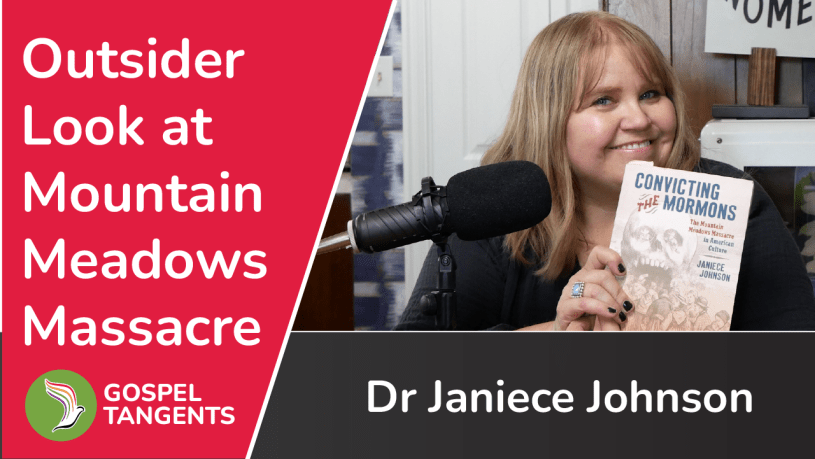
148 years ago this week, John D Lee stood in his first trial for the Mountain Meadows Massacre. Dr Janiece Johnson has studied the Mountain Meadows Massacre for over 20 years. Her latest book, “Convicting the Mormons” (can be purchased at https://amzn.to/46Thoxg ) is based both on her Ph.D. Dissertation as well as the time she spent working with Richard Turley & Barbara Jones Brown on “Vengeance is Mine.” Janiece discusses how Americans viewed the massacre, and how the massacre has been used to cast aspersions on Mormons over a century. Check out our conversation…
Trial of the Century
Janiece 26:33 I am not a lawyer, but looking at this interdependent relationship between the prosecution for Mountain Meadows, and the popular narrative that’s being told about Mountain Meadows because that relationship is always interdependent. The law is not this pristine sphere in which bias and prejudice don’t pass through this sphere.
GT 27:06 Justice is not blind. Are you saying that?
Janiece 27:08 Surprise! And maybe, we’re more attuned to that now than we were earlier in the century. But the 19th century courtroom definitely and courtrooms have never been a place free of bias or prejudice. We see that in the 19th century. And I think there’s a really intriguing relationship between what’s going on politically, and what’s going on in this popular narrative of Mountain Meadows that is spinning and growing. When John D Lee finally comes to trial in 1875, his first trial is like the O.J. [Simpson] trial in the mid-1990s.
GT 27:53 It’s that big?
Janiece 27:54 It is that big. It is. Newspapers across the country and into Europe onto the continent and the U.K. [cover this trial.] You have reports on this trial, small towns, large cities. It is the thing of the day.
GT 28:14 It is interesting to compare it to O.J. because I mean, at least people our age remember that.
Lee’s Trial Put Mormon Church on Trial
Janiece 39:34 Well, they turn around and start his trial. Now, the first trial, they don’t actually have any witnesses that can testify to him murdering anyone. So that’s a significant problem. And there are lots of curious legal things going on. They introduced one indictment in September of 1874, but they introduced a second right before the trial. And there are lots of lots of weird things going on there.
GT 40:08 We have to talk to Rick and Barbara about those issues.
Janiece 40:11 Well, those are covered in detail in The Legal Papers. But that’s why The Legal Papers are two volumes and then you have the trial transcripts, which are another 3000 pages on top of that. So that could leave us talking all day. But for where this comes in to my book, when we get to trial. In the opening arguments, they hint that they’re going to get at the real person behind the case.
GT 40:44 Who is?
Janiece 40:46 They never say. So, you don’t actually get that really said until you get to the closing arguments. But all along the way, they’ve been hinting that it’s Brigham Young. Brigham Young as the one who is behind all of this.
GT 41:02 And even today, we have people, Will Bagley for sure. I know he has passed away. But he was sure that nothing happened in the territory without Brigham Young’s knowledge and approval.
Janiece 41:16 Yeah. I mean, one of my responses there would be then, why does Brigham keep repeating himself? If people do everything he tells them to do, why does he have to say the same thing dozens of times? But anyway, that’s not a complete defense there. But I think that the first trial, though, most of the time, they’re talking about local leaders, but they leave it ambiguous enough that the press takes it and runs with it. And the most enduring thing that they achieved with the first trial was creating this fiction that Brigham Young ordered the massacre. That’s going to stick to present day. In the two years between when the first trial ended in 1875, and August of 1877, so it’s just two years. When Brigham Young dies, the narrative has shifted completely. Half of all of his obituaries, say that he ordered the Mountain Meadows Massacre. This becomes a central part. And so in those two years, that narrative completely shifts.
GT 42:37 Because of the first trial?
Janiece 42:38 Because of the first trial and the way that they shaped the first trial. It was never about Lee. It was about Mormonism in general and Brigham Young specifically.`
GT 42:53 So, it wasn’t Lee on trial, it was the Mormon Church on trial.
Janiece 42:56 Lee is sitting there at the bar the whole time, but they’ve pretty much forgotten that he’s the one on trial. And you have these different threads of accusations of Mormon savagery, questions about Mormon whiteness. Are Mormons white?
GT 43:20 That sounds like Paul Reeve.
Janiece 43:21 Yeah. Well, that’s one of those questions. Spencer Fluhman talks about the vexed whiteness of the Mormons. But curiously in a different way than Paul’s work plays out, in the trials and in a lot of this popular narrative that’s written about Mountain Meadows, it is the Mormons who look white. This is the problem. It’s not that Mormons look like all these other people of color or different ethnicities. But Mormons look American. They look white, and it’s this duplicity. That is the problem.
Janiece 44:06 I mean, I think we still have some threads of that Mormon niceness. Katie Lofton at the Mormon History Association last year talked about “the Mormons smile.” There is this duplicity. The Mormon smile shields something dangerous behind, something sinister. And that definitely plays out.
GT 44:33 Mormons just can’t be trusted.
Janiece 44:35 Yeah, no. They look white. They look American, but we can’t trust them. And therefore, they’re more dangerous than those people who signal to us with their dark skin that they can’t be trusted. I mean, these ideas about race, they’re all historically constructed. They’re slippery, these ideas. You can never quite pin them down. And if you’re in a minority religion or a minority racial heritage or whether you’re Italian or you’re Irish and you haven’t quite gained whiteness yet. You can do everything to act like you’re white. And people are still not going to think you’re white. And with Mormonism, there is this duplicity.
We’re looking at the trial and execution of John D. Lee. How reponsible was Brigham Young? How did the trials affect public opinion against the Mormons? Dr Janiece Johnson says this reverberates, even to today with the recent release of Under the Banner of Heaven.
Keeping the Massacre Alive
GT 21:46 Interesting. So Lee is executed in 1877, 20 years after the massacre. Mountain Meadows continues to live on. I mean, it seems like and correct me if I’m wrong here, but it seems like the LDS Church especially tried to bury it until Juanita Brooks came out with it. Was it ever buried between those [events?]
Janiece 22:15 It’s never completely buried. It keeps coming up. So even after statehood in 1890, you start getting more fictional stories that bring up
GT 22:28 Sherlock Holmes. There was an episode where Sherlock Holmes talked about the Mormons.
Janiece 22:34 Yeah, so the Scarlet Letter talks about Mormons. So you get Abraham Gash who was (I’m trying to remember if he’s a federal attorney,) but he has some federal position in Utah. He writes a novel about Mountain Meadows. The heart of this [story] is a little girl who’s supposed to be one of the orphans, who was left at Mountain Meadows and she is adopted by a Mormon family and never gets sent back to Arkansas with the other Mormons.
GT 23:07 That was a rumor.
Janiece 23:07 There were lots of those stories that are perpetuated. But he’s going to write a novel. So with Bancroft’s History, I think it’s published in the late 1890s, you’re going to get the first more historical view of Mountain Meadows. When we get to the 1930s, you’ve had the Reed Smoot trials, which again, all the Mountain Meadows stuff is going to be dragged up in the press. It’s only going to show up in the congressional testimony as kind of a last-ditch effort.
GT 23:08 Reed Smoot was the early 1900s, like 1904.
Janiece 23:33 1904 to 1907.
GT 23:50 Right.
Janiece 23:50 So it’s three years. A senator from Tennessee is going to bring up Mountain Meadows just at the very end as a last-ditch effort [to derail Smoot.] But you’ve got a new publication of John D. Lee’s confessions. You’ve got Wild West shows that show Mountain Meadows that senators could go for entertainment at night. You have this League of Women Voters who published this copy who give the funding to publish this new copy of John D. Lee’s confessions. And the guy who publishes it his introduction, it’s the same story we’ve heard before. He says “I had to sneak two copies of this out of Utah. People should know this happened. No one’s heard of it.” There have been dozens of editions since 1877.
GT 24:52 So, non-Mormons are keeping this alive.
Janiece 24:54 But he says, “You all need to know this. Nobody knows this, and you need to know this.” I mean, even when we go forward to like 2007 with September Dawn, the woman who wrote the screenplay for it says something very similar like “No one knows about this, and this tells you everything you need to know about the Mormons.”
GT 25:19 Well, and of course, recently we have “Under the Banner of Heaven.”
Under the Banner of Heaven
GT 25:59 And so can you talk a little bit about Under the Banner of Heaven?
Janiece 26:04 So the book comes out in 2003. I think it’s 2003. Still, if you look on Amazon, it is often the best seller in Mormonism. I think that VENGEANCE IS MINE overtook Under the Banner of Heaven maybe once.
GT 26:27 Hallelujah.
Janiece 26:28 But yeah, it is consistently [a top seller.] And he is trying to write in the wake of 9/11. He is trying to write about the dangers of religious extremism specifically to try and avoid those claims that he’s been racist if he’s talking about Muslim extremism. He goes for Mormon extremism. But Krakauer’s larger argument is that religion opens up the possibility for extremism. Therefore, religion is bad. That’s not a particularly nuanced argument about religion. Because I don’t know. Football, soccer can also cause extremism, and cause people to be violent and to do horrific, violent things.
GT 26:36 You didn’t say Hockey.
Janiece 27:04 Hockey, it just happens while they’re playing it. But, when we get to the TV show, this story is going to endure. And then it’s a TV show. This is actually the final thing that I talked about in my book is Under the Banner of Heaven, the limited series that was produced on Netflix last year.
GT 28:03 No, it was actually Hulu I think.
Janiece 28:06 Yeah, you’re right. It was on Hulu. I watched the final episode of that, and then wrote my last paragraph…
GT 28:15 Oh, really?
Janiece 28:15 …and sent off my manuscript.
GT 28:17 No way!
Janiece 28:22 Krakauer’s book looks almost nuanced compared to the TV show.
GT 28:25 Oh, really?
Janiece 28:27 Krakauer’s book is not nuanced. But the TV show takes a very heavy hand and leans into a lot of controversies, a lot of rumors. But it takes Krakauer’s argument in a different direction. It is just very focused on Mormonism. And it is that Mormonism produces dangerous men. This is what Mormonism is. And so some of the elements of that haven’t changed at all since the 19th century. Most of us aren’t really so concerned with establishing white civilization right now. I think. There are some people who are concerned with that still. But yet, the story is malleable enough that even though that structure in that discourse of white civilization has changed, the Mountain Meadows story is still malleable for whatever you want it to be.
Janiece 29:32 And these stories don’t yield any new information about Mountain Meadows. They actually tell us more about the people who are writing them than they do about the massacre itself. That is something that is worthy of our study that we need to better understand, We’ve seen lots of work done good work done to try and better understand that the horrors or Mountain Meadows as a historical event. But the way the story has been used doesn’t give us more information about that. It tells us about these places where Mormonism breaches boundaries of whether it’s people thinking about Protestantism, or Americanness or white civilization. The story becomes used to show these places where Mormonism crosses these limits whether it’s 19th century or 21st century.
GT 30:43 So, it seems like a lot of the anti-Mormonism that is still present, can we tie it all the way back to Mountain Meadows?
Janiece 30:57 A lot of it. I mean, we’re going to see a lot of these narratives still. And yeah, it’s I mean, there are some, some very direct threads that we’re going to continue to see.
Do you think MMM continues to be used as a bludgeon to attack the LDS Church? What was Brigham’s role in the massacre? Do you think Lee’s first trial unfairly tainted Young?
 Wheat & Tares
I’m late here, but I have two comments.
– President Brigham Young may or may not have authorized the massacre, but we factually know that Governor Brigham Young did not bring justice to the victims of the massacre. He is not free of guilt. It is far past time that his role here is disclosed as freely as his role before the massacre.
– Discussing Mormon skin color in the popular press of the day as a form persecution seems very ill advised.
David,
Thanks for commenting. Next week I will be discussing the role of Brigham Young in MMM with Richard Turley and Barbara Brown. They make the case as early as 1859, Brigham was pushing for prosecution of the murderers. Their book has new evidence regarding the prosecution of John D Lee and has new info that turns the traditional narrative about Young on its head.
I don’t understand your 2nd comment. Are you saying the press shouldn’t have talked aobut “Mormon skin color?”
I’ll read your new post with interest. But, I will look to their comments knowing the date of the MMM was 1857.
Regarding skin color, see Janice 44:35. I’ll leave this with my first comment.