
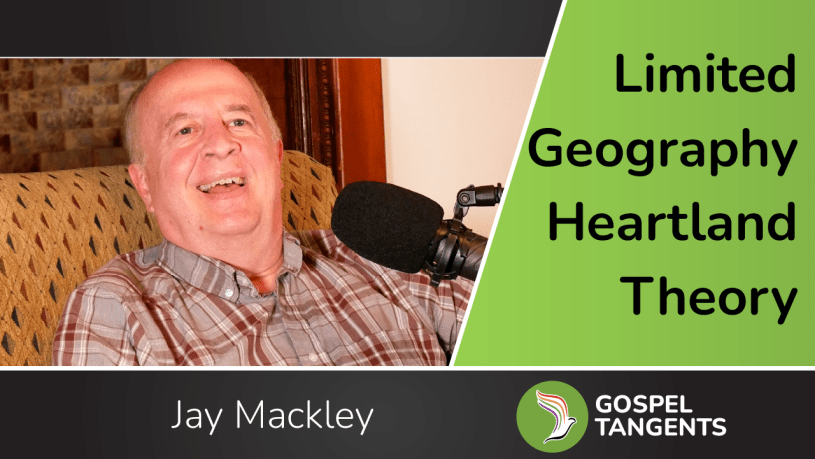
I’m excited to have Jay Mackley on the show. You probably didn’t know there is more than 1 Heartland Theory out there. A lot of people think that the current models cover too much area, but Jay has a computer optimized Limited Geography model. Check out our conversation…
GT 04:49 Okay, and so, one of the big differences and that’s why I introduced you as the Limited Geography Heartlander, because Rod [Meldrum] and Jonathan Neville. Is there a third one that I’m missing?
Jay 05:06 Rian Nelson and Wayne May.
GT 05:09 They cover about 1.5 million square miles?
Jay 05:15 That’s correct.
GT 05:17 And how big is yours?
Jay 05:19 1/10 of that. 150,000 square miles.
GT 05:22 Okay. And so I know that’s been a big issue with people. John Sorenson is probably; I like to call him the dean of Mormon geography. A lot of people depend on him. And he’s been the one who’s really proposed [a smaller area.] It used to be that everybody thought that North America was the land northward, and South America was the land southward. And John was the guy who said, “You know what? there’s no way you can get from South America to North America in three days. And so, it’s got to be a lot smaller than that. And so I think a lot of people depend on that. And so it’s been a big knock [on Heartlanders.] I know Rod and Jonathan have their different opinions on that. But it seems like you are a little bit more open to this limited geography, just here in North America, rather than Guatemala. Is that a fair statement?
Jay 06:21 Well, I’m a Heartlander, so I believe it’s here in North America. But the period of time that’s covered in the Book of Mormon where the geography is extensively discussed, is during the reign of the judges, which roughly speaking is 93 or 100 BCE to the coming of Christ. So that’s only a little over 100 years. So the total history the Nephites. During that time in the Book of Mormon, we do have a lot of information about geography. In total, the Book of Mormon has a geographical reference in one of every three verses, at least one and sometimes more. And so there was a lot of information about Book of Mormon geography in the Book of Mormon itself. And that’s what my model is based on.
GT 07:02 Okay. Okay. So I think the fact that you’re [limited geography is a plus.] What do you call yours? You don’t call it limited geography. What do you call your theory?
Jay 07:13 It’s Zarahemla-centric Heartland Model.
GT 07:16 Okay.
Jay 07:17 So the ZCHM. It doesn’t roll off the tongue.
GT 07:23 I like Limited Geography Heartland. I think you should change it. But anyway.
Jay 07:25 Maybe I should. Maybe I should.
GT 07:28 I think it would be appealing to those who believe it’s more of a limited geography. They just think that 1.5 million square miles is way too big.
Jay 07:40 No, it’s ridiculous. 1.5, or one and a half million square miles just doesn’t fit the Book of Mormon. And so yeah, that’s the one thing about the Central American model that I agree with is the limited perspective on the size of the geography that’s explained. The Book of Mormon says that the peoples in the Book of Mormon, spread throughout the land totally, in later periods, but in the stories that we have, in the narrative that we have this specific about certain towns and cities and lands and geographical features, that’s a limited, because the history took place in a limited area at that period of time. It’s just a slice of time. Later on, they certainly probably went further, much further into Canada, and much further into Mexico and South America. But that history is not covered in the Book of Mormon. We don’t have that. So we work with what we have.
Why does Jay Mackley prefer a tight translation instead of loose for the Book of Mormon? We’ll hit the tougher questions: anachronisms, DNA, and geology. There is a claim that there is a Nephite Temple across the Mississippi River from Nauvoo. Does Jay think there is evidence? Check out our conversation…
GT 15:50 Well, let me ask you this. Because you took me by a site today, right across the Mississippi River. Nauvoo is right across the Mississippi River.
Jay 16:51 Right.
GT 16:51 I know Wayne May apparently has purchased this land. And he says that it was a temple of Zarahemla there.
Jay 16:58 He believes that.
GT 16:59 He believes that and so I think you guys are planning. (Correct me if I’m wrong.) Maybe I shouldn’t say you guys. Wayne is planning on doing some ground penetrating radar or something to see if we can find this. Is that right?
Jay 17:15 There’s been some electrical resistivity scans that have been done. And they are somewhat positive toward the idea that there was a foundation there. And I don’t know about the ground penetrating radar or what Wayne’s doing currently.
GT 17:32 Okay, maybe I made that up, but that was on my understanding. So would you expect to find a temple in that lot there where Wayne thinks there’s one?
Jay 17:45 I wouldn’t expect to find any remnants of a temple.
GT 17:48 You wouldn’t expect it.
Jay 17:49 I would expect it would have been made of wood. It would have been long ago dissolved into the dirt.
GT 17:55 Okay.
Jay 17:56 But this sand foundation I’m talking about is the only thing that would indicate there was anything special there that’s been found. And you can build buildings on sand if it’s the right kind of sand. It’s actually a good foundation because it drains the water and keeps things away.
GT 18:16 So do you think Wayne’s going to find anything?
Jay 18:20 I don’t think he’s going to find anything more that’s been found. Because right now our magnetometry scans are done on that lot, electrical raises resistivity scans, which scan down so we have an idea was underneath the dirt. And there’s been some actual digging. That was before my time before I got involved with the Heartland Group/Heartland activities. But I don’t see that there’s anything left to be found. And it’s basically not conclusive as far as proof at this point.
GT 18:52 Is there anything that you guys can imagine finding that would prove to skeptics that Heartland is correct?
Jay 19:05 Well, let me parse that from two perspectives. One is the area of Montrose has been known for years as a rich artifact-finding place. People have extensive collections in their barns. Farmers around have stuff they’ve plowed up. It was obviously heavily populated area in antiquity, because, they’ve found pearls and jewelry and pipes and pottery and some metal.
GT 19:38 But that wouldn’t prove a Nephi was here or a Lamanite.
Jay 19:40 No, it wouldn’t prove that. But it just proves that it was a heavily populated area one time in antiquity and so these artifacts have been found. There hasn’t been anything that I know of that’s been found that had any writing on it in this area. The biggest thing that we’ve found so far in our research for that particular area is LIDAR scanning that has been done. We found the berms that I talked about, the earthworks, 10 miles worth of earthworks.
GT 20:12 And that’s here in Fort Madison?
Jay 20:14 No, that’s actually down just south of Montrose[, Iowa].
GT 20:17 Oh, Montrose.
Jay 20:18 Yeah.
GT 20:20 I guess I’m trying to put my skeptical hat on for a minute here.
Jay 20:24 That’s your job. That’s good.
GT 20:26 So there’s a berm. Let’s say it was built by humans. It could have been any number of Indians, or Native Americans that did this. What is the proof? How do we know that King Benjamin built it or whoever? I don’t know. It might not date to King Benjamin’s time, but a Book of Mormon person. How would we know that those berms date to a Book of Mormon person that we could identify?
Jay 20:52 Well, because we were digging into the berm and we found a “Zarahemla was here sign.”
GT 20:56 Oh, nice.
Jay 20:58 Actually, no.
GT 21:00 See, that would be perfect. And that would be great.
Jay 21:02 That would be great. But we just know, based on our research so far, that we believe that it’s prior to 1878, based on the tree ring samples that we’ve taken.
GT 21:16 Prior to 1878 is not Book of Mormon times, though.
Jay 21:18 This berm is massive, and it would require a Cahokia type effort. Why would they do it other than for defensive fortifications? And if it were the defensive fortification that maybe it belonged to Native Americans of 800 AD? Or maybe it was 100 AD? We don’t know. But we expected to find something. And we did. That’s the bottom line. We were so thrilled to get the latest LIDAR data.
GT 21:47 But if it dates to 800 AD, that wouldn’t help you, would it?
Jay 21:50 No. And so we need to do some additional work. So, it’s not conclusive at this point. But we’re not done either. So we need to have archaeological expedition that actually goes into the berms. We’ve done a little bit of preliminary look at them. But we need to actually get down and get a sifter and see what we can find. Because if it’s a defensive wall berm, that means there were soldiers. These lookouts there, they probably had human habitation and probably had a family nearby. And you would expect maybe five or 10 feet down to start finding interesting things. And what the local farmers have told us is that those berms have been very, very fruitful areas for artifact hunters, which is a very popular thing around here because of the amount of artifacts that are available. But the berms are particularly rich in those in those things. But I think if we dig down 10 or 15 feet, or five or 10, I should say, that we’ll start finding stuff.
GT 23:00 I guess the skeptic would say you may find stuff. But that doesn’t mean it’s the Book of Mormon.
Jay 23:04 No, that’s true. What we’d like to do is find stuff that we could date. Now, when I said that before, that I didn’t believe in carbon-14 dating…
GT 23:14 Unless that helps your case. Right?
Jay 23:15 Unless it helps my case {chuckles}. I don’t believe in carbon-14 dating that goes back any more than a few thousand years. I think they tried to calibrate it to account for errors. But I think the flood basically changed everything and you can’t measure the carbon 14 prior to the flood.
GT 23:33 My understanding is carbon dating is very accurate within say 100 years or so. I mean, it has an error range [but is good] up to 30,000 years.
Jay 23:43 Even that depends on if it’s contaminated, or there’s a host of things that can go wrong with the sample. So I do think it’s fairly accurate for short range dates.
GT 23:53 Would it be accurate for Book of Mormon times?
Jay 23:55 I think so. I think so. And in fact, when we did our magnetometry scans over the 250 acres, which was two years ago, we identified what looked like to be round houses and postholes and things but then we did some coring. And we took core samples from areas that looked very fruitful based on the scanning results. And we came up with charcoal, and that kind of stuff can be dated. And the magnetometry scans, it’s designed to detect where there were fires. And so fire pits are the type of things that show up on there. And so we could get charcoal by coring it down to the level where the scan said it was and this was pre very precise GPS coordinates that we used. And we sent those off to Finland. There is a company over there that sent back the results. And they came out to be 1000 AD, which basically meant we’re on the wrong trail, or we just didn’t go deep enough. And the magnetometer scanning only goes about five feet. And that’s what we took the samples from. So we think that the lands been built up over the years by farming and by time. I think I’ve heard once that just normal dirt, you’ll get an inch of stuff every 10 years or something, and so you can multiply it out and you have several feet in 2000 years.
GT 25:32 So, you’re cool with carbon dating within the last 6000 years?
Jay 25:37 I’m cool with that within that period. But even that needs to be validated. And tree ring dating dendrochronology, I think it’s called, is actually the most accurate thing. And they have documented tree rings back to farther than you think, several thousand years BC and so you can actually use that as a dating method. Also, if you can come up with a tree sample or even a fossilized one?
GT 26:08 Well, my understanding is they use tree rings to recalibrate, carbon dating, but it’s still [accurate.]
What do you think of a Book of Mormon temple across the river from Nauvoo? Will they find anything? Do you think Jay’s skepticism is healthy for geography researchers? Is Jay’s Limited Geography model a step in the right or wrong direction?
 Wheat & Tares
Obviously I’m missing something here.
Obviously I’m missing something here.
Talk about agenda based “scholarship”. Like most Mormon apologists, the heartlander and meso-american zealots start with their unfounded assumptions that the BoM is non-fiction. In their world it is damn the scientific method and full steam ahead.
It is beyond absurd to claim “…you can’t measure carbon 14 prior to the flood”. There is no scientific consensus that a global flood occurred; and certainly, no basis to assume the ark story is anything more than another OT fable.
It is tragic that Meldrum, Sorenson, Peterson, et al., still solicit funding to promote their priestcraft. One would hope that Mormon hierarchy would exercise control over these snake oil salesmen.
Perhaps Galileo was right when he wrote: “I do not feel obliged to believe that the same God who has endowed us with senses, reason, and intellect has intended us to forego their use.”
I was in the same ward as Jay a few years ago. He and Jeri are good people. It was interesting to listen to his conclusions.
Carbon 14 is unreliable because of the Flood? But dendrochronology is reliable? But we have tree ring dating verifying dates back to 10,000 BCE and even further on multiple continents. If there was a global catastrophic flood as described in Genesis, wouldn’t it have killed the trees? Just try submerging trees under water for weeks, they don’t do well. For a young earth creationist or biblical literalist, dendrochronology is not your friend.
After reading all this inane conjecture, it appears that all the apologists are accomplishing is establishing the BoM as historical fiction. But if members need a setting for the BoM, the Malay Peninsula option is starting to look good. Narrow neck of land, a pyramid-like structure in Cambodia, easier to get to from Jerusalem. And like NA, there is little archaeological or DNA evidence. What’s not to like?