

[Image from Polk Museum of Art]
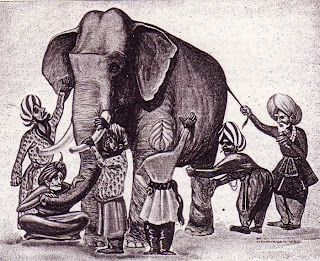
You’ve probably heard the story of the blind men describing an elephant. The parable originated in India and has spread all over the world. It goes like this:
There were once six blind men who stood by the road-side every day, and begged from the people who passed. They had often heard of elephants, but they had never seen one; for, being blind, how could they?
It so happened one morning that an elephant was driven down the road where they stood. When they were told that the great beast was before them, they asked the driver to let him stop so that they might see him.
Of course they could not see him with their eyes; but they thought that by touching him they could learn just what kind of animal he was.
The first one happened to put his hand on the elephant’s side. “Well, well!” he said, “now I know all about this beast. He is exactly like a wall.”
The second felt only of the elephant’s tusk. “My brother,” he said, “you are mistaken. He is not at all like a wall. He is round and smooth and sharp. He is more like a spear than anything else.”
The third happened to take hold of the elephant’s trunk. “Both of you are wrong,” he said. “Anybody who knows anything can see that this elephant is like a snake.”
The fourth reached out his arms, and grasped one of the elephant’s legs. “Oh, how blind you are!” he said. “It is very plain to me that he is round and tall like a tree.”
The fifth was a very tall man, and he chanced to take hold of the elephant’s ear. “The blindest man ought to know that this beast is not like any of the things that you name,” he said. “He is exactly like a huge fan.”
The sixth was very blind indeed, and it was some time before he could find the elephant at all. At last he seized the animal’s tail. “O foolish fellows!” he cried. “You surely have lost your senses. This elephant is not like a wall, or a spear, or a snake, or a tree; neither is he like a fan. But any man with a particle of sense can see that he is exactly like a rope.”
Then the elephant moved on, and the six blind men sat by the roadside all day, and quarreled about him. Each believed that he knew just how the animal looked; and each called the others hard names because they did not agree with him. People who have eyes sometimes act as foolishly. [Source]
The moral of the parable is that humans have a tendency to claim absolute truth based on their limited, subjective experience as they ignore other people’s limited, subjective experiences which may be equally true.
God as an Elephant
The nature of God is the elephant. We all have our own subjective experiences with God, but none of us can comprehend God in his entirety. Our concept of God is based on our subjective experience, mixed with what we’ve been taught about God. Here are some observations that have been true for me in my personal interactions with God:
- God has helped me with little things like lost car keys.
- God wouldn’t do what I wanted about big, huge issues like my sexual orientation and family relationships.
- God loves me unconditionally.
- Some things that I thought were blessings seem to really be just the way things are and I don’t have to be righteous or even pray and ask for them.
- God is fine with me not paying tithing.
- God confirmed for me that it was okay to stop attending Church.
And here are some ideas about God that are bigger than just my interactions with him:
- God doesn’t rebuke his followers when they do bad things in his name. From the Crusades to the Catholic sex abuse scandal to polygamy, God just lets people who say they believe in him do whatever they want.
- My opinion is that this is really poor leadership. God ought to reign in his followers when they start hurting other people. The fact that he doesn’t make him look incompetent, callous, or like he approves of things that turn out to cause a lot of harm. It would be easier to believe that God is good and just if he would just reign in the worst excesses of religious violence and abuse. This also makes it impossible to develop an accurate view of God’s nature and character. God is a really hands-off manager and it’s pretty frustrating.
- God created a world full of diseases and natural disasters. There is a lot of beauty too. But God is fine with the beauty existing side by side with things like cholera and volcanoes.
- My opinion is that God has a very different idea about good and bad, right and wrong, than we do. We should blame God for cholera and volcanoes. People who want you to credit God for every good thing, and then absolve him for every bad thing are giving a very skewed view of God. He’s God for both the good and the bad. Bad stuff is his will too. It’s okay to be angry about this, and try to find ways to, for example, treat cholera and rescue people from volcanoes.
Discussing the negative things God does usually gets shut down by someone explaining that we don’t understand God’s purposes, or we brought bad things upon ourselves. Part of the elephant is that it hurts when the elephant steps on you. The pain God causes is part of God’s nature and we shouldn’t shy away from grappling with it.
The LDS Church teaches that we have the gift of the Holy Ghost and the right to receive personal revelation. In practice, that means we are supposed to find out through revelation that we should be obedient to the prophets. Prophets admit that they don’t know everything about God, but then they shut down the revelatory process by refusing to consider other peoples’ subjective experiences with God.
For example, President Nelson isn’t going to have the same experience with God that a lesbian has, and he’s rejecting her view of the elephant just because he doesn’t want to admit that maybe her view of God could add something to his view. I believe that President Nelson, in all sincerity, is speaking the truth about his experiences with God when he talks about conditional love and a God who expects him to stay on the covenant path and have an ideal LDS life. He’s decided that the elephant is like, say, a tree trunk. That is President Nelson’s truth. However, that isn’t my truth about God. I’ve considered President Nelson’s truth and discarded it; in my experience, the elephant is more like a spear.
The LDS prophet’s view of personal revelation is that he’s got the best interpretation of the elephant, and God would tell him if there was more to it [fn 1]. The prophet knows everything important about God’s nature, and no one else can know something different. Rather than learning from other people, he shuts down their experiences and stays solely with his experience with the elephant.
Combining Our Experiences of God
What if revelation about God’s nature doesn’t work like that? What if learning about God is supposed to be a group effort?
For example, when Joseph Smith first taught that little children are saved without baptism, it was a new and merciful doctrine. The common teaching during Joseph Smith’s day was that children who died without baptism went to limbo, or even hell. How could a merciful and just God do that to a baby?
Over the decades since then, much of the Christian world has moved away from teaching that unbaptized babies go to hell. The idea is even softening in the Catholic Church. From what I can tell, the idea spread from several sources throughout Christendom. Most people don’t want to believe in a God who would send a baby to hell just because he wasn’t baptized.
We (Christians) all agree that God doesn’t damn unbaptized babies. Yay! We can all agree on this common characteristic of the God-elephant. Society’s values changed; society’s concept of God changed.
Another example of society changing its collective idea of God is slavery. Slavery is present in the Bible and is not condemned. Since then, society’s collective morality has progressed to the point that slavery is universally considered a terrible condition. Slavery still exists, but it’s wrong and no one uses the God of the Christian Bible to justify slavery anymore. Godly people went from using the Bible to justify slavery centuries ago to being convinced that God could not possibly want people to be enslaved. Society’s values changed; society’s concept of God changed.
Currently, LGBTQ issues are a hot topic in religious spaces. President Nelson says God teaches that gay sex is a sin. Other people who are LGBTQ, or have an LGBTQ family member, have prayed about the issue for themselves and felt God’s approval of gay relationships. Why would God create people and then forbid them to love? That isn’t just or kind, and we want to believe God is just and kind.
Society’s values are changing; society’s concept of God is changing.
Less Scripture; More Revelation
Sometimes religion jumps ahead of society’s morals. Religious leaders were hugely influential in the USA’s civil rights movement. Abolitionists used Christian teachings to attack slavery.
Other times, religion lags behind society’s morals. The LDS Church lagged behind the civil rights movement in the USA. Women have gained equality in secular institutions faster than they’ve gained equality in religious organizations. Some religions even reject medical science, which increases suffering.
Scripture is a record of a prophet’s relationship with God and what the prophet taught the people of his day. Each prophet who contributed to scripture is describing his view of the elephant. That’s all scripture is — a series of men trying to describe the elephant. Unfortunately, scripture has come to mean that we should limit our understanding of the elephant to what men knew of the elephant centuries ago. When we tie society’s morality to a scripture that can’t change, we stop society’s moral development. After all, “prophetic teachings do not become more valuable with age. That is why we should not seek to use the words of past prophets to dismiss the teachings of living prophets” (Elder Haynie of the 70 in General Conference April 2023). Let’s take that even further. Why do we need to confine our ideas about God’s nature to what the living prophet teaches?
President Hinckley said, “bring with you all that you have of good and truth which you have received from whatever source, and come and let us see if we may add to it.” (General Conference 2002.) Then the prophets reject every truth about God that they didn’t receive first.
Religious Freedom
This idea does not work at all with the hierarchy of The Church of Jesus Christ of Latter-day Saints. Ever since Joseph Smith told Hiram Page that the revelations he was getting were from Satan (D&C 28), prophets have had a lock on Church-wide revelations. This keeps the Church strong, but stifles revelation. As many have noted, the Church’s goal is to maintain the Church as an institution. There isn’t much about coming to know the nature of God anymore, unless it’s through Church-approved and Church-correlated channels.
I had to break through that mental barrier in order to deepen my understanding of God. Eventually, I came to accept my journals as my own personal scripture. They are a record of my dealings with God, my ponderings and my understandings. Some of my insights were sparked by reading what prophets said about their dealings with God; some came as I prayed about situations I couldn’t find in the scriptures. My scriptures aren’t canonized. No one else has to accept my records as guidance for their lives, but they are scripture to me.
Imagine a world in which the canonized scriptures were just a jumping off point, rather than a fence, for ideas about God. The nature of God includes our interactions with him. God is not an inanimate object, like a rock, that can be factually described in absolute terms. The rock weighs a certain amount, is a certain color, is made up of certain minerals. But to know a living being, we incorporate our relationship with that being. Your knowledge of your child is based on interactions with your child, not just objective facts about them. Interactions are individual experiences. You can’t let someone else dictate the terms of your interactions, or just accept that your interactions with God would be identical to someone else’s interactions. You have to have your own interactions to get to know someone, even God.
Once a belief about the nature of God has spread widely enough, we would rejoice for a new understanding of the nature of the elephant. Add or replace any previous understandings of the elephant as necessary, and then move on. Society’s morals trend towards justice, equality and mercy. Our ideas about God should never lag behind what secular philosophers can teach us about how to treat each other.
For me, there is more religious freedom outside of the Church than inside it. My beliefs are not subject to President Nelson’s veto power. My experiences with God are not limited by what prophets think is appropriate. God is an elephant, and prophets are just as blind as I am. It’s a pity we can’t all listen to each other and learn from everyone’s experiences with God.
[fn 1] The prophets in the scriptures don’t generally teach that we can’t have any different experiences or ideas about God. Limiting God to what one man says seems to be a modern development.
Questions:
- I’ve read a bit about the Jewish concept of God. Jews don’t believe in obedience without discussion (I’m generalizing). God loves a good argument with his followers. I like this approach better than the LDS and general Christian teaching that God expects exact obedience and doesn’t owe his followers an explanation. Have you ever argued with God? How did it go?
- The recorded prophets frequently record exhortations to obey rules, but once in a while, they talk about the nature of God. Do you find value in what scriptural prophets have written about the nature of God? Are there other scriptural prophets that have a different view of the elephant than you have?
 Wheat & Tares
This is a brilliant post. Brilliant when it is correct, and also brilliant when it is wrong.
The OP is correct that God does not want mindless, unthinking followers that have to be told every minuscule action that must be taken in life, such as where to look for car keys. God wants people who can think and reason for themselves after receiving teaching and enlightenment.
God is not a hateful being—it is man who twists religious teachings to perpetrate hatred. God would never create someone to be a certain way (race, sex, orientation, etc) and then demand that people be hated for the way they weee created.
The OP strays, however, when it infers that God is responsible for creating all of the pain that humans suffer through. Much of the pain comes from individuals’ own actions: gluttony, substance abuse, and wanton sexuality for instance. It was not God who created the honky tonks, Dairy Queens, and 7-Elevens. It was man, influenced by dark forces.
But the central thesis of the OP is absolutely correct. We are not here to be mindless creatures who are controlled by others like some character in a violent video game. We are here to learn and grow, and that requires us to evaluate what we are taught in light of our experience on this planet.
JCS, you misread the original post. Janey didn’t say God is responsible for all or even most of human suffering. She specifically named volcanoes and cholera as two things God is responsible for putting on our fallen earth. She didn’t say anything about the misery that we humans cause for ourselves. You seem to be going along with the common Mormon idea where the intimacy gets blamed for 90% of their own suffering when you say that much of the pain that humans suffer is their own fault. Personally, I would say that a good portion of my suffering is God’s fault. The largest portion of my personal suffering was caused by fellow humans doing evil to me. Last the smallest portion of my suffering has been my own carelessness or stupidity.
Let’s take your lovely example of gluttony. Science is now proving that over eating is really caused not by the person “gluttony” but by their body lacking certain things that turn off hunger. They are honestly hungry, but their body is malfunctioning so they stay too hungry and eat more than their body needs. Their fault? No, they have a poorly designed body that God gave them. God’s fault.
Janey, wonderful post. And I agree with all of it. I really do not like the church’s current prophet’s experience with God. I think he has transferred his experience with his earthly father onto God and turned God into a judgmental jerk. Then he sees nothing wrong with loving his own children in conditional ways.
I am still trying to figure out if I have done something like that and projected ideas onto God that are not God at all.
Really enjoyed your treatment of this parable, Janey. Thank you. So much of what you are saying rings true to me. I’m going to respond to your question about arguing with God. In a poem I wrote for W&T awhile back, I included this line: “Ain’t got much use for a god I can’t swear at.”
Maybe the first time I really argued with God was during the peak of my faith crisis in college. After months of complete inactivity from the Church, and a great deal of emotional struggle, I finally stopped wearing my temple garments. When I finally did, I prayed and said, “Okay, God. I’m taking off these garments and I’m going to see if you still love me.” Life went on, and from time to time, I’ve continued to have spiritual experiences within the context of my agnosticism.
More recently, in fellowship with the Community of Christ, I’ve begun blending traditional Christian theology with traditional mindfulness practice. I’ve notice how my impulse is to stifle who I am in order to be reverent and pure-minded. Old Mormon habit that actually impedes meditation. So, when I start meditating, I just try to let it flow out of me, whatever it is: angry thoughts, silly thoughts, even those pesky impure thoughts I routinely have. I just let myself experience them, and then I picture myself placing those thoughts on an altar. In effect, I say, “See God? This is me. Deal with it.” It tends to go well and include a sense of relief.
I’m learning how to argue with God. And bottom line, a God who cannot tolerate our temper tantrums, who would punish us for them instead of walking alongside us as we have them, well… in my opinion, a God who is that thin-skinned is a pretty useless god.
Great article; and thought-provoking. One nit: Wasn’t it Pte . Hinckley who made the 2002 quote in General Conference ?
It doesn’t make sense to me that God will help us find lost keys, wedding rings etc but doesn’t respond to the pleadings and cries for help from starving people—including the 3.1 million children who die from starvation each year (well I guess he responds—letting them die to ease their suffering).
Clearly, life is a game of luck, beginning with the circumstances of one’s birth.
I’ve come to believe God is more hands off than hands on.
(And yes why is “His” church always lagging in recognizing equal rights?)
I am reminded of this parable whenever I encounter musings on/conversations with others about “Heavenly Mother”. “Heavenly Mother” is part of “Team God” – so descriptions of “Heavenly Mother” are descriptions of “God” in our theology. We have “Heavenly Parents”. And our descriptions of “God” as divided between “Heavenly Father” and “Heavenly Mother” are very distinct and specific – and become points of contention rather then points of diversity and/or connection.
Can’t think of anything good about Cholera. If Vibrio cholerae was sentient, they may disagree. (as an aside, the oldest fossil records of life are bacterial)
If it wasn’t for volcanoes, no Hawaiian vacations or hiking in the Andes. In fact. no volcanoes no life on earth. Making the argument of where to vacation a moot point.
I favor the view that not only does God like a good argument, god expects us to argue even if it is faulty.
However, those who believe in exact obedience seem to believe that obedience requires the eradication of those who favor the argumentative model. I would debate why that is, but I don’t want to set up myself for elimination.
But I’d like to defend 7-11 and Dairy Queen due to the fact they continue to be attacked by one of us on W&T. Am I the only one here who enjoys Big Gulps and Blizzards every once in a while?
A reminder that the Talking Heads song “Nothing But Flowers,” released in 1988, contains the line “I miss the honky tonks, Dairy Queens, and 7-Elevens.” Evidence that JCS has been trolling us for 35 years.
“God has helped me with little things like lost car keys.”
I have similar experiences.
“God wouldn’t do what I wanted about big, huge issues like my sexual orientation and family relationships.”
Yes; nothing that intrudes on someone else’s free agency. Turns out God *was* helping but it took 20 years to help; I had some growing and adulting to do.
“God loves me unconditionally.”
So it seems. The devil is in the details. I am supposed to love my enemies but they ARE still my enemies. I just have warm fuzzy feelings about them (supposed to, anyway). In other words, God loving you unconditionally might not translate into any specific benefit. But it is nice to know.
“Some things that I thought were blessings seem to really be just the way things are and I don’t have to be righteous or even pray and ask for them.”
This is also true for the bad things in life. Stuff happens.
“God is fine with me not paying tithing.”
Of course. It is your choice to make. God is find with you making choices. That’s the whole purpose (more or less) of mortality. However, being fine with your choices might not mean what you think it means. God is fine with me building a house, he is fine with me NOT building a house, but where will I live? I am the beneficiary of my choices.
“God confirmed for me that it was okay to stop attending Church.”
Of course. It is your choice to make. If you want to attend; do. If not, don’t. To do otherwise is stressful, fake, hypocritical. The only immediate consequence of not attending is a lack of that particular kind of sociality; but maybe you don’t want it anyway. I am pretty much an introvert and don’t need regular social interaction.
Doctrine and Covenants section 88 is relevant to this topic.
32 And they who remain shall also be quickened; nevertheless, they shall return again to their own place, to enjoy that which they are willing to receive, because they were not willing to enjoy that which they might have received.
33 For what doth it profit a man if a gift is bestowed upon him, and he receive not the gift? Behold, he rejoices not in that which is given unto him, neither rejoices in him who is the giver of the gift.
I interpret this (and nearby verses) as being that I am building my next life RIGHT NOW. The things I want and like, and seek in this life I will continue (most likely) to want and seek in the next life; and I will CHOOSE the kingdom that possesses the things I want and like, and the indication is that I will be happy with my choice; even if it is not your choice (and vice-versa).
If you don’t like church NOW you probably won’t like it THEN; same with any other like or dislike.
If you pay tithing it is because you WANT TO. If not, then don’t. God needs absolutely nothing from you, me or any other human that ever lived. Choose a life and live it. Certain benefits exist for social animals that do not exist for solitary animals, and of course, some benefits exist for solitary animals; going where you want, when you want, nobody telling you what to do or not do. Just don’t fall on hard times or break a leg.
“The OP strays, however, when it infers that God is responsible for creating all of the pain that humans suffer through.”
This is the “Problem of Evil”
https://en.wikipedia.org/wiki/Problem_of_evil
Consider the captain of a ship; ultimately responsible for everything on the ship.
The orthodox view of God is Omni-Omni, omni everything, captain of the ship. The implication is that you have NO freedom to choose, only an illusion, for it was known the moment you were created exactly what you would do, every minute of your life, and necessarily is not just “okay” with God, but designed by God, because there is no other designer.
Were that the case, there’s no point discussing it, except of course this conversation was foreseen and inevitable!
OR
God did NOT create everything; deep inside every person is an intelligence, a spark of “you” that is not like “me” and it is that which creates free agency and choice. Ensuring the sanctity of choice rises above (almost?) everything else. Why is that? I believe it is because God is a parent, we are the children, and children must be raised not created! What will we become? Some children turn out a lot better than others despite your efforts. They have freedom! Not many choose wisely in my opinion BUT THATS THE PURPOSE; to sift the wheat from the tares; each being responsible for your own choices. Handling the power of God must be only in righteousness; and while God *might* know who is righteaus, justice requires a demonstration and it must be uncontaminated by influence. Satan will influence; it is what he does, and to keep things in balance God (or angels your your great-great-grandmother) will also influence you; SO THAT you make your choices based on what is in your heart and mind.
Great article, I love your use of The Parable of the Elephant to draw comparison to our understanding of the nature of God. I wonder, and I may have some ideas, but what would be
the argument put forth by the general body of orthodoxy if this concept came up in, let’s say, Gospel doctrine class one Sunday?
I wrote on this as well. :). https://wheatandtares.org/2018/04/05/looking-at-god/
I should add that vis a vis slavery:
“Deuteronomy 23:15 NKJV
“You shall not give back to his master the slave who has escaped from his master to you.”
All of that said, I’ve always been taken with the God of the Book of Abraham who comes across as one of us, trying to help us find our way home in a universe that predates him and that he found himself in.
If you accept that God might be at least indirectly responsible for negative things, I believe you have to consider the possibilities of a god who is malicious, incompetent, trickster, or indifferent. Or non existent.
Paradoxically, one of the few spiritual experiences in my life was when I took my telescope to the middle of the Arizona desert at midnight – by myself – to see if I could see a sandstorm on Mars. While I was observing the stars it occurred to me that I was literally nothing and also that my problems were literally nothing. It was a massive revelation.
The closest thing to a god that I can accept as existing is science and logic. I don’t understand why atheism is such a negative thing. Embracing logic and reason seems noble and worthwhile; it doesn’t have to equal cynicism and nihilism. I actually think the world would be a better place if more people thought “what is logical” vs “what would Jesus do?” So much pain and suffering in the name of God and the fact that I see an elephant trunk instead of his anus.
Anna – thanks for setting the record straight. Lots of this world’s suffering is not caused by other people. We can expect God to take responsibility for setting things up this way.
That goes right along with Jake C’s poetic comment. God can handle our anger. He wouldn’t be much of a God if the only thing he can deal with is worship and praise. Good leaders must deal with the hard stuff too.
Raymond Winn – thanks for catching that! I fixed it.
Michael 2 – sure, that’s your experience with God and I wish you all the best. Your God won’t be designing my afterlife, however.
Todd – wouldn’t that be a fun discussion? We fervently testify that God knows each of us as individuals, but then assume that God, who is eternal and unchanging, must treat everyone the same in everything that matters. If you had the discussion in Sunday School, you’d sure upset a lot of people! But I bet at least one person would come thank you for it later in private.
Toad – I’ve had the same thoughts about how believing in science and reason leads to moral behavior. Altruism and morality aren’t confined to religion. I saw someone comment on the development of AI by asking what would happen if AI was really intelligent. Like, if a CEO hands over its company and its profits to AI, and AI decides that happy people are more productive so it gives everyone a raise and reduces the quotas. It just makes sense to treat people decently. Religious beliefs motivate cruelty as much as anything else motivates cruelty.
Michael 2 – have you ever had An Experience with God? I don’t mean the typical Church answer, in which obedience to what teachers and prophets tell you to do produces a warm calm feeling. I mean you’ve wrestled with God (like Jacob in the Old Testament) or gotten angry with God (like Jake C describes) or somehow encountered God beyond just the well-behaved and predictable God who sends you a warm feeling when you do exactly what prophets tell you to do?
Janey, if what if Michael 2’s experience with God was like that? Would it invalidate his experience? Why would it be invalid? And who are you to suggest that Michael 2 is experiencing God the wrong way?
I don’t think the problem is with the wrestle with God. The problem is when religion is used, in a way, to escape the wrestle. Jacob, in Genesis 34, has an all time WWE type match with God and God seems so pleased with the wrestling match, that he awards Jacob a new name, Israel. The name Jacob means, “He who wrestles with God”. The wrestle is what brings about change, symbolized in the story by the name change, Israel, which means, “Let God Prevail”. I prefer to view God, in this context, not so much as the literal human we profess, but as the very process of redemption, the process better known as “Life”. Life is a wrestle, it’s both beautiful and ugly, rewarding and punishing, happy and sad. To view the gospel as a way to escape “Life” is to completely misunderstand Mormon theology. The wrestle is not the problem, the attempt to avoid the wrestle, IMO, is the belief that we can become like God without the very process that brings it to pass.
As far a truth, the LDS tradition approaches truth as a Noun, like something I discover and set on my desk, as opposed to a verb, maybe even better, an adverb. Truth being the manner in which we live, the pursuit of goodness and justice, not facts.
Quem Iuppiter vult perdere, dementat prius
“Those whom the gods wish to destroy, they first deprive of reason.”
“True scholarship, by definition, must “be conducted without bias, and results published, regardless of whether they confirm any particular hypothesis or doctrine,” he said. If you begin with a desired conclusion, you must ignore contradictory evidence. “That is not scholarship; it is propaganda.”
This statement is a stinging indictment against any intellectual or spiritual endeavor that begins with the need to confirm what has already been decided. This problem, in my opinion, not only threatens “True Scholarship”, but also meaningful “Faith”. If my faith is pinned, at every turn, to confirming that “The Church is true”, then it already lacks what I think Moroni is teaching us in Moroni 7.
Moroni seems to suggest that faith carries with it an ethical responsibility, which is, a willingness and humility to continually place my beliefs back into the experiment of mortalities crucible, to be tried and tested, to bring forth fruit meet for repentance. For as Moroni says, “Ye receive no witness until after the trial of your faith”.
Faith is not a clinging to what I know, it’s taking the assurance I have and using it to hurl me towards the unknown. It’s exposure to the mystery of what God is and what I am capable of becoming.
We might say faith is where rationality meets intuition. It’s when we have enough evidence to make things, not seen, plausible, and our common sense, moral compass urges us forward into the unknown. Thank you for your beautiful writing.
“Men see the grandeur of the idea of unity in the means, God in the end. That is why the idea of grandeur leads us into a thousand forms of pettiness. To force all men to march in step toward a single goal—that is a human idea. To introduce endless variety into actions but to combine those actions in such a way that all lead via a thousand diverse paths to the accomplishment of a grand design—that is a divine idea.
The human idea of unity is almost always sterile; God’s idea is immensely fertile. Men believe that they attest to their grandeur when they simplify the means; but it is God’s purpose that is simple, while his means vary endlessly.”
.Alexis De Tocqueville captures in two paragraphs, what I believe, summarizes perfectly, the cycle of human failure. Shakespeare’s Hamlet says it this way, “There are more things in Heaven and Earth than are dreamt of in your philosophy”. Human beings, and unfortunately, Latter day saints who tout themselves as truth seekers, have instead relegated themselves, without even knowing it, to “Proposition defenders”. We are no better than the corrupt version of science that Terryl Givens calls “Scientism”. Our seeking instinct has been obstructed by our loyalty to truth claims, instead of our commitment to God. And why wouldn’t it be? Why would one seek when what they know seems to be all there is?
Tocqueville beautifully illustrates what Dave Brisbin expresses in his book “The Fifth Way”, he writes, “The quality of the means we use ALWAYS matches the ends we produce”. As I have read the New Testament this year, Jesus seems to constantly ask us to exchange ends for means. In the Lord’s prayer, he says “On Earth as it is in Heaven”. He empty’s himself of his divinity, bringing heaven to earth, so earth can be brought to heaven. It seems clear to me that, Heaven is not some arbitrary reward in the hereafter reserved for the ultra-pious and exact law keepers, but rather, the construction of the types of people and relationships that constitute heaven. In short, the gospel is not a way to be seen as acceptable to God, it is “The Way” to see as he sees, without bias, pretense, preference or prejudice.
jasonsager05 – I genuinely wanted to know if that was his experience with God, and if he had ever sought a different experience with God. The point of this post is that we all have different experiences with God. The way I read Michael 2’s comments, he was criticizing my experience with God by warning me of some sort of consequence for following my own experiences. The whole tenor of his post (as I read it) was, “you can do that, but you’ll be sorry later.” If I was misreading him, I wanted to know. Michael 2 doesn’t have any authority to devalue my experience with God.
Personally, I think RMN and Michael 2 have had experiences with God that reinforce their obedience and conditional love mindset. I’m not out to devalue that. My experience with God’s unconditional love is equally as valuable, though. And people like RMN and Michael 2 tend to jump up and say that I can’t have that experience.
God is an elephant, and Michael 2’s experience is valid for him, and my experience is valid for me. I’m coming from a place where, in my younger years, I had experiences more like Michael 2’s suggested experiences of conditional love and hope for a greater reward if I was more obedient than someone else. I was wondering if he’s ever challenged that experience (which he doesn’t have to do). He doesn’t have to seek a different experience with God, but I was curious if he ever had, just because I used to see God the way he sees God now (based on what he said in his post, which is necessarily just a brief glimpse).
I know the discussion here is pretty much over, but I keep thinking about the parable and how we each see God so differently. The thought keeps nagging at me that there are blind people who approach the elephant and grab hold of its rider’s foot. The rider would be an organized religion, which teaches us about God, helps us to approach God by bringing the elephant to the blind men, then keeping it still as the blind men approach. But he/it is not the elephant/God. In the application of the parable to God, the rider is a helper of the blind men, but also a controller of the elephant, so of course people’s experience of God get tangled up in the church that teaches then about God. So, how many are describing religion (the rider’s foot) rather than describing an experience with God?
I know for myself, I was brought up Mormon where God is a male with a body and is our Father. Well, my experience with my earthly father gave me a different lens for the concept of “father” and then the emphasis of heavenly FATHER by the church destroyed my ability to trust God. For a long time, I couldn’t even get to God because my church was in the way. The elephant rider was kicking me in the head.
Now that I have stopped away from the church, I experience God through her creations, and as a very nurturing, creative, feminine being.
I look at other Mormons I know, and they seem to experience God as masculine, powerful, commanding, hierarchal, organized, and his love as conditional. Sort of like I see the church. I have to wonder, are they really experiencing God, or just experiencing the church that they think is run by/is God. I wonder, are they feeling part of the elephant, or did they catch hold of the rider’s foot?
Anna, thank you so much for your reflections on the rider and also the divine feminine. I think a lot of us, especially many of us who have stepped away from Church activity, are exploring the experience of God as a feminine presence. That has increasingly been my deliberate choice in recent months. And I know that for some others I’ve encountered, the experience of communing with the divine has ceased to be about a singular gender, or even drop gender altogether. I love how this parable directs me to image possibilities beyond my limited perspective
Beautiful reflection Anna. If there is anything philosophically sophisticated in Mormon theology, which I actually think there is much, the Church has just dumbed everything down to the level of an 8 year old, I do however believe Lehi’s discourse in 2 Nephi 2, if read critically reveals the need for opposition in all things. ALL things, that’s a lot of things. Unfortunately, the Mormon interpretation of this verse suggest opposition exists to give definition to the other, light and darkness, happiness and sadness, etc. However, that is not how the text reads. The text says, “There must “Needs” be opposition in all things”, inferring that opposition is not a binary, but instead what makes “The Whole”. Opposition is the glue that prevents the isolated parts from becoming excessive and extreme. We have all but eliminated the “Feminine” energy in God (the divine), and as a result the “Masculine” energy has reached the point where a virtue becomes a vice. Joseph Smith reportedly once said, “Truth is found in the proving of contraries”, and if that is true then we have chopped half of the truth of God out of the picture.