
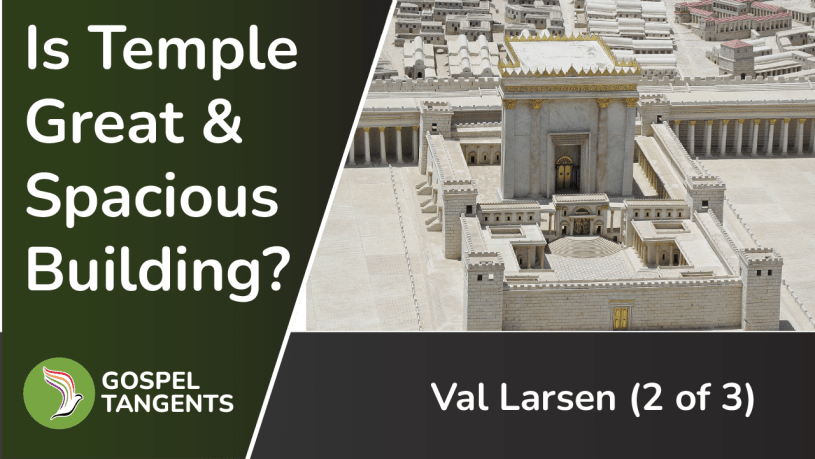
Is the Jerusalem Temple the Great & Spacious Building mentioned in the Book of Mormon? Is Divine Mother, theosis/exaltation in the Book of Mormon? Dr Val Larsen says “Yes!” He also thinks Laman & Lemuel tried to kill Nephi for religious reasons! Check out our conversation!
Val 31:28 So let’s begin with the great and spacious building. In his book Plain and Precious Things, David Butler now this is D John Butler, not the seminary teacher, Dave Butler that a lot of people follow. I had never heard of David Butler before sacrament meeting this past week. Somebody mentioned, “I’m sure a lot of you are following Dave Butler,” and I thought “Oh, that didn’t know D John had all these followers” But it turned out it was a different guy. Dave Butler offers several reasons for thinking that this great building is the temple. The fact that the building is high in the air…
GT 31:59 Wait, wait, wait. The great and spacious building?
Val 32:00 Yes. It’s the temple.
GT 32:02 Is the temple?
Val 32:02 Yes. Remember.
GT 32:04 They are mocking?
Val 32:04 I’m telling you. I’m telling you Lehi’s dream is set in Jerusalem. Right? The great and spacious building is high in the air on Mount Moriah. Down into the valley, there’s a valley in the dream. Right? In which a pure fountain of water flows and dirty, dangerous water flows. And on the opposite side, there is the Mount of Olives that’s totally associated with Christ and has a sacred tree on it. Okay. So what I’m doing here is I’m saying Lehi’s dream, this is typical of dreams. You were telling me about a dream that had your truck in it before we started here. Right? Lehi had a dream that had Jerusalem in it. Is this surprising?
Val 32:53 So, I kind of got off track here. Temples are archetypically in a high place, and Butler notes that HaKol was the most obvious word for Lehi to use when he’s describing the great and spacious building. The Hebrew word HaKol refers specifically to the large middle room of the temple. The temple would have these three main sections. In the middle one, the biggest one, was the HaKol. But it was also used for the temple as a whole and for any large building. So it’s a capacious word. If you’re referring to a great building, you’d say HaKol, but you could also use it to refer to that main room in the temple or to the temple as a whole. And it can be used again for a building like the palace. If Lehi said, HaKol as seems likely, great building, and temple or palace were alternative translations of what he said. Lehi indicated that the people in the building wore clothes that were exceedingly fine, the kind of clothing that the temple priests and princes typically wear. Butler notes that Exodus actually repeatedly prescribes fine clothing, the word that’s actually used there in the Book of Mormon as the appropriate dress for the priests in the temple. So these people were all dressed in fine clothing. They’re pointing and mocking the people that are over on the other side of the Kedron Valley, at worshipping at the sacred tree that had been there at that time.
Val 34:22 The mocking people in the great and spacious building are at clearly connected with the Jews who mocked Lehi when he was prophesying. And that’s said in the Book of Mormon right there. He was mocked. And Lehi says the mockers were of the house of Israel. And among the mockers, the Bible tells us were the chief priests who would be found in the temple. The Bible, this is in Second Chronicles chapter…
GT 34:46 These are the Josiahan Jews.
Val 34:48 Yeah, it says that prophets came into Israel at that time, and that the chief priests mocked them. So Lehi is one of the prophets that came in at that time, and the chief priests were among the people that were mocking him. Okay. Since they have the power to kill him in spite of his status and personal wealth. Lehi is obviously a rich guy and prosperous guy from what we know of him. It’s apparent that the people who oppose and mock Lehi include the civil and religious authorities, the people in Jerusalem that have power; that is the people who control and administer the palace and the temple. And of course, their temple and palace, like the great and spacious building in the dream are on the verge of an exceedingly great fall. I mean, a few years after this, everything’s going to be razed to the ground. So this great building that’s about to fall great and spacious, HaKol, you can call it the great and spacious building. You can call the great and spacious temple too. But it is going to fall.
What do you think of this claim? Do you agree or disagree?
Satan is Fruit of Tree of Knowledge
Is Satan the Fruit of Tree Knowledge? Is Divine Mother in the Temple ceremonies? We’ll talk about these and other issues like why Christ was baptized, and why Dr Val Larsen thinks Moral Influence is the best atonement theory. Check out our conversation…
Val 23:51 Let me pause here and note that the sacred tree is an important element in all of Lehi’s major teachings, his dream, the allegory of the olive tree, which is I said, you see it with Zenos. But it was also actually Lehi’s teaching, and his final Patriarchal Blessing of his descendants. At the end of Jacob’s patriarchal blessing. Lehi mentions mother in heaven, and her two most prominent sons, two divine beings who stand in opposition to each other. So the fallen angels, Satan, who seeks to destroy humanity and the mediating Messiah, Christ who seeks to save them. He then mentions two sacred trees, the Tree of Knowledge of Good and Evil and the Tree of Life. Satan is associated with the Tree of Knowledge of Good and Evil. He gives us its fruit. He probably is its fruit.
GT 24:43 Satan is the fruit of the…
Val 24:45 Tree of Knowledge of Good and Evil.
GT 24:46 Wow.
Val 24:47 Okay, now think about this. The tree is the Divine Mother. And her two most prominent sons in the pre-existence are Jehovah and Lucifer. And, again, the fruit of the tree…
GT 25:03 This is another reason why [mainstream] Christians don’t like us.
Val 25:06 Yes. The fruit of the tree is the children of the mother. It is a consistent symbol. So the Tree of the Knowledge of Good and Evil, I’m saying it’s Satan. Let me go on here in the way I want to say it and I’ll come back to in a second, okay. So when we partake of that fruit, we come to know who Satan is, to know evil. Adam and Eve knew good before they met Satan. They already knew good, but they couldn’t fully understand what good was until they partook of the fruit that Satan gave them. After partaking of that fruit, Eve quickly figured out who Satan was. She and Adam set their sights on getting back to the Tree of Life where the other fruit was available. Christ who can usher them again back into communion with the gods.
Val 25:59 But it isn’t just Eve and Adam who have to partake of these two trees. The trees mark a cycle of departure from father and mother in heaven and return to them. That all of us have to experience. These symbols symbol suggests that each of us takes leave of our mother in heaven as we entered this world. And when we decide to leave her and the Father through birth, we like Eve, partake of the Tree of Knowledge of Good and Evil. We encounter Satan. Then we come to Christ, if we come to Christ, and repent and partake of the fruit of the Mother Tree of the Tree of Life. We’re reincorporated in the heavenly Council and can live forever like our father and mother in heaven.
Val 26:40 So these two trees, one tree is bearing Satan. Satan gives Eve the fruit. She eats of the fruit. Now she knows what evil is. She knows/ She recognizes Satan and evil. And her task now is to get back to the Tree of Life, but she can’t get there before she’s had an encounter with Christ. They need that altar. And they need to make sacrifices and they need to receive Christ, and receive the skins that he’s going to give them and repent of their sins, and now come back and partake of that tree of life, which is the atonement. That’s actually the thing that when they’re making the sacrifices and doing all that, they’re actually, in a sense, partaking of that tree. But through that repentance and brokenhearted and contrition, that’s what gets them back.
Val 27:31 So, Adam and Eve are actually emblematic of every one of us. Bruce Hafen and Marie Hafen talk about this as in in powerful ways. But every one of us partook of the Tree of Knowledge of Good and Evil. We did that when we made the decision to depart out of the Eden we were in, which is the pre existent time, and enter this world where we’re going to know Satan. So birth into this world is to encounter Satan. And, Satan is a son of the divine mother. So, the Divine Mother has these two sons, and she’s right there with us as we enter. I mean, I think we depart from our [heavenly parents.] It’s just like Nephi. Nephi is coming down from the tree in heaven. So every one of us. So we depart from our Divine Mother and come into this world. And first thing we do is we encounter Satan. Now we know both good and evil in more profound ways. And hopefully we get back to Gethsemane to the Mount of Olives, and partake of that tree of that fruit of that mother again, that second son that’s going to save us.
I should note that these are short segments from Val’s article from the Interpreter: Theosis in the Book of Mormon: The Work and Glory of the Father, Mother and Son, and Holy Ghost.
Do you find these explanations as surprising as I did? Is Val pushing the theological envelope? Do you think Satan is the fruit of the Tree of Knowledge of Good and Evil?
 Wheat & Tares
How much wackier can LDS theology GET? Ooooops, my mistake. We don’t have a theology, we have revelation, and ten thousand wacky explanations.
Oh boy. Val Larsen should stick to marketing.
I have very little patience for ad hominems. In the words of Jim Rome, “have a take and don’t suck.” The first 2 comments suck and further ad hominems will be deleted. You are welcome to disagree with Val, but drive by insults are discouraged and deleted from this point on. Disagree with a reason, not an insult.
I knew his view would be controversial, but if you’re going to disagree, give me something substantive, not insulting.
I give Val Larsen credit at for thinking in new ways, which is sadly lacking in the church in general. I may not agree on all of the ideas he was expressing. The one area or criticism is not on the ideas but in how long it took to lay out his thesis. I would love to have Dan McClellan weigh in on Val Larsen’s ideas.
Rick, I found Val’s hypothesis mildly interesting as a thought experiment, but nothing more than that. It feels a little bit like the deep analysis fans often engage in with their favorite fictional characters. Sure, you can make the argument that Lehi was trying to each, in a veiled manner, the existence of a heavenly mother and the connection between her, Jesus, and Satan, as well as the idea that the holiest place in the Israelite religion had become, at least for Lehi, a den of iniquity filled with the unrighteous, but to get there, you have to hand wave a whole lot of historicity issues. My biggest objection is that if you’re going to claim that Adam and Eve and Satan are literal/historical (and Lehi too for that matter), then why is the fruit of the tree of knowledge of good and evil then a figurative reference to Satan who is, according to LDS and most Christian traditions, already present in the Garden of Eden? It just seems to be a rather odd place to draw a line between the literal and the figurative.
Raymond, I agree you that he a long time getting to his point. When we met at the restaurant, it was more of a dialogue and I enjoyed the Convo more. But since he knew he was being recorded, he wanted to get all his ducks in a row. I did mention his thesis briefly to Dan McClellan and Dan felt the merger of El and Yahweh happened a few centuries earlier and said there were some problems relating Asherah to Heavenly Mother.
Not a Cougar, I found Val’s Explanation of great and spacious building compelling, and makes a lot of sense.
I’m a little bothered by Satan being the fruit(and it didn’t seem like he held strongly to that position.) Knowledge=Satan seems to be an anti-intellectual message. I anm reminded that some think the transition from Hunter-gatherer(Cain) to farming(Abel) is indeed a bit of an anti-intellectual argument, and perhaps had ancient origins, but I find it problematic. Knowledge is power, not the devil.
The LDS version of the Garden of Eden story does not change the essential elements of the Christian narrative. This has long puzzled me because there is an inherent contradiction. The problem is LDS doctrine teaches that every person existed as spirits before coming to earth. In this premortal world we had agency and with that agency we individually and collectively made a deliberate choice to reject Satan and follow God’s plan. The essence of God’s plan being that we chose to leave the presence of God to experience mortality where we would have agency to choose for ourselves. To save us from our sins Jesus Christ offered himself to be our Redeemer. All of this debate and decisions taking place prior to the creation.
With that background why do we find Adam & Eve having to make the choice to follow God a second time? And why this second time are they making this choice with very limited understanding? Agency require us to have knowledge of the consequences of our choices. Adam & Eve are presented as being unaware of the reasons for not eating the fruit, or the benefits and costs for eating the fruit. God simply says they will die. That is an awfully incomplete warning given what was really going to happen. Why is Satan the one more fully explaining the choice? Why is he offering the choice? Why is Satan blamed? If the choice to eat the fruit is a good and necessary thing, why is God angry at Satan?
With all the changes church leadership has been willing to make to the temple instruction, why are they reluctant to improve or clarify the conflict between God, Satan and Adam & Eve? For example, shouldn’t God be the one explaining to Adam and Eve the costs and benefits of eating the fruit? Shouldn’t Adam & Eve willfully make the choice to eat, seeing it is a good thing to do so? Shouldn’t the offer made by Satan be a deception that is clearly in conflict with God’s plan?
So, under this framework, Satan is delicious to the taste and very desirable?