
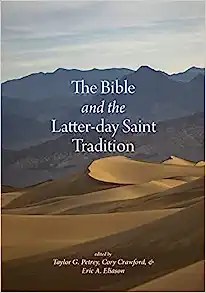
Here is the 4th installment in my series on Paul. Following Marcus Borg’s New Testament chronology in order (see below) we’re at Philemon. It’s a short book of only 25 verses, so I’m going to cover it in one paragraph, then move on to introduce a new LDS source for your study of the Bible: The Bible and the Latter-day Saint Tradition (Univ. of Utah Press, 2023).
Onesimus was a slave. His apparently rich owner was Philemon. Philemon was a Christian and likely a leader in his house church. Onesimus ran away and came into contact with Paul, likely because he knew Philemon admired Paul, and while with Paul he converted and was of some help to Paul. Being a runaway slave was a very serious transgression in Roman society. Paul wrote a nice letter to Philemon asking him to forgive Onesimus and sent it back to Philemon in the possession of Onesimus the slave. (The KJV often softens the harsh relationship by using the term “servant.”) In the letter, Paul is using friendly persuasion to get Philemon to do the right thing, maybe even free Onesimus, now a fellow Christian. Paul sounds like a bishop having a conversation with one of the high rollers in the ward, putting his arm around Brother Bigshot while strolling down the hall: “George, I’m sure you know that boy Joshua Kimball who is going on a mission next month? He worked for the summer but it’s time for him to go and his mother can’t spare much to support him. I know a couple of hundred dollars a month wouldn’t be much of a burden on you. It might not be any burden at all. Can I tell the mother a kind member of the ward is going to contribute half of his mission cost every month for the next couple of years?”
Now let’s talk about The Bible and the Latter-day Saint Tradition, hot off the press at the University of Utah. It’s edited by Taylor Petrey, Cory Crawford, and Eric Eliason. There are 31 chapters, written by scholars across the LDS spectrum and covering both the Bible and the LDS engagement with it. Put this under your pillow at night and you’ll wake up smarter. I’ll just talk about one chapter, “Paul’s Letters and the Acts of the Apostles,” by Taylor Petrey. I’ll just pull out some good info from the chapter in a bullet list:
- “In the twentieth century, Mormon engagement with Paul largely avoided the historical-critical scholarship about the search for the “real” Paul and mostly downplayed interests in Pauline theology. … LDS critical interest in the historical Paul remains tenuous.”
- Most scholars recognize only seven authentic letters of Paul (Romans, 1 Cor., 2 Cor., 1 Thess., Galatians, Philippians, and Philemon). Pauline authorship of other letters in the NT attributed to Paul are either disputed or largely rejected by modern scholars.
- “None of the canonical Gospels was written before Paul’s own letters.” And Paul says very little about Jesus in the authentic letters.
- Hebrews “is the most doubtful of any of the disputed Pauline letters,” not even claiming Paul as the author. This is noteworthy given the many quotations and allusions to Hebrews in LDS scripture and doctrine.
- “In Joseph Smith’s revelations, Pauline formulations are deeply influential. … Smith produced important revisions of Paul in his “New Translation” (Joseph Smith Translation/JST).”
- “Overall, Paul and the Pauline tradition remain understudied in LDS scholarship and are typically ignored or seen through a conservative lens.” The last few paragraphs of the essay highlight a few LDS scholars who are engaging with Paul, including Adam Miller and Joseph Spencer.
Recall my previous post asking what quotations from 1 Corinthians are doing in the Book of Mormon. Here’s a longer list of substantial quotations given by Petrey in the section on Paul and Mormonism:
There are substantial direct quotations of Paul, including passages on gifts of the Spirit (1 Cor. 12:5-11 = Mormon 10:8-17) and on charity (1 Cor. 13 = Ether 12:35, Mormon 7:1, 44-46). Among the minor quotations are a series of Paulinisms (e.g., “By the law no flesh is justified,” 2 Ne. 2:5 = Rom. 3:20) and well-known sayings (e.g., “O, wretched man that I am,” 2 Ne. 4:17 = Rom. 7:24; “to be carnally minded, is death, to be spiritually minded, is life eternal,” 2 Ne. 9:39 = Rom. 8:6). … [Also] Paul’s metaphor of the wild and cultivated olive trees as a description of the Gentiles (1 Ne. 15:12-18; Jacob 5 = Rom. 11:17-24) and the egalitarian vision of membership in Christ (2 Ne. 26:33 = Gal. 3:28).
So, winding up, did anything in that bullet list grab your attention? Has anyone else purchased and read The Bible and the Latter-day Saint Tradition? I’ve only read three or four essays so far. It’s almost more of a reference book than one you would read cover to cover. Next week is Philippians unless something terribly exciting hits the headlines and demands my blogging attention.
.
Running List of Sources on Paul
Marcus J. Borg, The Evolution of the Word: The New Testament in the Order the Books Were Written, HarperOne, 2012.
Taylor G. Petrey, Cory Crawford, and Eric A. Eliason, eds., The Bible and the Latter-day Saint Tradition, Univ. of Utah Press, 2023.
Thomas A. Wayment, The New Testament: A Translation for Latter-day Saints, revised edition, Greg Kofford Books, 2022.
Marcus J. Borg’s List of NT Books in Chronological Order (with links to earlier posts)
1 Thessalonians
Galatians
1 Corinthians
Philemon
Philippians
2 Corinthians
Romans
Mark
James
Colossians
Matthew
Hebrews
John
Ephesians
Revelation
Jude
1 John
2 John
3 John
Luke
Acts
2 Thessalonians
1 Peter
1 Timothy
2 Timothy
Titus
2 Peter
 Wheat & Tares
Pauline theology is ignored by the Church these days, that is true. But why? The irrefutable fact is that the Gospel According to Paul is ignored because it is not comfortable.
The Gospel of Paul is exacting. It requires self-discipline, self-reliance, piety, and soberness. That is not a popular message in today’s self-centered society.
Paul would not have put up with the vast hordes of members who neglect caring for elderly windows because they are too busy watching TikTok. Paul would not have put up with members who neglect the poor because they are keeping their money for that trip to Río to see Dua Lipa.
In short, Paul’s theology calls on members to give up those worldly things that keep them from serving others. That is not a popular message for the “me first” crowd, so the message is ignored.
Seems the names of the master and slave are reversed in the second paragraph
I will simply throw Ben Spackman’s treatment of Philemon into the mix.
https://benspackman.com/2019/11/gospel-doctrine-lesson-40-colossians-and-philippians-but-mostly-philemon/
Thanks for the comments, everyone.
Gerald, yeah I messed that up. I’ll go fix the paragraph.
MrShorty, great discussion by Ben Spackman at the link. He always has good things to say.
After wading through far too numerable mentions of Dua Lipa in JCS posts, I finally broke down and googled the name. Does JCS have a crush?
Also, I have to acknowledge that I first became familiar with the new interpretation of Paul through one of Elder Holland’s talks and references to NT Wright. While I think most LDS are unfamiliar with Pauline scholarship, a few GAs and scholars are familiar.
Also Blake Ostler mentions Pauline scholarship in his writings.
Misnamed Pauline letters, proto-Isaiah, no need for Golden Plates and funeral papyrus, translation isn’t really translation, OT is historical fiction, etc. What’s left?
Do we know which of Paul’s letters were in the Marcion Bible?