
Today’s guest post comes from Jim Bennett:
“The Family Proclamation isn’t some part of the gospel or some minor doctrine. IT IS THE GOSPEL.”
I burst out laughing when I read that on Twitter a few days back. “Cool beans,” I snarked in reply. “Really puts the Atonement in its place.”
But the thing was, he wasn’t kidding. And he wasn’t the only one to jump into the thread to bear witness against me. To a growing contingent of radicalized anti-woke warriors in the Church, all that silly Jesus stuff doesn’t matter nearly as much as making sure that we treat LGBTQ people like dirt.
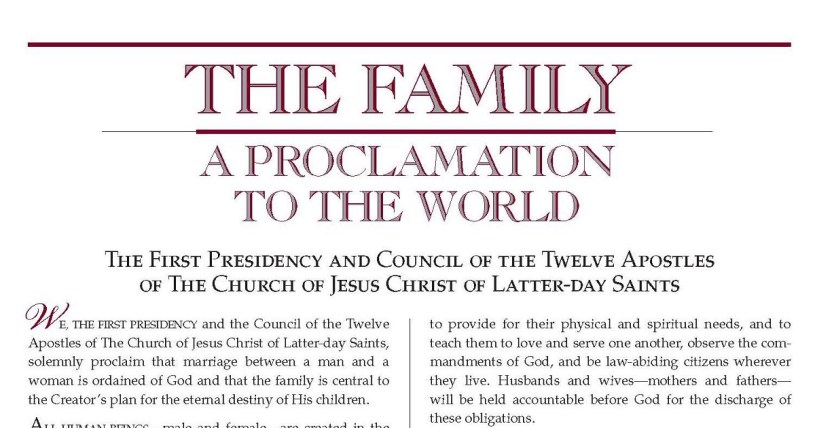
Except the Family Proclamation doesn’t say anything about treating LGBTQ people like dirt. In fact, it doesn’t say anything about LGBTQ people at all. I find it stunning that this document, a 608-word replacement for the entirety of the Bible and the Book of Mormon in the minds of the D-zNat faithful, is so frequently weaponized for things it doesn’t actually say.
Case in point: in that same Twitter thread, this guy accused me of heresy for refusing to concede that gender is “immutable” like the Family Proclamation says it is. Except the Family Proclamation doesn’t come close to saying any such thing. The FP’s entire commentary on gender comes in a single-sentence summation that defines it as “an essential characteristic of individual premortal, mortal, and eternal identity and purpose.” So he’s dead wrong, at least until some rogue thesaurus decides to christen “essential” and “immutable” as synonyms.
I can do this all day with the Family Proclamation, and when I’m feeling frisky, sometimes that’s exactly what I do. What, you say the Family Proclamation condemns same-sex marriage? No, it doesn’t. It talks about how God loves marriage between a man and a woman, and how procreation shouldn’t take place out of wedlock, and many other commendable things with which I can wholeheartedly agree, all the while leaving the negative stuff – “oh, and same-sex marriage is NOT ordained of God! So there!” – to the reader’s imagination.
“Oh, come on,” they tell me as I take the language of the Proclamation at face value. “You know what they really meant.”
Indeed I do. That’s why all this is prelude to my main point, which is that those who are eager to see the Family Proclamation canonized as revelation on par with scripture don’t seem to have thought that position all the way through.
The Family Proclamation is in a weird theological limbo. It is one of several official Church proclamations, but all the others have completely faded into oblivion, including the most recent one approved just three years ago with a weird COVID hosanna shout, never to be mentioned again. Nobody would consider those to be scripture, so why is the Family Proclamation a sort of super-scripture framed and displayed prominently in chapels and homes more frequently than anything written in the Standard Works? Surely it qualifies according to the definition as a revelation?
Boyd K. Packer certainly thought so. “It qualifies according to the definition as a revelation,” he said in his controversial 2010 Conference address “Cleansing the Inner Vessel.” He went on to say “And, uh, would do well that the members of the Church to read and follow.” If you’re reading that sentence, know that the garbled syntax is Elder Packer’s, not mine. It’s almost as if the words weren’t on the teleprompter, and he was making them up on the fly. Also, if you’re reading that sentence, I know that you’re not reading it in any Church publication, because that sentence, at least the part about the FP being a revelation, was removed from the official transcript.
Now why would that be? Elder Packer was the President of the Quorum of the Twelve at the time. Publicly and embarrassingly correcting the senior apostle is not something the First Presidency would do lightly. Such a correction is compelling evidence of significant disagreement behind the scenes as to the Family Proclamation’s revelatory nature.
But just for fun, let’s imagine a future where Elder Packer’s position carries the day. The proclamation is officially presented to the Church, canonized by common consent, and added to the end of the Doctrine and Covenants as Official Declaration 3.
I don’t think people realize that suddenly, “what they really meant” when they wrote the Family Proclamation would then cease to matter.
When we read any statement in the Church handbook, we correctly consider the intent of the people who wrote it. But when we read the revelations, we only consider God’s intent, not the intent of the messenger who relayed the revelation to us. Do believers ask, for instance, what Joseph Smith’s intent was for any passage in the Book of Mormon? When Jesus speaks in the Doctrine and Covenants in the First Person, surely it would be faithless to ask what Joseph meant by anything He said?
Revelations remove the responsibility for their words from mere mortals and place it in God’s hands. Were that to happen with the Family Proclamation, the document would instantly become open to far more inclusive interpretations than are currently applied to it.
That’s how it works with personal and private revelation, too. Patriarchal blessings are often fulfilled in ways that defy the expectations of the patriarchs who give them. That creates a connection to the Divine that we celebrate rather than criticize – a feature, not a bug.
Similarly, further light and knowledge that brings greater inclusion for LGBTQ people would cause a reevaluation of the Family Proclamation that would surprise and delight us with unexpected divine meanings in words that only seemed to reflect human intent before. It would also infuriate the very people currently clamoring to elevate the Proclamation to revelatory status.
Be careful what you wish for.
 Wheat & Tares
Sadly, the people in favor of canonizing the Proclamation on the Family (but none of the other many proclamations of equal provenance) want it for the wrong reasons — they want to use it as a club against their neighbor. That seems uncharitable to me.
All or none, I say — canonize all of them or none of them. But I prefer canonizing none of them.
I am okay with the proclamation as a proclamation. After all, it wasn’t received by revelation or promulgated as revelation.
I have a hard time with anything written by the fine lawyers at Kirton & McConkie being canonized . Not once have I ever sustained turn as a leader in my faith. Why wouldn’t the Lord tell his prophet what to say, not the paid legal team.
“I find it stunning that this document, a 608-word replacement for the entirety of the Bible and the Book of Mormon in the minds of the D-zNat faithful, is so frequently weaponized for things it doesn’t actually say.”
Now, wait. I thought you were only allowed to do that with the Constitution Of The United States.
Only if we do a trade. Section 132 of D&C decannonized for the proc on the family canonized. I think the church would come out ahead even as badly sexist as the PoF is.
I understand that the drafts went through different reviews and edits, by various committees and lawyers and staff employees, and it went back a forth from the working teams to the general authorities (who? at what level?) a couple of times. In other words, it is a polished and crafted document written by MEN (meaning humans). It was not received by revelation. Now the Spirit can testify that a writing is true, but revelation of this nature, the canonical kind, usually comes from a prophet’s mouth or pen, and is not the work of committees. This “proclamation” is no different from any other, and none of them are canonized. We should be careful only to canonize what is given by the mouth of the Lord, and now what we would like the mouth of the Lord to speak.
I agree with ji that those who want it canonized want to use it like a club. They do not treasure it for the truths about God that it reveals. They want a weapon to fight a fight. For me, that is ample reason not to ever canonize it.
For LBGTQ advocates, what do you want from the LDS church? How would what you want coexist with the absolute need for the religion to yield an abundance of child bearing families? You say the church should not discriminate. I ask how does the church function at all if same sex attraction and gender dysphoria are deemed acceptable, normal behaviors?
What is sin? Christianity demands acknowledgement of sin. Does sin exist in the LGBTQ paradigm? If what one personally believes is superior to all other things, where is personal accountability? Where are the boundaries for sexual expression in a philosophy based on the premise all sexual desires must be accepted?
Christianity cannot coexist with a philosophy of unbounded sexuality. Christianity declares there is a God of Truth who is constant and unwavering and who is Superior to man, woman and children. Gender fluidity declares the individual is Superior and what the individual feels is Truth.
The two worldviews are in fundamental tension. How do you forsee a reconciliation?
@A Disciple: I think you’re overcomplicating this. Accepting LGBTQ+ folks in to Mormonism doesn’t mean allowing unbounded sexuality or eschewing the concept of sin. Chastity and fidelity still work the same way they always have. The Beatitudes remain in force, unchanged. It would really be no more of a change than it was to accept interracial marriage, and certainly a much smaller change than moving away from polygamy.
Gender fluidity does not put the individual above God. We learn many things about ourselves through our lives, accepting those things is not disregarding God.
@Jim The problem I have with your hopeful view of canonizing the Proclamation on the Family (PooF) is what happened with the Word of Wisdom (WoW). Now I would argue that WoW is just as much the word of man, rather than the word of God, as is PooF. But even if you believe the original WoW text was revealed by God, the actual text of the WoW seems to be fairly irrelevant today. When BY and then later presidents decided to interpret it to mean something that wasn’t there before, that became what it said even if it wasn’t in the text. I guess because the current prophet gives himself that right to interpret God.
So I don’t think LGBTQ members are going to be able to read the text of PooF and say, God says that my (trans) genderness is an essential character or such, because the current prophet will do exactly what is done with the WoW.
Now if we got lucky and someone who eventually succeeded to be church president decide he wanted to interpret the text in a non-anti- LGBTQ manner, I agree it could be done. I am just saying that when you claim living prophets,the text really doesn’t matter because it is read by members however it is told to them to read it. Since PooF was written to promote discrimination against gay marriages, and it’s text will be interpreted in that discriminatory way thru at least the death of DHO, canonization of PooF will be even more harmful than it is now.
@A disciple. “Christianity cannot coexist with a philosophy of unbounded sexuality. Christianity declares there is a God of Truth who is constant and unwavering and who is Superior to man, woman and children. Gender fluidity declares the individual is Superior and what the individual feels is Truth.”
So I does Joseph Smith fail your test of Christianity? He most definitely was preaching more unbounded sexuality with polygamy than any LGBTQ person I know. And what about Joseph declaring man equal to God, his felt Truth?
I think LGBTQ people are just asking to be treated like the rest of God’s children, not declaring themselves God Almighty.
@Georgis “it is a polished and crafted document written by MEN (meaning human)”
The deep irony is it’s more accurate if you left out the part in brackets. Because although there may have been committees and reviews and edits, women were never consulted.
In Greg Prince’s interview with Chieko Okazaki, she’s very blunt that the Proclamation would have been different if the RS Presidency had been involved or even aware that it was being drafted. The first they learned of it’s existence is when they were told that the prophet was honouring them by announcing it in the women’s session. You know, because women are so valued.
Some statements in the proclamation are very clear and difficult to interpret in any way that is different from their original intent. Here’s one:
“We further declare that God has commanded that the sacred powers of procreation are to be employed only between man and woman, lawfully wedded as husband and wife.”
The only possible exception I can see here is how a transgender person might fit within this scheme. Even so, I think it’s clear that the apostles were talking about biological men and women. And if any clarification ever becomes necessary on that point they’ll declare it or edit the text so it’s understood that way.
@A Disciple, it always makes me sad to think that exclusion of LGBTQ people is central to some people’s interpretation of the Restored Gospel. The idea that if we accept LGBTQ people, we will no longer have “child-bearing families” is especially bizarre to me. Heterosexuality is in no danger of going away.
Suppose, for instance, that the Church ludicrously embraced “unbounded sexuality.” The risk of me becoming gay, bisexual, or transgender would still be 0%. This idea that human sexuality is a delicate flower that will collapse into some debauched universal anti-cishet free-for-all is a really weird boogeyman that just doesn’t fly anymore.
I also don’t know how to respond to “Christianity demands acknowledgement of sin.” Is sin as a concept in danger of going away? This just doesn’t seem like a compelling argument to me.
As to how I foresee a reconciliation, that’s the beauty of it. We are a church that believes in continuing revelation and further light a knowledge. It’s not up to me to determine how that light and knowledge will come or what it will look like when it does come. I don’t think limiting what God can do is ever a productive exercise.
@10ac, the WoW is a really compelling case study, because I think you’re right – in some ways, it’s gone in exactly the opposite direction of what I’m predicting with the PotF.
The text explicitly states that the WoW is “not by commandment or constraint,” and its reference to “barley” for “mild drinks” in verse 17 of section 89 is actually an endorsement of beer as an alternative to “wine and strong drinks.” And when was the last time anyone talked about eating meat “sparingly” or using tobacco as an herb for sick cattle?
At the same time, this also paradoxically proves my point, which is that text is no impediment to assigning new interpretations. Even with a canonized revelation, we apply the interpretation we like for the modern church and blithely ignore the parts we don’t like.
@Jack, you have somehow managed to completely miss the point of my post.
You and I both know the intent of the men who wrote the Proclamation. I’m arguing that claiming this is not the product of men but a revelation from God means that God’s intent then supersedes the intent of any of the Proclamation authors.
Using the euphemism “powers of procreation” instead of what they actually meant, which is “sex,” means that you can read that sentence to be only a dismissal of procreating out of wedlock. Biologically speaking, a same-sex couple does not have the power of procreation. A future Church could then say that the more
Inclusive interpretation is what God intended all along.
@A Disciple – Respectfully, I disagree. The argument is flawed and it oversimplifies and reduces the complex issues regarding LGBTQ rights and religion.
Firstly, it falsely assumes that LGBTQ individuals cannot have child-bearing families – they absolutely can and do through adoption, surrogacy, etc. Even single individuals can parent children and raise them in the LDS church if they so choose. Additionally, there are heterosexual couples in the church who choose not to have kids, and thus don’t line up with child-bearing ideal.
Secondly, the argument presents a false dichotomy between “real” Christianity and LGBTQ acceptance, assuming that one cannot be both Christian and accepting of LGBTQ individuals. This overlooks the fact that there are many Christians who are also LGBTQ advocates and who see no inherent conflict between their religious beliefs and their support for LGBTQ rights.
The argument also falsely equates acceptance of same-sex attraction and gender dysphoria with the belief that all sexual desires must be accepted without boundaries. Acceptance of same-sex attraction and gender dysphoria does not equate to condoning any and all sexual behaviors.
Please do not take this as a personal attack – I think important to challenge these assumptions to have productive conversations about acceptance within religious communities.
I also certainly don’t claim to have the correct answers, but these things need to be wrestled with from both ends.
I’m opposed to canonization for the reasons already mentioned, plus one additional reason: it’d create a new creed.
Even if the actual meaning of that new creed were up for grabs, I think Joseph Smith was on to something when he warned of the limitations of creeds.
Here are some inescapable tensions that are not solved by “tolerance” because they impact the intrinsic meaning and culture of the church
1) In the teaching of youth do we expect the church curriculum to give equal standing to non-heterosexual relationships? What would be the meaning of the Law of Chastity and how is it taught? What do LDS parents expect their children to be taught?
2) Do we expect the church to give equal standing to same-sex couples? What about equal standing to trans and queer individuals? By equal standing I mean the persons would be considered for high level callings the same as “normal” members, all while retaining a public, LBGTQ identity.
3) As the culture war wages, the advocates for non-traditional sexuality continue to attack long-standing norms. We are now seeing the overt push to expose children to not only sexual concepts, but to explicit sexual images and behaviors. There is also the explicit denial of parental authority. LDS LBGTQ advocates may see their tolerance as specific to religious inclusion, but politically there is a contest over parental rights, common decency and the norms of public education. Where are the lines to decide what is acceptable?
Yes, there is a bit of irony on this matter given the LDS church history with polygamy. With polygamy, the church embraced an odd sexual practice and this association nearly destroyed the church, marking it as an obscure rural sect until the later 20th century.
But in modern times, no church has tolerated gender fluidity and prospered. The Methodist church recently opted to split – one part accepting gender fluidity and the other part staying with traditional teachings. Division does not strengthen. But on what basis can there be unity?
Now it could also be argued that churches that stay conservative will lose members, as they have been for the 21st century. My question is can a church meet the expectations of both social conservatives and progressives? Would the middle ground be satisfactory to both? What would be the middle ground?
My personal feeling on the question is church cannot persist solely on the basis of people being affirmed in their lifestyle choices. Rather, part of church should make us uncomfortable and remind us we are imperfect and broken. I think a people who come to church with that humble perspective can be unified but only inasmuch as they agree on the ideals. And there is the big sticking point. What are the ideals church members are striving to obtain? What principles do they want to learn, and teach their children to follow?
Jack: Here’s another take on the phrasing you think is so clear. “Powers of procreation” is not the same thing as sex. Most sex doesn’t involve procreation at all. Also, we have no prohibition on non-fertile people (such as post-menopausal women) having sex.
A Disciple: “the absolute need for the religion to yield an abundance of child bearing families” Why do you think this is an absolute need? We baptize single people. We baptize people who are past the age of child-bearing. We baptize people who are infertile. And polygamy actually reduced the total number of children born when it was practiced (instead it just maximized the number of children its leaders and practitioners fathered). Your assertion is not a foregone conclusion by any stretch. It does appear to be a priority for leaders now that convert baptisms have plateaued and are petering out, but by that same token, chasing out anyone who doesn’t vote Republican or who has a family member who is LGBTQ seems like a terrible strategy to retain families. Nearly all the families I know in that situation have quit the Church. Jesus never once mandated anything like what you are claiming.
You also say “how does the church function at all if same sex attraction and gender dysphoria are deemed acceptable, normal behaviors?” First of all, it functions a helluva lot better than it does by denying that gay people exist and should be shoved back into the closet to either live life solo or marry against their orientation. As for gender dysphoria, that isn’t a “behavior.” This is about the gender a person identifies with, and it has nothing to do with “sin.” In fact, you can be trans or non-binary and asexual, having no interest in sex, which seems to be the ideal you espouse for anyone who is not cishetero. You need to educate yourself and learn some empathy before you go spouting off. The same could be said for a whole lot of people in the Church at all levels. What makes you think you’re the expert on someone else’s life? We live in a pluralistic society, and given the persecution Mormons faced in our early years, we would be wise to remember it.
Margot: While it’s accurate that none of the women who are general officers of the Church were consulted or informed in advance of the rollout, I believe there was one female lawyer involved in drafting it (among a handful of lawyers), if the story I heard was accurate.
A Disciple: You honestly don’t know what you are talking about, like at all. Here are some thoughts about your questions:
1) Why are we shoving marriage down people’s throats AT ALL, especially children? How about the actual teachings of Jesus? He barely mentioned marriage at all. Just what is it we are worshiping? As a Primary teacher, there isn’t a Sunday that goes by that marriage isn’t mentioned in some form or other to these small pre-pubescent children. Why is this appropriate? Let kids be kids!
2) I understand how important it is to men that nobody else in the Church ever have any actual power or authority. But the Church (which already bars women from any meaningful roles in leadership that don’t involve male oversight for decisions and budget) could just put LGBTQ people on equal footing with women, and men could still feel that they are one up which seems to be the primary motivation here.
3) Status quo isn’t the same thing as morality. Men have beaten and mistreated their families without consequence since time immemorial. Does that make it right? The Bible is full of rape and genocide. Does that make it right? Precedent and tradition have never been arbiters of morality. “We are now seeing the overt push to expose children to not only sexual concepts, but to explicit sexual images and behaviors. There is also the explicit denial of parental authority” These are simply lies. I’m not sure where you are getting your (mis)information. The very idea that kids are being exposed to explicit sexual images and behaviors is ludicrous, but a friend told me once that his ward considered a Victoria’s Secret ad to be “pornography.” Hyperbole doesn’t serve this conversation well.
Kids at Church are exposed to heterosexual concepts (if that’s what we are calling the endless talking about marriage). That’s no different than acknowledging that some people are queer. It’s simply a fact of life, and whether individuals are cishetero or not, all human beings deserve dignity and respect. If you want to talk about parental authority, look no farther than the red states who are stripping parents (and doctors) of access to gender affirming care that the medical association agrees will save lives. Trans and non-binary people have always existed, but they’ve hidden in the past because it was unsafe, and many committed suicide. Progress may be scary to conservatives, but that doesn’t make it right for you to curttail others’ basic rights to exist. As for gender dysphoria, if it’s a *mental disorder* then on what planet would treating it as a sin or “lifestyle choice” be a kindness?
Churches do not exist to affirm one’s identity or lifestyle choices. On that we agree. But they also shouldn’t be pushing people out or treating people as sub-human. Churches that affirm the judgmentalism and self-righteousness of cruel people are failing even more than those who embrace everyone because they are failing in their original mandate, to change hearts and turn them to Christ.
Interesting post and discussion.
If we are talking about how LDS leaders in a hypothetical future might interpret the Family Proclamation, all we have to do is look at how LDS leaders past and present interpret canonized scripture. They don’t try to get to the “intention of the author” by learning the ancient language used in the original text and consulting scholarly historical-critical arguments that try to establish original context and meaning. No, they don’t make any effort at all to do that and largely ignore (if not ridicule) scholarly efforts along these lines.
LDS leaders take the approach that any particular scripture means whatever they want it to mean. They don’t feel particularly constrained by any consideration of scholarship or author’s intent or tradition or even what prior LDS leaders taught — just whatever the current leadership wants it or needs it to mean.
So if a future cadre of LDS leaders wants the Family Proclamation to have a more inclusive reading, they will easily do that. Nothing about the text, canonization, or prior LDS statements will prevent that. Nothing.
Jim Bennett and Angela C,
I understand better now what the OP is driving at. Even so, I must say that I find the thesis a bit scary. Because what we’re talking about here is something akin to the way the doctors of the law would torture the scriptures in order to draw from them the meaning they were looking for. Now I’m not saying that you’re doing that. You’ve only spoken in hypotheticals to make your point–and that’s fair. But continuing in the same vein we might just as easily impose a whole new hermeneutic on all of the scriptures having to do with Christ as the only possible means of salvation–with the intent to prove that there are other ways to be saved. It’s doable–but it misses the mark.
That said, I realize that sometimes we inadvertently look beyond the mark. And so the Lord has provided a mechanism by which we can correct our targeting–and that’s continuing revelation through authorized channels with the counsel of living prophets serving as the word of the Lord for the church collectively. And so, if the proclamation were to be canonized I’d have no problem with receiving it as scripture — not anymore than I do with the rest of the canon — because I’m confident that the living oracles would protect its meaning and intent.
***
I think A Disciple has offered some powerful ideas for us to think about–especially in the final paragraph of his/her last comment. I wouldn’t be too quick to dismiss him/her.
I have long felt an undercurrent in the church’s negative approach to LGBTQ+ member issues, and utter refusal to acknowledge healthy marriages and the families created by them, as driven to some degree by a perceived need to control the lower status of women in current temple marriages. I didn’t come up with this on my own, but have read it in past discussions of heterosexual marriage. If queer marriage was given status along with cishetero marriage, it would highlight the imbalance in the status of wives, which would also wreak havoc on the underlying doctrine of polygamous marriage. If you read the FProc with this in mind you can see the care taken in the wordcraft of those esteemed lawyers to exclude all monogamous unions other than a man and wife, without excluding polygamous unions, past, present, and future.
I also am dismayed by the pearl-clutching comments that rely on misinformed hyperbole to make their case. When one disconnects from the hyperbole, that case becomes shrill and weak indeed. I can’t see how such fearfulness has any place in the gospel of Christ.
I’m with MDearest. LGBTQ+ issues strike at the heart of conservative principles (namely patriarchy and self-interested competition as a moral good), but not Gospel principles.
“it would highlight the imbalance in the status of wives, which would also wreak havoc on the underlying doctrine of polygamous marriage”
I recently discovered my beloved grandfather was sealed without our family’s permission to a woman he briefly married civilly and then quickly divorced, a woman he never told his family about. We do not know if his second wife, my beloved grandmother to whom he was sealed for eternity knew about the first marriage. Our family does not participate in proxy post-Manifesto polygamous temple sealings, but some people in our church do.
“polygamous unions, past, present, and future”
I think the OP has an interesting point here – the true meaning of the FP is obvious, but thanks to the legal team’s wordsmithing, canonizing it could backfire (which would be kind of funny). In the end, proclamations are kind of weird… they’re essentially quasi-holy press releases. They shouldn’t be canonized.
@A Disciple – yes, you are absolutely right that there is tension, but tension doesn’t make something intractable. There have been plenty of other instances of tension where the church’s position caused tension. In the cases of black men holding the priesthood and polygamy, that position changed (at least in part) because of social and legal pressure surrounding the issues. We saw it more recently with the PoX being walked back.
@Jack – The idea that someone can receive personal revelation as long as it’s in line with the old men in charge bugs me. Its cousin is the idea that even if the leadership is wrong, you’ll be blessed for your obedience. This combo (1) promotes authoritarianism, (2) makes it much easier to garner support for questionable ideas, and (3) offers absolution if something really goes wrong (morally, legally, socially).
Inspired or not, church leaders get things wrong, or sometimes simply allow their words and actions to be filtered through their personal opinions and worldview. We have to use our own intelligence and judgment as well. “Wrong answer? pray harder” is the realm of authoritarianism.
We can look at the PoX for a live case study of all this – the President of the church was being ravaged by dementia and a brutally harsh, exclusionary policy was announced. The backlash was instant, and it caused a great deal of pain.
-Was this a moment of unpopular prophetic inspiration like in so many scripture stories?
-Was it an unfortunate mistake and a product of the man’s deteriorating health?
-Was it someone else behind the curtain using the ailing prophet like a puppet to push an agenda?
Given how quickly the policy was walked back, the first option seems unlikely. We’ll never know what the real answer is on the other two.
Either way, the policy felt very wrong from the beginning to MANY people. There are those who prayed for personal revelation and felt it was still wrong – these people now feel vindicated by the reversal. There are others who prayed and felt it was right to “follow the prophet” and support the policy – these people can still feel blessed for their obedience in supporting a terrible policy and have an easy excuse for doing so.
The world is not black and white. There’s no green light that illuminates when God presses the button to speak through a prophet – we still have to use our own judgement and speak up when something seems wrong.
Excuse my English, I’m not native but, could someone explain to me why same-sex marriage should be accepted in the church but polygamy between adults is condemned?
The Pirate Priest,
“The idea that someone can receive personal revelation as long as it’s in line with the old men in charge bugs me.”
I believe that individuals can receive personal revelation that is counterintuitive to general counsel. But they need to keep it to themselves–and only speak of it when constrained by the spirit. It should be general counsel that is prioritized for the church collectively and personal revelation that is prioritized by the respective individuals who receive it–the former being openly acknowledged and sustained collectively and latter being treasured up and carefully guarded.
Re: the policy on children of same sex couples: sometimes counsel requires obedience within a certain range of acceptability. For instance, the Lord told Joseph Smith to gather 500 men for Zion’s Camp–that was his will. But then the Lord goes on to say that if he couldn’t find 500 then try to get 300–and if he couldn’t find 300 then try to get 100. And then he gives a *commandment* to Joseph that he he was not to form Zion’s Camp with less than 100 men. The word of wisdom seems to have some of the same leeway — the wiggle room between what is the Lord’s will and what he commands — as do the parable of the talents and other teachings from the scriptures.
And so, that’s how I see the alteration of the policy in question playing out. There apostles stayed within the range of acceptability for that particular counsel when they produced the second iteration of the policy. In fact, I’d say that this sort of thing — doing the best we can within an acceptable range — is rather common in the church.
@a disciple, please LMK where you see Jesus reducing “sin” to “sexual sin” meaning “sex outside of a hetersexual marriage.”
Anyway, that’s a ridiculous concept. There is no reason the concept of “sin” can no longer exist just because we decide that a bunch of people who want to be in loving and committed relationships with each other can go ahead and do so. You are operating from a purity culture framework–the very framework Jesus resisted during his life and teachings. I view “sin” as actions that hurt other people (like, for example, discriminating against same sex couples!). I think it is a formulation of “sin” that is much more in line with the teachings of Jesus Christ than a focus on so-called “sexual purity”.
For more detail see here because I don’t want to type a long comment and have already posted directly on-point:
@Jack – I appreciate the nuanced view here, and it’s a valid argument that the people charged with leading the church have a much more difficult job trying to keep the organization of the Church organized and provide direction to literally millions of people. It’s hard enough to get a church league basketball team on the same page.
You and I agree with the idea that divergent inspiration is possible, but we may disagree regarding the degree to which it’s possible and whether it should be kept to oneself. I certainly agree that it’s not my place to try to walk up to the pulpit at General Conference and say that I received a revelation that the church leadership is doing everything…even if I disagree with them on some point. However, I think it’s important to raise a voice when something doesn’t seem to pass the sniff test – the leaders are ultimately human after all.
Since you brought up the Word of Wisdom, it makes a good illustration. An old mentor of mine in the LDS church once asked, “Will you go to hell if you have an occasional beer with friends, and it never causes you any problems whatsoever? No, that’s ridiculous. HOWEVER, it’s not practical for the leadership of the church to point at one person and say, ‘God says you can have a beer!’ then point to their neighbor and say, ‘Sorry, God says no beer for you…’ ”
The original intention was “be healthier, here’s some ideas.” The endless arguing and bickering about what was/wasn’t ok are probably what turned it into a Mosaic list of do’s and don’ts.
Regarding LGBTQ issue specifically, I think there is a distinction. There are some very old, very strong opinions held by leaders of the LDS Church (as with many religions). Some of them, like Elder Oaks, are very vocally open about their opinions…and it becomes very very difficult to distinguish between vehement personal opinion and inspiration in this case. Especially since it’s arguably the most divisive issue we are dealing with as a society right now – possibly even more volatile than abortion and gun rights in the current climate.
I don’t have the right answer, but I am also very uncomfortable with leaders of any religion saying “God will only accept you if you are straight, cisgender, or pretend to be.” Jesus was pretty clear on the point that there is room for everyone at his party.
@Jack, “That’s how I see the alteration of the policy [the POX] in question playing out. There apostles stayed within the range of acceptability for that particular counsel when they produced the second iteration of the policy.”
Your apologetic argument for the POX doesn’t make any sense. Remember, the pre-POX position of the Church is nearly identical to the post-POX position of the Church. If the current position of the Church is acceptable, then the Church had no need to move to a new and different position “within the range of acceptability” because it was already there before the POX was enacted.
The Pirate Priest,
Thanks for your thoughtful response. Re: The Word of Wisdom: I agree with your mentor 100%. And I’d add to his/her reasoning that the general guidelines for the WoW should also be followed by everyone in the group in order to support the community of the saints. Some folks wouldn’t be phased at all by drinking a little wine with their dinner. But others–folks like me–would might become alcoholics after only one drink. And so the WoW is sort of a communal covenant that we make for the sake of all involved.
I agree that questions dealing with LGBTQ concerns is probably the most sensitive issue right now. I can’t say that I have all of the answers–but I think there’s a lot of wisdom in the way the President Nelson frames the issue. He places all issues regarding sexuality within the purview of the Law of Chastity–and then allows that law to speak for itself on the specific issues that it has the power to measure. So far as I can tell the LoC clearly answers most question and concerns regarding sexuality. (Transgender issues may be an exception–and if so would require additional counsel from other inspired sources having to do more specifically with the effects of transitioning and so forth.)
Interesting post. I had forgotten how the Family Proclamation was worded so ambiguously. We all know very well what the intent of those words were when written, and that original meaning would certainly be embraced by those who want to see it canonized. However, I think the OP is correct that over time Church leaders and members would read into those ambiguous words the meaning that they wanted to get from them.
I personally despise the Family Proclamation because it is frequently used as the basis for discrimination of LGBTQ individuals and women in the Church. I simply don’t think it was inspired of God. I would like to get rid of it, or at least see it forgotten as the other recent proclamations of the Q15 have been forgotten. That said, over the last several years, I have often pondered what might actually happen if the Q15 attempted to canonize the Family Proclamation today. It might possibly end up being a good thing for the Church–at least, if canonization failed or was quickly reversed like the POX.
I would think that if the Q15 wanted to canonize the Family Proclamation that they would need to announce ahead of time their intent and then put it up for a vote by the general membership by common consent, presumably at GC. Now, I’m under no impression that a majority of members would vote against the Family Proclamation or that votes would even be counted at all–they wouldn’t. However, I suspect that there would be enough outrage against the canonization attempt leading up to GC that the Q15 might terminate their plan before the common consent vote occurred.
An attempt at canonization like this would draw a ton of very negative external publicity which the Church hates. I believe that there would also be a ton of internal pushback against canonizing the Family Proclamation–it really negatively affects a *ton* of Church members and their friends. Many members consider the Family Proclamation to be scripture. However, if the Q15 had to change course and remove the canonization from the GC agenda, I think this would really change the status of the Family Proclamation in many members’ minds–if it’s not scripture, why didn’t we proceed to canonize it at GC as originally planned? Even if the Q15 went ahead and canonized the Family Proclamation in GC, many members would likely leave the Church over this event, and there would still be a ton of pushback against it in its canonized form as OD3. Canonization is simply a no-win situation for the Church. I think the Q15 knows this and will never attempt to canonize it as a result (and the repercussions of trying to canonize it are just going to keep getting worse and worse as time goes by, and society becomes more and more accepting of LGBTQ individuals), but it sure would be interesting to observe–and possibly a great catalyst for needed change in the Church–if they tried.
mountainclimber479,
“If the current position of the Church is acceptable, then the Church had no need to move to a new and different position “within the range of acceptability” because it was already there before the POX was enacted.”
They did it for the sake of the members who were deeply concerned about the negative effects that the policy might have on those whom it would touch.
An analogy might be something like: In an alternate past Joseph Smith successfully gatheres 500 men for Zion’s Camp. But then there’s a cry among the members–that taking so many able bodied men away for such a long period of time would be very burdensome for the women and children and elderly who remain behind. And so, out of compassion for those who would be left to manage things on their own, Joseph decides to cut the number down to 300 men for Zion’s Camp and allows 200 men to stay behind. And that’s OK because 300 is still within the range of acceptability–which is between 100 and 500.
@Jack, your analogy isn’t a good analogy because the starting and ending points aren’t the same. The starting point in your analogy is there was no Zion’s Camp, so no men were needed, and then it moves through different points where a different number of men were needed. Never do we get back to the point where God says just forget about the whole Zion’s Camp thing–no men are needed at all. That is exactly what happened with the POX, though.
With the POX, we have a starting position (pre-2o15) where God is OK with the children of gay parents being baptized. This is the same position we’re in now after the POX was reversed in 2019–God is now once again OK with baptizing the children of gay parents. We know we’re within God’s “range of acceptability” right now because Nelson said so when he reversed the POX in 2019 which means the pre-2015 position on the baptism of the children of gay parents was also acceptable. In other words, there was no need for the Church to enact the POX to move the Church into your so-called “range of acceptability” because the Church was already within than range pre-2015.
If you want to believe that the Q15 was inspired to both enact and reverse the POX, then I strongly feel like sticking with “I don’t know why, but I just believe God didn’t want those kids baptized for those 3.5 years for some presently unknown reason” would probably be your best bet here rather than trying to employ apologetic arguments that simply don’t make any sense at all to explain God’s apparently very fickle opinions on the baptism of the children of gay parents.
Regarding the idea proposed in the OP, I think it’s a valid reading of the situation to say that the PoF is worded vaguely enough to mean whatever the current living leaders say it means. It’s been dissected a billion times on the bloggernacle already, but a few salient points:
– Preside basically means nothing in practice. It’s a bone thrown to the sexists whose insecurity requires that they believe they are one-up on their wives. In reality it usually means they choose who says the prayer. Big deal. BUT codifying it into the sealing process, THAT is a bigger deal and it’s already happened. That’s requiring newly marrying couples to agree that the wife is less than the husband, deliberately.
– The phrase “individual adaptation may be necessary” (I can’t remember the exact wording) can do a lot of heavy lifting, depending on who sits in the biggest reddest chair. Literally every family requires individual adaptation. We are all human beings. We differ.
– Gender being an essential characteristic is compatible with being trans or non-binary because your innate sense of your gender is essential to your self-identity and how you feel in your body. It doesn’t say “gender is solely your assigned sex at birth,” and it can’t say that because intersex people exist, so that would be nuts.
The other thought I had is that canonizing it or not feels irrelevant since Oaks (the one who assigned it to the lawyers to write, if the stories are to be believed) has also declared that policy is now as binding as doctrine and revelation. That’s a huge shift from mere years ago when policy meant something that they were pretty openly admitting was *not* revelation or binding. Now, any opinion that makes it into the handbook cannot be contradicted on penalty of discipline. It is an extremely authoritarian tactic, and quite alarming. So, canonize the PoF or not; we are already in a thought police state.
@Elisa – the two posts you linked to were great. The one on The Love and Laws of God was especially interesting. “Is this rule rooted in compassion or purity?” is an apt test. We should always be vigilant against arbitrary purity rules (in the church and in society at large).
Obviously, the Law of Chasity gets the most attention when it comes to the FP (and rules on modesty and media usually point back to chastity), but your read on it in the other post has merit. There has been no issue in the church historically reframing the specific requirements of particular purity rules, even Chastity.
“No sex before marriage. Oh and the only REAL marriage is between one man and one woman (it even says so in the BoM)…Oh, and just ignore that time when the rule was one man and a whole bunch of women…and also ignore those times when some of those women were 14 or 16 years old, or when they were already married to someone else. Oh, and no bikinis…they’re real-life pornography that endangers our pure pure boys.”
LGBTQ people are more than capable of living in committed, consensual, loving, healthy relationships…and many many do. They’ve been around since the dawn of humanity and will be here until the end of humanity.
At some point, we end up being the Pharisees Jesus is pointing at saying, “knock it off, these people count too.”
This is sophistry. LGBTQ+ people are invited to come to Christ the same as anyone else and we have to do it the same exact way: by putting of the natural man and repenting of all our sins.
“But my LGBTQ+ness is who I am so it’s not fair.”
Yes, life is tough. It really is, and I applaud those who gave this and keep trying and I do not condemn those who quit trying. Do you think putting the natural man off is easy to a heterosexual living in a land of filth and porn? We all get stretched beyond the breaking point somehow.
Do you really think that you were LGBTQ+ during premortal experience? Based on what? The feelings of the natural man? The natural man is an enemy to God and a notorious liar so you really should ask for a little more evidence.
If you do a serious study of the Bible you cannot imagine that Jesus Christ would approve claiming this as your eternal state. But, unsurprisingly He has a plan for us. We must repent (I’m trying to do so myself and it’s not easy) of our rationalizations, self-deceptions, and sins and then He in His own time will heal us. He really can make weak things strong but we must keep our eye single to Him. If you don’t want that, you can choose otherwise. But don’t lie to yourself and say that Jesus approves because he doesn’t.
You might say that this is mean and you might censor me. But mean is to lie and say something is healthy when really it’s poison. Disrespect is to say that people with these urges aren’t capable of living the gospel of Jesus Christ as outlined in the scripture. Harmful is to seek to change God’s will to match yours instead of the other way around. It’s by doing this that 2 Thessalonians 2:10-12 will be fulfilled:
“10 And with all deceivableness of unrighteousness in them that perish; because they received not the love of the truth, that they might be saved. 11 And for this cause God shall send them strong delusion, that they should believe a lie: 12 That they all might be damned who believed not the truth, but had pleasure in unrighteousness.”
@Jack says this: Some statements in the proclamation are very clear and difficult to interpret in any way that is different from their original intent. Here’s one:
“We further declare that God has commanded that the sacred powers of procreation are to be employed only between man and woman, lawfully wedded as husband and wife.”
In addition to the issues noted above, I’ll point out that none of the first six presidents of the church followed this “commandment” with respect to the lawfully wedded part. I think the most reasonable way to read that is that the statement is limited to a certain time and place, i.e. roughly the last 100 years, just as animal sacrifice or the WoW or 3 hour church was once commanded by God at certain times and places. Under this reading, anyone who says that the PF is eternal unchanging doctrine is simply wrong, regardless of whether or not their initials are DHO.
I think the only other possibility is that this commandment, and the so called law of chastity more generally, is a relatively minor commandment, i.e. the kind of commandment that we would expect the entire first presidency to intentionally violate on a near daily basis with minimal negative consequence. Something akin to only forgiving seven times sixty-eight or desiring to declare repentance as an angel like Alma did.
Pro tip: if you want to basically say “gay sex is always and inherently sinful” you should say it about like that, rather than trying to do it by negative implication without thinking through what you’ve written.
@LB, equating the experience of an LGBTQ person asked to live a life of celibacy and loneliness with how tough it is for you to not use porn is… well, how to describe it? Ridiculous? Repugnant? A black hole where any trace of empathy goes to die?
Seriously, it is astonishing to me that anyone could present such a tone-deaf, contemptuous, dehumanizingly ignorant argument. Shame on you.
LB, as a serious student of the Bible, can you point to the passages where Jesus condemns those who live a non-heterosexual lifestyle?
As though being who you are is a “lifestyle.” My apologies for taking the lazy way out, dear reader. Shame on me.
LB: Do you really think you were heterosexual in the pre-existence? How on earth would you even know this? If you don’t have receipts, I’ll just have to chalk it up to your hetero bias.
@jaredsbrother: Jesus is not recorded to have said anything regarding homosexuality – it’s not in the gospels at all…Paul maybe did in three places, but two of the three are essentially catalogs of behaviors that are regarded as unacceptable with no real emphasis given to any individual item on the list…this is also unsurprising considering that Paul was basically a celibate ascetic.
The one passage that very likely addresses it directly is Romans 1:26-27…but the context of the whole passage is about idolatry rather than homosexuality, which sort of changes the tone that homosextuality may be the result of willful idolatry (i.e. “worship idols and God will give you over to the whole catalog of bad behaviors I mentioned before”). Again this is celibate St. Paul preaching an ascetic worshipful life to be ready when Jesus comes…which he thought would be in a year or two.
What makes this more interesting is that the one passage that might be outright directed at homosexuality was also probably written just before any of the gospels were written…so it certainly didn’t carry over as something critical to be included in the stories of Jesus’ life and ministry.
It’s also not like it was a new topic at the time either…it was also a very frequent theme in literature of the time. Just a few decades before Jesus, Julius Caesar was criticized for having an affair with King Nicomedes of Bithynia (interestingly not so much for the affair itself, but for taking a passive role in the affair). Multiple other prominent figures present during the early days of Christianity had relatively well-known same-sex relationships…There are even some writings discussing some same-sex weddings happening in Roman society (although it wasn’t exactly approved of either). So it’s not like it was something hidden away or overlooked..
Why is it that some people define morality solely in terms of the bedroom? How about expecting morality in the boardroom?
Next time any reader here fully reads canonized scripture, notice how much it promotes social justice and how critical it is of “the wealthy”. When you read what Jesus teaches, it’s not what many claim. Quite the opposite, in fact.
People are hurt by immoral individuals’ and corporations’ actions. Children are hurt. People may work full time, but still be unable to afford shelter, clothing, food, medical care, transportation, any possible future retirement, etc. There is a continual push to defund any social safety net, but the same people do not oppose any tax cut. There is scant social safety net for the foundation of our society (look into compensation and working conditions for people along the food production lines).
Even the few at the “top” are hurt, as so many of them become depraved, lacking empathy. They push policies that diminish their accountability when they pollute our air or water, or damage our earth. When they factor in compensation for a wrongful death they cause as “part of the cost of doing business”. They use their ill-gotten gains for campaign donations to politicians willing to pass legislation that further enriches them, for flattering US Supreme Court justices, for think tanks that produce ideas to convince regular working people (the backbone of our economy and society) to support policies that gut the middle class.
Morality is much larger than what we hear from grossly well-compensated talking heads and in Sunday school.
If LDS Church leaders produce a comprehensive document about morality, I would support it being canonized.
David Day,
“I’ll point out that none of the first six presidents of the church followed this “commandment” with respect to the lawfully wedded part.”
I believe they did. Of course others may interpret the circumstances differently than I do. They believed that the Law of the Kingdom superseded the law of the land. And after the saints relocated to Deseret they lived according to their own temporal laws as well–which rendered the former distinction between the laws of church and state moot.
“I think the most reasonable way to read that is that the statement is limited to a certain time and place…”
However that may be, the proclamation is the counsel that we’ve been given at this time. And so whether or not it is unchangeable should have little relevance to what our level commitment should be to follow the Lord’s counsel.
“I think the only other possibility is that this commandment, and the so called law of chastity more generally, is a relatively minor commandment…”
The Law of Chastity has been taught since the beginning–and the only way that it has ever been modified is when the Lord has commanded is people to practice polygamy.
“Pro tip: if you want to basically say “gay sex is always and inherently sinful” you should say it about like that, rather than trying to do it by negative implication without thinking through what you’ve written.”
Just to clarify–my comment had to do more with the language of the proclamation than with my personal opinions about chastity. Even so–yes–I believe that gay sex falls outside the range of permissible sexual intimacy as defined by the Law of Chastity
Jim Bennett,
LB is certainly capable of defending him/herself. But let me ask you a question: which of these tow scenarios is more heartbreaking:
1) The young gay man who must put away all hopes of finding fulfillment in marriage and family in order to live the Law of Chastity?
2) The elderly sister who desperately wanted marriage and family but never fulfilled that dream because no man ever took enough interest in her?
This discussion is exactly why the PotF should never be canonized and why I no longer attend LDS meetings. Try to imagine how you would feel if you were gay and then ask yourself why? If you were gay would that be your choice? If your kid came to you and said they were gay is that because they made a poor decision? Can you fathom yourself being LGBTQ because that’s how God wanted it to be? That it’s just the way your body works? That’s it’s not something that needs to be overcome? If you can put yourself in those shoes maybe you can begin to see how this effects so many and cannot be chalked up simply to morality and chastity and sin. This is a one-sided war the church is engaged in. Stop attacking and be a peacemaker.
The claims in the statement made by LB can be turned 180° and applied with equal logic to a cis-het person, and then the sophistry becomes even more visible. Moreover, the hubris of claiming there is a plan for LGBTQ folks, and further claiming that HE know what it is — and then blithely tells us it’s Gods will for people “with those urges” to just suck it up buttercup, life’s hard for everybody. Us dudes all have to resist filth and porn. And Then misinterprets the concept of the natural man, turning that into a hammer, and for good measure bludgeons the reader with some scripture, without a shred of context, because his meaning is obvious, innit?
I’m on board with Jim Bennett’s reply: Shame on you.
And Jack, your questions are offensive to both a young gay man and the elderly sister. You should retract them, only in part because they’ll stir up troublesome hurt feelings that are an unnecessary tangent to the primary discussion. Unless that is your intent, in which case I’ll put a teacup on my head.
MDearest,
It’s a sad day when we can’t talk about victims–even in the abstract–for fear of hurting or offending someone. When we take a virtue to the extreme–even compassion–we invariably trammel other necessary virtues. Even so, if we’re going to err I prefer that it be on the side of compassion.
That said, instead of talking about others–let me talk about myself. I have lived a celibate life for the last eight years. Both the major depression that I’m stricken with plus the meds that I take for it are the elixir for killing that aspect of my life. Now that’s not to say that I never desire to be close to my wife–and she’s a real beauty, mind you. But I’ve got a veritable plowshare jammed in my psyche that prevents certain psychological connections from being made. This is something that I and my dear wife have to live with. There’s no way around it–only through it.
I don’t want this to become a sob story–because I really don’t feel deprived. In fact, I sometimes feel like the richest man in the world because of the marvelous blessings I’ve received throughout my life. Even so — and without wanting to compare crosses — I can say from my own experience that there are worse things than celibacy. And so the question that we’ve got to come to terms with (IMO) isn’t so much about whether or not the teachings of the church on marriage and family are equitable–but rather–whether or not they’re inspired. Because we can argue until doomsday over the former and never see eye to eye. But if we come to terms with the latter — in the affirmative that is — then that settles the theoretical terms of the issue. And the remaining questions will have more to do with the pragmatic aspects of living within the boundaries that the Lord has established.
“…the perfect elixir…”
Wait, did Jack just admit that LGBTQ+ people are ‘victims’ of the Church’s current policies! Awesome!
Jack,
I’m old. But I would never describe an elixir of medicines that kills one’s libido as “perfect.” Just sayin’…..
LOL. Yeah–I guess that’s like saying “the perfect storm.” Loads of irony.
Jack, the church’s teachings over the proclamation on the family are absolutely NOT inspired. I can testify to that truth as much as anything. It doesn’t even recognize the existence of intersex individuals. A whopping 2% of all humans that have ever lived… ever. The thing that I’ve noticed that believing members repeatedly turn to is sex. They regularly argue that it’s all about sex. Can you imagine if your companionship with your wife was considered a sin worthy of excommunication?
Corou,
As I say, revelation trumps all contrary arguments–no matter how well reasoned or earnest they may be. That’s why it’s so important that we learn for ourselves whether or not the apostles were inspired when they issued the proclamation. Otherwise, like Paul, we might actually be fighting against the truth without knowing it–even with the best intentions.
@Jack, re: your question directed at me:
In the two scenarios you pose, the second involves someone searching for love and never finding it. Had they been successful in finding love, they would have been embraced by the Church, with their love celebrated and fully accepted. She does, however, have the oft-repeated prophetic promise that the very sort of love she desperately wants will be fully available in the afterlife and hers for all eternity.
Contrast that with the first scenario, where the gay young man is forced to pray to never find the love he desires, because if he did, he and his partner would be cast out of the Church, perhaps even out of their families, and would spend the rest of their lives as pariahs in their faith community for having the simple day-to-day kind of companionship you take for granted. However, should he stay faithful and choose a life of celibacy and loneliness, he has the prophetic promise that he will be transformed in the next life into someone he wouldn’t recognize as himself to enjoy an eternity of a kind of love that holds no interest to him whatsoever.
It’s deeply bizarre to think the woman in these two scenarios has the more heartbreaking deal.
“It’s deeply bizarre to think the woman in these two scenarios has the more heartbreaking deal.”
I’m not suggesting that hers is necessarily anymore heartbreaking that his. Only that it certainly can be as heartbreaking–but perhaps for different reasons. There are many different elements that might be considered when measuring pain and disappointment–and two situations are never exactly alike.
What if we compare the young man and the elderly sister with regard to how they each (respectively) fare socially. Let’s assume that the man is well liked by his friends and peers and would have very little reason to fear that he would never find a mate. But the woman, on the other hand, is socially awkward and perhaps not very attractive according to the prevailing trends–and while she may hope to marry one day is doubtful about the prospects of finding a mate.
And so, with the stage set what we have is:
1) The gay young man is faced with having to make the terrible sacrifice of choosing to live his whole life without getting married and building a family–even though he is well liked and would have little trouble finding someone to marry if he were to choose to go in that direction.
2) The elderly sister, however, though she is not faced with having to make such a difficult sacrifice–at least not from the get-go–will live with the constant reminder that she is undesirable as a partner in marriage.
These are two very different kinds of burdens–but both of them are exquisitely painful in their own way. And even if we were to consider one of them to be more painful than the other there are yet other kinds of burdens that are even more difficult to bear–though perhaps not as morally ambiguous with respect to the whys and wherefores. I had a good doctor friend (who has since passed away) who volunteered his services in Haiti after the terrible earthquake. There were many sad stories, of course, but the worst was a married couple who lost all six of their children in the disaster. I have six children–and I cannot imagine that kind of loss.
Part of our experience living in this fallen world includes bearing both the burdens that come with the territory — trials that are common to all — and those that come with living the gospel–trials that come because of our commitment to live within the bounds the Lord has set.
Ya’ll, remember Jack’s position is:
“ As I say, revelation trumps all contrary arguments–no matter how well reasoned or earnest they may be.”
There’s literally no point arguing with him by his own admission. None.
The “revelation trumps facts and reasoning” approach sounds good to a certain sort of conservative Mormon, until you have to deal with the tricky questions of what counts as a revelation and what you do with a revelation you don’t like. Say John Taylor’s 1886 revelation that plural marriage would never be revoked and must be practiced forever “by those who will enter into my glory”?
https://en.wikipedia.org/wiki/1886_Revelation
And if you respond “that’s not a canonized revelation, so it doesn’t count,” then what about Wilford Woodruff’s 1890 Manifesto, which is hard to even call a revelation — it’s not in the format we recognize as a revelation. Or Wilford Woodruff’s 1894 changes to temple sealings, so men were to be sealed as children to their biological fathers, rather than to some prominent church leader as had been done up to that time, sort of a “join my team” approach to salvation and kingdom building?
If you’re going to throw out John Taylor’s 1886 revelation, then you have to throw out Wilford Woodruff’s “not quite a revelation” revelations as well, and Mormons should go back to practicing plural marriage and sealing men to men in temples.
Or you can take the more reasonable approach and weigh purported revelations against facts, reason, morality, history, and science.
@Jack, bless you, but at this point, your arguments are starting to feel like Abe Simpson’s stories about having an onion on his belt, which was the style at the time.
I agree 100% with Elisa, as such this is directed to the rest of the WT community.
The main difference between the older woman and the young gay man in Jack’s hypothetical is hope.
The sister can wake up every day with hope, however small that she will find someone.
The young man has had one of Paul’s foundational elements of tbe gospel cruely stripped away.
As the great prophet Mick Jagger said:
“Lose your dreams and you will lose your mind.”
Jack does inadvertently bring up one valid point:
The hypothetical never-married (in this lifetime) woman in Jack’s analogy does represent many real women. I find it deeply sad. I lay much of the blame for women (and men, sometimes) who live their lives unmarried squarely on the the LDS Church. Many could marry good men, if not for the deeply ingrained exhortation to only marry “a man worthy to take you to the temple”.
There is a lot of research about the negative effects of loneliness. Further, it is only in recent decades that young women have been encouraged(?) to plan for a career. Many single women live below their earning potentials.
I think we all have a lovely ward member, friend, or relative who fit Jack’s description (minus the paternalistic description he provided). It is an unnecessary lifetime burden created by the church.
That’s what I meant above. There are some verses both in the old and in the new testament condemning homosexuality and none polygamy, which incidentally is regulated. Sorry my english.
COMMENT MODERATION NOTE:
Polite request, which most folks are already doing. Please try to refrain from rapid-fire posting of multiple comments. Always good to take a breath before clicking “Post Comment” and ask yourself this: is there something else I wanted to add? Besides, three moderate-length comments in a row is every bit as longwinded as one long comment, but come with the flavor of dog-piling. And quick one-word comments, especially when they amount to sneering at other commenters, are officially unwelcome on this thread (to the extent that I am able to assist monitoring it. Though, I will respectfully defer to other W&T permabloggers if they veto my veto…) Also, as most folks are doing, probably best to focus on engaging/dissecting ideas instead of fellow commenters. Thanks, everyone (and I mean everyone)!!
Isabela
No need to apologize-from your comments so far, your English is at least as good as anyone else’ here.
It sounds like the historical Mormon practice of polygamy interests you. I recommend you read the Gospel Topics Essays the LDS Church published on lds.com (now churchofjesuschrist.org, I think) starting in 2013:
Polygamy and Polyandry in Kirtland and Nauvoo
Plural Marriage in The Church of Jesus Christ of Latter-day Saints
Plural Marriage and Families in Early Utah.
While polygamy was a concept that I strongly disliked, I remember wondering the same thing about the pushback we got for practicing it, as Mormons. After all, the revered Old Testament prophets practiced it. Several of my ancestors practiced it in Nauvoo and in Utah, and I felt defensive of them.
We know it was practiced by OT prophets, I think it was a cultural practice for them.
I believe that historically, many regarded it as akin to slavery.
Over the years I have observed the harms people face who practice it. Particularly, women and children.
I have read books and excerpts by Mormon women who were plural wives, like one by OC Tanner’s* mother, Annie Clark Tanner, A Mormon Mother (abt 1940).
From what I recall, as a devout Mormon woman, she accepted the practice. She described her experience honestly. When she was 19 she married a professor at Karl Maeser Academy (later became BYU). OC Tanner wrote a foreword for the 2006 edition. He “praised his mother for overcoming the challenges of the tragic life she lived”.
There were other women who practiced it and taught it.
Polygamy continues to be practiced by several groups that have branched from Joseph Smith and Brigham Young.
I also found a blog that had a short biography of most of Joseph Smith’s wives.
A large difference between polygamy and lgbtq+ attractions is that polygamy is a taught principle. Lgbtq+ has been regarded in various ways through the years. Today, research and science confirm what those who live it have said all along.
*OC Tanner was not raised with much money-he was the 10th child, and his father had stopped financially supporting his family. As a teenager he went to a wealthy neighborhood of Salt Lake to start the furnaces that warmed their houses. Later he started a successful jewelry business, which is still in operation. He was a serious student of theology, and taught Institute of Religion at the University of Utah. President David O McKay asked him to write the Sunday School manual in 1955, Christ’s Ideals for Living. Description in a BCC post:
“This lesson manual is timeless in its appeal, beautiful to read (it’s richly illustrated with art from many masters), an immediate source of comfort and inspiration. To me, it is the embodiment of the wonderful days of President McKay’s administration and ministry. It contains poetry, NT stories, GA quotations, and inspirational words from non-Mormon religious leaders. I still use it to teach my children. Here are just a few of the lesson titles: Good Will; Opportunity; Courage; Beauty; Serenity; Endurance; Thanksgiving; Peace; Magnanimity; Equality; Tolerance; Sacrifice; Eternal Life.”
Used copies of Christs’s Ideals for Living are still easily available. A quick online search shows they start at $7.29.
A Mormon Mother I’s about the same price.
Jake C.
I apologize for my series of comments. Thanks you so much for cleaning up the mess I made (late last night) and editing my last comment so that it is readable.
Dave B.,
“Or you can take the more reasonable approach and weigh purported revelations against facts, reason, morality, history, and science.”
That is definitely the approach we should take–and sometimes that’s all we need to get us moving in the right direction. However, if — after we’ve done our due diligence — we receive inspiration that runs counter to our well-reasoned conclusions then we should allow revelation to have the final word–however counterintuitive it may seem. That’s what I mean by allowing revelation to trump “all contrary arguments–no matter how well reasoned or earnest they may be.”
@Isabella – I think it’s a very valid question. I would think that polygamy doesn’t receive any particular attention in the old and new testament because it probably wasn’t considered morally questionable or taboo like it is today. It was probably more often driven by socioeconomic factors than by religious beliefs.
A lot of the rules in the old testament were more about only taking on another wife if you could physically provide for the larger family…or what to do about things like inheritance.
While polygamy was certainly a thing, many scholars don’t think it was particularly common just because of the significant amount of wealth it would require to support. My guess is that it was sometimes a necessity (when there weren’t many eligible men around due to things like war, for example), and that having a giant family with multiple spouses was something of a wealth and status symbol of the social elite.
Oh my lord, what on earth happened here?
I literally had neither the time nor energy to spend on the “conversation” I ignited in an honest effort to stamp out an anthill of threadJackery, not even to come back and check what reply I *might* have received on [what I thought was] a dying comment thread. And here I find a barrage of new (to me) comments, and a Special Perma Monitor on duty. I apologize to all y’all, and accept my share of accountability for the massive threadJack that ensued. Mea mea culpa.
Thank you Jim Bennett for stepping up to properly reply to the sub-topic much better than I would have, though the effort was futile. Thank you Elisa for your lucid reminder.
*Fills teacup now*
As with the rest of us, the author lives his church life according to how he thinks. In the author’s case, his mind dwells in “imagination” and not what is right in front of him…unless, of course, what is self-evident matches his imagination. The author shoots his entire wad on what’s not said. Why? Because what is said totally decimates what he imagines the Plan of Salvation to be. He so badly needs the Gospel to accept LGBTQ+ sexual behavior because he so sadly imagines it should. The author’s First Great Commandment is “love thy LGBTQ+ neighbor as thyself.” So heroic of him to imagine God’s commandments for the rest of us. The only reason the church would need to canonize the FP is because, for so many Saints such as this author, imagination isn’t the Gospel of Jesus Christ. Faithful Saints prefer what is acutally written in the FP, not what wasn’t. Are there any affirmations of LGBTQ+ sexual behavior in exisiting canonized church documents? Or is that imagined too?
So, someone has decided that W&T is now an ideological battleground? In one week we’re graced by both Jim Bennett and the ever-charming Paul Mero? Sacre bleu! And while the argument over the text goes on, not completely inconsequential but not really all that significant either, the case is made again and again that there are “faithful saints” and Korihors and never the twain shall meet. This is exactly the dichotomy Jim is working to overcome because, and I’m probably putting some words in his mouth here that may not be accurate, a church that can’t have a conversation about why people leave is a church doomed to regional influence, shrinking membership rolls, and relative influence, regardless of how much money they have. The remaining “faithful saints” will of course argue that they are actually God’s elect because they get it, but that is diametrically opposed to the prevailing wisdom of so many decades that the church would roll forth and fill the earth. There is no rolling; there is no filling. Go ahead, church, keep making the case that the existing approach to gender and sexuality is God’s plan while not even trying to explain why God would then send millions of people to earth that obviously fall outside the parameters of that plan other than to imply that they are sinners or offer empathy for their burden of loneliness and celibacy. Enjoy being regional, static, rich and irrelevant.
@Paul Mero, we know each other, albeit on an acquaintance level. I have been in your home. We have had many online discussions, some of them very recent. For you to make your disparaging comments about “the author” without acknowledging or disclosing that you have a past context with said author demonstrates that you are not making your comment in good faith. At least you’ve avoided the juvenile profanity that is the hallmark of your “Saints Who Swear” blog identity.
Paul Mero: Aside from disagreeing with the content of your comment (I guess you’re entitled to your wrong opinions just like everyone else), I find you reference to “wad shooting” to be needlessly crass. Please do better. Nobody else in this thread has used such vulgar references, especially since your metaphor has absolutely nothing to do with the discussion.
@Paul Mero – You flatly missed the point. Proclamations are fancy press releases – in the case of the PF, one that was scoured by a posse of lawyers to make sure it says just the right things and leaves just the right holes.
The very first one in 1841 that sets the precedent for what they are leads with, “…that we should make known from time to time, the circumstances, situation, and prospects of the
church, and give such instructions as may be necessary for the well being of the Saints.”
Quite literally a fancy newsletter. Here’s a handy list of them:
PROC. 1 (1841) – “Hello fellow Mormons! Look we made a proclamation! What happened Missouri was really awful…we’ll get through it.”
PROC. 2 (1845) – “Joseph Smith was murdered…we’re regrouping, but we’re still here. Come hang out with us! Also, a big hello to our friends across the pond!”
PROC. 3 (1865) – “Alright guys…lots of interesting ideas out there. Let’s just let the first presidency handles all that doctrine stuff.”
*** 125 year pause for dramatic effect ***
PROC. 4 (1980) – “Hello world! We’re the Mormons…still here after 150 years! Come hang out!”
PROC. 5 (1995) – “Here’s what our lawyers say we can imply about what we’ll call “alternative lifestyles” (*wink wink*) without actually saying anything about them. Ready…FIGHT! (look we made posters this time!)”
PROC. 6 (2020) – “It’s us again! The Religion Formerly Known as the Mormons! 200 years already?! Still here! Come hang out! (unless you work for the SEC)”
…#5 kinda sticks out like a sore thumb. Why on Earth should we want a newsletter written by lawyers almost 30 years ago to become scripture…especially one that’s already a massive source of division in the church?
LGBTQ issue are so incredibly polarizing and divisive right now. There are huge questions still to be answered in society at large…much less the church.
To Jim Bennett’s point – canonizing the FP would be a poorly veiled attempt to weaponize it. That weapon would cut a gash across the church that may not be repairable, and two sides can play the lawyer game if that’s where this is headed…the church just barely stanched the bleeding from the PoX. Canonizing this would be a huge tactical mistake no matter your stance on LGBTQ acceptance.
I’ve never heard of Brother Mero before, so I am edified.
Pirate, we may not always align, (that’s ok) but I want to drag this thread once more to let you know your list of church issued procs was edifying too, adding great context. Also delightfully, bluntly plain.
There’s a thing one must do when one finds their head spinning, as it were, from a person’s or institution’s doublespeak, popularly known as gaslighting. The only way to get back to a semblance of reality is to suspend belief on anything further that they say, and instead focus on what they do to determine their meaning and motives. Works every time.
And that’s why your funny list has such value for me, it places the action in context so I can assess what’s happening.
Speaking of bluntly plain, your last paragraph resonated with me. A rather well done coda to the OP and the rambles of comments in between. I have this urge to say amen.
@Jim Bennett
Perhaps we’ve met…ah, perhaps you were running for office and I was a delegate? I know you by your family name and your political commentaries. By “author,” I see I was being unnecessarily respectful. Regarding, “Saints Who Swear,” you are correct which I why deleted all of it…Twitter and personal blog…just after General Conference. On the other hand, a large part of my motivation to create it was the passive aggressive lamentations of progressive LDS and not-so-passive apostates. In one of my many moments of weakness, all of the half-truths and lies by the aforementioned just got to me.
@The Pirate Priest
I was baptized as an adult convert in 1978. So my caring begins then…#4, #5, and #6, as you refer to them. Those are not press releases even if they are not canon. You call it “weaponizing,” I call it an obvious restatement of doctrine. But I accept weaponizing too. If that means people such as yourself and others might rethink your faith, one way or the other, rethinking is a good thing for all seekers of truth. I find no need to apologize (or repent as Brother Bennett might ask of me) when suggesting you leave the LDS faith (if you have not yet done so) rather than even the thought that you might hurt the faith of others with whom you simply disagree. After all, the Church will still be there when you ask to return.
@Paul Mero:
1978 is an interesting year…gee it seems like something else happened about that same time…something about the Church and a marginalized group of people…following some sort of big social movement maybe? If only our caring about church history started before 1978 we might remember what was going on.
Artificially truncating your memory and impuning my faith is a sad argument for someone of your standing and background. I hoped for a bit more of a challenge or at least a whiff of a cogent argument. “Follow the old guys” it is, I guess…disappointing.
My thoughts and questions are having far less of an impact on the faith of church members than the words and actions of its actual leaders. Feel free to pull up the last few years of membership statistics if you care for something quantitative.
“Shut up, you’re making the others ask questions too,” has also been tried before. We could talk about Lowry Nelson getting called out in General Conference…There’s Hugh B. Brown and his fight for black members from inside the First Presidency just a few years before ’78…so many interesting discussions to have, if we only we cared remember the church before 1978.
@MDearest – Thanks for the kind word.
I totally agree that it’s important to hit pause to observe and think, even though it’s hard when topics are complicated and emotionally volatile…it gets even more complicated and emotional when personal faith is involved.
We can always learn from each other even if we don’t completely agree. 🙂
@The Pirate Priest
I failed to mention that I was baptized on September 30, 1978, in between GC sessions when “all worthy males” to receive the priesthood was sustained by the members. I am very proud of that. Truncating memory? Impugning your faith? Whatever. I wish you the best. I, too, have watched church membership roles decline dramatically. A dear friend has catalogued the decline several times in the editorial pages of the SLT. Church growth was highest over the past 40 years when Presidents Kimball and Benson were in the president’s seat. Interestingly, the low points began with President Hinckley up until recently. Why? Two things primarily, we quit prioritizing the Book of Mormon and, perhaps more importantly, we started our slide into “accommodating” gay-everything and now SSM. President Nelson’s tenure and his renewed emphasis on the BoM has stopped the slide from entering negative growth…but gay rights and SSM keep the Church from achieving new growth. It’s ironic, I think, that progressive members tied as “allies” to the LBGTQ+ movement (usually younger members get lumped in here) continue to leave the Church right at the time when the Church has fully embraced LGBTQ+. Guess the Church has not embraced it enough? Like maybe not gotten rid of the FP? So, not “impugning your faith”…simply addressing comments that sound an awful like other progressive voices who will never be happy with the Church until everything that makes it the Church (even pre-1978) goes away.
The church has fully embraced LGBTQ+? I must have slept through the second coming.
@jaredsbrother
Yes, fully embraced. The endorsement of “gay rights” amidst Prop 8 and the subsequent quiet apologies for Prop 8, “Mormon and Gays” web site and the adoption of “same-sex attraction” as a spiritual consideration, Then-Elder Oaks 2014 UVU “accommodation” speech, the 2015 “Utah Compromise” on a state nondiscrimination law (whereat Apostles were celebrating with and hugging Equality Utah representatives), President Oaks’ constant qualifiers about supporting “our LBGTQ brothers and sisters” in every stump speech about protecting religious freedom, and his (i.e., the Church’s) support of the Respect for Marriage Act endorsing SSM. I’d say that about covers the gamut. Yes, the Church behaves hypocritically on this issue — trying to please God and not offend Satan. But, again, I think the reaction of many progressive members — represented by your reaction — is that all of what the Church has done, from accepting “LGBTQ brothers and sisters” to endorsing SSM, still isn’t enough. And that brings us back to the FP which, while there are so many voices on this blog post downplaying the FP, the FP remains an offense to those voices. I get it…many progressive members won’t be happy until a gay man (or woman) is called to be an apostle or some such symbolism. At that point, trust me, you will not be able to sleep through the Second Coming.
@Paul Mero
I’d have gladly discussed this issue in earnest, but you stepped into the conversation by throwing a hand of Uno cards onto a poker table…then tripped over a chair when you tried to flip over the table. Luckily the comments section of the internet moves on quickly, and it was already chaotic anyway.
We are at odds on some things and surely agree on others.
We disagree on this:
“The author’s First Great Commandment is “love thy LGBTQ+ neighbor as thyself.” So heroic of him to imagine God’s commandments for the rest of us.”
No imagination necessary – Jesus still hasn’t added an “except LGBTQ+ people” clause to the second great commandment. He even had a handy parable about a Samaritan for lawyers and the like who had a hard time with the easy version.
How does that translate into leading a church? I can’t pretend to know…I don’t envy their job, and genuinely believe most of them are trying their best. But I can see a wrong answer even if I don’t know the right answer.
Then there’s this:
“I find no need to apologize (or repent as Brother Bennett might ask of me) when suggesting you leave the LDS faith (if you have not yet done so)…the Church will still be there when you ask to return.”
I find no need for you to apologize either. But you did tip your Uno hand here.
Every apostle I’ve shaken hands with has been mortal. One of them said that “the church walks into the future facing backward and looking at the past.” So far his description has proven very accurate. The church will be around, assuming it keeps the SEC at bay – it’ll be interesting to see what the next decade or two hold.
We definitely agree on some things too:
1. I totally misspelled impugn.
2. “…Rethinking is a good thing for all seekers of truth.” Well said; I agree with you completely.
The conversation on W&T has moved on, but this topic will surely come up again. I genuinely hope there is a meaningful discussion to be had. We can always learn from others, whether we agree or like each other or not.
There is a lot of ignorance, if not dishonesty, in this article. And the posts are a stark reminder of why the doctrine of the family is one of the biggest sifters in the Church today.
The Proclamation on the Family doesn’t stand in isolation. It’s the very heart of the Gospel taught in ancient scripture, by modern prophets, and in the temple. In a lot of ways, it simply restates and reaffirms the teachings that have always been there. When people say, “It is the Gospel,” they mean the principles therein encapsulate the very purpose of the Plan of Salvation.
And what is that purpose? To become like our Heavenly Father and Mother. It’s the same eternal pattern established with Adam and Eve in the beginning. This is only possible for the male and female combined.
The Atonement of Christ isn’t an end in itself. Christ didn’t suffer and rise again for the sake of simply suffering and regaining His own body. His Atonement is to bring back into at-one-ment ship with the Father and help us to become like Him and our Heavenly Parents.
The spiritually immature who pit love against obedience, and want wickedness to be included in the Gospel in the name of love, are essentially wanting themselves or others to be saved IN their sins rather than FROM their sins. They are simply asking for something akin to an indulgence for their particular sins or weaknesses.
Things like same-sex attraction or gender dysphoria did not exist before this mortal life and they won’t afterward. They are products of the Fall, no different than, say, cancer or depression, and will be remedied in the resurrection. Those who struggle with these things have the same promises, provided they remain in the Covenant.
That’s the answer, folks. Remaining in the Covenant, and trusting in the Savior and His Atonement, to heal and make one whole. Not to want to change the Gospel rather than have the Gospel change us. That’s simply idolatry, where people create a god in their own image and then want a church of their own making.
And with Jared offering the tired, hurtful, and I’m pretty sure unscientific, argument that LGBTQ+ identities are a mental illness/ailment, I’m sincerely hoping we’ve finally plumbed the full depth of this discussion. Disinclined to turn off the comments at this point, but I’ll also say I don’t see anyone saying anything new. And since, intellectual/spiritual assessments being served and volleyed repeatedly by only a few participants were not the goal of the original post, I suggest this discussion has mostly (completely?) run its course.
There have been a lot of interesting things said, so I hope no one walks away feeling they wasted their time. Thanks to our guest poster for providing this impetus for a cultural check-in and vigorous debate. Several new posts are up, important developing discussions await you all. Peace to each of you.
Kindly allow me to make an additional comment, commenting on Jared’s last post, but it back to the original post, too.
Jared: It’s the very heart of the Gospel taught in ancient scripture, by modern prophets, and in the temple.
Georgis: No. The heart of the Gospel is perhaps captured by Paul at Pisidian Antioch: “Be it known unto you therefore, men and brethren, that through this man is preached unto you the forgiveness of sins: and by him all that believe are justified from all things, from which ye could not be justified by the law of Moses.” The heart of the gospel is that each of us, individually, may have our sins forgiven, and with our sins forgiven we are justified to return to the presence of God.
Jared: In a lot of ways, it simply restates and reaffirms the teachings that have always been there.
Georgis: The teaching of the sealing of the family in an eternal unit was not known to the Jews, and probably not to the Nephites, either. This is a new teaching. The saints at Corinth did baptisms by proxy for their dead, but that was to meet the requirement that one had to be baptised to return to return to the Father. There is no teaching about eternal families in the New Testament, is there?
Jared: When people say, “It is the Gospel,” they mean the principles therein encapsulate the very purpose of the Plan of Salvation.
Georgis: I agree that through the Gospel the Plan of Salvation is given life and force, but when I think of the word “gospel,” I think about the good news of Christ’s birth, life, death, and resurrection–you know, what was proclaimed in the four Gospels. There are things appended to the gospel, and there are other truths, but for me the gospel message is Christ born, lived in the flesh, died, and rose again the third day, and I too shall rise from my grave.
Jared: And what is that purpose? To become like our Heavenly Father and Mother.
Georgis: Nope. To return to our Heavenly Father; we know nothing else about anyone else. If we talk about Heavenly parents, must we also talk about Heavenly grandparents, aunts, uncles, and cousins? The scriptures refer only to a Heavenly Father, and Jesus Christ whom He has sent. To teach anything more is to go beyond the mark (Jacob 4:14). Elder Renlund’s talk a couple of conferences ago referenced Heavenly Mother, and the footnote went to the gospel essays, where no revelation about the existence of such a person is discussed. Where the scriptures are silent, we should be silent.
Jared: It’s the same eternal pattern established with Adam and Eve in the beginning. This is only possible for the male and female combined.
Georgis: “This is only possible…” Let’s not limit God’s power. Maybe we should admit that we don’t know. One can posit, based on scripture, that Adam, created in the image of God, contained everything masculine and feminine, and was a perfect being, and then woman was created from the man. Every good “male” quality (strength, loyalty, courage…) is from God and every good “female” quality (compassion, understanding, tenderness…) is also from God. Perhaps the Father encapsulates all that is good, whether it be male or female.
All of this to say, I am not sure that the Proclamation on the Family encapsulates the whole Gospel and is the purest and finest statement of how God works with man. It does not claim to be revelation in its own first sentence. The document at one point talks about how gender has always existed–that is new doctrine not found in the canon of scripture, and is a modern idea first taught (I think) by Elder Packer only a short time before the Proclamation was issued.
The Proclamation points away from Christ and His mission to save our souls and to return us to the Father, and points to us, and this might be going beyond the mark. Christ is the mark, and Christ alone. Jesus never taught that He came to save families; indeed, he taught that families would be torn apart as one member followed Him with other members followed their old traditions. I do believe in eternal families, but this is a blessing and benefit of salvation, but individual salvation, me being forgiven for my sins, and you being forgiven for your sins, by the merit and grace of Him who was God, and who was made flesh and dwelt among us, and who died, and who rose again: that is the gospel message. Everything else is nice, but individual salvation should be the central point of our gospel message.
Georgis – This response smacks of mainstream Christian thought rather than a member of the Church familiar with the Restored Gospel. It’s Terrestrial-level understanding, where we see those described in D&C 76 having a “testimony of Jesus” but not accepting the fullness of His Gospel.
We know the overall purpose of the Father’s Plan of Salvation isn’t just to return to Him but to become LIKE Him. That’s the difference between the highest degree of the Celestial Kingdom and the two lower levels. Only in the highest is exaltation and the continuation of the family unit possible. And, as the prophets have taught repeatedly, that is ultimately only possible through eternal marriage. The name-title “Elohim” is plural and ultimately involves male and female. Only these combined make eternal life and posterity possible. This isn’t extra-canonical speculation. We know this.
And speaking of the canon, you can’t appeal to it on one hand, while ignoring it on the other. You pretend to care about it up until the subject of homosexuality comes up, then it’s “Let’s not limit God’s power.” That is as dishonest as it is inconsistent. If anything, it’s those who want the doctrine to change (as if that’s our prerogative) that are limiting God’s power and rejecting the healing the comes through the Atonement of Christ. They act as if same-sex attraction or gender dysphoria are somehow the exceptions to this and can’t be remedied in this life or the resurrection. Again, they want to be saved IN their sins rather than FROM their sins.
To put it bluntly, homosexual relationships are a literal dead end, as are all relationships not sealed for eternity by the Holy Priesthood. Those not willing to abide in the new and everlasting covenant of marriage – the apex of the Covenant Path – are they who, as D&C 132 states, “cannot be enlarged, but remain separately and singly, without exaltation, in their saved condition, to all eternity; and from henceforth are not gods, but are angels of God forever and ever.”
There’s a reason why the gate to eternal life is strait and narrow and few there be that find it.
I am dismayed by the unkindness and lack of charity in Jared’s posting, especially in the first and last paragraphs. I expect better from a Latter-day Saints.
@Georgis
Pretty sure the doctrine of continuing revelation covers most of your if-the-Bible-doesn’t-say-it-shouldn’t-be-said commentary. For the record, as a pathway to the FP in 1995, the creation of the Family Home Evening Manual (early 1900’s)began the teaching in the modern era that families are forever; Harold B. Lee was the first prophet I am aware of to talk about exaltation being a family matter at GC in conjunction with the creation of priesthood correlation; President Kimball famously spoke about exaltation is NOT an individual matter; the consolidation of church finances (President Packer) was justified on the pretext of families; as was the three hour block consolidation; then came the FP; then came two-hour church; and now home-centered-church supported. My wife and I joined the church back in 1978 because families can be together forever — somehow we knew about the doctrine in 1978.
Jared, I wrote not a single word about homosexuality, so your statement perplexes me: “You pretend to care about it [the canon of scripture] up until the subject of homosexuality comes up…” Where did I embrace or endorse homosexuality? Your fury and rage come from a dark place within you, and you saw monsters where there are no monsters.
Why would you attack me ad hominem from the outset, writing that my “response smacks of mainstream Christian thought rather than a member of the Church familiar with the Restored Gospel,” with me having a terrestrial-level understanding of the gospel. Why the venom? For your information, I have entered into the higher covenant of marriage and I think that I am on the covenant path, hold a recommend, try to do right, and have checked all of the boxes, and my children are doing well too, but I also try not demean and attack people from a position of supposed superiority.
You may speak truth with the tongues of men and of angels, but you are hollow and empty as sounding brass, or a tinkling cymbal, for it looks like you lack charity. For charity suffers long, and is kind, does not vaunt itself, is not puffed up, does not behave itself unseemly, and is not easily provoked. Jared, with all respect, you seem to be easily provoked. I encourage you, try to find a way to make peace with your neighbor, lest you make him an enemy. I am not your enemy. You may think that you have a celestial view while I have only a terrestrial view, but come down from your high horse. I think that Jesus taught a better charity than you, and I invite you to follow President Nelson’s recent counsel to try to be a peacemaker. I’ve been trying for many years. I think that it has done me good and I invite you to give it a try. Speak truth, but with kindness, and read what people write before judging them unfairly and unrighteously. Out on this end.
Georgis – In response to my statement that exaltation is only possible for the male and female combined, you responded, “Let’s not limit God’s power.” You know precisely what you were insinuating. And now you’re backpedaling. You tried to cast doubt on many things we do know regarding the Gospel and it’s clearly because you don’t agree with them. But once pressed, you play dumb. There is a clear, underlying reason why you criticized the Proclamation on the Family.
Charity is certainly desirable. We all need it. However, there seem to be some – the spiritually immature – who pit love against obedience. Charity isn’t an excuse for “spineless permissivism,” as President Nelson once put it. Lying by saying sin isn’t sin, or hoping that one day what has always been sin will no longer be considered so, is not love. As President Monson said, “Sin often wears the mask of tolerance.”
I’m not coming from a position of personal superiority but frustration from self-professed believing members who don’t understand, or even want to understand, one of the most basic and fundamental parts of the Gospel. Indeed the very heart of it. As several prophets have said, the Church is simply the scaffolding with which eternal families are built.
The article which spawned these responses comes from a position that fights against and rebels against this fundamental part of the Gospel – the doctrine of the family – and wants things that are directly contrary to it. Few things are more diametrically opposed to the Plan of Salvation than the “LGBTQ” agenda today. The answers to the dilemma of those that struggle with these things are there, it’s just that many of them and their supporters don’t like those answers. And so, as I said, they create a god in their own image and want a church of their own making.
I will give the original author some credit – at least he’s honest about his desire to see wickedness taught as happiness, and the LGBTQ lifestyle to one day be fully accepted in the Church. Others, including yourself, play a shell game where you feel the same way but won’t put your cards on the table.
You’re free to believe what you want, and I commend you for staying on the Covenant Path yourself, but giving even tacit support to what the article above is pushing for isn’t doing anyone else any favors. Least of all those who struggle with those things. And, in case you haven’t noticed, the doctrine of the family has proven to be one of the biggest sifters in the Church today and more than a few have apostatized because they couldn’t “abide sound doctrine.”
You either understand it or you don’t. That’s all I say on the matter.
I will reprise my first comment on this thread.
Sadly, the people in favor of canonizing the Proclamation on the Family (but none of the other many proclamations of equal provenance) want it for the wrong reasons — they want to use it as a club against their neighbor. That seems uncharitable to me.
I say this as a supporter of the general principles of the proclamation.
With all thanks to the patience of the page moderator, a final thought on this from me. I appreciate Jim’s openness. I’d like to think my openness is equally appreciated. And yet commentators who disagree with me…and now “Jared”…respond as if we’re not clear. I’m not sure why those who disagree generally avoid “putting their cards” on the table or think us “getting personal” is somehow a personal attack. Jim’s faith is personal, as is mine. His progressive views are personal, as are my orthodox views. Each of us…and all others on this post…believe our perspectives and worldviews are accurate. As it should be. Frustrating to me in these forums are those commentators who think they are above the discussion…in terms of intelligence and/or in obsession over obscure and irrelevant factoids. I reflect on whomever now accused me of ignoring church proclamations prior to 1978 when I was baptized or even Jim and his defenders who always focus on what’s NOT said…or to be left to “interpretation.” I know hardened apostates who strain at a gnat over Brigham Young being racist or Joseph marrying a 14 year old…and hundreds of other minutia which for them are huge stumbling blocks. As difficult as it is for many progressives and apostates to believe, faithful Saints don’t care about those things…like really don’t care. That we don’t care doesn’t make us blind or ignorant…it just makes us enduring and, by extension, faithful. Lastly, after 40 years in the trenches of the modern American culture war and witnessing the struggle first hand within the Church, the “gay issue,” not Brigham, not Joseph, not a piece of awful Church history, is what will divide this Church and sift it clean. That our own Church leadership has muddied this issue makes matters only worse. Hence, Jim’s post about the FP and why he is not incorrect that “interpretations” are even entertained today. I wish it were nor so. Brethren who believe in “same-sex attraction” (i.e., born that way) only make life hell for their LBGTQ+ “brothers and sisters” who have to wonder why their sexual behavior is condemned if the Brethren suggest they were born that way. And orthodox members such as I are puzzled as to why our Church endorsed SSM with the passage of the Respect for Marriage Act when the consummation of SSM is a sin before God. A course correction is beginning and the sifting will grow in intensity. I hate it all. Clarity is best. But everyone lives with this muddled approach by the Brethren on “gay issues.” Here’s to hoping for clarity…one way or another. I prefer canonizing the FP to help that clarity along.
Paul Mero: It sounds like you are saying you wish church leaders would just definitively say that LGBTQ people are damned so we can get the whole sifting over with. But you also acknowledge that some of the prophets of God believe LGBTQ people ARE born that way, which creates ambiguity. (Why brothers and sisters is in quotations, suggesting ironic usage, I don’t exactly know.) My hope is that you and Jared live the rest of your years in abject frustration because the brethren never explicitly endorse your world view and you have to wonder just a bit, since you revere them as prophets. Still, that mild uncertainty that may follow you the rest of your days is not much to live with when compared with people who think God hates them and sent them here with certain inclinations as a cruel joke.
Paul Mero:
“And orthodox members such as I are puzzled as to why our Church endorsed SSM with the passage of the Respect for Marriage Act when the consummation of SSM is a sin before God.”
The church indorsed the Respect for Marriage because of certain protections that it has in place for religion–that’s my understanding.
Now, from one TBM to another–it’s not enough to be orthodox. If we want to survive we have to be crazy orthodox–and that means following the living prophets even when their counsel may seem a bit counterintuitive.
jaredsbrother,
Pardon me for jumping in–but I think the real nexus of the argument is whether or not the Law of Chastity is ordained of God. Because if we learn that it is, then arguments having to do with whether or not LGBTQ people are born that way (should) become a secondary concern–the primary being: will I strive to live up to the demands of the LoC?
In 2015 I was a temple worker and the definition of chastity, in the endowment film, was no sex outside of a legal and lawful marriage. That has been the definition since 1970 when I was married. I can not find confirmation but suspect it has been since polygamy ended. Over 100 years. We believe gods laws are eternal and unchanging. He could foresee the legalising of gay marriage.
That definition of chastity would include gay marriage. I expected the church would allow it to include gay marriage.
Within 6 months the definition of chastity was changed to exclude gay marriages.
Jack, Which definition of Chastity is ordained by God? The one that stood for over 100 years, or the one that was changed to discriminate against some of Gods children 8 years ago?
Jared,
If there is a doctrine of the family you seem certain it can not include gay families. Why not? Are you certain it is not just your prejudice? I don’t see how gay married couples oppose hetro families. If we include them does that not strengthen the institution of marriage? Do you similarly oppose inter racial marriages?
If you think hetro sex is required to create life consider how 2 males created Adam, and then Eve?
In conservative Utah these ideas might be acceptable. In the rest of the first world opposing others rights to have the same privileges you have is bigotry and is not viewed with approval. Some members, along with other American based religions have infiltrated our conservative political party, and the selection of candidates. The result is that they are unelectable. They do not even oppose gay marriage, but other gay issues.