
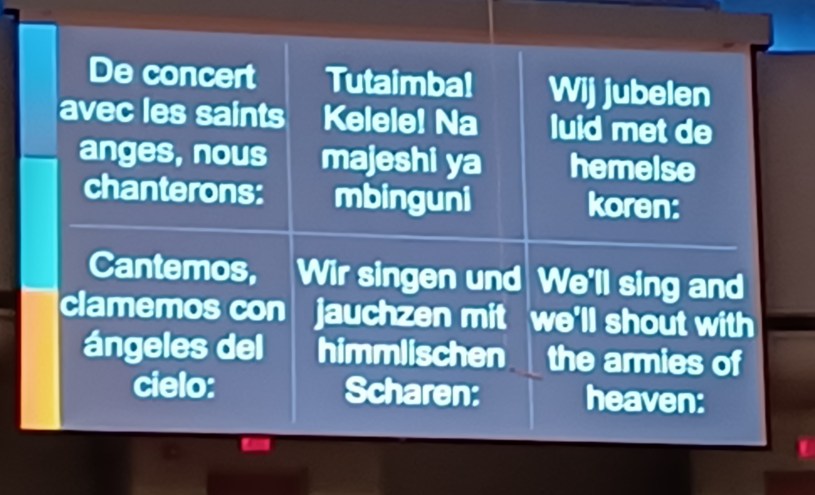
The week-long conference in Independence, Missouri, wrapped up Friday afternoon. Although numerous items of legislation were passed by the approximately 1,800 delegates, what was most evident was the international and gender-based diversity on display.
A majority of the prayers offered by Conference participants were in languages other than English, without translation. Many of the songs performed by small groups, as well as congregational hymns, were also in multiple languages. The photo above was of one of the giant screens in the conference chamber, showing lyrics in multiple languages for “The Spirit of God Like a Fire Is Burning,” during Thursday evening’s worship service. (Archived videos of worship services can be found here.)
Changes in leadership were notable. The new president of the Council of Twelve Apostles (Mareva Arnuad of French Polynesia) is the first non-native English speaker in that role. She is also one of six women in the Twelve, the largest number ever, and one of seven apostles born outside the USA.. One of the counselors in the Presiding Bishopric (Wim van Klinken, from the Netherlands), is the first person in the PB from outside the USA, as well. For the first time the Senior President of the Quorums of Seventy is a woman. The Standing High Council now has its first high-priest members from Honduras and India, as well as an African-American from Iowa.
Some importantlegislation was approved:
Baptism and Memberahip: The delegates formally requested the prophet-president, Stephan M. Veazey, to seek divine guidance on whether persons baptized before the age of eight in other Christian denominations may become members of Community of Christ via confirmation after having attained the age of eight. Currently, this option is available only to those baptized elsewhere after the age of eight.
The Climate Emergency: All Community of Christ jurisdictions (world church, national churches, mission centers, and congregations) are encouraged to take responsibility for reducing carbon emissions. The Earth Stewardship Team will identify and help develop resources and ways of doing that.
Racial Justice: The Church commits to eliminating institutional racism with a goal of an inclusive church in an inclusive society, and that this will be achieved through prayer, discernment, worship, love, justice, and nonviolent advocacy.
Universal Scripture Access: Delegates narrowly defeated a resolution that would have requested the First Presidency to formally study the possibility of providing free, online access to the church’s three books of sacred scripture. Much of the concern had to do with allocation of staff and financial resources when there are more pressing needs.
Marriage: Does not change existing doctrine or practice, but establishes a process whereby apostles may recommend, with approval of First Presidency, adaptations in some national and cultural situations. Monogamy and the church’s Enduring Principles remain as core guidance.
Recommendation on Removing Doctrine & Covenants Section 116: Referred to the First Presidency, because of the complex historical, social, and theological issues involved. That section originated in 1865, about a month after the end of the U.S. Civil War. Apparently some members of the Reorganization had been influenced by Brigham Young’s 1847 ban on Blacks in the priesthood, and Joseph Smith III considered that and other factors before presenting the statement. Leaders and delegates were cautioned against using “presentism” (judging past actions according to current standards) in situations such as this.
Compassion for Refugees / UN World Refugee Day: Delegates added climate as a category of refugees, then passed the resolution which will create an annual Refugee Day on the church calendar in June; the resolution encourages jurisictions to actively support efforts to assist refugees.
Organization of Additional Jurisdictional Units: The First Presidency was authorized, through a change in the church’s bylaws, to organize additional forms of organizational units not currently in use, or presently foreseen or anticipated.. These may be based on national or physical boundaries or no geographic designations (such as virtual or online groups).
Items Referred to First Presidency Due to Lack of Time: Resolutions decrying Christian Zionism and seeking further clarification on the church’s stance regarding nonviolence; and clarification of the audting and budget process,

A personal note: I have attended a great many World Conferences of the Community of Christ (before 2001, the Reorganized Church of Jesus Christ of Latter Day Saints, or RLDS Church). I recall from decades ago looking to the rostrum at Conference, seeing an all-male priesthood (with men almost always wearing dark suits, white shirts, and ties) presiding. English was by far the language used (with translations provided to those few delegates who needed it). Worship services were formal and relatively standardized (preaching services each evening by a top church leader). In short, those memories seem far, far away and vastly different from today.
I still grieve the loss over those decades of thousands of church members who left, primarily conservative/traditionalists but also including a fair number of progressives who believed change was taking too long as well as some folks who simply got tired of all the bickering over small and major matters. Transformation of the church has picked up steam during the past decade or so. This World Conference more fully reflects the characteristics of our international faith community than ever before. And yes, the Community of Christ still faces major challenges in the years ahead, particularly in regard to demographics and finances. As well, this old, unilingual, white guy sometimes felt unsure of just what was going on at times. (At least I’ve not reached the “Get off my lawn!” stage.) Yet because of it all, I remain hopeful as our journey continues.
 Wheat & Tares
@Rich Thanks for the update. With the approval of new juristical units, do you foresee the rapid development of online units that are still geographically centered, but serve the broad areas of US without any CofC brick and mortar congregation like Tennessee? And might there be a way for these to have an occasional physical conference for in person worship?
10ac
That’s a real possibility. During the Conference someone from an online community of U.S. Indigenous People in the church spoke. He mentioned that they gather in person 4 times during the year–Spring, Summer, Harvest, and Winter Moons–but otherwise just online. Creating that group apparently took a long, administrative process. This new change to bylaws will allow that to happen easier and more often.
I’m full of admiration. If envy is one of the 7 Deadlies, I’m also full of sin!
One of the reasons the church struggles with finances is because those conservative/traditionalists were the loyal tithe payers. I know many members who limit their contributions to the operating of their local congregational facilities. A conference report about 12 years ago stated that only 25% of the membership tithe, and the median age of that group was early 60’s. Tithing doesn’t seem to be a concept embraced by many progressives in the church.
Bickering has been fostered by conservatives and liberals alike. One traditional congregation near my hometown was visited by their apostle (female) and threatened to “get with the program”. They told her to leave. BTW, this branch has women in the priesthood.
Mark:
I believe the core problem is not tithing, as incongruous as that seems. The core issue is an aging membership, which leads directly to steadily decreasing number of contributors.
CofC members as a whole have actually been remarkably generous in their contributions of tithes & offerings.
It doesn’t matter whether you have tithe-payers (using either a net or gross method) or contributors giving out of their generosity, when the total numbers doing so steadily decreases.
This, of course, is not unique to the CofC but is the case throughout many Christian denominations. Sure, it doesn’t help when you have folks stubbornly looking no further than their local congregation. Revisiting the same old fights year after year does nothing for the spread of the gospel.
From comments I’ve read here at W&T, the LDS Church is not completely immune to the same contributor trends, just more a timing question perhaps.
Surprised by the squashing of universal scripture access.
I can understand the resources needed being a concern, but people not having access to scripture seems like it would (or should) be a bigger concern.
Thank you for the write-up, Rich! Very much appreciated. Fascinating for me to get a window into this method of church governance. I often hear/read progressive Mormons calling for a more inclusive, truly common-consent governed, church experience. And I’m like, well… it’s out there. Community of Christ, with all its graces and struggles, is showing us all how its done. Not easy. Curious to see how it continues to develop.
Can you explain to me what the denounciation of Zionism might look like? I would imagine in an international church, traveling to Independence in order to get a spiritual experience would feel very exclusionary to some. I also was getting the vibes online that your members weren’t terribly attached to the Independence Temple other than as a symbol–or loved it but not the way it was currently being used, or preferred Kirtland’s, or found more spiritual fulfillment in being outdoors. What’s the chances that elements of the Independence temple and children’s center could be shipped to different congregations to bring that to them (assuming no cost like the latter-day saints–Brighamites funding it in exchange for land)? Would people want that if they are moving away from the concept of Zionism? I would imagine that enhancing local church’s environments would help with regional bonding and pride. Also I saw a video from the youtube channel 52 churches in 52 weeks–the person visited your Stone Church in Missouri, and the leader was saying Stone Church wasn’t getting enough use out of it to justify things as they were going. He and others assumed that your church was falling apart, but I know that’s not true–you are just growing in other areas. Any insight–does this mean that Independence might not make sense as the headquarters anymore if the local churches were needing to consolodate? Do your church leaders have to relocate there if they are from say the South Pacific or do they correspond online? If the church is entirely internationally-run I could see Independence as being a problem among a diverse world. I could be wrong and I don’t want to offend if Independence is still very important, I just wondered what direction things were going. It doesn’t appear that CofC is using–look where we are located and what is here–as any basis for legitimacy in the eyes of other followers of Joseph Smith are in the way that say the Temple Lot church is. Although the whole Zion thing among the Temple Lot is bizzare since they believe that Joseph’s only job was to translate the Book of Mormon. I think jumping ahead to later years and saying, oh yeah and lay the cornerstones of a future temple too was just to establish their legitimacy in the latter-day saint movement. Since they don’t have much of a presence online I can’t really ask them why they adopted the Zionism movement or why it matters.
Is it okay, I think they meant the *other* Zion.
So, were the Taiwanese there this year? I always look for their flag,
Allyson:
There is very little interest among church leaders and members outside North America in the Book of Mormon (and, frankly, not all that much in NA, either). The same is true for what we in CofC call the Inspired Version (JST, or Joseph Smith Translation). That’s the Bible version the church has published for a century and a half (thanks originally to the heroic efforts to save the manuscript by Emma Smith back in the day), as it owns the copyright. However, the church recommends using any number of high-quality, reliable, scholarly translations of the Bible (the NRSV is my personal preference). As for the Doctrine and Covenants, it is available in print and e-versions for a small charge, and can be updated as it’s added to. Recent sections (160 to 165), which are most widely used these days, can be accessed for free on the church website. The resolution at Conference called for all three to be made available free in print and e-versions in multiple languages. It’s not that translations in French, Spanish, and some other languages don’t exist, but more about providing much-needed and much-wanted resources in those languages. Yes, we value scripture deeply, but recognize the need to prioritize resource production.
Rich Brown–I’m assuming NA means North America? Do people outside North America get their trips to the auditorium for conferences subsidized or raise money for trips? Or is there a local leadership like a Fiji-run Community of Christ (complete with their own first presidency, similar to how there are denominational equivilents who hold fellowship with their American counterparts in Africa and other parts of the world)? Is there any struggle to access church sites, or do they just not care?
Zla’od–Okay, so what you are saying is Christian Zionism refers to trying to support Israel’s Zion be re-established as it was prophesied might no longer be accepted among the CofC. So it doesn’t refer to Christians of European descent trying to create a western Zion, like the Mennonite/Amish ancestors who took over a town in Germany, declared it the New Jerusalem and oppressed the people living there. I just thought that the latter, creating a Zion in America would have a bigger negative connotation to a progressive church or be considered more insensitive than helping a minority group regain their footings. I’m not saying that Israel as a nation is right in what they do, they have made a lot of poor decisions in their legislature, recently they almost voted to jail Christians for sharing their faith and even Palestinian Christians get treated like they are part of a middle eastern terrorist group–they continually have been biting the hand that feeds them. Christian Zionists will reap their own poor harvest by trying to strongarm it themselves and declare themselves allies instead of letting the Lord do it. I’m guessing that’s what members opposed to CZism are thinking, but maybe I’m wrong. Maybe they don’t think there should be a Zion in the East period, and logically anyone trying to establish a Zion themselves would need to re-evaluate that. I’m just trying to understand CofC’s priorities.
Allyson–go to scriptures dot byu dot edu. On the left hand column you can click on any scripture in the bible and see the complete Joseph Smith translation for it online. If anyone needs the complete inspired version online BYU has published it. Obviously it’s not CofC’s Doctrine and Covenants, but CofC people can look at ones that are shared
You’re not the only one who was wondering what was going on at times! Thanks for lunch, by the way! I was so impressed with the truly international feel of the conference, as well as the open communication, and open dissent, civil dialogue dissenting with the prophet and the back-and-forth. Of course, legislation is quite messy, and it can feel quite inefficient, but it was wonderful attending my first World Conference!
It was interesting that the delegates debated a resolution about apologizing for past racism, and after it passed, Pres Veazey had ruled that lawyers said they couldn’t support it. I heard 2 interesting summaries as to why: (1) the CoC leadership wanted people to feel they had been heard (even though they couldn’t accept the resolution), and (2) apologizing for racism opens them up to lawsuits. It’s why both (a) Oaks said the LDS Church will never apologize, and (b) Dominion couldn’t get an apology from Fox because shareholders would eat Fox News and put it out of business.
Plus, I thought it was soooo interesting to hear the different musical groups from different nations around the world. You’d never see a graffiti artist at LDS General Conference!
I would be interested in a whole W&T post about civil liability and potential apologies by the church (either CoC or the Brighamite church). Does our current justice system really incentivize organizations to withhold apologies for wrongdoing?
Rick B:
A friend of mine was sitting in the row behind a well-known lawyer when the delegates added that additional Whereas paragraph to the resolution concerning an apology for past discrimination. The lawyer muttered loudly, “That’s going to be a problem.” At the end of the session he made a beeline for the First Presidency on the rostrum. When we resumed right after lunch, President Veazey made his statement. Sadly, the USA is a very litigious society, so while the statement makes good theological sense,it’s also a legal minefield.
Is It Okay…:
The resolution at World Conference called for the CofC to separate itself from and condemn Christian Zionism. The big problem here is the widely different ways the word Zion is used.
Zionism (and zionist) for the past century and a half or so has come to mean return of Jews to Palestine and the establishment of the modern nation-state of Israel (which has the side effect of displacing Paleatinins). Many people tie that to Old Testament (Hebrew Bible) prophecies. It merges theology and politics. That can be a sticky issue right there.
Christian Zionism takes this a step further by making a Jewish return to Palestine a precursor to a literal second coming of Jesus. In recent decades Evangelicals have latched on to this in a big way, developing elaborate scenarios for the End Times which they believe are literal fulfillment of the apocalyptic visions in the New Testament Book of Revelation. From there you can get into pre- and post-millenialism, the Rapture, and a violent end to the world led by a warrior Jesus. Buried within all that is the expectation that Jews must eventually become Christians or be destroyed. Christian Zionists are often closely aligned with White Christian Nationalism, with its own disgusting array of religious bigotry and white supremacy.
All that is a far cry from what we in Community of Christ believe about the coming reign of Christ’s peaceable kingdom on earth. Instead of misinterpreting the apocalyptic visions of Revelation in literal ways which somehow spell out exactly what the future holds, we look instead to the New Testament Gospels to discern from Jesus’ teachings, miracles, and example what the emerging peaceable kingdom will be like. Whether one believes in a literal or more metaphorical Second Coming of Jesus (and you’ll find both among CofC members), the various latter-day saint visions of Zion are NOT like the Christian Zionism I’ve described above.
Dealing with all the nuances involved in this topic is not something easily dealt with in a large legislative setting. Conference delegates had little enthusiasm to wade into all this, and I’m rather relieved there wasn’t time to get to the resolution.
Is It Okay…:
I’ll try to answer some of your other questions.
Yes, there is a Delegate Fund to assist folks traveling from outside the USA. A bigger problem is often obtaining visas, considering restrictive actions by the US government in recent years. This Conference delegates from Honduras participated from a remote site over video connection. I expect to see more of that in the future. Students at Graceland University also participated that way, because Conference was held during finals week.
The Temple in Independence serves as both a powerful symbol and important place for the church. It along with the Auditorium across the street comprise International Headquarters, and that will always remain so.
There are congregations even in the vicinity of Independence that struggle with aging and/or declining membership. Some have closed and others eventually will, too. But there are also strong, vibrant congregations here and elsewhere (my own congregation in Blue Springs, next door to Independence, is an example). In coming years expect to see new and perhaps unexpected forms of congregational life created.
With advances in technology, and with real-life experience gained during the pandemic, it is possible for some top church leaders to live somewhere other than Independence. I expect that will be the case for our new president of the Council of Twelve Apostles. She lives in Tahiti, French Polynesia.
Zla’od:
The flag of Taiwan is displayed in the Auditorium conference chamber because we have members in that island “nation.” Whether there were actually Taiwanese delegates present last week, I really couldn’t say.
Rich Brown,
Thank you for taking the time to help me understand the Christian Zionist movement more, as well as your church. Online, looking at evangelical discussions about how to help Israel they are all, “we got to help Israel build the temple”, but then they scowl at latter-day saint movement churches and wonder why we build temples and mutter something about temples built with hands–kind of hypocritical. I’m not sure if they are annoying/funny/misinformed but I haven’t seen anything about white is right or anything like that. Perhaps it’s the whole focus on America, and it being a chosen land, that gives them that reputation? I don’t know. I think they are a little lost relying on literal interpretations without leadership. But then again we all get lost from time to time. I try to be one with Christ and to be worthy of guidance from the Holy Spirit; it keeps me from steering into soul sucking rabbit holes/trails.
That’s always fun and humbling to work with people internationally and from different cultures, and gain their perspectives. I read from some BYU scholars that the Church of Jesus Christ of Latter-day Saints was seriously considering a temple ship that docked and visited people in different countries many decades ago. They didn’t know how safe that idea was and scrapped the plan. Probably a good idea since ships are vulnerable. Then again land-based temples and buildings can catch fire, the Church of Christ-Temple Lot has lost their building…three times maybe? And Latter-day Saints have lost several of their temples/tabernacles/meetinghouses that way. If something were to happen to the Indepence Temple due to some crazy actor (that’s not unthinkable in today’s climate), it might be too big of a loss for CofC to absorb and not seen as a priority by the members abroad. But if the temple were portable like the tabernacle in ancient times (or divided up) they might be just as invested in it. Even just changing up where you meet for conference or doing things in their language as you suggested was starting to happen more, is definitely a move towards making things more equitable. Sounds like the temple is still loved (though I’m curious as to why a CofC member online in a forum claimed fellow members were only pretending to be supportive–maybe they’re in the minority) just not it’s location since you said that love for the Book of Mormon and America isn’t big abroad, and leadership doesn’t feel they have to be in Independence (headquarters for your church have changed multiple times in the past and it’s not unthinkable that it might change again). Is it true that the Book of Mormon is on its way out in the CofC or is that just a rumor?
Kirkstall, I’ll let Rich Brown or John Hamer tackle your request!
Yeah, there’s a group in Taipei, or at least there used to be. (Maybe closed during Covid?) FB photos show about 13 people and a dog, half of them white (including the dog).
https://www.facebook.com/TeipeiTiawan
I’m just happy they don’t have to call themselves “Chinese Taipei”! (Maybe “Teipei Tiawan” was a compromise? Or somebody has lesdyxia.
Hey, I got a CofC question. On all those Centre Place YouTube videos (which rock btw), there are a bunch of symbols in the background, one of which is a nine-pointed star. If memory serves, this was explained as the symbol for inter-religious dialogue. Now my question is–why a nine-pointed star for that? Whose idea was this? (I suspect the influence of a certain Persian sect, but why would their symbol turn up here?)
I would have suggested building more temples if the idea of splitting or making the temple portable is out of the question with the help of the latter-day saints in exchange for land, but seeing as it’s too expensive to just put scriptures online, I’m guessing that’s out of the question. I remember when tours at Kirtland were only a few dollars, I’ve heard it’s now $10 and the virtual tour $7. The Independence temple tour also costs. Sorry that it’s come to that. The way the economy is going and the fact that you can find videos online for free doesn’t bode well for raising money that way. When I found out that a virtual model cost to view, I found this one on youtube at no charge: Kirtland Ohio Temple (1836) [8k 360]
Clearly people either need to be energized to pay tithing if selling more land whenever the economy hits a snag is out of the question. Young liberals are the least likely to pay a full 10% and they probably make up most of your converts–and just leaving it to people visiting your properties and scriptures online apparently to foot the bill is risky. I think it’s smart that your church did a survey recently to find out what young people care about today. The internet was the primary means of conversion, a substantial number of them were LGBT, they want community and experiences like being outdoors and going to camp. None of that sounds like it happened by visiting your temples and finding inspiration there, nor does it seem like other members/main website were great proselytes (the stone church video on youtube attests to the latter: Protestant Explores Temple Lot Finds Grieving Latter Day Church) . It looks like a lot of your members come from ex-latter-day saints, but it appears that they don’t stay for very long. The same spirit that inhabited them when they quit they just brought with them to the next church (meaning the same things they didn’t like they anguished about when they converted to CofC). What changes do you think are coming next? Do more surveys need to happen?
This lovely video recap of World Conference was posted by the church:
https://fb.watch/kfJ8EcBsLA/?mibextid=5Ufylb
According to Rich: “There is very little interest among church leaders and members outside of North America in the Book of Mormon (and frankly, not all that much in NA, either)”
It’s important that the readers know the Community of Christ has never officially stated a repudiation of the Book of Mormon, or the Inspired Version (Joseph Smith Translation); despite leaders and members calling for the removal of both from its official canon of scripture. (Yes, Rich, I read them in years past when I was a member). I believe the leadership fears such an action would further alienate those members who still carry a positive testimony about those volumes and advocate their use.
Are traditional ideas figuratively “shouted down” the way progressive ideas were before being passed by conference vote? I remember an essay entitled “Dissent: an RLDS tradition” but now it appears dissent against Progressive Liberalism has no place. A friend of mine who thought of the Independence Temple in terms of ushering in Zion was quickly informed “We don’t believe THAT way anymore”. Is there no room for both perspectives?
Mark Gibson,
I think that’s smart of you to ask questions about if there’s people there who think there might be “no room” for them.
Out of curiousity I wanted to see what happened to that church featured on the youtube channel, the Stone Church, in that video by checking out their facebook page. It looks like they combined four congregations in the Independence area into either the temple or auditorium assembly room, labeling a special around the “Table Ministry”. It was only supposed to last for three months, but now they are saying on their facebook page that there’s “no timeline”, and anyone who misses Stone Church can just turn to previous recordings. Google maps shows that the Stone Church is still closed on Sundays but open for preschool. What do you think should happen to that historic church building? What should happen in Independence?
Anyone else can chime in too…or is it too difficult to think about? I can understand that as well, I guess I like to ask hard questions because I’m a bit of an amateur anthropologist: I like people. I am also curious as to how the international leadership will affect things.
The Stone Church use to house the main RLDS congregation, including the FP. To hear that its status has diminished is not surprising. The progressives of the COC continue to distance the church from its connection to “Mormonism”. No doubt some wish the church’s headquarters could be relocated.
As for the fate of Independence, the Mormon element will always be present. At least a dozen breakoff groups from the 3 parent churches exist in town; some maintain only one congregation for their entire faith. Only 2.5 acres remain for the Temple site so it will be difficult to erect a structure (an LDS mini-temple might make it).
As the COC blends into the Christian background of the city, the LDS should increase its presence. That has begun with the recent historical markers of Mormon events/places around town and the LDS Temple in neighboring KC, although it is not meant to imply an abandonment of a temple in the center place.
That is interesting, thank you. I didn’t realize that CofC Independence congregations were more conservative or hosted the leaders, but I guess that makes sense. It is curious that the Latter-day Saints–Brighamites have passed over the Far West lot that the church owns, maybe it’s too out of the way to justify building it right now. As far as the Church of Christ–Temple Lot, they won’t build on their own because they believe in ecumenicism. The RLDS seems to believe in that too, joining the council of Christian churches, but with other Christian faiths. Apparently they tried it with CoC–TL 100 years ago and it just led to people joining CoC and leaving the RLDS.
I noticed that the CofC put a sign acknowledging that the land the temple and auditorium are on used to belong to the Osage tribe. That totally makes sense if it’s a place of sacred ancestry/pilgrimage to them, but they were forced there by another tribe and didn’t stay there for more than a few decades. I wonder what CofC meant by it–an attempt to relate more to people/bring them in, or guilt about proclaiming that land as important to them? It doesn’t make sense that Zionism = white supremacy, because wouldn’t a white supremacist want nothing to do with the Jews? Most of them hate them. It seems that whenever CofC is making a change they do it gradually, and that might be happening here. That’s why I’m suspecting that they might be moving in a new direction.
Consider: With the exception of Catholics and Latter-day Saints, Christian churches don’t direct churches from another country (they are all the such and such denomination of that country and it’s run by a local presidency)–the Catholics operate out of the Vatican and the latter operates in Salt Lake. Latter-day Saints tried to have an international Young Women’s board where people stay in their own country or people speak in their own language in conference and it didn’t work out. Probably internet and translation problems (it’s easy to find a Polish person who can translate English speakers into their own language but how do you manage translating Japanese into Polish?). What CofC is doing by having leadership all over the world is fascinating and unusual, even admirable–but it probably isn’t sustainable if they still care about establishing Independence as a thriving city for their church. Eventually the international group is going to steer attention away from America. They are going to wonder why they must pay for an American temple–since they don’t have one of their own. Charging tourists a pretty penny to listen to the organ play in the temple or hear an explanation isn’t likely to foot the bill.
The conservative members are mostly outside the main church in groups called Remnant Church, Restored Church, etc.
The LDS plan to build facilities at Far West to host events like youth conferences. The temple site is still owned by the LDS and the COC have a congregation tight across the street.
When the RLDS temple was built, the plan was to have a 25 million dollar endowment fund raised to operate the temple. Perhaps their financial problems caused them to dip into it; since they now charge admission as they do for historic sites.
I doubt anyone is still checking back here, but I have seen a lot of people speculate that the Latter-day Saints–Brighamites will build a temple anyway in the near future without the entire plot of land like the CofC did. That’s extremely unlikely that they’d do it with out the entire plot of land, here’s why…
1) There were supposed to be small 24 temples according to Joseph Smith’s plans (see churchofjesuschristtemples dot org slash independence-temple)–I’m not saying that can’t change I’m just saying that there might not be much purpose in building one–because if you click on the 3D model, you’ll see that it’s not supposed to be for the same ordinances latter-day saint temples are used for today–it functions much like the Kirtland Temple. There’s already assembly halls in temples in Utah that can be used by church leadership (not in every temple, just certain ones).
–>SIDE NOTE: Because the church builds assembly halls for special occasions I find it funny that latter-day saints of all denominations assume that if the Kirkland temple were ever aquired it would be gutted and a baptismal font would be installed and only their members could enter–there’s plenty of temples with visitor’s centers and the old temple part could easily function as one. They often back out of changing temples if there’s enough pushback, like keeping paintings.
2) Doctrine and Covenants 45:68 talks about people fleeing to Zion to safety–many latter-day saint leaders (this was many decades ago) interpreted that as a second civil war that will be present nearly everywhere in the states. Looking at the prophecies about it, they explain it as happening in three parts the first one has people of all kinds who don’t want to fight fleeing to Utah and there being a repeat of what Joseph of Egypt did for his brothers. The second part being people going to Independence being led by someone mighty and strong (D&C 85:7)–though the reasons and logistics weren’t too clear. Sort of a repeat of what Moses did but only the righteous people would be able to come to Zion and building it up there. Then it appears that the metropolis might grow from there (establishing and building other prophesied places the saints were never able to build, so maybe that’s where Far West comes in?). It sounds like they are waiting for the Independence area to be cleared out by civil conflict before rebuilding the “waste places” (D&C 103:11), but that doesn’t stop them from petitioning other churches in Independence to buy their land. There was also speculation by Joseph F. Smith and Heber C. Kimball that the land would be cleared out and hard to reach because everything would have been abandoned in the civil conflict and the transportation system would have broken down. But the apologetic foundation FAIRLatterDaySaints doesn’t think the “yellow dog” prophecy by Kimball really happened and the “what will become of the railroads” by JFS in a discourse was anything more than a faith promoting speculation. So maybe they don’t anticipate needing to wait for all that and that the change will happen before things get really bad, but I still think they are waiting for the land to completely open up and that’s unlikely to happen any time soon.
3) There’s also the whole city of Zion plat designed by Joseph that is supposed to have lots divided out for residents that would allow them to have a lot of property. The problem is latter-day saints–brighamites have filled up that land in their own way thinking that somehow gives them front-row tickets to the city of Zion when it is built (I know because some of my relatives live there and have that mentality) but if Zion is supposed to be a reward for the righteous and only the “pure in heart” can be there, the church isn’t going to just accept them living there and give them citizen status based on their residency.
If all this seems far-fetched, consider that the Hendrickites have a design for a temple that looks like a Parthenon–contingent on building it when all the latter-day saint factions have united together, that seems far less likely than a second civil war.
Is It Okay…:
If the LDS Church were to announce they were going to build a temple in Independence, many church members would hear it as “JESUS IS COMING! GET TO JACKSON COUNTY RIGHT NOW!” Which is to say, That’s just not going to happen. Nobody wants that kind of panic. They made the deliberate effort to build the KC Temple across the river in Clay County for just that reason. Secondarily, an LDS temple on the Temple Lot in Independence would have to be bigger, taller, and grander than the CofC temple across the street. Now, they have room, where the LDS Visitors Center is now located, but it’s also the lowest point on the entire Temple Lot acreage.
Thansk for this interesting review of the last CofC World Conference. The review is very positive, as many positive things happened. But the review also fails to mention the (less than? ) half-filled auditorium, and the very bad joke the Presiding Bishopric made about our Roman Catholic brothers and sisters.
Yes, it was an insensitive comment by the new PB, but at least they later apologized FWIW. As for half-empty conference chamber. Delegates were spaced out due to Covid. And, I suppose, business meetings are not as fascinating as a series of short sermons/talks as you might find elsewhere.