

I am in my mid 50’s, so you may have to adjust a few dates to apply to you, but I think it equally applies to most everyone. It might be that getting older gives you more time and motivation to think about the end of your life. I don’t spend all my time shuttling kids around or attending their concerts. On a side note, I find being an empty nester GREAT! I have started to think about retirement (sounds great to me!) and the $ needed for retirement. I did have to go figure out about how much longer I have to live. So I found an online lifetime expectancy tool .
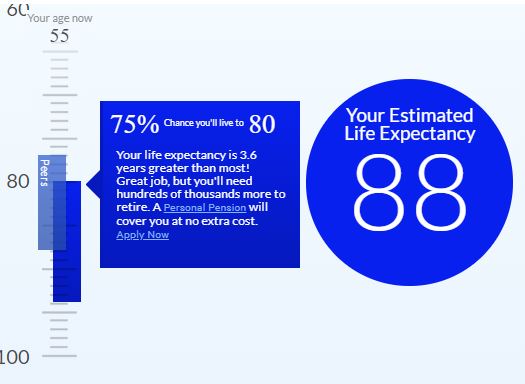
It said I had a 75% chance I will live to 80 (1 year more than my father) and a 25% chance of living to 96. But overall it said on average I will live to be 88. Knowing I have 25-30 years does make me look back and realize that isn’t much time.
I listened to a podcast that was more of like eavesdropping on 2 people having a conversation. The topic turned to the topic of death and specifically on how much time we have before death changes how we look at death and how we live.
They discussed what they would do different if you knew you had a day, a week, a month, a year, a decade, etc. They agreed that a decade or more probably doesn’t change what we will do in the near future (other than maybe taking a look at our life insurance policy). And no surprise that on the other end of the scale it would change what we do in the next few days. The shorter the timeframe, the more effort we usually put into living life to its fullest. How many college papers assigned weeks in advance were turned in with only minutes left on the clock?
But it started me thinking of how the Mormon view of eternity and being sealed to our spouse plays into this equation [1]. Does the fact that we have “eternity” to work our marriage relationship affect how much effort we put in resolving issues TODAY?
I remember reading many years ago on a blog someone mentioned that she heard a bunch of sisters in her ward in a RS activity just really talking down about their husbands. The one sister listening finally said, “I am so sorry that you have to live with your husband for eternity as it sounds really bad.” That was probably a combination of being a bit rude and a bit passive/aggressive (or is it aggressive/passive in this case?)
I have heard some talk about with temple marriages that “you just have to hang on in this life then everything is going to be celestial.” That does seem to me that at least for some people the prospect of living with someone eternally can effect a relationship. With that logic it would seem that working on the relationship is second behind “making sure we both make it to the celestial kingdom.” First and foremost one has to make it to the celestial kingdom. Just make it across that finish line and everything else is small change – including liking being around your spouse.
So do you think that the prospect of eternity changes how we might otherwise work on our here and now relationships?
[1] Even before I got married I already came to the conclusion that sealings were mainly about spouses being sealed. Otherwise if you come from a huge Mormon family, you would be in one humongous group. To me that mentally devolved into “heaven” as we would be sealed one way or another to most everyone. I want to be with my wife – the only person I have “picked” to be in my family. I do want the kids and grand-kids to come (I hope my mansion has enough room for them). I wonder if the rule of thumb about “Guests, like fish, begin to smell after three days” applies in the afterlife?
 Wheat & Tares
This is a great question, Happy Hubby. Anecdotally, there are a fair number of people who, when they have a faith crisis, find that their spouse wants to leave them, because a less-than-fully-faithed person won’t be going to the Celestial Kingdom, and they don’t want to risk their chances. I think this fits perfectly with the suggestion you make at the end of your post: ” Just make it across that finish line and everything else is small change – including liking being around your spouse.” You just need another worthy person, and whether you like them or not or have a good relationship with them at all can be worked out in the eternities (along with all the people who wanted to get married but couldn’t find a partner, and the people in polygamous marriages who didn’t want to be, presumably.)
Sorry this is a bit of a tangent, but the criterion of just finding another worthy person to cross the finish line with you totally reminds me of the Spencer W. Kimball quote about marriage that gets batted around so much, where he said something like that almost any two worthy people could make it work. (I think the “almost” is often omitted.) And it does seem like more generally, we Mormons are overly focused on getting to a particular finish line, and have little concern for what happens afterward. Missionaries with investigators? Just get them in the font and in the church, and everything else will work itself out. Young people dating? Just grab someone and marry them and everything else will work itself out. Aging married couple? Just grit your teeth and get across the endured-to-the-end line and your relationship will work itself out.
”Just make it across that finish line and everything else is small change…”
There might be some portion truth in this sentiment, looking at things broadly. I am not offering an excuse for neglecting duties or opportunities, but I apppreciate the message that whatever unfairness, imperfection, failure, sadness, and so forth that we find in this short life, we understand that the day will come, for those who have faith, hope, and charity, and who endure to the end, when—
And I heard a great voice out of heaven saying, Behold, the tabernacle of God is with men, and he will dwell with them, and they shall be his people, and God himself shall be with them, and be their God.
And God shall wipe away all tears from their eyes; and there shall be no more death, neither sorrow, nor crying, neither shall there be any more pain: for the former things are passed away.
And he that sat upon the throne said, Behold, I make all things new. And he said unto me, Write: for these words are true and faithful.
And he said unto me, It is done. I am Alpha and Omega, the beginning and the end. I will give unto him that is athirst of the fountain of the water of life freely.
He that overcometh shall inherit all things; and I will be his God, and he shall be my son.
I believe passionately that an eternal view of marriage and the christian life necessarily requires us to develop a relationship that is as celestial in nature as we can possibly accomplish, and that the idea that all shall be made well does not mean that some magical change will be made to an abusive, neglectful, or irresponsible spouse.
Bad news for the likes of me who don’t have a clue what good behaviour looks like, but I have tried to make it my business to find out, with variable effect in my children. I think it’s arrant nonsense to expect God to do something by magic that we have been unwilling to do in this life, but I really hope He will help me with what I’ve been unable to do, which is feeling like a lot at this late stage, judging by results.
Fortunately, I am able to trust in God’s love.
I have always felt that people with this attitude, of just endure to the end, have already flunked the test. The test was never to grit our teeth and keep the minimum commandments. The commandments were just a stepping stone toward learning to love others, especially our spouse. The test is to learn to love others like Jesus loves them. And tolerating your spouse with the assumption that once you make it to the finish line, then you will learn to truly love them, just isn’t going to cut it. The attitude is wrong. We have this earth life to learn how to love, that is the finish line. So, if you are not doing everything possible to love your spouse, then you have stopped before the finish line because you misunderstand where the line is. The line is not determined by temple sealing and then being an active Mormon and paying your tithing for the next 50-70 years. If you don’t learn to like each other now, all the tithing in the world will not buy your ticket into the CK.
My Relief Society President told me that my husband and I seem to be the only couple in the ward that loves each other, and we do. We have a very sweet relationship (we are in out early seventies). I was a child during the David O. McKay era and stories were often told about their constant love for one another. I wanted a marriage like the McKays, and I believe that I have one. We walk holding hands, just like the McKays. Our relationship evolved in this way, not because we were sealed in the temple, but because it is what we wanted. It will continue to evolve throughout the eternities, because we bound together by our hearts’ desire.
Ziff – I don’t think your comment is a tangent as it is related to the topic. I think someone that is willing to look at themselves as to where relationship issues and not just claim their partner is 100% of the problem are probably better working at their marital relationship AND better at not rejecting a spouse because they don’t believe 100% the same.
I used to kind of believe the SWK “any 2 people can make a marriage”, but my life experience has told me that I isn’t so true. The advice used to be given to gay member to “just get married and it will work out.” For the majority in this case it didn’t work.
Ji – I do hope for God to make the afterlife great. But I was trying to point out how some spouses don’t try now. Similar to the “why baptize people now and instead just wait and let everyone die and in the millennium their work will be done.”
I like your humility handlewithcare. Assuming yourself to be imperfect generally leaves you more open to do your part and not just point a finger.
Anna – thanks for your comment and I agree with it. But your comment of “keep the minimum commandments” made me think of some that attempt to keep the maximum of commandments – while at the same time being a jerk to their spouse.
I wasn’t talking about the afterlife being great. Rather, my point was that we don’t have to qualify for the celestial kingdom in this mortal life. In this life, we want to develop faith, hope, and charity, all centered on Jesus Christ, and endure to the end. Then, in the resurrection and during the Millennium, we will continue to learn and grow, and hopefully, we will qualify for the celestial kingdom before the final judgment at the end of the Millennium.
There are so many inequities in this life, seen and unseen. We don’t have to solve all of them in this life — in the next life, they will all be taken care of, and we’ll have a thousand years to qualify for the celestial kingdom.
What you are seeing as “some spouses don’t try now” might be an imperfect judgment of imperfect people, rather than a fair judgment considering all the facts and circumstances. Rather than judging that they are failing as a couple in their relationship, I prefer to be hopeful for the future. I don’t want to judge an imperfect couple, or a couple of imperfect people, for an observation of their here-and-now relationship. I’m content to leave judgment in God’s hands and to wish them well.
As I said before, my purpose is not offering an excuse for neglecting duties or opportunities — rather, it is to sustain the hope for the future that the Gospel brings. If one doesn’t develop a perfect relationship with his or her spouse in this life, for whatever reason (including laziness or sin), they might yet do so in the Millennium.
My wife and I were sealed in the London temple in 1970, and have a great life together. I now question anyone knowing what it will take to get into the CK.
Of the 7 billion people on the earth, perhaps 4 million meet mormon ck requirements.
1.8 billion are muslim, none of them being exalted?
2 billion are other christians,
300 million gay people
I am not even sure some of the faithful mormons who think this life is about learning obedience will be welcome. I believe this life is to learn to love as God does, and I see many non mormons who seem to be doing better at that than most mormons. Gay people seem to be particularly compassionate.
We are told there will be reeducation opportunities, but will they be to allow everyone else to become mormon, or to help those who have developed a certain level of love to grow more?
I will probably find out in 25 years or so.
For those of you who are younger, I effectively retired at 55, because I could no longer get a job. My wife and I lived off our assetts for 10 years, and now have a part pension plus remaining assetts. We usually have at least one overseas trip a year, but expect that could become a problem in a few years(14 hours on a plane in cattle class) perhaps more cruises.
Since retiring we have helped each of our children build a first home, and by building themselves, and using unconventional building materials, were able to create equity, we have also built our own dream home with our own hands.
If you can aquire assetts (in my case property) you can live more comfortably in your retirement. The provodent living programme is I think about improving your income, rather than using your existing income to acquire assetts that increase in value.
I truly believe that a “temple sealing” doesn’t do any good without the sealing by the Holy Spirit of Promise which requires effort time and focus to reach. Any couple/family not actively seeking this sealing is likely to be disappointed in the afterlife.
After my faith crisis I admit that I probably put less energy into our marriage. I genuinely try to be a good dad and husband but internally I doubt that I’ll be married to wife forever. It’s both comforting and depressing.
I think being married to the same person for a trillion trillion years will get boring. I mean – to have a break will I go for a million year backpacking trip at a Kolob National Park? I love my wife and we usually get along well but I can’t comprehend eternity. That’s probably why we humans depend so much on the “it will all work out attitude” because we can’t explain it any other way.
My wife knows my lack of belief and it hurts her. I think that she thinks because of my doubts that she’ll ultimately marry someone else in the eternities. I hope that if there is a loving God that a) he will forgive my unbelief or b) that eternity for us single people will still be tolerable.
On a grim but less serious note, since my faith crisis I worry a *lot* less about death. I trail run and bike in Arizona and there is a real chance I’ll meet my demise by falling off a cliff or getting eaten by a rattlesnake. At least it will be doing something I like.
Up until a few hundred years ago, people did not marry for “love” as we do today. They married out of necessity, convenience, or were forced from an arranged union. Do any these couples want to stay together for eternity just because they needed kids to work the farm? I think there is a bad case of “presentism” going on when we do sealings for people that were married more than 200 years ago.
I speak (obviously) only for myself, but one component of my faith transition was this feeling that I wanted to take more advantage of my precious time on earth. I found myself loving my kids better, serving my wife more, being more patient, cherishing my relationships more because I have this feeling that this life might be all I get with them.
I hope I’m wrong, but for me, losing the surety of an eternal perspective made me feel more in tune with the moment, with valuing the here and now. I have heard enough of others express a similar sentiment that I think it’s a fairly common aspect of a faith transition.
That said, I think this reflects more poorly on the believing version of myself who sometimes took relationships and life for granted because there was always eternity. I know of plenty of believers who do much better job than I did (and do) to truly be remarkable, loving, and Christ-like human beings. I still have a long ways to go but my motivation to get there has grown stronger since losing faith. One of the ironies of my journey has been that the less literally I have believed in Christ, the more Christ-like I have found myself becoming.
DoubtingTom – you perfectly captured what made me post this. And I agree that there are very devout and believing members that cherish “now”. But I didn’t while I was believing and I can’t put all of that on the church. But I have to admit it was a significant if not majority factor. I am having a hard time separating my change in belief/perspective from me just getting a bit older. I assume it is a bit of both.
There are two meanings of eternity: lasting forever and being outside of time. The second is the appropriate definition for religion.
Time doesn’t exist for God. Time in this universe will end; all the stars will burn out. Being in eternity means to be out of this universe and its time. When you are in that place, all the time of this universe is an eternal now.