
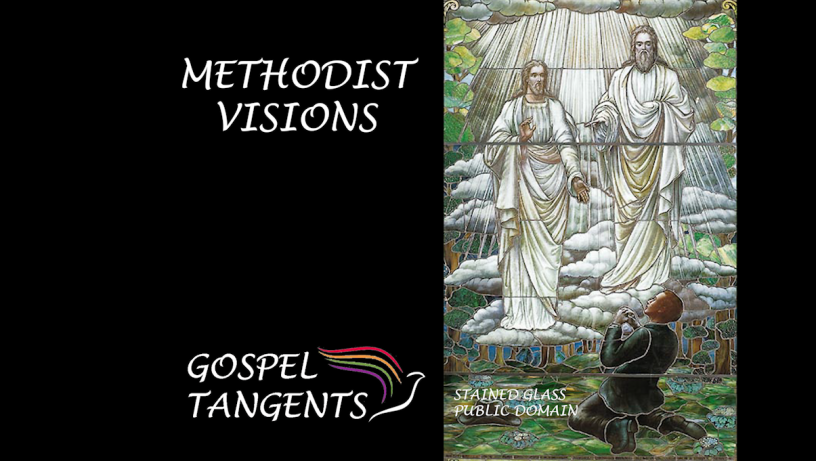
The number of prophets who have claimed to have seen God is very small: Moses, and Joseph Smith. The First Vision is known as one of the most unique visions in all of religion. But it turns out that accounts of Methodist visions were common in Joseph’s day. Is it true that Joseph’s First Vision may not have been as unique as we thought? Historian Dan Vogel tackles that question. He believes something happened to Joseph Smith in 1820 or 21, but doesn’t think it was a vision. Was Joseph’s experience similar to Methodist visions?
Dan: People at the revival, especially Methodist ones, would get religious enthusiasm, as they called it. They would get all excited and some people would have heavenly visions. Some people would see Jesus. Forget about the revivals, a lot of ministers at the time, when they wrote their autobiographies would write about their conversion story, and it would include seeing Jesus or some experience with deity, a born-again type experience. This is what I would suggest that Joseph Smith really had–we’ll eventually get to that, and that the story evolved over time.
…
Dan: The 1832 account has Joseph Smith concluding that all the churches are false, at the age of 12, like his parents. Lucy, and Joseph Smith, Sr. had both made the same conclusion, that all of the churches were false. But it wasn’t tied to they [the churches] didn’t have authority. They were just corrupted by the traditions of men. No one’s thinking of, “Oh, they don’t have priesthood authority, because Christians didn’t think that way.” Catholics did [think that way], but Protestants didn’t think of, “Oh, we have authority and the Catholics don’t,” or whatever. Protestants got their authority to baptize because the Bible commanded that you be baptized, and that is the authority, the commandment coming from the Bible. Whereas Joseph Smith said, “No, it has to come from revelation.” So, when the angel commands to baptize or you got a revelation through the stone to baptize, that is a new revelation, and that is the new authority. So he has current authority, current revelation. That is the original concept of authority, before there were any stories of angelic ordinations. But, in the 1832 account, Joseph Smith has already concluded there’s no church. So when he goes to pray, he’s not asking which church is true. He’s asking, “How am I going to be saved? There’s no true church. They’re all apostate, and what am I to do?” Jesus appears and basically, confirms his belief that there the world liest under sin and all that, and says that those who believe on my name shall be saved. So it’s very close to a revival experience. You have faith in Jesus and you’re saved.
GT : Almost a born again kind of experience?
Dan: That’s what I say. What I say is, if you take Jesus out of it, it would be born again experience. So, why does he have to see Jesus?
GT: You think he basically in 1820 or ‘21, did have a born again experience?
Dan: Yes.
There has been a discrepancy as to when the Melchizedek Priesthood was restored. Was it in June of 1829, 1830, or 1831? Historian Dan Vogel weighs in on the controversy and makes a case for later than the official Church story.
GT: Okay, so it sounds to me like you’re making a pretty strong case for the restoration of the Melchizedek Priesthood being 1831, which really wasn’t known about until 1835. Is that what you’re saying?
Dan Yeah, 1835. Alma Chapter 13 talks about the high priesthood and associates the high priesthood with Melchizedek. So in June 1831, it’s the high priesthood that is given to elders, and for time it was the elders with more authority. It wasn’t a separate office at first. It takes several months before it becomes the high priest office, but it was elders that had the high priesthood. So, that high priesthood, of course, because Alma is going to be associated with Melchizedek, and that’s why it says for the first time. The eldership wasn’t associated with Melchizedek. So in the church you had, for a while, elders. Elders were the charismatic leaders of the church, and the teachers, priests and deacons. were under elders.
GT: Yeah. So from what I understand, I spoke with Greg Prince about a year and a half ago, one of the things he said was when the church was very first organized, you had elders, priests and teachers. Those are the only three authorized.
Dan: Right, deacon came a little later.
GT: Deacon and Bishop came when Sidney Rigdon was baptized, and he said the Bible has Bishop and Deacon and so those were added later, both to the Aaronic priesthood, but it sounds like..
Dan: There’s no Aaronic, yet.
GT: So it was just the priesthood. Okay. I’m trying to remember because Quinn also delves into this and it sounded like elders were kind of like, “We’re not sure if they’re Aaronic or Melchizedek,” because it was kind of confusing.
Dan: Elders and then the High Priests were separate. Not until the expansion of D & C 107 were elders included in the High Priesthood and formed two layers.
Dan will also weigh in on Michael Marquardt’s claim that the Church was restored in Manchester, rather than Fayette. Here are some questions for you.
- Dan does think Joseph had a religious experience in 1820-21, but does not believe it was a vision. Do you agree or disagree? Why?
- Was the Church founded without Melchizedek Priesthood? Why or why not? Are you persuaded by Dan’s reasoning?
- Are First Vision discrepancies a big deal to you? Explain.
- Do you think evidence indicates the Church was founded in Manchester, rather than Fayette?
 Wheat & Tares
“In the year that king Uzziah died I saw also the Lord sitting upon a throne, high and lifted up, and his train filled the temple. Above it stood the seraphims: each one had six wings; with twain he covered his face, and with twain he covered his feet, and with twain he did fly.” Isaiah 6.
” And above the firmament that was over their heads was the likeness of a throne, as the appearance of a sapphire stone: and upon the likeness of the throne was the likeness as the appearance of a man above upon it.
And I saw as the colour of amber, as the appearance of fire round about within it, from the appearance of his loins even upward, and from the appearance of his loins even downward, I saw as it were the appearance of fire, and it had brightness round about.
As the appearance of the bow that is in the cloud in the day of rain, so was the appearance of the brightness round about. This was the appearance of the likeness of the glory of the Lord. And when I saw it, I fell upon my face, and I heard a voice of one that spake.” Ezekiel 1
Others have seen the Lord.
“…in the 1832 account, Joseph Smith has already concluded there’s no church. So when he goes to pray, he’s not asking which church is true. He’s asking, ‘How am I going to be saved? There’s no true church. They’re all apostate, and what am I to do?'”
And there is the most fundamental difference between the 1832 account and the 1838 account. The difference in the number of heavenly visitors in the vision is a side bar in comparison. The common focus on the difference in number seems to me to arise from the Church’s later use of the 1838 version to support its view of the nature of the Godhead/Trinity. Of course, that is hardly necessary in view of Stephen’s vision (Acts 7:55-56) and to many no more persuasive. What question Joseph took to the grove seems to me far more fundamental.
But in the end, I fail to see how or why it is necessary to skip from the similarities between JS’ experience and other reported “visionary” conversion experiences of the time to the conclusion that Joseph’s experience “was not [did not include] a vision.” What did I miss in Dan’s reasoning?
“I never heard that an angel had ordained Joseph and Oliver to the Aaronic priesthood until the year 1834 5, or 6”
David Whitmer
“In 1831 I heard Joseph tell his experience… many times about angels visits, and about finding the plates, and their contents coming to light but I never heard one word of John the Baptist, or of Peter, James, and John’s visit and ordination. Till it was told some years afterward in Ohio”
William E. McLellin
David Whitmer is one of the three witnesses of the Book of Mormon and the Church has spent a lot of time promoting his veracity. William E. McLellin was an original member of the Quorum of the Twelve. It is striking that neither heard about the restoration of the priesthoods by John the Baptist or Peter, James, and John until the mid-1830s.
Dan Vogel’s research makes a good case, from contemporary historical records, that Joseph and Oliver did not make claims authority was conferred upon them from John the Baptist, Peter, James, and John until well after the organization of the church. Instead they derived authority from other sources. So yeah, the visits from John the Baptist, Peter, James, and John most likely did not happen.
On First Vision discrepancies, they didn’t used to be a big deal to me, until I put it together in other contexts. Joseph Smith had a Trinitarian view of God that eventually became a distinct Godhead teaching. This is evident in the unedited version of the Book of Mormon (add even after edits) and I the earlier First vision accounts. Sometime in the early 1830s Joseph Smith became more pronounced in his view that God as Jesus were separate beings.
To jump on John W’s comment about the ramification of Joseph Smith’s Trinitarian view, or more specifically as pointed out by Dan Vogel, Modelism (the doctrine that the persons of the Trinity represent only three modes or aspects of the divine revelation, not distinct and coexisting persons in the divine nature – Google Dictionary): Modelisim would have been contradicted by the 1838 First Vision account but not the 1832 account. Since the church, however, teaches that the concept of the three distinct members of the Godhead was established with Joseph’s vision in 1820 it conflicts with the doctrine of Modelism that was pervasive in the early days of the church, including the Book of Mormon (see Abinidi’s discussion in Mosiah 15). One wonders why Modelism was pervasive if Joseph Smith already knew the nature of the Godhead from his vision.
So that is one of the reasons the differences between the 1832 and 1838 accounts are problematic. In fact, the 1832 account didn’t come to light to the general membership of the church until the mid 1960s. Previously it had been cut out of the 1832 church history known as the “Letterbook”. The history of the Letterbook from the Joseph Smith papers project states “Also, the initial three leaves containing the history were excised from the volume…Manuscript evidence suggests that these excisions took place in the mid-twentieth century.” This would mean they were excised while Joseph Fielding Smith was the Church Historian. This lends credence to the notion he saw the account as problematic. The account only came forth to the general public after Jerald and Sandra Tanner published the following (found at the FairMormon website):
“Levi Edgar Young, who was the head of the Seven Presidents of Seventies in the Mormon Church, told LaMar Petersen that he had examined a “strange” account of the First Vision and was told not to reveal what it contained. The following is from notes by LaMar Petersen of an interview with Levi Edgar Young which was held on Feb.3, 1953:
“A list of 5 questions was presented. Bro. Young indicated some surprise at the nature of the questions but said he heartily approved of them being asked. Said they were important, fundamental, were being asked more by members of the Church, and should be asked. Said the Church should have a committee available where answers to such questions could be obtained. He has quit going down with his own questions to Brother Joseph Fielding (Smith) because he was laughed at and put off.
“His curiosity was excited when reading in Roberts’ Doc. History reference to ‘documents from which these writings were compiled.’ Asked to see them. Told to get higher permission. Obtained that permission. Examined the documents. Written, he thought, about 1837 or 1838. Was told not to copy or tell what they contained. Said it was a ‘strange’ account of the First Vision. Was put back in vault. Remains unused, unknown.”
JR, I’m not sure I understand your question, but let me take a stab. Essentially what Dan Vogel is saying is that Joseph embellishes the story over time, making it more grandiose and making claims that lead to more authority for himself. We’ll get more into that next week, but that’s the quick and easy version. He also thinks it changed from a personal, born-again experience to a vision of God and Jesus. Dan accepts a born-again experience, but thinks the vision is an embellishment to allow Joseph to claim to be an apostle, and take over leadership from others who felt they were more qualified to lead.
Thanks, Rick. So, Dan takes the vision aspects of the 1832 version to be embellishment, not just the changes in the vision report from 1832 to 1838. The question is why? Are there accounts earlier than 1832 of what Joseph told anyone about his experience in the grove? If so, do they omit all visionary aspects? I recall other historians reporting accounts of near contemporaries of Joseph having not only born-again experiences but visions of Jesus in connection with them. If that is correct, why not Joseph?
We talk about why Dan feels that way, and Dan thinks he has compelling reasons for why Joseph evolved with the vision. It’s too long to answer in a short comment (although I summarized it in my previous comment.) My next episode on the 1835 vision is a bridge between 1832 and 1838 accounts, and Dan says 1835 is a pivotal year.
Let me also add that 1832 is the first account of the first vision. There is nothing earlier.
So far, the earliest known account of Joseph’s vision is the 1832 version. We have no records from Joseph or anyone else referring to it. That means twelve years elapsed from the time Joseph says the vision occurred to when we have any documentation for it. This is noteworthy considering other experiences that had been previously disclosed, such as the visitation by Moroni or the experiences of the three witnesses. Why leave out telling about a visitation from the Lord? Vogel’s hypothesis is Joseph probably had a spiritual, born again, experience in 1820, similar to others of his day, but Joseph expanded it in 1832 to include seeing the Lord in order to qualify as an apostle. The hint of embellishment is the fact it took 12 years to disclose the Lord’s visit until it mattered to help establish Joseph’s bonifides to qualify as an apostle. The addition of God the Father in 1838, plus including elements from the revival of 1824, can be seen as a demonstration of Joseph’s proclivity to embellish previous stories (such as how Moroni morphs from a treasure guardian/spirit into a corporeal angel.)
@Dave C. No, the earliest references to the 1st Vision happen prior to 1832, read Doctrine and Covenants 20 and the Reflector Feb 1831, specifically saying, that Joseph “had seen God frequently and personally”. There is some evidence that he was talking about it in 1827, “I, Joseph Capron, became acquainted with Joseph Smith, Sen. in the year of our Lord, 1827. They have, since then, been really a peculiar people — fond of the foolish and the marvelous — at one time addicted to vice and the grossest immoralities — at another time making the highest pretensions to piety and holy intercourse with Almighty God. The family of Smiths held Joseph Jr. in high estimation on account of some supernatural power, which he was supposed to possess.” Joseph Capron affidavit, 8 November 1833; in Eber D. Howe, Mormonism Unvailed (Painesville, OH, 1834), 258-259. Dave C. ais also wrong bout the restoration about the MP as well, It wasn’t known until 1832 “owing to spirit of persecution” We know David Whitmer was ordained an Elder in June, 1829 and later a High Priest in Oct. 1831 so I find it unconvincing that you would say he had never heard of any restoration of the Priesthood by “the mid-1830s” See the following by Edward Stevenson
“Now what strikes me forcably, is, David said soon after his return [1 June 1829] from his little mission to bring Joseph the Prophet and Company from Pa. Joseph Babtized him and Ordained him as the 3d Elder in the Church. Mark it, this was the very next month after the confermation of the Aronic Priesthood in Pa. on the Susquhanah River, now I have always believed that our Prophet recd. the Melchesedic Priesthood soon after the Aronic, and at the same place—before going to Peter Whitmers at Fayett Senaca Co. NY—to continue the Translation of the Book of Mormon. Davids telling me that he was babtized in Senaca Lake or River, in June , and being ordained, and imediately after called to assist in the great work June 1829, is good evidence to me.” Edward Stevenson interview with David Whitmer, Journal History of The Church of Jesus Christ of Latter-day Saints, 22–23 Dec. 1877
I also don’t find Dan convincing at all. Prof. Richard Bushman tackled the idea of other visions from God, but they unlike Joseph Smith’s never went anywhere, Dan is hardly the first to go over that ground. In regards to the MP restoration Mr. Vogel doesn’t really answer the question, all we get is “yeah, 1835” that is hardly a “pretty strong case”, why delve into the offices of the MP when asked about the restoration date? Read DC 27:12(which was written in 1830 by the way) which talks about Peter, James and John ordaining Joseph and Oliver Apostles and this isn’t even the first mention of them being Apostles, section 20 written in April 1830. I don’t find alleged discrepancies with the 1st vision convincing at all, sorry!
Dave c, I know that many like to make hay about the fact that 12 years elapsed between the 1820 vision and the first reference in 1832. Maybe that’s important, maybe it’s not. Whizbang beat me to the punch when he referenced Richard Bushman.
It is not unusual for information to come out decades after an alleged incident. Just this week, Pres Trump was accused of sexual assault some 20 years ago. Bill Cosby was likewise accused if rape decades after the fact. The Temple Lot case had women testifying of their relationship. Mountain Meadows is another case of testimony long after the fact.
So mere passage of time isn’t at all convincing to me. People stay quiet about things all the time.
whizzbang: Sarcastic statements like Joseph Smith seeing “God frequently and personally” do not necessarily confirm the 1838 account of the First Vision. D&C 20: 5 only says before 1823 it was “truly manifested” to JS that he had “received a remission of his sins.” It doesn’t say what that was. Verse 37 states that prospective members were to “truly manifest by their works that they have received of the Spirit of Christ unto the remission of their sins.” The Whitmers and Cowdery objective to this passage because it was too much like the Puritan practice of proving to church elders that one had saving grace before be admitted into the covenant.
Part of my interpretation of the First Vision deals with an autobiographical reading of Mormon 1:15, “being fifteen years of age … I was visited of the Lord, and tasted and knew of the goodness of Jesus.”
You should know that the reference to John the Baptist and Peter, James, and John in D&C 27 was added in 1835. The reference to PJJ says, “by whom I have ordained you and confirmed you to be apostles, and especial witnesses of my name.” This pertained to the Q-12, which was organized in Feb. 1835. The eldership was revealed by “the voice of God in the chamber of old Father Whitmer” (D&C 128:21); this was in June 1829, according to the History of the Church. Oddly, Cowdery did not mention PJJ when the Q-12 was organized. I would suggest that’s because JS didn’t expand D&C 27 until after that, probably about March or April when he expanded D&C 107 (JSP dates it to ca. Aug. 1835). PJJ was introduced to justify the Q-12, not the office of elder. So there is no date for the appearance of PJJ. The Melchizedek priesthood dates to June 1831 with the introduction of the high priesthood.
Hi, Dan,
I had thought confirming the 1838 vision account and whether there was a vision associated with JS’ 1820-21 experience were different subjects. The 1832 account does include a vision similar to others’ reported visions in connection with their born again experiences.
You seem to have argued that there was no such vision. Is that because even the 1832 account appears to you to be a part of the process of elaboration to bolster authority as an apostle? The argument seems to be based in part on the historical conception that one must have seen Jesus to be an apostle. D&C reports that “Joseph Smith, Jun., … was called of God, and ordained an apostle of Jesus Christ,” Unless that was also a later interpolation (which you can probably tell us) that would be a suggestion (under that qualification for apostleship) prior to 1832 that there had been a vision. Have I missed the boat on what your argument is that there was no vision as reported in 1832?
@Dave C. No, you’re wrong Dc 27 :12 was added in Sept. 1830 and you didn’t deal with the Apostle reference in DC 20. I don’t care if you the Capron reference convincing, as that is not what I was responding to. You made the claim that “So far, the earliest known account of Joseph’s vision is the 1832 version. We have no records from Joseph or anyone else referring to it” and I have given you examples that you’re wrong.
I find it odd that in DC 18:37-39 that David and Oliver were told to “search out the twelve”, and that revelation is referenced in a June 14, 1829 letter from Oliver to Hyrum , which by the way Section 18 calls David and Oliver Apostles, but the 2 witnesses are to search out the Twelve and did so in Feb 1835. We see a progression here, of being ordained to the MP and called as Apostles and then to searching out the Twelve when the times was right
My mistake that comment was meant for Dan Vogel!
“So mere passage of time isn’t at all convincing to me. People stay quiet about things all the time.”
Rick B – I understand an argument based on the lack of evidence is not as strong as an evidenced based one. It’s why I started with the qualification “So far…”.
@Dave C. But you would be wrong though, there are references prior to 1832
Whizzbang, what are these references prior to 1832?
@Rick B. I gave three in my first post, the DC 20, the 1831 article and the 1827 Capron statement. If they aren’t references to the first vision then I’d be interested in a convincing argument otherwise
Dan talks a lot about the Articles & Covenants in our interview, which later became D&C 20. Concerning D&C 20, the Church website says “the revelation was not presented to the Church until June 1830, suggesting that additional revelation could have been received between April and June 1830.”
See https://history.churchofjesuschrist.org/article/articles-and-covenants-of-the-church?lang=eng
Dan makes a special note about D&C 20 saying it does not specifically make a reference to the First Vision. Verses 5 and 6 do not state anything about Jesus or God appearing, but rather an angel (presumably Moroni), so Dan disqualifies this as a First Vision encounter, and lean more toward a born-again experience. Let me quote:
I don’t buy that interpretation for the simple fact that Moroni, or any other Angel doesn’t forgive sins When I pray for forgiveness I don’t pray to Moroni or any one else but God the Father. We know that in 1823 Joseph prayed “I betook myself to prayer and supplication to Almighty God for forgiveness of all my sins and follies, and also for a manifestation to me, that I might know of my state and standing before him; for I had full confidence in obtaining a divine manifestation, as I previously had one.” But he never said he got a forgiveness of his sins instead he was told about the Book of Mormon, his name being had for good and evil etc. I think it’s a Richard Bushman argument that the first vision didn’t set Joseph apart from others it was the idea of the Book of Mormon
Maybe I’m wrong in this, but I can’t see Vs. 6 above stating that JS was forgiven of his sins…? It says he was ministered to through the angel. Is this a difference in how they used the word minister in the time period?
I don’t really have the knowledge to judge any of this (but find it fascinating and educational to watch you all do so). Whizzbang, I read your comment showing the earlier references to the 1st Vision and kind of scratched my head. For example, “…making the highest pretensions to piety and holy intercourse with Almighty God” is so vague that it could mean a bunch of different things. It could mean a vision just like we teach now. It could mean personal revelation (in the sense we teach now). It could mean an elaborate high-church ceremony that demonstrates piety and holy intercourse for all the world to see. It’s all just to vague to me for it to be declarative.
@ReTx-In verse five it says in part, “truly manifested unto this first elder that he had received a remission of his sins” but when? 1820? and who forgives sins? and the Capron reference, “holy intercourse with Almighty God” it could be his vision but whatever it was he had some communicative interaction with Almighty God and you’re right unless we have more information it could mean any number of things but it could include the 1st Vision. If anything though this Capron person knew about it and how did he hear about it? someone was talking about it
D&C 20:6 doesn’t say JS was again forgiven of his post-forgiveness entanglement with the vanities of the world. It is v.5 that says he had previously received a forgiveness, before becoming again entangled. I think that is what is described in the 1832 account of the first vision. I see verse 6 as essentially changing the subject — continuing with a narrative and no longer talking about either forgiveness or the first vision. I look forward to a response from Dan as to D&C 20: 2 on JS being ordained an apostle and what that might mean in the context of what little I understand of Dan’s argument that the vision narrative (apparently even the 1832 version) developed out of the need to bolster authority as an apostle by having seen Jesus. I can understand that argument as to changes from the 1832 version to the 1838 version, but I haven’t yet grasped why it leads Dan to say there was not in 1820-21 a JS vision of Jesus similar to those of some JS contemporaries in their born-again/forgiveness narratives. If 20:2 is not a later interpolation into the Articles and Covenants and if a calling/ordination as apostle could not apply in the absence of seeing Jesus, then there was a claim of such a vision prior to 1832.
Why bother to take the step of saying there was no vision, rather than that the developing narratives suggest that the 1838 account may not describe what the vision likely was? Perhaps because Dan begins with “an autobiographical reading of Mormon 1:15, ‘being fifteen years of age … I was visited of the Lord, and tasted and knew of the goodness of Jesus.’ ” But even that says Mormon was “visited of the Lord” suggesting a vision. So, I remain confused about the argument that there was in 1820-21 only a JS born-again experience with no vision, rather than a born-again experience with a vision of Jesus like some others’ 19th century born-again experiences.
Then there is the 1829 Section 18 and its repeated references to the Twelve, clearly meaning a new Twelve and not the Twelve of Jesus’ time, though Section 18 calls the new Twelve “disciples” and not apostles. I wonder just how old and how ubiquitous the idea was that one could not be an apostle without having seen Jesus.
“After it was truly manifested unto this first elder that he had received a remission of his sins”
Sure, the description can be compatible with the 1832 or 1838 vision accounts. It is also compatible with a born again experience that has no accompanying vision. We don’t know; it doesn’t tell us anything about the experience Joseph Smith had. But Dan does point out verse 37 of this same section concerning “All” those who want to be baptized. The verse states they need “to truly manifest by their works that they have received of the Spirit of Christ unto the remission of their sins…” No vision required. Therefore, one cannot assume verse 5 makes the case that a vision did occur. In fact, combined with verse 37, it makes a stronger case that Joseph is referring to a spiritual event involving the “Spirit of Christ.” or in terms of Modalism, the manifestation of God via the spirit mode. This does not indicate a familiarity of the Godhead as separate and distinct personages in which Christ would have a physical body of flesh and bone, a concept that was supposed to already be made manifest to Joseph Smith according to the 1838 vision account. The fact that we don’t see this understanding here lends weight to the point that such a vision was a later embellishment.
Interesting article and interesting exchange. I think with all of these things different people can look at the data and come to a number of different conclusions. If one wants to come to a faithful conclusion that generally lines up with the traditional narrative, one can look at the data and string it together in a way that comes to that conclusion. I think Dan Vogel does a pretty good job at showing why the data makes his conclusion more likely. If you want to see more details, I would say check out his very good YouTube videos on these different topics.
I just finished reading the book Sapiens. One of the most interesting points is the power and importance of collective myths to unify groups, especially as they get bigger. At the founding of the Church, people rallied around the idea of shared spiritual experiences and gifts of the spirit. In our case, as the Church grew and needed more centralized power in Kirtland, there needed to be theological claims of authority and a foundation narrative to bring people together and build the organizational structure. The First Vision and Priesthood restoration narratives filled these roles. These have been incredibly powerful narratives to build and unify the Church. If you can look at the data and keep the narrative in tact and it works for you, that’s great.
Yes, Dave C. Verse 5 is compatible with no vision, the 1832 account of a vision, and with the 1838 account of a vision. There is no need to suppose that a vision is necessary to remission of sins. I’ve yet to see anyone argue that verse 5 somehow confirms that there was a vision. My question is why Dan concludes that there was no vision rather than that the 1838 version of the vision is a later embellishment of whatever vision may or may not have occurred. Why not leave it open whether there was a vision of Jesus associated with JS’ born again experience just as others’ claimed in connection with their born again experiences? There is no need to drag the 1838 version into that question. There is no need even to drag the complete content of the 1832 version into that question. I simply have seen no one articulate a sufficient reason to conclude there was no vision, rather than there may not have been a vision, or whatever vision there may have been the reports of it were embellished over time. So far, the “no vision” conclusion seems to be more akin to testimony bearing than history or analysis.
Yes, Felix, but it is a big step between “more likely” to “there was no vision.” There is similarly a big step between dropping or modifying what I think you mean by the “traditional narrative,” i.e. the 1838 version, and “there was no vision” of anything. Maybe I just like epistemic humility better than I like firm but unnecessary conclusions.
I believe there was a vision that was mystical and charismatic. I think this was sincere and Joseph felt called to a prophetic work. However, I think it evolved into the First Vision narrative and served a theological and authoritative purpose.
@Dave C. I think you are lumping two things together here. Verse 37 right out of the gate talks about baptism, not a vision “And again, by way of commandment to the church concerning the manner of baptism” They are talking about Baptism and you’re right you don’t need to have a vision to be baptized. Joseph prayed for a forgiveness of sins and saw Moroni instead and no mention of sins but the coming forth of the Book of Mormon. If you read the heading of the 1832 account it says “Jesus Ch[r]ist the son of the living God ” Why would he write that if he thought they were the same person just manifested differently? I think it leads to a belief that he had a vision and saw two distinct personages, just like he said in the 1832 account and the 1838 account. The argument against modalism is further bolstered by 1st Nephi 12:18, “the Eternal God, and the Messiah who is the Lamb of God, of whom the Holy Ghost beareth record, “
It’s interesting too that the 1832 account talks about Joseph calling his first vision a “hevnly vision “-I’m inclined to believe that he had a vision or at the very least documented the fact, early on, that he claimed to have had a vision
Re D&C 20: Hmm… That still doesn’t make sense to me. Here’s why. If I put the events in order, I get this:
(1) it was truly manifested unto this first elder that he had received a remission of his sins,
(2) after that he was entangled again in the vanities of the world;
(3) but after (then) repenting, and humbling himself sincerely, through faith,
(4) God ministered unto him by an holy angel, whose countenance was as lightning, and whose garments were pure and white above all other whiteness;
It seems like some time passed between the (1) remission of sin, a period of (2) sinning and (3)repenting, and (4)the vision of the angel. Are you saying these all happened as part of one vision?
ReTx, Don’t know if you’re asking me. If you were, my answer is “no.”
Sorry about not being clear. I was asking whizbang, although after posting I think others did as well.
JR – I was under the impression whizzbang was making the argument that DC 20:5 was a pre 1832 confirmation of a vision account based on responses to made to my comments. I was answering those.
@RetX I’d say no as well
whizzbang – So your argument isn’t about the presence of the angel at all, correct? You are saying that ‘truly manifested of the remission of sins’ is a reference to the First Vision. Is that right?
If yes, I just can’t make that leap with you. It’s just too vague.
@ReTx I am saying that verse 5 is a reference is to the first vision and and the angel it talks about in verse 6 is Moroni, who came three years later in 1823.To me, it seems clear. Joseph was told in the first vision his sins were forgiven him and then how can you be “entangled again in the vanities of the world;” v5 all in the same visit? there has to be a separation of the two experiences, so one is the first vision with him being forgiven and then the “again” he mentions is with the Moroni visit especially when it says in verses 7-11, which is talking about the Book of Mormon, which is all Moroni
Jr: The statement from the Palmyra Reflector about JS seeing God frequently and personally is too vague and ambiguous and sarcastic to be used in any manner for a specific vision. It doesn’t work to simply turn my argument on its head by suggesting that since D&C 20:2 says JS was ordained as an apostle, he must have therefore had a vision in 1820. It would be like arguing since D&C 84:22 says without the priesthood “no man can see the face of God, even the Father and live.” Actually, JS’s and Cowdery’s being ordained as apostles in D&C 20:2-3 refers to their being ordained as elders, as verse 38 explains: “An apostle is an elder.” At this point, apostle was not an office but a charismatic calling. Cowdery and David Whitmer were apostles called as was the apostle Paul (D&C 18).
whizzbang: You changed your comments from Dave C. to me, but you actually quoted Dave C. Nevertheless, I will comment on part of what you said.
On the date of D&C 27:12, you obviously didn’t look it up in the Joseph Smith Papers, Documents vol. 4, p. 408, which dates it to circa August 1835. D&C 27 was originally given on 4 Sept. 1830, according to the heading in the Book of Commandments, Chap. 28, and comprised only the first 4 verses in present editions.
On D&C 18, which is more complex than you seem to realize. Two things to note about D&C 20: this foundational document says nothing about angels ordaining JS and Oliver Cowdery and there is no mention of the Q-12, which had been discussed in D&C 18. JS had dropped for the time being the Q-12 and linked the apostleship with the elders, who were the charismatic leaders. D&C 18 had assigned Cowdery and David Whitmer the task of choosing the apostles, who were to ordain priests and teachers and build up the church. This would leave Cowdery and Whitmer out of the hierarchy. Cowdery received his own revelation about June 1829 that called him an apostle and commanded him to ordain priests and teachers and build up the church. D&C 20 is therefore a compromise document. It has nothing to do with PJJ. The authority for elders came through the voice of God in the chamber of Peter Whitmer’s house in June 1829. The MP was associated with the introduction of the high priesthood in June 1831. PJJ was added to D&C 27 after the organization of the Q-12 in February, because PJJ were not mentioned at that time, and before publication in the 1835 D&C about August.
whizzbang: “I gave three in my first post, the DC 20, the 1831 article and the 1827 Capron statement. If they aren’t references to the first vision then I’d be interested in a convincing argument otherwise.”
As I have already said twice, Cole’s 1831 statement is not evidence that JS had a vision in 1820. D&C 20 says nothing about a vision, only a manifestation. Capron’s statement was given in 1833, but he only says he met Joseph Smith Sr. in 1827 but had since that time heard them, presumably the Smiths, claim to have “holy intercourse with Almighty God.” So we don’t know who Capron is talking about not to mention what kind of communication with God is meant. There is nothing about a vision of God or anything that can be identified as the First Vision of Joseph Smith.
Rick and whizzbang: My position is that the manifestation of a forgiveness of sins in D&C 20:5 alludes to an event prior to the 1823 appearance of the angel. It says nothing about a vision.
Thanks, Dan. Of course, I did not argue that “20:2 says JS was ordained as an apostle, [so] he must have therefore had a vision, in 1820.” I am inquiring how you get to there was not a vision in 1820-21, rather than to there may not have been a vision in 1820-21.
BTW, it is equally consistent with D&C 20 to conclude that JS and Cowdery were ordained as elders AND were ordained as apostles while some other elders were not ordained as apostles. “An apostle is an elder” is not the same as “an apostle is only an elder” or all elders are apostles. Whether a notion of dual ordinations, in the church’s current sense, is consistent with other historical evidence is unknown to me. As to Section 18 and its use of “ordain” and “Twelve” but never “apostle” it is curious that, as you note, it also says “even as unto Paul mine apostle, for you are called even with that same calling with which he was called.” Of course, if they were called in the same way (and not only with the same calling), then they had a vision of Christ. Paul’s vision on the road to Damascus was one of those I recall hearing in the latter part of the 20th century in support of the theory that one could not be an apostle without having had such a vision. While I think our church leaders have pretty much put an end to that theory for the current church, I do not have any idea how old or ubiquitous that theory is. It seems to be an important part of your argument as to embellishment, but it doesn’t get us to there was not a vision of Jesus in 1820-21 — not even one similar to other roughly contemporary born again experiences with such visions. I’m still missing any understanding of how you get to “no vision” rather than “maybe no vision, if the entire vision story even in the 1832 version were an embellishment of the experience whatever it was.”
JR: “But even that says Mormon was “visited of the Lord” suggesting a vision.”
Being “visited of the Lord” doesn’t necessarily mean a personal appearance of Jesus; in fact, the context of this passage implies otherwise. The phrase “visited of the Lord” only appears one other time in the Book of Mormon in 2 Nephi 27:2 when quoting Isaiah 29:6.
The phrase is not found elsewhere in the Bible. However, the phrase was used by one of Joseph Smith’s contemporaries to describe conversion. The Reverend Jesse Lee in describing the effect of Methodist preaching in 1808, said:
“The Eastern Shore of Maryland and Virginia and the lower counties in Delaware, were remarkably visited of the Lord; and many hundreds of people were truly converted, and made the subjects of grace.” (Jesse Lee, A Short History of the Methodists, in the United States of America … (Baltimore, MD: Magill and Clime, 1810), 344.)
The phrase “tasted … the goodness of Jesus” alludes to Hebrews 6:4-6:
“For it is impossible for those who were once enlightened, and have tasted of the heavenly gift, and were made partakers of the Holy Ghost, And have tasted the good word of God, and the powers of the world to come, If they shall fall away, to renew them again unto repentance” (Heb. 6:4-6).
And possibly also 1 Peter 2:3:
“If [it] so be ye have tasted that the Lord is gracious.”
And Psalms 34:8:
“O taste and see that the Lord is good.”
Elsewhere in the Book of Mormon, it alludes to conversion. At a revival-like camp meeting, King Benjamin declared to his audience:
“ye have known of his goodness and have tasted of his love, and have received a remission of your sins, which causeth such exceedingly great joy in your souls” (Mosiah 4:11).
Alma also declared:
“many have been born of God, and have tasted as I have tasted …” (Alma 36:26).
The Book of Mormon, therefore, describes a typical charismatic born-again experience for the fifteen-year-old Mormon, which may more accurately reflect Joseph Smith’s original story of his pre-1823 “manifestation.”
I would argue that a born-again experience is most probable, because if Joseph Smith had seen a vision of Jesus in 1820 or 21, it is not likely that he would later add the appearance of the Father. He added the Father because he had previously added the Son.
Likewise, I would also argue that the words Jesus spoke in the 1832 account seem contrived, because if Jesus had spoken the words in the 1832 account it would not be likely that Joseph Smith would later substitute them with words we now know are anachronistic.
Moreover, why would Jesus need to talk in a montage of scripture passages and paraphrases? Indeed, it is difficult to believe that Jesus would be dependent on the Bible for his words, as if he needed to provide Joseph Smith with future rhetorical force for his claims.
“I wonder just how old and how ubiquitous the idea was that one could not be an apostle without having seen Jesus.”
Despite having been called as an apostle in 1835, William E. McLellin, who left the church in 1838 and was apparently unaware of Joseph Smith’s First Vision in 1878 when he questioned how Smith and Cowdery could call themselves apostles because they were “witnesses of the true translation from the plates—the Book of Mormon; but not of Jesus Christ in any sense. For them to make such a profession was simply false in every sense of the word. They could not be apostles of Jesus unless they had seen him.” (in Stan Larson and Samuel J. Passey, eds., The William E. McLellin Papers, 1854–1880 (Salt Lake City: Signature Books, 2007), 404.) McLellin added that “the Apostles of Christ at Jerusalem, and all his Disciples in America saw, heard, and felt, hence they could bear a firm witness and testimony that they most positively knew what they declared. Did Smith & Cowdery thus know? They did not. They never in the early days of the church so professed or declared.” (Ibid., 424.)
Cowdery’s charged to the Twelve: “it is necessary that you receive a testimony from heaven for yourselves; so that you can bear testimony to the truth of the Book of Mormon, and that you have seen the face of God. … Never cease striving until you have seen God face to face. … Your ordination is not full and complete till God has laid His hand upon you.” (History of the Church 2:195-96.)
@Dan Vogel, Dc 27 on the JSP website says, “JS said that the first paragraph of the 1835 text “was written at this time [early August 1830], and the remainder in the September following.”6 JS, then, affirmed that the first part should be dated August 1830 and the remainder September 1830” So, given that the revelation was given in 1830, but published in 1835. The way I read that it means DC 27 was given in 1830, Aug and Sept.. To me PJJ wasn’t added in 1835 and I don’t see the evidence suggesting that it was. Can you provide evidence that has Joseph Smith telling Oliver to make up the story of being ordained to the MP by PJJ in 1829 or 1830 or 1831? I don’t read Oliver as being surprised by being called an Apostle or making any statements saying he was told to lie about PJJ
Does anyone know the date when Joseph & Oliver began the ordinance of laying on of hands for the gift of the Holy Ghost?
I find it hard to believe that William McLellin would not have heard about Joseph and Oliver seeing Jesus considering the fact that a revelation that is part of now section 137 (Jan. 1836) mentions Joseph seeing Jesus and even mentions William, “I saw the 12, apostles of the Lamb, who are now upon the earth who hold the keys of this last ministry, in foreign lands, standing together in a circle much fatiegued, with their clothes tattered and feet swolen, with their eyes cast downward, and Jesus in their midst, and they did not behold him, he the Saviour looked upon them and wept— I also beheld Elder McLellen [William E. McLellin] in the south” which not surprising after this revelation William was called on a mission t the South.Interesting too that on June 6, 1835 he heard Elder Parley Pratt talk for an hour and half on what is now section 76 which clearly demonstrates that Joseph and Sidney saw Christ and God the Father, so if he wrote in 1878 that Joseph didn’t see Christ and his father he must not have remembered this sermon or was lying
It’s your interpretation that William was talking about the first vision, but it isn’t supported by facts.
“I would argue that a born-again experience is most probable, because if Joseph Smith had seen a vision of Jesus in 1820 or 21, it is not likely that he would later add the appearance of the Father. He added the Father because he had previously added the Son. ”
Thanks, Dan. I think I understand the argument now. It seems that by “born-again experience” you mean born-again experience unaccompanied by a vision in JS’ case, even though there are records of others’ such experiences that are accompanied by or include a visions.
@Dan-You mention the phrase “visited of the Lord” but then provide examples of “tasted of the Lord” what do the two have to do with each other? I don’t see a connection. How can you be “visited of the Lord” without having a vision?further, do you think it’s possible people can use the same phrase but mean seperate things? Homographs do exist. I am wondering why you brought up Mormon being “visited of the Lord” when his son Moroni said in Ether 12:39, “And then shall ye know that I have seen Jesus, and that he hath talked with me face to face, and that he told me in plain humility, even as a man telleth another in mine own language, concerning these things” I am just not convinced by your claims
@Dan-If you refuse to accept DC 20:5 talking about the First Vision then why should we accept your claim it talks about being born again? the verse never says the phrase “born again” in fact Joseph thought about being born again differently then you seem to think he does.In DC 5:16 says, “And behold, whosoever believeth on my words, them will I visit with the manifestation of my Spirit; and they shall be born of me, even of water and of the Spirit” Can you provide evidence Joseph was “born of me, even as water” was he baptized in 1820? in 1839 he also said, “Being born again comes by the Spirit of God through ordinances” Can you show us the date the ordinance of his baptism was in 1820? If what you say actually happened then Joseph would say so for you to believe it, if you can provide us that date of his water baptism please share! He links born again with ordinances, like baptism and the Holy Ghost
“And behold, whosoever believeth on my words, them will I visit with the manifestation of my Spirit; and they shall be born of me, even of water and of the Spirit”
Interesting connection here with the word ‘manifestation of spirit’ and the ‘manifestation’ that led to a remission of sins. I’m iffy on how we define what a ‘manifestation of the spirit’ actually was for JS. I don’t know that I’m comfortable narrowing down the First Vision to a ‘manifestation of the spirit’ based on my experiences with such manifestations nor the arguments here, although I can see why others do so. I think this is why ‘something-happened-but-I-don’t-know-what’ is such a compelling way to look at the First Vision.
One of my listeners asked this and I don’t know the answer. “was there an event between 1832 and 1835 that prompted Joseph to view the Father and Son as two separate beings? Was he being influenced by someone else by 1835 like Sidney Rigdon?”
@Rick B. I know Pres. Lorenzo Snow stated much later in life, that he heard Joseph talk about the the two distinct personages appearing to Joseph in Nov. 1831 at a conference. I wouldn’t say Rigdon influenced Joseph about two deities as per their shared vision of Jesus and God the father in what we know today as Section 76
JR: I’m confused when you say: “I did not argue that ‘20:2 says JS was ordained as an apostle, [so] he must have therefore had a vision, in 1820.’” To me it seemed you were making such an argument when you said: “If 20:2 is not a later interpolation into the Articles and Covenants and if a calling/ordination as apostle could not apply in the absence of seeing Jesus, then there was a claim of such a vision prior to 1832.”
When McLellin criticized JS and Cowdery for calling themselves apostles because they had not seen Jesus, he was unaware that JS had subsequently added a pre-1830 vision of Jesus for himself and Cowdery. This would imply that the definition of “apostle” had been changed. So the term apostle in the early sources does not imply a vision of Jesus, although it implied the recipient of a charismatic experience. Mormon had a charimatic experience of Jesus (not a vision) at age 15 and calls himself “a disciple of Jesus Christ” (3 Ne. 5:13), which the BOM’s term for apostle. Cowdery and Whitmer were apostles because they were witnesses to the angel and plates (D&C 18). These apostles were called charismatically, and they were given the task of choosing the Twelve, who were to hold the office of apostle. This plan was derailed with Cowdery’s revelation and his resistance with the Whitmer to a hierarchy. So the compromise was to link the apostleship with the elders, who were the charismatic leaders who ordained and held meeting through the power of the spirit. Note that John Whitmer’s elder’s license, 9 June 1830, states that he is “an Apostle of Jesus Christ an Elder of this Church of Christ” and that the part about apostle was subsequently crossed out (JSP, D1:142-46). Licenses issued at the same time to Joseph Smith Sr., a priest, and Christian Whitmer, a teacher, do not have the same mention of apostle. When John Whitmer was sent from NY to OH in Jan. 1831, Rigdon’s letter of introduction called him “an Apostle of this church” (Howe, Mormonism Unvailed, 110). None of this implied a vision of Jesus. That’s why McLellin had a problem, but it didn’t take McLellin to point that out.
As to D&C 18, Cowdery and Whitmer had been called as was Paul, charismatically, to be BOM apostles. Whitmer never claimed to see Jesus at this or any other time. This is why Cowdery said to the Twelve in Feb. 1835: “You have been ordained to this holy Priesthood, you have received it from those who have the power and authority from an angel” (HC 2:195). The Twelve were ordained by the three witnesses who were called by the angel to be special witnesses to the plates. Cowdery did not mention PJJ and the keys of the apostleship because it hadn’t been invented yet. The apostles needed more keys than what elders had, and D&C 27 was expanded, along with D&C 7, to have these keys given by PJJ to JS (Cowdery is not mentioned) at some unspecified time. The 1838 history also leaves the visitation unspecified, although it associates the eldership with the voice of God in June 1829 and the Melchizedek Priesthood with the introduction of the high priesthood in June 1831. PJJ seems to be a completely separate appearance dealing with the keys of the apostleship.
whissbang: Yes, the HC states that D&C 27 “was written at this time [early August 1830], and the remainder in the September following,” but that’s not credible. The JSP editors point out that verse 11 mentions “Michael, or Adam,” and that reflects a post-1833 understanding. They also question: “if all of what appears in the 1835 version was originally dictated in 1830, it is unclear why the additional material was not included in the extant 1831 and 1833 versions” (JDP, D1:409). The stronger case by far is that JS added the information to D&C 27 i 1835, along with additions to D&C 7, 20, and 107 pertaining to priesthood.
“Can you provide evidence that has Joseph Smith telling Oliver to make up the story of being ordained to the MP by PJJ in 1829 or 1830 or 1831? I don’t read Oliver as being surprised by being called an Apostle or making any statements saying he was told to lie about PJJ”
It wouldn’t be a very good plan if they went around talking about it. he only thing required is to show the probability that the story about PJJ was invented in 1835. Requiring a confession is not necessary in law or history.
Dan, Little words like “if” in what I had written mean something to me, and, of course, prior to 1832 doesn’t necessarily mean in 1820. Similarly, I think much of my confusion about your argument arose from your interview expression to the effect that there was no vision in JS’ 1820-21 experience — a much stronger statement than your later version in these comments that a born-again experience (without a vision) was “most probable” together with why you thought it most probable. I try to be clear, but often fail. Sorry about the confusion. I appreciate your work. The history is far more complex that the simple version currently commonly presented by some. It is also difficult for one not steeped in the documents of that complex history to determine when words were used to mean something different from common usage in one’s own experience of current Mormon-speak. Thanks again.
whizzbang: “I find it hard to believe that William McLellin would not have heard about Joseph and Oliver seeing Jesus considering the fact that a revelation that is part of now section 137 (Jan. 1836) mentions Joseph seeing Jesus …”
McLellin was talking about JS and Cowdery calling themselves apostles in 1830.
“It’s your interpretation that William was talking about the first vision, but it isn’t supported by facts.”
McLellin wasn’t talking about the First Vision, because he didn’t know about it. If he had, he couldn’t have made his argument.
Thank you all for your comments and the discussion. I have been struggling with making sense of the Church’s priesthood claims (which I simply believed in for 40 years), with the implications of the historical record.
Dan, if someone wanted to really dig into the research and history on this, where would they start? I just got Greg Prince’s book, “Power from On High.” What other books or articles would you recommend? I am well past limiting myself to “church-approved sources.”
whizzbang: “I am just not convinced by your claims”
Of course, I’m not concerned by that. I can’t convince everyone, especially someone who demands evidence no one reasonably expects to exist. Nevertheless, my goal may only be that my interpretation of the data be understood.
You seem to think that the phrase “visited of the Lord” has only one meaning, when I showed that it does not. That’s why I focused on “tasted … the goodness of Jesus” and showed that it is associated with charismatic experience. What’s Moroni have to do with Mormon’s experience at age 15?
whizzbang: “If you refuse to accept DC 20:5 talking about the First Vision then why should we accept your claim it talks about being born again?”
It doesn’t mention a vision just a manifestation of a forgiveness of sins. If that’s all you had in 1820, how would you read it?
“the verse never says the phrase ‘born again’”
I use the phrase “born again” to describe the type of experience I think JS had
“in fact Joseph thought about being born again differently then you seem to think he does. In DC 5:16 says, ‘And behold, whosoever believeth on my words, them will I visit with the manifestation of my Spirit; and they shall be born of me, even of water and of the Spirit’ Can you provide evidence Joseph was ‘born of me, even as water’ [D&C 5:16] was he baptized in 1820?”
This is silly in the extreme. You think historical issues are solved with word games? As I said, the term “born again” is mine and that it designates JS’s forgiveness of sins in 1820. You don’t deny he had a forgiveness of sins in 1820, do you? It has already been observed that D&C 20:37 requires members to prove that “they have received of the Spirit of Christ unto the remission of their sins” prior to being baptized into the church. You should also know that the words you quote from D&C 5 were added in 1835, but they are irrelevant anyway.
“in 1839 he also said, ‘Being born again comes by the Spirit of God through ordinances’ Can you show us the date the ordinance of his baptism was in 1820? If what you say actually happened then Joseph would say so for you to believe it, if you can provide us that date of his water baptism please share! He links born again with ordinances, like baptism and the Holy Ghost”
Again, solving historical issues involves more than doing a word search and trying to find apparent (not real) contradiction and then making snide remarks. Your argument makes no sense.
From Dan: “Despite having been called as an apostle in 1835, William E. McLellin, who left the church in 1838 and was apparently unaware of Joseph Smith’s First Vision in 1878..” and “McLellin wasn’t talking about the First Vision, because he didn’t know about it.”
Wow. I didn’t realize those McLellin’s quotes came from 1878 and that he was still unaware of the Joseph Smith’s first vision claims. McLellin left the church in 1838 so he wouldn’t necessarily be privy to 1838 JS vision version, at the time, but he seemed unaware of the 1832 version as well as any from other sources. After Joseph Smith’s death, McLellin had spent time with both Sydney Rigdon and James Strange and then with the Church of Christ (Temple Lot). This would lead one to believe knowledge of Joseph Smith’s vision just wasn’t ubiquitous prior to 1838 and even then, not something of importance to various LDS movements outside of those who followed Brigham Young.
Anyone know how the First Vision is regarded by other Latter-Day Saint movements besides the Church of Jesus Christ of Latter-Day Saints?
JR: Being careful and fluent in speech are at odds, but I can barely do either of them. I’m more comfortable writing. Thanks for your questions.
Rick: “was there an event between 1832 and 1835 that prompted Joseph to view the Father and Son as two separate beings? Was he being influenced by someone else by 1835 like Sidney Rigdon?”
The word “beings” is tricky. The Lectures on Faith uses “personage”. Saying there are two personages is not the same as saying there are two beings. So it is not clear how JS viewed the two “personages” that appeared to him mentioned in the 1835 account. Even JS and Sidney Rigdon seeing Jesus “on the right had of God” in D&C 76:23 isn’t clear, because it parallels Acts 7:56, and was understood by modalists differently. But the Lectures made a subtle shift in its description that made seeing two personages possible. The following is from my first video on the First Vision.
While still sounding very much like Book of Mormon theology, the lecture made a subtle shift by never declaring Jesus was both the Father and the Son. Instead, the Father remains a personage of spirit outside the body of Jesus and enters only via the Holy Spirit which emanates from God and is “shed forth upon all who believe on his name and keep his commandments.” Nevertheless, it appears the Son remains only a vessel for the Father’s spirit, if not his spirit personage. As the lecture states,
“The Son … possess[es] all the fulness of the Father, or, the same fulness with the Fathe[r]; being begotten of him … The Father and Son possess the same mind, … the Son being filled with the fulness of the Mind of the Father, or, in other words, the Spirit of the Father.”
Because the fifth lecture describes the Father and Son as personages but not the Holy Spirit, some have concluded that this represents a shift to binitarianism. However, while the lecture describes the Son as a “personage” of flesh, it nevertheless fails to define the Son as a “person” distinct from the Father and therefore may only be a variation of modalism—albeit, one that would allow for the simultaneous appearance of the Father and Son. Sidney Rigdon, an early Mormon convert from Campbellism, helped Joseph Smith prepare the lectures and consequently the binitarian-like formulation of the Godhead may reflect Rigdon’s Primitivistic background.
@Dan-I provided you one example of when William Mclellin knew that Jesus appeared to Joseph and i’ll provide another in his own handwriting, Joseph said to the Twelve “In the first place God manifested himself to me and gave me authority to establish his church, and you have received your authority from God through me; and now it is your duty to go and unlock the kingdom” Minutes 27 Feb. 1835. So clearly William forgot or lied about what he knew earlier. You need to engage evidence and stop forcing your ridiculous theories through. I can’t take your claims seriously. Cheers
whizzbang: You lecture me on not engaging the evidence and forcing my interpretation through after you give a quote that has nothing to do with the First Vision? God manifesting himself to JS happened in June 1829 with the voice of God in the chamber of Peter Whitmer’s house, which gave him authority to organize a church.
@Dan -You’ve contradicted yourself over 4 times now. I look forward to your next book and maybe it won’t take 15 years this time
whizzbang: My advice to you is learn how to think like a historian, not an apologist or polemicist.
@Dan-You don’t know anything about me or my University education in history so i’ll let it slide, but i’d suggest you stop with the conspiracy theories and baseless conclusions. You may have written books a long time ago, but you are no scholar.
I was actually enjoying the back and forth. A pity it fizzled out. Does anyone know of a resource with all of the versions/revisions of the Doctrine and Covenants so that it’s relatively straightforward to track how each section was modified over time?
Raskolnikov’s Successor, Your question wasn’t addressed to me, but I found the following two books interesting, well-researched and relevant to early Mormon concepts of priesthood: Jonathan Stapley’s “The Power of Godliness” and Sam Brown’s “In Heaven as it is on Earth,” both published by Oxford University Press. There may be others, I’m neither scholar nor historian.
I found D. Michael Quinn’s – The Mormon Hierarchy: Origins of Power – really helpful.
Not a Cougar – Though I haven’t read it yet, I understand Gregory A. Prince’s “Power from on High” is also a good resource about the development of the priesthood.
I’m sorry the conversation fizzled as well. I’ve learned a lot!
I thought this excerpt from the first Chapter of Gregory A. Prince’s “Power from on High” is particularly relevant to the discussion in this thread from both the First Vision and priesthood development perspective. Interesting how Prince moves the development of authority beyond Moroni, John the Baptist, and Peter James and John to Elijah:
“…Despite the importance attached to the first vision by subsequent generations of Latter-day Saints, it did not serve as Smith’s call to the ministry or claim to divine authorization.
That claim began with another vision, in the autumn of 1823, when “an angel of the Lord came and stood before me.” The angel called Moroni entrusted to Smith “plates of gold upon which there was engravings which was engraven by Maroni & his fathers the servants of the living God in ancient days and deposited by the commandments of God and kept by the power thereof and that I should go and get them.” Translating the plates into the Book of Mormon marked the beginning of Smith’s ministry. It established among his followers his credentials as a prophet. Such authority, however, was implied, for Smith never claimed that Moroni bestowed formal authority by the laying on of hands, the manner sanctioned by ancient and modern Christianity.
As the Mormon restoration unfolded, the essence of divine empowerment assumed a more concrete form. Almost six years after Moroni’s visit, angelic beings bestowed authority on Smith and his assistant Oliver Cowdery by the laying on of hands. Although in the Mormon church today the term “priesthood” refers to this bestowed authority, such a relationship did not develop until years after the founding of the church. Initially authority was understood to be inherent in what are now termed “offices.” Three offices—elder, priest, and teacher—were present by August 1829, as were the ordinances of baptism, confirmation, and ordination, but the word “priesthood” was not used in reference to these for another three years.
In June 1831 a modern “pentecost” occurred in which supernatural powers, similar to those reported in the New Testament book of the Acts of the Apostles, chapter 2, were bestowed upon latter-day disciples through their ordination to the “high priesthood,” thus coupling the concepts of “authority” and “power.” Between 1831 and 1835 an organizational consolidation occurred, resulting in the 1835 designation of the “Aaronic Priesthood” and “Melchizedek Priesthood,” which incorporated the elements of authority and power which had developed over the prior dozen years.
Perhaps the most important and certainly least understood development began in 1836 when Smith and Cowdery recorded a vision of Elijah, the Old Testament prophet. Although Elijah did not become associated with priesthood for another two years, he gradually became the most important figure for Latter-day Saint authority. Indeed, after 1840 Smith never associated Moroni, John the Baptist, or Peter, James, and John—previous angelic ministers—with the concept of priesthood, opting instead to emphasize Elijah.”
Raskolnikov’s Successor: Prince’s book was the first real good treatment on the topic. Quinn’s Origins of Power is also good. I published an article on this as well: “Evolution of Early Mormon Priesthood Narratives.” John Whitmer Historical Association Journal 34 (Spring/Summer 2014): 58-80. I also have two videos that go into detail on YouTube.
whizzbang: I’m only going by your performance here. Your attempt to entrap me in contradiction was strictly amateurish to say the least. You may know lets of other things, but you don’t know this subject. It is quite obvious to me that you were trying to invent responses on the spot without really understanding my position. Collusion between Smith and Cowdery doesn’t fit your attempt to label it as conspiracy theory. I don’t think my conclusions are baseless, especially since you have repeatedly failed to over turn them. They have as much respectability as reconstructions as any historical reconstruction.
I don’t understand your comment about my having written books “a long time ago.” Are you familiar with my work? My most recent publication was History of Joseph Smith and The Church of Jesus Christ of Latter-day Saints: A Source- and Text-Critical Edition. 8 vols. Salt Lake City: Smith-Pettit Foundation, 2015, which won John Whitmer Historical Association’s Whittmore Best Documentary History Book Award. I think I’m dong quite well for not being a scholar.
Not a Cougar: Mike Marquardt’s The Joseph Smith Revelations (Signature Books, 1999) has discussion of the changes for each section. My own copy of the Book of Commandments has all the changes marked. I think the Tanners has a version of the same thing. It would be nice to have all major editions and manuscript versions compared in a single volume.
@Dan- “I think I’m dong quite well for not being a scholar.” I think you’re “dong” well too, i’m convinced. “History of Joseph Smith and The Church of Jesus Christ of Latter-day Saints: A Source- and Text-Critical Edition. 8 vols. Salt Lake City: Smith-Pettit Foundation” of which you were editor. You’ve proved to me you are a hack and conspiracy theorist. Good luck to you.
whizzbag: I think a fair-minded person will see you for what you are and judge my comments more kindly.
Dan, thanks for being part of the discussion. Sorry about the noise.
I’ll second Dave C’s citing of Greg Prince’s book Power From on High. In a fairly compact narrative, it lays out the chronological development and elaboration of LDS priesthood offices and hierarchy in the early years of the Church, which is largely obscured by the retrospective accounts found in standard LDS sources (explaining past events using present priesthood concepts) which use expanded or rewritten D&C sections as a starting point.