
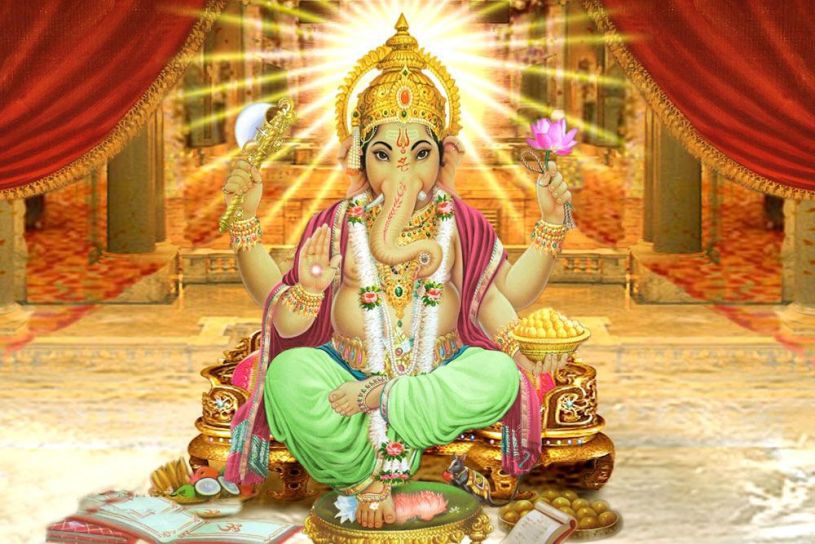
Today is Diwali, the most important Festival in the Hindu religion. Hindus will light clay lamps to signify that the light inside their souls has triumphed over the spiritual darkness. People wear new clothes, decorate their homes with lights, and light fireworks to celebrate the festival. It’s their version of Christmas, with children receiving gifts and sweets.
Working with Indians and traveling to India for my job, I’ve learned a lot about Hinduism over the years and find that it helps me gain insights into Mormonism. The most common misunderstanding of Hinduism is that it’s polytheistic. The variety of Gods sometimes with animal faces and with apparently strange roles is hard for Westerners to understand. But Hinduism is actually monotheistic, with all the “lower” gods being representations of the same One God.
Gods can be categorized under two headings. “Nirguna Brahman”: the one God and Supreme Being, a formless and impersonal supreme being without qualities or attributes–and comparable in a general way with the way Christians perceive God the Father. This One God Cosmic Being, is made up of two parts, male and female component (Heavenly Father and Mother?).
The second is “Saguna Brahman”: the personified, personal forms of the supreme reality that is worshipped as God. This is similar to how Christians perceive Jesus Christ, and in Hinduism there are three main Gods of this type (Brahma, Vishnu, Shiva), each with various incarnations and representations. It is said Hinduism has thousands of gods.
It is important to note that these are not two different realities, but rather two different ways of perceiving the true ultimate reality; the first is perhaps more the subject of philosophical and intellectual speculation and meditation, while the second is more the object of adoration, sacrifice, and devotion. The multiple incarnate Gods signify a certain aspect of God: creator, ruler, warrior, scholar, nurturer, healer, etc.
Hindus call these lesser Gods “avatars” of God, which means “descent”, reminding me of when the angel asked Nephi, “Knowest thou the condescension of God?”
One of the most popular Hindu Gods is Ganesha, portrayed as an Elephant with four arms.

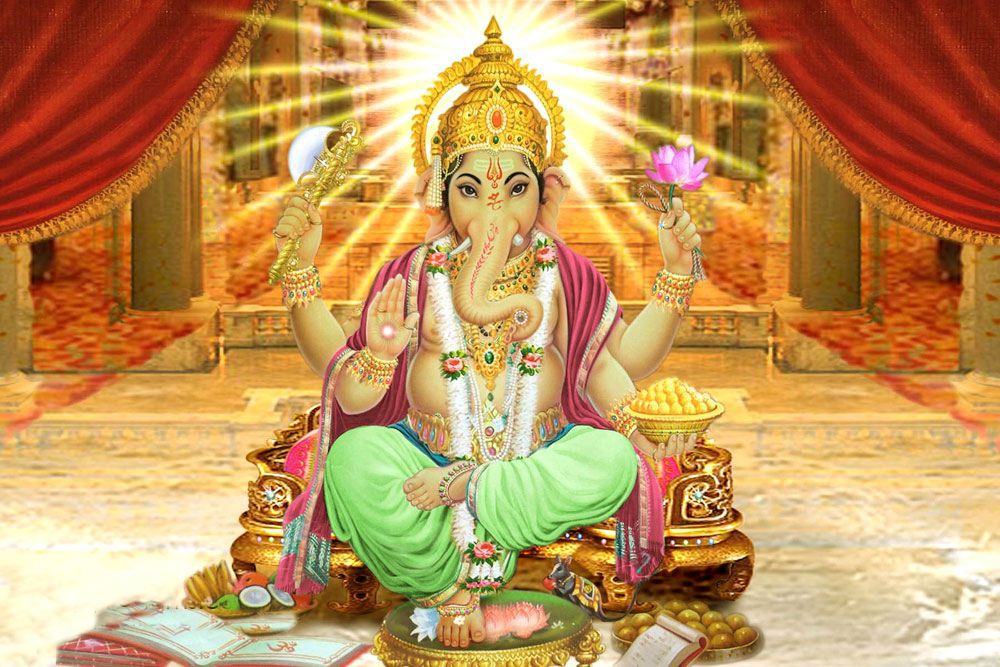
Some symbology of Ganesha:
- big head: he’s very intelligent and can think through ways to help us with our problems
- small eyes: to concentrate
- large ears: to hear our prayers
- small mouth: to listen more and talk less
- multiple arms: to do more, he’s very powerful and utilizes all his arms
- big belly: digests good and bad experiences
- only one tusk: he keeps the good and throws away the bad
- in his top hands: he’s usually carrying different items. A noose: to control the wavering mind, a weapon to conquer the ego/pride, rope: to remove obstacles, axe to cut off enemies
Just like Hindus believe God took a body (number of times) and came to Earth to show mankind different characteristics about him. Mormons also believe God took on a body and came to earth and lived as a man to show us characteristics about him.
In Joseph Smith’s inspired exegesis of Hebrews 2:17-18, he revealed why God came to Earth. Alma 7:11-12:
11 And he shall go forth, suffering pains and afflictions and temptations of every kind; and this that the word might be fulfilled which saith he will take upon him the pains and the sicknesses of his people.
12 And he will take upon him death, that he may loose the bands of death which bind his people; and he will take upon him their infirmities, that his bowels may be filled with mercy, according to the flesh, that he may know according to the flesh how to succor his people according to their infirmities.
Other interesting aspects of Hinduism or comparisons to Mormonism:
- Hindus believe the divine resides in all beings. the greeting “namaste” references the divine in one person acknowledging the divine in the other.
- The Hindu doctrine of incarnation is not entirely different than the Mormon doctrine of eternal progression. Hindus don’t believe in a Heaven/Hell concept, but rather that life is for the purpose of becoming like God. You retain the progression you made in this life into the next life and continue progressing until you achieve “exaltation”. The difference being that in Hinduism the next life is another birth into Earth.
- Mormons LOVE Holi, the festival of colors, when the Krishna temple in Spanish Fork is submerged by locals showing up to spray colors on each other.
- Strict code of ethics, commandments, and moral law.
Hindu Literalism
Hinduism is facing the same tension other religions are experiencing related to scripture literalism. In Hinduism, it’s not as severe, because their myths are dated much further back in time. And also because Hinduism doctrine is very fragmented, and it is more of a religion based on orthopraxy (right doing) vs orthodoxy (right believing). But the tension still exists.
Ask ten Hindus if they believe the foundational myth about the Goddess Ganga and the River Ganges to be literal/actual history or simply metaphorical, and you will get a range of very passionate opinions. Some will go so far as to say if a story like this could be proven false historically, it would destroy the entire religion. Others think that idea is absurd, understanding the value is in its spiritual application not its actual history.
Wholesale vs Retail Religion
Marcus Borg uses a concept from business merchandising to make a comparison of wholesale God/religion vs retail God/religion. He makes the case that all religions believe in the same wholesale God. Every religion starts with the basic component that there is an all knowing, all powerful God that loves us and wants us to be good to each other. This is like a wholesale merchandiser that keeps the product very generic. Then different retailers will take the same product and package it in their own unique way to communicate it. He compares this to the religions of the world, who all express the basic wholesale God/religion message and personalize it.
In this sense, I can view Mormonism and Hinduism as two very similar religions. At the wholesale level, we are the exact same. We believe in a God that is the Supreme Being that loves us, that life has a purpose, and that we should be good to each other. Then around this “wholesale” core, we wrap around our own “retail package” to make it more personal and easier to understand and relate to at the individual level.
 Wheat & Tares
Fascinating stuff. Thanks for this.
I’ve heard the word “namaste” before, but never knew what it meant. It’s a beautiful concept.
“Polytheist” is something of an epithet these days, the kind of charge that monotheists (and everyone *thinks* they’re a monotheist) tosses rather freely at their religious opponents. Jews and Muslims have the strongest case for being true monotheists, but even they have a whole variety of angels and demons, some named and some anonymous, in their cosmology. These are no different from the variety of semi-divine beings that populate Greek mythology and that we have no hesitation in seeing as polytheist. Trinitarian Christians and Tritheist Mormons have a weaker case for objectively claiming the monotheist title. LDS leadership having recently welcomed Mother In Heaven into the Mormon pantheon, I guess we’re Quadrotheists now. Anyway, I think it’s a real stretch to bring Hinduism under the monotheist banner, although there are no doubt “God of the philosophers” types in Hinduism who feel like monotheists and I’ve even heard there are non-theistic Hindu branches, much like Buddhism.
More interesting than expected. Thank you!
Dave B. Yes, I glossed over the montheistic-polytheistic thing a bit. You could read a lot on the subject and still not be sure how to properly categorize it. My main point on that is to explain to those unfamiliar with Hinduism that the many Gods or avatars in Hinduism are meant to be viewed as representations of one God and can’t be considered stand-alone Gods. Though, they sort of can be? Confusing, I know. Anyway. That segues into a critical logical piece for me that’s been important in my faith journey. For some people, it’s difficult for someone to believe in a literal, resurrected Jesus Christ or in a Heavenly Father or Mother that sits in the sky and governs the universe, but those people also may believe in something they call God, whether it be the collection of human wisdom or love or “the universe” or “something transcendent”. But it’s hard to do much with that God. It’s hard to have a relationship with that God. It’s hard to feel loved or comforted by that God. But using the Hindu avatar concept, we can picture Jesus Christ or Heavenly Father or Heavenly Mother as an avatar of that God and have a relationship with that more material, humanistic representation of the higher level God that’s hard to understand. I go into that more in this post http://www.churchistrue.com/blog/christmas-for-the-deconstructed/
That was great. I have done some philosophical studies in Hinduism but stay away from those religious minor gods as they appear weird. You lay out the similarities which helps out. Thanks
Sounds like modalism. A Christian heresy, but then almost anything is a Christian heresy if you look hard enough.
I’m a Mormon Deist that believes in Heavenly Father, Heavenly Mother, and Jesus Christ. Modalism fits for me. I don’t mind it being a Christian heresy. 🙂
I think i’m a henotheist. But I don’t mind being called a polytheist: God the Father, Mother in Heaven, Jesus Christ, the Holy Ghost, and let’s not forget Prez Snow’s couplet.