
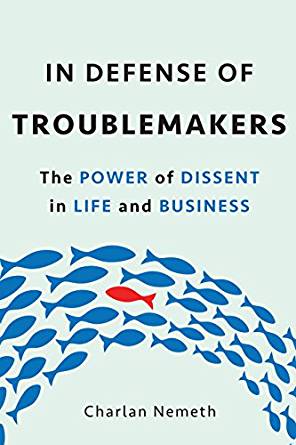
Since all church policy is set by our oligarchical leadership, group decision making is a valuable topic to understand how policies are formed and transformed over time. I’ve been reading a book called In Defense of Troublemakers: The Power of Dissent in Life and Business by esteemed psychologist Charlan Jeanne Nemeth. It’s an interesting look at group dynamics in decision making, and why groups sometimes fail to consider all options. The book presents a few surprising insights confirmed by studies such as:
- A dissenting view is more powerful and persuasive when it’s a minority view–whether it’s right or wrong.
- Playing “devil’s advocate” is ineffective, because we know it’s pretend. Only authentic dissent persuades group decisions.
In other words, although people find the majority opinion compelling, they also feel invested in considering an authentic dissenting opinion. Since the bloggernacle was build on dissenting opinions, this is great news for those of us who find ourselves disagreeing with majority opinions from time to time.
The message of this book is not that we should create dissent, but that we should permit dissent and embrace it when it is not present.
Another chapter in the book, “Group Decisions: Often in Error, Never in Doubt,” discusses how “groupthink” happens and what conditions contribute to these types of ill-advised decisions. In describing decision-making in councils, lds.org says:
In councils you gather input and then work together to come to unanimous consensus.
“Straining for consensus” is the definition of “groupthink” according to Irving Janis who coined the term. It is “the model of bad decision-making.” Janis adds that “groupthink” is:
“the mode of thinking…when concurrence-seeking becomes so dominant…that it tends to override realistic appraisal of alternative courses of action.”
Obviously, making a decision involves eventually coming to some consensus to move forward. The issue is whether alternatives are sufficiently considered to avoid making errors in judgment. Is the focus on “gathering input” or on “coming to consensus.” Janis studied infamously bad group decisions like the Bay of Pigs invasion to analyze how groups fall into the trap of seeking consensus without sufficiently evaluating alternatives. Here are the group traits that lead to poor decision making:
- Cohesion
- A directed leader
- High stress
- Little optimism in the group for better alternatives to the leader’s position
These are the group’s conditions, which then in turn lead to the following symptoms:
- Stereotyping out-groups
- The illusion of invulnerability
- Self-censorship
- The illusion of unanimity
- Direct pressure on dissenters (self-appointed “mind guards”)
- Rationalizations
- Hubris
The outcomes of these symptoms are:
- An incomplete survey of alternatives and objectives
- Poor information search
- Selective bias
- A failure to examine the risk of the preferred choice
All of these lead to a quicker than ideal rush to agree to a solution that the leader prefers, but that is not well evaluated for risks. Regarding the Bay of Pigs, Kennedy infamously said “How could I have been so stupid as to let them proceed?” Well, the answer is that they were simply agreeing with his strongly stated preference, one that his brother Bobby ensured others knew not to oppose. And according to the book:
It does not take stupid people to make stupid decisions.
Of the conditions that create groupthink, the most important is a directed leader who openly expresses a preference for a specific outcome. That one occurrence will cause a cascade of other symptoms as group members seek to demonstrate loyalty to the leader in an effort to improve morale and group cohesion.
So what does that mean from a church governance perspective? It means that when you have a directed leader with a strong opinion, the group tendency will be to support that leader’s agenda and to suppress dissent in the interest of cohesion and morale. This is particularly true if the issue under discussion:
- is stressful
- doesn’t have clear alternatives that are better
- involves out-groups
- is complex
- doesn’t have a clear champion whose ideas differ from the leader’s
We are at an interesting time in church leadership having just ended Pres. Monson’s decade of tenure during which time (particularly toward the end) he was not leading with vigor to Pres. Nelson’s tenure. Our new church president has many ideas and strong views he is eager to put into practice. As a former surgeon, he is used to being decisive and directing a team. As we saw in the Wikileaks, members of the quorum of the twelve receive information on various topics that interest them and that are related to church policy, but how that information is gathered, presented and considered is related to the dynamics within the decision-making group. And all groups have to watch out for the rush to a confident consensus which is usually related to group dynamics more than it is related to the quality of decision.
Group processes, by and large, conspire to suppress the very diversity of viewpoints that we seek. As we interact with others, we start to develop a shared view of an issue. Whatever differences we have in the beginning become fewer. It is not just that we want to conform or to agree with the majority opinion. It is that the group interaction itself has particular patterns that conspire to limit the range of information considered by the group. It is our desire to seek agreement, coupled with some common group processes, that contributes to poor decisions. . . By their nature, groups move in the direction of consensus. . . . The consensus then intensifies the belief in the correctness of the position.
Dissent is the antidote to the bias toward convergence that exists in groups:
When we are exposed to dissent, our thinking does not narrow as it does when we are exposed to consensus. In fact, dissent broadens our thinking. . . . The implications of dissent are important for the quality of our decision-making. On balance, consensus impairs the quality of our decisions while dissent benefits it.
In my own corporate background, we used to talk about the effectiveness of a decision using this formula:
Quality of Idea X Buy In = Effectiveness
The gist was that even if the idea chosen wasn’t the best one, the real magic was in the ability of the people executing the decision to make it happen. This mindset fought against the tendency of a leader to dominate with a strong opinion, focusing instead on gathering input.
When individuals in a group are too focused on belonging to that group, they don’t take the risk of offering a dissenting opinion. That belonging comes at the price of our pretended agreement to ideas we might not actually support.
Paying this price often leads to unreflective thinking, bad decisions, and reduced creativity, not to mention boredom, vulnerability, and deadened affect. . . . All the while, we are in these deadening meetings and interactions where many people are often a bit fake–often opportunistic.
Why would people follow the group into error? In manufactured experiments, it was found that 37% of members in a group will follow the majority’s incorrect judgment rather than their own, just to fit in. That percent is higher when the task is more difficult or ambiguous, and among individuals with lower self-esteem or who have a high degree of investment in belonging to the group. They fear rejection by the group more than they fear being wrong with the group; there is safety in numbers. But even one vocal dissenter creates room for individual liberation from the hold of consensus.
If we want church decision-making to seek the best decisions and not just consensus, here are some conditions that need to prevail:
- Dissenting views within the Q12
- Individuals willing to present information that contradicts the preferred solution
- Time and space to evaluate options (not forcing issues for quick decisions)
- Providing clearly better alternatives
- Reducing complexity and ambiguity in ways that enable understanding
What do you think?
- Are decisions made in church governance more or less prone to groupthink than other groups? Is it a bigger risk with an active and vigorous church president, or absent that does someone fill this role anyway?
- Does our focus on hierarchy hinder good decision-making or enable it?
- Do you think dissent provides valuable input into our decision-making process? Can you think of examples?
Discuss.
 Wheat & Tares
My callings of Music/Choir Director and EQ Presidency put me into group meetings. But as a convert, I sometimes dissent with ideas/suggestions outside the LDS norm. I’ve encountered the “we’ve never done that before” so I make sure to check what’s documented so I know there’s nothing that forbids it.
What’s most irritating is the notion that a dissenting opinion “doesn’t follow the Spirit”; as if your alternate suggestion is insulting God himself. Many’s the time I’ve wanted to raise my hand in opposition to a calling but I don’t want to deal with the afterwards.
I don’t believe the members of the Twelve don’t voice their dissenting opinions when they counsel among themselves. None of them lived lives as shrinking violets. Where group think might come in with them is by consistently picking members who already think the way they do.
They never allow that they might have hashed out differing views during their deliberations. We only see the end result, which is sweetness and light. This is a disservice to the membership of the church who don’t get to see that processs. Instead, members are led to believe everything was roses during deliberations and therefore that’s what it should be for their councils – which lead to the problems Angela C highlights.
I would highlight the idea, “Providing clearly better alternatives.” Expressing disapproval without giving being able to give reasoned objections to the proposed action, and, hopefully, providing a viable and better alternative is unhelpful. Without those two keys (or at least first), you’re just the cantankerous old coot whom everyone tries to avoid.
I understand situations where you don’t immediately have a better idea, but feel that, “This is a mistake. I don’t have the right answer, but this is the wrong answer.” I’ve been there when you need to slow the proverbial train before it runs off the tracks. But mindless contrarianism doesn’t accomplish anything either.
Some of the best church meetings I have ever attended were where opposing viewpoints were expressed. Such meetings, however, are rare. Those of us who grew up in the correlation era were conditioned to abhor disagreement or alternate points of view.
As Dave C mentioned, closed-door Q15 meetings are not the mythical echo chamber love-fests we make them out to be. These are 15 men from completely different backgrounds, different social circles and in some cases different generations, who would probably have nothing to do with each other if not for their callings as apostles. Disagreement in such a group is inevitable. According to the SWK biography “Lengthen Your Stride”, the process of lifting the racial restrictions in 1978 was years in the making, because of (or in spite of) political brawling among the apostles. I recall a recent general conference when Elder Oaks and Elder Ballard gave talks that basically contradicted each other; the former doubling down on the Proclamation and traditional marriage with undertones of anti-LGBT hostility, while the latter enjoined the audience to be kind and welcoming to gays.
When discussing groupthink and managing agreement, it’s also worth mentioning the fable of the Bus to Abilene (look it up) which is relevant to the Latter-day Saint experience and probably deserves it’s own post.
Great minds think alike. I thought it was a fun book.
While councils may seem problematic given the discussion in the book, I think at the local level the Ward Council is a fairly effective device, particularly since the role of women in the council has been upgraded and the senior leadership have really encouraged bishops to listen to various opinions voiced by participants.
Senior leadership councils are a different matter, and we really have no clear idea how they are conducted. I’m guessing there is more deference to the senior apostle or President leading whatever committee is meeting. Whether they are used to solicit honest opinion and feedback from the participants or simply to engineer unanimous support for the leader’s preferred option is very unclear. Probably depends on the personality and experience of the leader. I find it rather disheartening that Pres. Nelson seems to place more reliance on what he dreams about at night than on feedback from other senior apostles. That’s according to his own reports, which often speak of his personal revelatory methods but which never mention any input from other apostles.
I blogged several years ago about the idea that the most strident voices (least tolerant) in the Q12 will always carry the day. This book confirms that aspect of group dynamics. An example of a poorly rolled out policy is the PoX forbidding the baptism of children raised by committed gay parents. That decision, from what we know, seems to have several hallmarks of groupthink. It’s not that everyone was in lock step either (which we can clearly see they were not), but here’s where- the gaps likely occurred:
– Dissenting views within the Q12 (We know there were)
– Individuals willing to present information that contradicts the preferred solution (I believe this was the case)
– Time and space to evaluate options (not forcing issues for quick decisions) (This was definitely pushed through so quickly that there was no implementation or communication strategy)
– Providing clearly better alternatives (This seems to be a gap as there STILL aren’t any solutions out there)
– Reducing complexity and ambiguity in ways that enable understanding (this was definitely assuming that children of gay marriage are as easy a solution as the children of polygamous marriages, which is not at all the case.)
Other traits exhibited:
– Stereotyping out-groups (There was a mistaken belief that “gays” and “LDS” were 2 completely separate and distinct groups, not that there are gay people being born to LDS families)
– The illusion of invulnerability (Trying to portray this policy as “revelation” is clear evidence of this)
– Self-censorship (We can’t know this one)
– The illusion of unanimity (This is just status quo)
– Direct pressure on dissenters (self-appointed “mind guards”) – (Among the Q12, we can’t know)
– Rationalizations (Yes, there are still to this day rationalizations of why this policy was the kindest option)
– Hubris (Continuing to try to hold it up as an example of “revelation” is evidence of this)
That’s not necessarily the norm, though. This was just our Bay of Pigs. As to “ministering” and the church name change, who knows? They are such minor changes, I’m not sure how much anyone cared.
Angela, I am curious about the tension between:
“– Dissenting views within the Q12 (We know there were)”
and
“– Self-censorship (We can’t know this one)”
Perhaps I have misunderstood the context in which “self-censorship” is intended, but, how is it that we “know there were” dissenting views but “can’t know” whether the dissenters have self-censored.
I am inclined to think that, even in the Q12, dissenting views (especially, but not only, from junior members) might not be expressed — not because they are “shrinking violets” {Dave C], but at times because they are astute enough to have a reasonable sense of when their dissenting views will not be productively considered and expression of an unsuccessful dissenting view would make future expressions of dissenting views less likely to be seriously considered.
If a gap occurred at “– Providing clearly better alternatives”, perhaps it was because of a failure to identify clearly (or to face up to) what so-called problem needed a solution. IF, as sometimes purported, the problem were responsibility for protecting children of a gay parent from conflict between teachings at church and example at home (or even concerns about liability for any such church teaching of children), it is hard to believe that none of the Q12 thought of expanding the parental consent policy to clearly require informed consent and to direct what was to be communicated (and how) to be sure such consent was informed. But it is not difficult to imagine silence as to any such better alternative resulting in part from failure to clearly identify and agree on what problem is being addressed.
Not a Cougar: “Expressing disapproval without giving being able to give reasoned objections to the proposed action, and, hopefully, providing a viable and better alternative is unhelpful. Without those two keys (or at least first), you’re just the cantankerous old coot whom everyone tries to avoid.”
I think you can dissent without giving an alternative if you’ve built enough social capital. But of course, this means that you spend some.
I wonder if sometimes you can also get away with promising to have an alternative the next time you meet, which could keep the decided action provisional and slow things down a little.
Reasons are hugely important. In a business context, I’ve been able to say “It doesn’t sit right with me and I don’t know why yet” before and be taken seriously, but I’ve always later figured out why or that I was wrong, and spent some social capital to do that in the first place.
Many years ago, after I sat through (and tried to correct) an anti-evolution Institute class, I approached the teacher afterward and brought up the disagreements between B.H. Roberts and Joseph Fielding Smith over the topic of evolution. The teacher, who was a recently returned mission president, was horrified that I would suggest that two leaders of the Church once disagreed over something. “The Brethren are always unanimous!” he said to me knowingly. (I tried really hard not to roll my eyes.) Were the Brethren a lot less unanimous in past decades? Are they more concerned about the “illusion of unanimity” today than they were in the past?
Also, I think that what Angela says about the most strident voices totally applies to the topic of evolution. So much of the anti-science, anti-evolution sentiment that persists in the Church today is a result of Joseph Fielding Smith’s strident voice. According to Greg Prince’s David O. McKay biography, the reason that Joseph Fielding Smith (and others) got their intolerant ideas across to so many members of the Church was that President McKay was a tolerant person who didn’t correct them.
When citizens collectively possess required knowledge, but it is distributed among members of society, good debate and consideration of all relevant opinions hopefully discovers this collective knowledge.
When what is wanted is the mind of God, then no number of committee is going to find what is on God’s mind and more than one opinion clouds the answer. However, a few God-speakers can help reveal a pretender among prophets.
Autumn asks “Were the Brethren a lot less unanimous in past decades? ”
So it seems. The first few decades had strong leaders with wildly different ideas and it seems everyone was making prophecies (the “yellow dog” prophecy for instance).
One other element to church leadership that different some from other organizations is that leaders are “sustained” because they are believed to be called of God. So…it isn’t as simple as just a bunch of ideas being discussed openly, there is an added later of faith in the leaders that adds to the desire to support and agree, and contention is of the devil.
Heber13: Yes, of course the purpose of a church council is to bring the group to consensus with God’s will, not an individual’s will, but as human beings, our ability to understand, interpret, and prioritize divine will is limited by our own perspective. Instead of a council with Jesus present saying “No, this is my point,” you’ve got 15 men saying, “No, this is Jesus’ point.” Quite a difference.
Trousers, I couldn’t agree more. See my second paragraph in that post 😉