
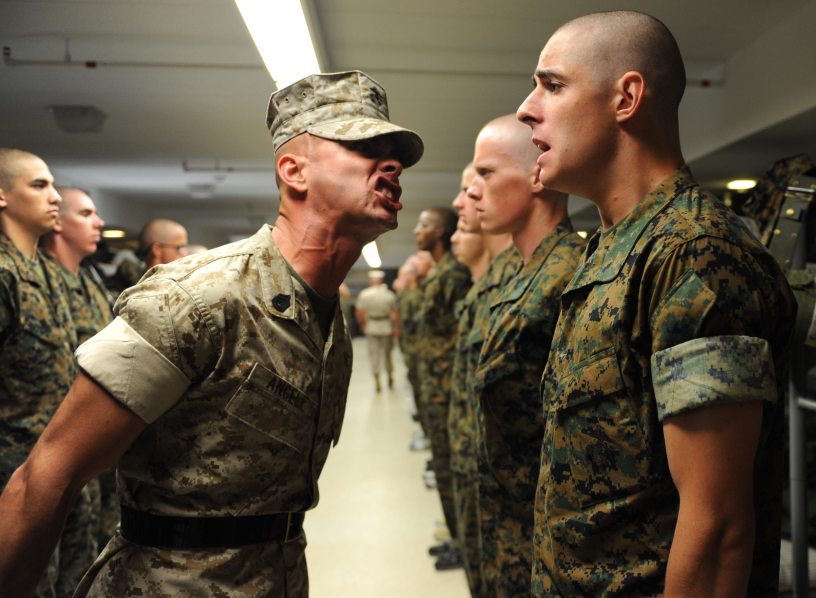
There have been many case studies of subordinates failing to question the leader, even when it was obvious that the leader was making a terrible mistake, leading to disastrous results.
The worst accident in aviation history happened because the first and second officers on the flight deck convinced themselves that the captain, the senior most pilot for the airline, could not make a mistake, even though they both saw it.
The results learned from the terrible airline disaster is that cockpit crews are now trained to question each other, with no repercussions for a Jr officer questioning the decisions of the senior officer. Also, the medical profession has taken a lesson from this disaster, and nurses and assistants in the operating room are encourage to speak up if they see anything wrong
From an article on what pilots learned from the airline disaster is the following quote
We learned to teach co-pilots, for instance, that even if God himself is in the left seat, they still have to speak up instantly when something is wrong. Instead of the autocratic leader who needed and accepted no advice, we’ve redefined leadership by creating strong captains who know how to create a team to help them make better, safer decisions.
I wonder if we could apply any of the lessons learned in the aviation to the LDS church? Can we learn to speak up, “even if God himself is in the left seat”, which we are taught is true? When we see an approaching disaster caused by a leader in church, either at the local or general level, can we speak up to avoid the calamity? I think the creation of counsels in the church is a step in this direction, but when the ultimate authority and final decision is left with one man, can this be overcome?
There is probably not much if anything we can do at the general level, as there is no direct communication with those making the decisions. At the local level, we may be a counselor to the leader, or maybe just a concerned member of the ward. Can we speak up in time to avoid the problem, or are we held back by the teachings that our leaders are inspired by God, just like the copilots were held back by the seniority of the captain making the decision to takeoff? Can we question leaders without it looking like criticism?
Have any of you ever tried to stop a church leader from making a mistake? How did that leader take your advice?
 Wheat & Tares
All across the Church, lay leaders and members talk to each other and counsel together all the time. The caricature drawn in the original posting regarding the Church is wholly unfair and grossly inaccurate, in my experience.
The author on this OP is allegedly Bishop Bill, but I can’t help wondering if it wasn’t ghost written by Dieter F Uchtdorf.
I am glad that some like ji have not found this to be the case. My guess would be that ji is probably male (as am I) or they probably would have had a few more experiences directly or with other women they know that have dealt with men that feel the priesthood gives them the final say. I am in my mid 50’s and I have seen things change a bit, but in my lifetime I remember hearing talks in general conference that were clear in my mind that “the man rules the house.” This mentality is still around in many. If you have heard about the stake president that didn’t like the woman breastfeeding in church, after the sister left the stake present apparently told him he needs to take control of his wife. I find that absurd and even insulting, just as I did as a teenager hearing the talks back in the 70’s. I don’t think it is the majority and it is over time getting better.
As far as personal experience with a church leader, I have many minor issues I didn’t quite see eye to eye with a bishop or stake president, but that is going to be normal. The only thing I have not liked is that some feel in a leadership position, they simply can’t do wrong. Some put that on a leader that doesn’t feel that way.
What I do find bothersome is that most leadership studies tend to emphasize that leaders that have humility and are willing to listen to feedback, especially negative feedback, are more effecting AND people are more likely to follow the leader. Hiding behind, “I have the authority” don’t understand respect is earned, not bestowed by laying on of hands.
I think our council system and our presidency system both guard against this. I agree with Happy Hubby that there is definitely greater difficulty for women in speaking up/being heard. We’ve all been trained basically to exclude women and ignore their input although I see the church currently working hard to change that.
There is no “caricature drawn in the original posting regarding the Church.” Instead, there is a series of thought questions about a hypothetical (seeing an approaching disaster or an impending leadership mistake), whether or how to counsel in that event, and what our experience has been with respect to any such event or counseling. Maybe ji thought the attention getting title and picture were presented as a description of Church leadership. the first sentence of the OP suggests to me that it was not.
In various roles, I have had mixed experience in counseling Church leaders (and others) how not to repeat what appeared to be a mistake. Generally, suggestions have been well-received and sometimes acted on. The more serious ones were acted on appropriately.
My few somewhat negative results can be attributed, I think, to three things, in varying degrees: (1) my then bumbling, insensitive way of making the suggestion (2) error in my perception of the “mistake” (3) some leaders’ insisting (whether out of insecurity, pride, fear, desperation or whatever — and never quite acknowledging it) that, because they are “entitled” to revelation, whatever crosses their minds with respect to their stewardship must be “inspired” or that their authority [rightness in their minds] was not to be questioned. It has sometimes seemed that the Church’s “entitlement” language with respect to revelation is not only wrong but dangerous. I don’t think it works that way; anyway it doesn’t for me, either in private life or in my Church calling.
Yes, we can question leaders without it looking like “criticism.” But there is also nothing wrong with constructive criticism delivered in a manner, time, and place where it can do some good. With some leaders it cannot. With most I have had occasion to deal with, it can.
I think there are definitely both sides to this. In the short time my wife has been RS President I’ve seen her get questioned and criticized by a few members who would probably be appalled by their own actions had they had all the information she did on specific situations.
In the few ward councils I’ve served on, I think one of the things that has impressed me the most is just how much the Bishop does rely on those around him. I have no doubt most Bishops do in fact study things out in their mind and utilize all the resources at their disposal. When it came to those matters that required more privacy, I felt like I’d get brief glimpses of greater reliance and power in the Spirit, but I obviously couldn’t know much beyond that.
I’d imagine it works similarly on the higher levels . I do think the Lord lets Church leaders do a bit of “Autopilot” from time to time, but I think He is ultimately in control. Being the teacher that He is, I imagine He often ends up being one “questioning” leaders, in addition to being the one they answer to.
We have a lot more leeway to question local leaders, but heads of organizations have the right to overrule any contrary counsel we’ve given. At that point, in my experience, you are expected to do what you can to make sure you see the vision of that male or female leader achieved, no matter how much you disagree with it. More often than not, things turn out fine (even when you disagreed with the choice). When things don’t turn out fine, it sucks for everyone, even for those who saw the disaster coming.
Mountain Meadow Massacre is a great case study as well and specific to priesthood obedience.
I read recently a pretty powerful quote which I’ll paraphrase, “If you surrender your right to say No to the small things, you will find you have no ability to say No to the big things.” History proves this to be correct, in that decent people get caught up in commiting the world’s worst atrocities because of all the small things they allowed.
IMHO many regrettable issues could have been avoided in church history had members individually said No to minor things.
I have experienced a variety of management styles in both my church and professional life. My personal experience does not suggest not that local church leaders are any better or worse than the general population. At the local level, there may be some tendency to listen less to underlings because Inspiration, and even less to women because Priesthood, but I have seen similar tendencies in the professional world as well. At the general level it’s a whole different ball game.
I try to speak up when I think it’ matters, even when I don’t think my suggestions will go over well. I also try not to sweat the little stuff, which is equally important.
Most of my church leaders have been willing to listen to feedback. But I was on a ward council for a short time where the bishop literally rolled his eyes every time I opened my mouth. Now I will confess, that I responded in not-the-best way, mainly by becoming more vocal about differences of opinion that didn’t matter as much. I was released after about 6 months.
I think our differences of opinion were minor. And I don’t think it was wrong for me to be released. But I do think that the bishop quashed any dissent. That ward council was an echo chamber; there was no room for new ideas or open discussion.
Have any of you ever tried to stop a church leader from making a mistake? How did that leader take your advice?
My spouse and I tried to alert our Stake leaders to the untruths and misleading Prop 8 political material contained in the Six Consequences material taught by them during the Sunday meeting block. (thinking maybe they were unaware and would be appreciative and want to correct the record or stop distributing it?) When we finally met with the Stake President he was very rude to me while the opposite with my husband. I don’t know why. Did he think I was the instigator? Or was it simply because I was a woman? Or something else? (My husband was in the bishopric at the time—but ended up resigning his position several weeks later and has not returned to full activity).
Among members of the church, a critical element of interacting with leadership is the role of revelation. We’ve had so many lessons about regarding the Lord’s anointed and not steadying the ark it may give us pause to open our mouths. Leaders can help.
I had one bishop whose word wasn’t only final, it was about the only one allowed. He considered he was the only one receiving revelations for the ward. If he was a pilot in command…
I contrast that with a discussion in a bishopric meeting where the bishop clearly felt a counselor the YW president had suggested was not the right fit. Nonetheless, he stated he respected the inspiration given the YW president and approved the calling. At the time I was struck by how these two individuals had different inspiration and the how the Bishop resolved the conflict.
Do I think feedback is important and allowable? Yes. Do I think the leader still matters as to how much feedback I’m going to give? Also yes.
As a woman I have experienced this even with other women, especially when you are so much younger. I was serving in a RS Presidency with a RS President that was 30 years my senior. It was her first time as a RS Pres and I knew going in as her counselor she was not one to listen to people and had an agenda to make the sisters conform to what she felt was the way they should be living their lives. I wished many times I had not accepted the calling. Often she would say, “I think this will be good for this sister. She needs to learn to serve better and grow.” I was like, how dare you make those decisions for others! There was one sister in our RS that would do whatever she was asked no matter what. She was taught from a young age to never say no. I knew that public speaking was very difficult for her and caused her extreme anxiety. She was always telling me how she wished so much that they would quit asking her to teach lessons and give talks. She was retired now and she just couldn’t handle it anymore after so many years. So, I told our RS Pres to please not ask her to teach. So, what do you think the RS Pres immediately did? Right away she asked her to teach a RS lesson. It made me so mad! I had seen this lady give talks and lessons before. She would stand up there and visibly shake all over. She could barely hold the paper and read the lesson. The poor thing was an absolute wreck! She only did it because she felt she had to. I confronted the RS Pres and was told that I did not know her as well as she did and she knew this was good for this sister. This was one of many things she did to try and wield her power. Finally, I just could not take it anymore and asked to be released. This may seem small, but I think there are many ways that people in the Church are manipulated into doing things. Many would ask why the sister didn’t just say no. I know as women we feel too guilty to say no. And, if we do say no many times we are chastised by a leader saying “have you forgotten the covenants you made in the temple?” This RS Pres used that line many times on the sisters to get them to do things she wanted them to do. I cannot tell you the amount of freedom I feel now that I have learned to say no and not feel guilty about it.
ji – I think my earlier post probably inappropriately pointed the finger at you. I respect that you have had good interactions and I am glad that is the case with you and the wards/leaders you have had. I certainly have had some leaders that were very good at accepting feedback.
But I certainly have seen way too many men that think they are superior to their wives and leaders that think there word is the end of the discussion. I have seen some be extremely rude to their wives in a church meeting. I only regret now that I didn’t call them on the carpet either privately or even possibly publicly in one case.
On a macro level, as opposed to a micro level, the Church needs better avenues for members to make their opinions known to leadership. For example, I was alive during the time of the priesthood/temple ban. The 1978 proclamation might have come earlier had there been better avenues for member input. I will forever wonder if there is something that I and other progressive members could have done to hasten the process. Call it hastening the work if you will.
I cant’ help it. here comes an Air Force story:
I worked with an helicopter pilot who flew a type of helicopter that has a flight engineer (FE) sitting just behind the two pilots. The pilot told me when he first started flying that type of helicopter he considered the FE a bother. That eventually changed for him. One of the FE duties is to read out aloud the rate of the aircraft’s descent from off the vertical velocity indicator, or VVI. In certain situations of slow forward movement, the physics of descending too fast into a helicopter’s turbulence could cause the helicopter to lose lift and fall – an extremely dangerous situation, especially near the ground. The pilot told me whenever the FE’s voice would start changing to a higher, excited, pitch, as the FE was relaying their descent rate, the pilot realized he needed to pay attention and slow down.
One day, like Elder Uchtdorf, I’m going to work that into a sacrament talk about feedback. Or listening to the high pitched promptings of the Holy Ghost.
In my faithful days, I was a counselor to an extremely authoritarian and sure of himself bishop. Had to take the submissive old housewife approach numerous times and give him just enough information for him to realize the correct decision himself. I.e. Ward boundaries overlap, so that he would allow YSA to transfer to the YSA ward; and that Deacons age out at various times so that he shouldn’t make the newest deacon the Quorum president.
“when the ultimate authority and final decision is left with one man, can this be overcome?
Not while keeping order and structure. Consider Lutherans. A small dispute arose at a chapel near Pelican Rapids, Minnesota. I have not been able to find out what it was. Because of an irreconcilable difference, the congregation split and a new church was built about half a mile away. One of my ancestors is buried at one, his wife at the other.
If final decision is NOT left to one person, then it is left to many! What then? Then schism with each authority taking some followers.
“Can we question leaders without it looking like criticism?”
Sometimes. Rather a lot depends on your own motivation for doing so. Do you see a danger the leader does not? Then a simple “Danger Will Robinson” alert is not really the same as questioning the leader. If the leader has a narcissistic personality, the answer is almost certainly “no”. I haven’t encountered this much in the church but I encountered it rather often in the navy and almost daily in business.
When I was a young boy, growing up in a small Utah town, one of my favorite things to buy from the local Mercantile was a balsa wood airplane; particularly the one with a wind up propeller, attached to a rather large rubber band. Now, obviously this was long before the internet, hand-held devices and digital games – but through the eyes of my memory, it was a great way to grow up.
One of the great things about this particular airplane was that the longer (and tighter) I would wind the propeller, the greater force with which the plane would take off – and the farther it would fly. Sometimes, you could even wind it tight enough that it could sting if you let it go and have the propeller hit your fingers.
When I think of what’s happening within “The Church” right now, in terms of members “finding their voices” and pushing back on leadership – sometimes forcefully, I can’t help but think of my wind-up airplane analogy. For well over 150 years, people have been directed (told) what to do; by those who (supposedly) are closer to God because of their particular calling.
It’s been my life’s experience that when people are spoken down too, made to feel less than and/or forced to “bottle up” their own feelings, perceptions and ideas (many times against their will – through shaming techniques) that when they FINALLY LET GO OF THE PROPELLER – WATCH OUT! I feel little sympathy for “The Church” and it’s leaders these days – for (I believe) that they are now paying for feelings, emotions, misdeeds and unrighteous leadership which have been swallowed by many, many members for decades.
Lefthandloafer – I remember those balsa wood planes. I loved those as a kid.
I think your analogy is applicable to many. For those that feel they are subverting much of themselves because “the leader (therefore God) said so”, once a crack in the belief that the leader speaks for God, the shelf breaks and there is resentment.
Love the picture at the top of the post. Takes me back to my own time at Paris Island. But you know, even in the Marine Corps the best leaders are those that take input, know their marines, and don’t make decisions that someone further down the chain could make. Those were principles of leadership constantly taught in the Marines, and applied with varying levels of success. Even in combat you don’t just ‘do what you’re told.’ Marines have to be what Lincoln called ‘thinking bayonets’, responsible for their decisions while carrying out the mission entrusted to them by their leaders.
When we give away our agency, we feel less responsible for the ill our choices can bring – we also rejoice less in the good of our choices.
I tend to be frank with people, including leaders at church. Agency requires information and knowledge, by sharing my perspective I empower others to fully utilize their own agency. Often, I’ve dealt with Bishops who were on a power trip, or were blindly following the directions of the stake. It does not contribute to the health of the ward when voices are silenced or disregarded. I’ve also had leaders who accepted influence. Not that they always agreed with me or changed their minds, but they listened and considered. The problem is that leaders are rarely chosen by their ability to effectively communicate and work with others.
I agree with the above. This church should be run by consent, our leaders MAY speak for God, but God speaks to us. In this way revelation in the church flows through the entire church, not just 15 men in a room the majority of whom are from the western US. More effective avenues for providing feedback would lead to a healthier church.