
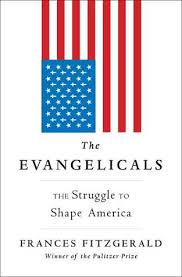
Or, if you prefer, Mormons are a lot like Fundamentalists. Or Mormons think like Fundamentalists. The reference is to Christian Fundamentalists, not Mormon Fundamentalists (aka practicing polygamists, as opposed to mainstream LDS, most of whom are non-practicing polygamists). That is my takeaway from reading The Evangelicals: The Struggle to Shape America (Simon & Schuster, 2017) by Frances Fitzgerald, a Pulitzer Prize-winning writer.
The Fundamentalists emerged in opposition to the Modernists (who have evolved into Liberal Protestants who attend mainline Protestant denominations). As Fitzgerald recounts:
In the 1890s and the early years of the twentieth century liberal theology took hold in most of the major seminaries and divinity schools …. The shift in Protestant thinking had progressed to the point that biblical infallibility and the immutability of church doctrines were no longer common understandings among educated people in the North. (p. 95)
Fundamentalists were the ones who retained a belief in biblical infallibility and doctrinal immutability.
- Point 1: Infallibility of the scriptures (except when it is convenient to downgrade a Bible verse or doctrine in favor of a Mormon scripture or doctrine) and immutability of church doctrine are certainly current LDS views.
The Scopes trial in 1925 was a watermark defeat for Fundamentalism, which subsequently retreated from public view until roughly the 1970s, when Billy Graham successfully rebranded conservative Protestants as Evangelicals, and the 1980s, when Evangelicals suddenly became politically involved and influential as a wing of the Republican Party. But the Scopes trial and its aftermath gave Fundamentalists a defining identity as anti-evolutionists, which holds true right up to the present.
- Point 2: Mormons score higher than almost any other denomination in their rejection of evolution.
In 1910, as the Fundamentalist movement was taking shape in the North, the Presbyterian general assembly authored a five-point declaration to distinguish the conservatives from those liberal-thinking seminarians, namely:
the inerrancy of Scripture, the virgin birth of Christ, His bodily resurrection, substitutionary atonement, and the authenticity of Jesus’ miracles” (p. 96).
- Point 3: Doctrinally, standard Mormon beliefs, embraced by both members and senior leaders, line up pretty closely with key Fundamentalist beliefs, with the Mormon twist on inerrancy being “historicity of the Book of Mormon and its accurate translation from gold plates with Reformed Egyptian characters by Joseph Smith” instead of “inerrancy of Scripture.”
Dispensationalism. Premilleniallism. Race-based doctrine. Drinking as a sin (Mormons add coffee and tea). “Below the belt” moralism (sin is largely a matter of sexual orientation and behavior) with little or no concern about social problems like racism, sexism, and poverty.
- Point 4: Right down the line, Mormon views and doctrines match up with Fundamentalist views and doctrines.
It’s only because Mormon history as recounted in official sources (and by many academic historians) is strictly denominational history, with little or no reference to contemporaneous and often parallel developments in the rest of American Christianity, that we Mormons are largely unaware of all this. Mormons and Fundamentalists: We are religious twins, separated at birth.
The second half of the book is largely about Evangelical involvement in politics since the 1980s. The Christian Right and the Moral Majority turned a lot of conservative Christians who voted Republican into right-wing Republicans who went to church once in a while. This is evident in the emergence of the Tea Party movement — largely conservative Christian voters who finally shed the religious trappings — and finally Trumpism, which draws deep support from Evangelicals.
- Point 5: Mormons followed Evangelicals into political activism. Sure, we fielded a not-Trump protest candidate in the recent general election and Mormon politicians on the national stage have been bluntly critical of Pres. Trump. But rank-and-file Mormons support Trump about as widely as rank-and-file Evangelicals do.
The bottom line: Despite avoiding overt anti-intellectualism most of the time and despite the Church sponsoring the BYUs rather than bible colleges, Mormons think and act and sound like Fundamentalists. And if you think and act and sound like a Fundamentalist, you’re a Fundamentalist.
 Wheat & Tares
Umm, so I think it’s pretty obvious, esp. in the last 40 years or so, that there is an increasingly overt anti-intellectual strain in the church, one that’s only seemed to increase in direct proportion to all of the fear-mongering “the world is getting worse every day and we’re close to the end” rhetoric and BYUs are at least as conservative and seminary-like as most bible colleges, IMHO. I think it’s pretty easy to see this, but other than that, I agree with much of what you say. It’s odd how Mormons seem continually to resist labels that clearly indicate what and who they are. Most Mormons would blanch, I think, at being called misogynists or bigots, but, in fact, such prejudices are built into our theology, so I’m often puzzled at the LDS resistance to terms that actually describe us pretty well. We have a hard time owning our baggage and our bigotry, which is one of the reasons we prefer, generally, to whitewash our history rather than confront it and to vilify intellectuals (esp. historians) who want to tell real, but not “useful” (useful in the Boyd K. Packer sense of the term) truths.
Interesting post, thank you Dave B. One thing I have found is that not only do most Mormons think and act like fundamentalists, I think the majority would assume that all other believing Christians are also fundamentalists. Our missionary program is designed for people with fundamentalist Christian beliefs. Our perception of the Christian world is largely that they are fighting about which church has the correct priesthood authority and we have the answer. The discussions about problems with a literal interpretation of the Bible, the historical Jesus and a non-substitutionary atonement are pretty foreign to most Mormons, although they have been going on in the Christian world for the last 100 years. I think most of us assume that if someone identifies as a Christian they believe most of the same things about the Bible that we do.
I would argue that the similarities between Mormons and other fundamentalists noted in this post are superficial at best. There exist a number of studies that highlight that Mormonism is a predictor of upward social mobility while fundamentalism and evangelicalism accurately predicts downward mobility. I think it virtually impossible for both of those observations to be true (and they are) and for there to exist, in any real sense, meaningful similarity between the two groups. At the end of the day, fundamentalists of all sorts share very little in common with Mormons.
Dictionary.com defines downward mobility as the movement of an individual,social group, or class to a lower status. Geez..thanks PaulM. And I was thinking that Christians should be building each other up and embracing our differences. Love thy neighbor as thy self …and you know all that stuff this evangelical learned.
I feel like I’ve been observing this same trend firsthand for the last few decades, and it stems from the same root: the Moral Majority / politicization of the church and alignment with the GOP simultaneous with the Evangelical proliferation in the same. tl;dr, lie down with dogs, get fleas.
Most appalling is that Mormons are generally not leaders in this, but more often followers–at least lay members (and often, top leaders, but not always). Rather than setting the moral tone (which we have at least attempted to do on immigration at the top levels), we usually just cave to the moral tone of the GOP which has frankly lost its soul to the point that Trump garners 80% approval among Evangelicals and something over 60% among Mormons. That’s mind-boggling to me given how little Trump represents or aligns with any Christian or Mormon values. He’s the scorpion everyone is willing to carry on their backs across the river who will inevitably sting mid-swim, drowning everyone involved.
Posts like this make me feel completely hopeless, but then so do most Gospel Doctrine classes anymore. I really can’t fathom how we’ve gotten so John-Birch NRA-loving crazy in so little time when it should be obvious to anyone who cracks a book that Evangelicals are not our target audience. We are simply twitterpated over Evangelicals because they outnumber us (we lust after their influence); it’s putting political values before religious values (and conflating them). I don’t understand why we would lose our soul to court them (or proselyte to them) when they quite literally think we are the worst ever. They might be happy to take our votes, but they certainly don’t have our backs, theologically or otherwise. They aren’t allies in any sense of the word, and they decry Mormon beliefs from the pulpit regularly. Why don’t we see that they are bad for us? But no, like the cheerleader to the self-esteem-eroding bad boyfriend, we can’t seem to get enough of what they are dishing out.
Informative post, and i agree with the points you made. Like Angela, I feel hopeless as well when I see some of the positions that are in the forefront in the church.
I think that the theology of Mormonism is not necessarily fundamentalist, so I’m intrigued by the question of how so many of the Mormon folk became fundamentalist. One possibility is that our politics made our religious tenets more fundamentalist.
The hinge of Mormon history is the end of polygamy and the great turn toward assimilation. We did not take a religious, ecumenical approach to assimilation. Instead, we emphasized politics as the path. Over a period of several generations, Mormons in the United States became super-patriotic. In fact, we overdid it: in adopting a reactionary, paranoid conservatism, we came to think of ourselves as more patriotic than everyone else. (In this way, we could enter the mainstream but still be a special example to the world. Now it’s not just our religion that’s special, but also our reactionary politics.) As we pursued this path, we identified more with people who shared the same politics, and their unfortunate mixture of fundamentalist religion with politics infected the way we understood our own faith. Voila! We got fundamentalist Mormonism without really trying. Politics overwhelmed religion.
It doesn’t have to be this way forever. This theory describes some but not all of contemporary Mormonism. An open, outreaching, creative Mormonism is not dead!
It has been clear that RWNJs hate being called bigots, but don’t mind being bigots. They hate being described as ignorant but don’t mind being ignorant (although this may be some kind of logical impossibility). They hate being described as sexist, but don’t mind being sexist. They are led by the nose by their leaders and call it freedom.
BuhBye Western democracy. Hello, tyranny.
It is very sad and explains why the church is no longer growing in first world countries. In Stake Conference last Sunday our American Mission Pres was talking about the church spreading to fill the whole earth, and inferring that it is.
There was a new Stake created, by reducing the number of wards in adjoining stakes. We now have 4 wards in each stake, so look growth.
It is expected that Australian members will be fundamentalist even though that is very extreme in our culture. We even have members who facebook their support for Trump.
And yes they do not accept that the church was ever racist, or that being anti gay marriage is bigotry. We were talking about the family proc, when domestic violence was raised. Our stake high councillor volunteered that he thought the me too movement had gone to far. End of conversation, no discussion allowed.
The only growth is move ins mostly from Tonga or Somoans via NZ.
There’s a table in this linked article that I think is more current than the study linked in the BCC post. http://www.pewresearch.org/fact-tank/2017/02/10/darwin-day/ It shows Mormons ahead of Evangelicals. I wonder if we are trending less fundamentalistic recently.
Thanks for the insightful comments, everyone.
Brother Sky, I think Mormons are in some ways more self-critical than other Christians, if only because of the constant need to respond to criticism of LDS doctrine and history. Even so, Mormons are largely clueless as to how others see us. Other Christians see us as heretics at best, nonbelievers see us as naive and gullible. Republican politicians see us as votes, so they say nice things about Mormons.
fellixfabulous, I agree that Mormons have a myopic view of “other Christians,” thinking mostly of Evangelicals. Mormon presuppositions about God and Christianity are so strong they simply cannot relate to Liberal Protestant or Catholic ways of thinking.
Angela C, I think part of the problem is that “liberalizing” Evangelicals can regroup into “liberalizing” but still Evangelical churches or movements, whereas there is no good way to find and join a “liberalizing” Mormon church or movement unless you happen to live in Boston, New York, or Berkeley. A few might shift to the Community of Christ, but for the most part truly liberalized Mormons simply get pushed out the door. One of the later chapters in the book is “The New Evangelicals,” which talks about this development within Evangelicalism. That’s just not an option within Mormonism. [Note: I’m talking about “liberal” in the religious sense, not the political sense.]
Loursat, that is a really good point. Since we can’t normalize religiously with other conservative Christians, we overcompensate by overnormalizing politically. We become superpatriots and super good neighbors because they won’t let us become good Christians.
Geoff-Aus, I imagine that the influence of American politics and American fundamentalism on the Church is even more disturbing overseas. Sorry.
I am married to a Mormon from a blue-blood family who became a fundamentalist. I attend meetings of both every week now, for many years. Much of this resonates with my experience. But I say, it seems more complex because there are so many flavors of Protestants and they change constantly. I think the appellation of “evangelical” is losing favor but the mentality is not weakening. I subscribe to the philosophy that you will not taste Chinese food in a Mexican restaurant and we best get information about evangelicals at least in collaboration with them.I would be a little cautious about these generalizations for that reason alone.
One unique characteristic of Mormonism is that it has not split into progressive and conservative wings. Rather the progressive wing stopped attending. I think we are more authoritarian and top leadership has remained united enough. The Presbyterians have split into 5 denominations, in contrast. Every time a church splits about half go one way, about half go the other way and half go away. The progressive churches are in decline while the fundamentalists are barely holding their own and while unaffiliated is the fastest growing group.If this continues we will be bickering about less and less until it becomes nothing.
Current politics is beyond me. I only pray that Romney is elected and that he is still burning inside over what an ass the current occupant in the white house has been to him personally at least, and that he can get 18 or 20 republican senators to impeach him. Thus fulfilling the white horse prophecy, close enough for me anyway.
Another unique feature is how we do money. Protestants collect it and spend it with relative transparency. We collect it more vigorously, invest it and only spend some portion with no transparency. The Protestants are usually broke. If the Mormon hemorrhaging doesn’t abate and the investments continue to be profitable, we will ultimately be a church of small numbers of nearly infinitely wealthy persons.
The greatest difference between Mormons and Evangelicals is quite obvious and fundamental. They are much more centered on Christ in the weekly life of the church. We are not. When they attend our meetings they are not convinced that we are even a Christian denomination. This before we get into distinctive Mormon beliefs they see as heretical. I’ve not the energy tonight to launch into another rant along these lines.But go see for yourselves if you doubt.
Evangelicals or fundamentalists or whatever you want to call us ( we were called holy rollers when I was a kid. And it wasn’t meant nicely) are unfortunately scattered in a zillion churches with as many names. So many different congregations with just a little twist on their bible definition of scripture. Big wealthy congregations and mega ostentatious churches and small churches with the very poor. If you are searching for answers to where you belong ,you can be in a different church 7 days a week. But for someone like me ,you might not find your place . Too many questions and not enough faith to just accept it. My daughters co worker and friend had left the Mormon church and she told me about this site. I respect your beliefs and it never was my intention to insult anyone. It seemed a safe place to seek answers and learn something new. I appreciate your tolerance of my uneducated posts . I will keep searching elsewhere.
Alice S., I have appreciated your comments and reading your viewpoint not coming from the same LDS background I do. I do not see any way in which you insulted anyone. There appears to be a wide variety of backgrounds and attitudes among blog posters and commenters here, with plenty of room for both misstatement and misunderstanding. I wouldn’t take up- or down- votes as meaning any more than that some few liked or agreed with (not the same thing) or disliked or disagreed with (also not the same thing) some unidentified part of the comment (or their interpretation of it, or their inference from it). While I think searching elsewhere is a good idea, I hope that is not to the exclusion of sharing your comments here.
JR…thank you for the encouragement. I didn’t get my feelings hurt or feel slighted in any way. I for sure don’t expect everyone or anyone to agree with me every time. I learn something new in every comment and post I read. I’m the one in my bible study group that has to sit still and be quiet to avoid the exasperated eye roll from the teacher.
Our perception of the Christian world is largely that they are fighting about which church has the correct priesthood authority and we have the answer.
Yeah, I’ve been trying to explain to insulated Wasatch Front-born missionaries for decades now that this line of thinking is a century out of date and that no one cares about “The One True Church” anymore, but it’s the only story they ever got. Then they’re puzzled why people aren’t more interested in their message like they were in Wilford Woodruff’s time.
Of course, the Church’s answer to that in the missionary lessons has been to double down on the generic Christ talk while still pushing the same line, leading to even more apathy on the part of investigators. They’re already [nominally] Christians, and furthermore they have only to look at the news and their goofy evangelical neighbors to understand Christianity, and either they think they’ve got it already or they want no part of it. We live in a world where “We have a living prophet!” means David Koresh or Jim Jones, not Isaiah.