
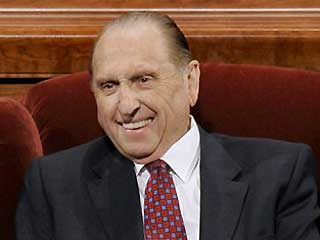
The Mormon world is abuzz today with reports that Pres. Monson has died. You can read a very thorough and thoughtful overview of his term in the Presidency here. NPR also had a great eulogy here.
Some highlights from his time in role:
- Lowered the mission age for women from 21 to 19 and for men from 19 to 18, resulting in a big increase in the number of missionaries serving.
- Added a 4th mission to the church, resulting in a substantial increase in welfare spending.
- The publication of Mormon essays providing more information on Heavenly Mother, polygamy, the priesthood ban, and multiple first vision accounts to name a few.
- The publication of the Joseph Smith Papers, ushering in more transparency.
- Reducing church commitment to his beloved Boy Scouts.
- In the last few years, he frequently ended conference meetings early, a trend we can only hope will continue.
His presidency also had some bumps:
- The legalization of gay marriage and the church’s often mixed and chaotic response to it that has hurt many families with gay members. There were some positive efforts in the creation of mormonandgay.com website, and the church’s push for discrimination-free housing for gay people, but these were overshadowed by the church’s financial support of Prop 8 in California and the Nov 5 policy to exclude children of gays from baptism as well as labeling gays in committed monogamous relationships as apostate.
- The Ordain Women movement and accompanying church backlash, along with some half-hearted steps to include more women in councils (adding the word “family” to explain their presence) and visibly showing their pictures in the conference center.
- The continued challenge of dealing with ready access to information in a digital age, which often contradicted church manuals or CES instructors’ versions.
- Schisms as some fundamentalists in the church broke off to form new religious groups.
- The Book of Mormon musical mocked missionary work, and the church’s PR spin “You’ve seen the play, now read the book” was a pretty ingenious response.
- Romney & Huntsman ran for president, adding scrutiny to the church.
There were other minor shifts that occurred during his tenure:
- Dress codes were relaxed in the church office building for women.
- Caffeinated beverages began to be sold on BYU campus.
- BYU, in response to backlash over honor code investigations of victims, formed a new Title IX committee to improve the university’s approach.
- New parental leave policies were instituted for employees of BYU’s schools.
Let’s take a moment to appreciate the contribution of a man who was beloved by many, whose focus on humanitarian efforts has made a lasting difference for many and the church as a whole, and someone whose folksy storytelling has touched a lot of hearts over the decades.
You will be missed, Pres. Monson.
 Wheat & Tares
I appreciated that he selected two of the kindest, least dogmatic men in the Q15 to be his counselors. Selecting President Eyring (who I know was a holdover from President Hinckley) and especially President Uchtdorf did the Church a big favor, I think.
It’s hard to be sad when he had a long life, very well-lived. Adding that fourth mission of caring for the poor and needy is fitting legacy for President Monson’s life, and probably what I will continue to associate most with his leadership.
Mary Ann – without taking away from your nice comment, the adding of the fourth mission and the actual amount and scope of that mission in practice represent an abject failure of the church. The way that the church conducts its business enterprises far eclipses its humanitarian activities.
Whilst I am sad that he has passed, I am glad that he is free from the burden of responsibility that I’m sure he felt all the way to the end.
He made a comment in his October 2008 GC talk, “Finding Joy in the Journey” that has really stuck with me. I had young children at the time so I appreciated his comment. When he said it I could tell he did so with that air of experience, which made it so genuine.
He said, “If you are still in the process of raising children, be aware that the tiny fingerprints that show up on almost every newly cleaned surface, the toys scattered about the house, the piles and piles of laundry to be tackled will disappear all too soon and that you will—to your surprise—miss them profoundly.”
I appreciate that perspective.
He was my father-in-law’s mission president in Canada. His story about a couple of missionaries in Canada is a wonderful story my family holds dear, as father-in-law was involved in that story.
No actual revelation. When asked what he wanted to be remembered for, he said he tried to do his best. A Prophet? He held the title.
President Monson will be the last apostle of the Church whom I deeply associate with my childhood. As I suspect others my age are thinking, he was one of the first–if not the very first–general authority who could get me to pay attention in General Conference when I was a kid in the 80s. He has an affable and engaging style.
Thank you for the rundown above. It was helpful since I’ve been inactive over the length of his term as President. I think I will remember him as emblematic of the Church in transition from a pre-internet to a full-on digital age. His leadership, like every previous President of the Church I’ve known, is and will continue to be viewed as problematic by folks like me. Nevertheless, there was so much goodness and sincerity there. What an amazing life of service.
President Monson cab be remembered as a prophet. There are many examples of his prophetic gifts. One account, among many, that stands out in my mind is the Methvin family.
In 1974, Christal Methvin , a 10 year old dying of cancer, wanted a blessing from a General Authority. She looked at the pictures of the GA and selected Thomas Monson. With the faith of a child she and her family asked Heavenly Father that apostle Thomas Monson come to give her a blessing. Her prayers brought about changes to Elder Monson Stake assignment. No one in Salt Lake knew about Christal, but the Lord did. Inspiration began to flow. President Benson told Elder Monson he felt impressed to send him to Shreveport Louisiana Stake.
When Elder Monson arrived for his assignment he learned about Christal for the first time. He was told that he would need to travel over 100 miles round trip to give her a blessing. He looked the schedule over and couldn’t find a way to do it. He suggested to local leaders that they pray for her in the Stake meeting and left it at that. However, the Lord had other plans.
Elder Monson gave an account of what happen in Oct 1975 General Conference saying,
“When the word was communicated to the Methvin family, there was understanding but a trace of disappointment as well. Hadn’t the Lord heard their prayers? Hadn’t he provided that Brother Monson would come to Shreveport? Again the family prayed, asking for a final favor—that their precious Christal would realize her desire.
At the very moment the Methvin family knelt in prayer, the clock in the stake center showed the time to be 7:45. The leadership meeting had been inspirational. I was sorting my notes, preparing to step to the pulpit, when I heard a voice speak to my spirit. The message was brief, the words familiar: “Suffer the little children to come unto me, and forbid them not: for of such is the kingdom of God.” (Mark 10:14.) My notes became a blur. My thoughts turned to a tiny girl in need of a blessing. The decision was made. The meeting schedule was altered.”
This is an example of how the Lord, when He desires, intervenes and guides his church leaders to accomplish His will.
Elder Monson continues,
“I shall ever remember and never forget that early-morning journey to a heaven the Methvin family calls home. I have been in hallowed places—even holy houses—but never have I felt more strongly the presence of the Lord than in the Methvin home. Christal looked so tiny lying peacefully on such a large bed. The room was bright and cheerful. The sunshine from the east window filled the bedroom with light as the Lord filled our hearts with love.
The family surrounded Christal’s bedside. I gazed down at a child who was too ill to rise—almost too weak to speak. Her illness had now rendered her sightless. So strong was the spirit that I fell to my knees, took her frail hand in mine, and said simply, “Christal, I am here.” She parted her lips and whispered, “Brother Monson, I just knew you would come.” I looked around the room. No one was standing. Each was on bended knee. A blessing was given. A faint smile crossed Christal’s face. Her whispered “thank you” provided an appropriate benediction. Quietly, each filed from the room.
Four days later, on Thursday, as Church members in Shreveport joined their faith with the Methvin family and Christal’s name was remembered in a special prayer to a kind and loving Heavenly Father, the pure spirit of Christal Methvin left its disease-ravaged body and entered the paradise of God.”
I first want to say that I’m glad that President Monson has been freed from this life and his suffering: particularly his decline over the past few years. It’s been heartbreaking to watch. Also, my sincere sympathies extend to his family for their loss.
In a respectful way, I do have two questions that really gnaw at my mind – and to which I would really appreciate all of your insights and counsel.
1. How does a Prophet of God amass an estate which is estimated to be greater than $14,000000.00: particularly after becoming a General Authority at age 36.
And,
If this value is even close to being correct – is it okay that a Prophet of God have such wealth: when others have so little?
Again, please know that I’m asking these questions with respect and am not trying to create a firestorm. Lately, I’ve been consumed in my reading about Martin Luther and the Franciscans. The possession of great wealth by the Popes and Priests (etc.) were one of the primary factors which fueled the demand for (and the results of) “The Reformation”.
Thank you (in advance) for your opinions.
“You’ve seen the play, now read the book” was a Final Jeopardy clue a couple days ago.
lefthandloafer
Look at the number you posted: $14,000000.00. What is it supposed to be? $14,000,000 (14 million) What is your source?
Everything I’ve read shows the GA all make the same amount of money, around $125,000 based on leaked pay stubs.
LHL, I’d be curious as to your source. I’ve never heard that before.
Jared, that’s a beautiful story with a wealth of God’s love in it. I’m not sure it is unique to Mormon prophets though. Members of other churches have had just as miraculous things happen to them.
I agree with what you say about other churches. I just haven’t found such accounts. Have you? If so, please provide a link(s).
I’m also very curious about the estimated value of the estate.
And I wonder if he has designated that any of it be bequeathed to the church.
This is a hard one to comment one as I don’t want to disparage a man in his passing.
As a man who we sustain as a Prophet, Seer & Revelator his list of accomplishments are unremarkable and unrelated to these offices.
At the President of the church and chief administrator his list of accomplishments were not all that significant to be honest. However this also might be a sign of a good administrator – there was not too visionary or too controversial. One could say he was a reasonable caretaker of the church.
I think Monson’s contribution was more significant in his personal ministry rather than his administrational or prophetic call. He seemed to be a good Bishop who cared for his flock. And Jared’s comment above is where I think his personal ministry was more significant than his other accomplishments….
I made a comment earlier, perhaps an explanation. There will be great tributes etc and it hurts me a little. My father joined the church in 1958, by 1960 he was on a building mission as a building supervisor. He was on a mission until the programme changed(8 or 10 years, My teenage years) and he then was employed by the church, to supervise building supervisors, in the UK. Later he was made supervisor for Australia, where he was also the church offices dealt with the tithing etc, with a secretary. Someone came from SLC and found out they had a builder and he was asked to go back to supervising buildings, while they employed a qualified manager type, who within 5 years had 50 people doing what my father and his secretary did.
You can see the buildings my father built. He did what he went on a mission to do. My father ended his mission broke(sold house and business and spent the money supporting his family while on a mission.
Pres Monson was employed to be an Apostle and then Profit. He seems to have been a good Bishop. From this side of the world I see no evidence of his doing what a Profit does. Is there any revelation? He will be fated as being a great Profit, and man.
My father will die in oblivion and poverty. Justice?
Jared, I’m iffy on how to respond to your comment to me. I’ve heard many, many accounts of the miraculous occurring in people of other faiths, especially the tender mercy type miracle you described. If you truly want evidence that this happens, I’d encourage you to in all sincerety ask those of other faiths about the stories in their families rather than look for stories online. It’s such a personal thing that I don’t know people always hold such stories up front and center (and when they do, I tend to be suspicious of their validity).
I agree with most here from my perspective “Down Under”, during the last decade or so the Church has had a number of failures and tens of thousands have left the Church with the historic issues and others handled very badly. If it was a corporation (Hmmm) the share holders would be asking some very hard questions.
Pres. Monson obviously lived a good life and his greatest work appears to be in his earlier times as many have observed. I had a problem listening to him, it may be me personally but he had a very Salt Lake romantic way of expressing himself…the opposite to Pres Hinkley who spoke more directly which I think fits our culture much better.
Nevertheless God bless him in his new life.
Geoff-Aus…….My very long experience in the Church is never ever become an employee…..I have a friend in Europe who worked for well over a decade very very hard and his wife unknown to him was having an affair and as a S&I teacher he was dismissed when all of it surfaced…..work that one out? This was in a poor country and it took him a very long time to get an income and then only a fraction of his Church pay…he is a sad and struggling man.
Maybe the Church should spend some of its time reviewing how it looks after its employees like your poor dad and I must admit many others I know.
May I say as a new graduate from University (many decades ago) with my teaching qualifications I was with 2 others asked to meet with someone from SLC who had to do with recruiting for the then church New Zealand High School. I was newly married and I asked this person what was the salary he said”well think of it like a Mission”…I then asked how much were the American teachers getting and he refused to tell me (I can tell you it wasn’t as a missionary)…..this set me up for life in regard to the employment in the church…..
The ‘temporal church’ has a lot to look at and improve…..I can only hope that a new administration can do some good….I wont hold my breath!
Good morning, everyone:
My apologies for not placing the commas in the correct place – to clearly identify the $14,000,000.00 (Million) dollar figure. Also, the following is the article wherein the financial projection is given:
https://www.msn.com/en-us/finance/companies/what-is-mormon-church-president-thomas-s-monsons-net-worth/ar-BBHNWof
Thank you (again) for your comments and insight.
Lefthandloafer,
President Monson inherited a lucrative business from his family- a printing press. He was able to serve as a nearly-full time bishop at 22 and a mission President at 36, in part because he was supported by his family’s Pioneer-built business. He lived quite humbly- in a modest home with few expenses. I don’t know whether his wife came from money or not. Look at his wedding pictures, he and/or she came from wealth. I know many rich people who use their money on stupid things, but the Monsons used their money to enable them to serve others and their church. He has written and published a few books, which would have pulled in some (not a lot) of money as well. If he invested his family assets wisely, it’s entirely possible that his estate is larger than what it would have been had he only been a poor life-long pastor.
And this report:
https://finapp.co.in › Wealth › Authors
Also, thank you for your perspective, Mortimer.
I’m pretty iffy on that $14M being correct after reading these articles. Both say he ha $2 – $3 Mil in real estate, but when one of those articles breaks that number out they seemed to be including his condo, which I believe is actually owned by the church and not him personally. Same with him recently purchasing a $90K car. Really? There was no way he was driving himself and more likely the church purchased the car for him to be driven to/from the COB/Temple Square – along with his security team and assistants as he’s been suffering from dementia for quite some time. Without some better evidence that he was this wealthy, I’m skeptical. If it is true, Mortimer’s scenario seems the most likely.
Having said all that, I’m getting an icky feeling for nit-picking on the wealth status of a generally good man 48 hours after his death…
I freely and completely acknowledge that President Monson did much good in the world; and appeared to generally be a good man. I don’t ask these questions to demean him or his kind acts. I’m simply trying to wrestle through some issues in my own mind and heart.
I suppose (for me) I look at the reality that President Monson worked (served) in the Church – full time – for 54 years. We now know that all of the General Authorities are paid; or receive a living stipend which is now above $100,000.00 per year. So, while recognizing that President Monson did provide service and (by many accounts) performed many kind acts, I simply ask myself:
1. Can a man who works for the Church for 54 years really know how it feels to lose a job; and not have any way to feed his family or meet his financial obligations?
2. Can a man who works for the Church for 54 years really know what it feels like to have no health insurance; at times when it is most sorely needed?
3. Can a man who works for the Church for 54 years really know what it feels like to lose a home and have nowhere to live?
4. Can a man who works for the Church for 54 years really know what it feels like to live in abject desperation?
and lastly, I suppose I ask
5. Can any of these men who are so insulated from the world, surrounded by “yes men” and sycophants, really know how many of the harsh realities of “day to day” life feel to (and daily crush) the average human being. Undoubtedly, they can be sympathic – but true understanding only comes from living something.
( For me – I so wish we could call someone to the Q12 who is not independantly wealthy, not a lawyer, not a doctor, etc…….how about a farmer; who has worked “with his hands” all of his life?!
Anyway, I do honor the goodness that President Monson displayed and I wish him Godspeed.
apples and oranges, the LDS market barely supports itself. You can’t become Dan Brown or Stephen King selling books to the saints.
We simply disagree, Mortimer. But, that’s okay.
LHL, on the one hand I agree with you. The LDS bubble is a bubble and church leadership doesn’t appear to ever exit it. This is a huge drawback to the church and the leadership. They feel very much out of touch with what is going on with average members. When we’ve had Apostles and GAs visit our stake, they only visit with families hand-picked by the SP so any ‘real’ interactions in their backgrounds must come from before their callings.
On the other hand, do we really want a farmer/plumber/janitor/store clerk managing a multi-billion dollar, world-wide organization? And would a farmer (etc) really be able to understand/connect to every single situation that members of the church find themselves in anyway? They might be able to emphasize with US style, blue-collar poverty, but what about aboriginal poverty? What about inner-city poverty? Is it realistic to expect leadership to represent all walks of life? And if they do, will they have the educational background to manage the very corporate, day-to-day needs of the church?
Again, I’m with you that the current leadership structure isn’t working on a number of levels. I just don’t think the solution (if there is one) will be simple or straight-forward.
Thank you for your thoughtful and insightful comments, ReTx. I suppose that as I grow older, I’m finding that I’m disturbed by the very idea that there is a class of people who are (by default or design) considered to be “our betters”. And, more often than not – it seems to come down to the amount of wealth and/or power they seem to possess. So, I have a strong tendancy to grouse and chaff under this suggestion; regardless of whether it is found in religion, politics, family etc. Have a good “rest of day”, my friend.
Jared, you seem to be confusing Inspiration for Prophecy. The story you tell, which I fully believe, is a story of personal inspiration that Elder Monson received. It is no different than the personal inspiration you and I receive on a daily bases. To be a prophet requires one to prophesize of future events. I’m not saying that Pres Monson did not do that during his tenure. But your story is NOT and example of that.
I agree with Retx that talking about a wonderfully compassionate human being’s flaws or wealth after they’ve just passed strikes me as distasteful and should wait for another thread. I enjoyed President Monson’s talks, especially when he was one of Pres. Hinckley’s counselors. He just always seemed good-humored and kind.
It seems like there’s a bit of a thread jack going on here re leadership etc. If it’s okay with the moderators, I would like to just ask Retx a question about leadership and class/suitability: Retx, what percentage of leadership in the church do you think is based on revelation, the prophetic gift, etc.? I’m with you on some level about certain skills being needed to run things, but as left points out, I do think that kind of thinking can lead to potentially disturbing conclusions about class and educational levels. If our leaders truly have access to God’s will and vision (as well as the church’s cadre of lawyers and accountants), it literally should not matter what their background is. I’m with you that it’s a bit unrealistic to expect leadership to reflect all walks of life, but leaders of different backgrounds (i.e. not corporate/white collar professionals) would lead to, IMHO, more compassion, more understanding of different peoples’ circumstances and therefore a more nuanced response to the needs of church members. I’d be curious to know your thoughts.
President Monson sounds like a true Man of God. You all have been very blessed to have had him in your lives . I have met a few men in my life as a preachers kid that carried such a presence with them. When they gave a prayer it truly spoke to your heart. Jared… My father was a wonderful pastor to his flock. Looking back and recalling memories through the eyes of an adult some things have a new light. My father visited every member of his congregation in their homes at every church he pastored. He was gone everyday all day. There were a few summers I was his tag a long. I have seen and felt things happen while he was praying for someone on those visits that to my child’s eyes and heart are so wondrous that I have kept them as something sacred to me. It is for those people who he was praying for to share those . But I can share one that my family still talks about. My uncle was dying and my father would call each night to talk to him and to my aunt. ( they lived several hundred miles away from us) . My uncle had slipped into a coma and was unresponsive to everything all that day. My aunt answered the phone and when she said my fathers name, my uncle opened his eyes . She put the phone up to his ear and my father said a prayer. My uncle passed away a few minutes later. A miracle ? A gift from God? I don’t believe my father had any mysterious or mystical powers , but he did have an unwavering faith. As a child and teenager I often felt our life was chaotic and I was filled with anxiety trying to be the perfect Christian example. Always though my father was the first person I called when I needed prayer for something. I miss that every day of my life. My thoughts and prayers are with President Monsons family. I know they must be feeling a great loss.
I realize this is a tribute page to a great man that you all revered. I meant no disrespect. Nor did I mean to compare my father or my life to the life and gifts that President Monson shared with you. I have the upmost respect for each of you and this site.
My compliments, Brother Sky. Very nice (logical & kind) narrative.
Thanks, left. I’ve enjoyed your comments as well.
“What percentage of leadership in the church do you think is based on revelation, the prophetic gift, etc.?”
Honestly, no idea. My guess would be not much. Especially as Mormons don’t have a good dividing line (does anyone?) between the workings of ‘the spirit’ and the workings of the non-verbal, intuitive, right-side of the brain. I’m not sure God cares as much about who is in what leadership position as we think He does, certainly He doesn’t stop them from doing/saying atrocious things.
“I’m with you on some level about certain skills being needed to run things, but as left points out, I do think that kind of thinking can lead to potentially disturbing conclusions about class and educational levels. If our leaders truly have access to God’s will and vision (as well as the church’s cadre of lawyers and accountants), it literally should not matter what their background is.”
I’m with you too, theoretically. The Dalai Lama is a good example of someone deeply inspirational (and God chosen by his people’s methodology) with little background or impressive education. And yet he is one of the most spiritually influential people on the planet. I have holy envy when it comes to Tibetan Buddhism. But…
The Dalai Lama isn’t required to manage a multi-billion dollar corporation-type organization. Our leaders do and must. One could argue that God raises up the right man for the job from pre-earth-life. Or one could argue that God simply picks someone who already has the correct skills. Or one could argue that like-chooses-like and it’s a old-boys/businessmen-club that mixes personal biases with ‘spirit’. I have no idea which is correct (or some fourth option that hasn’t occurred to me).
“leaders of different backgrounds (i.e. not corporate/white collar professionals) would lead to, IMHO, more compassion, more understanding of different peoples’ circumstances and therefore a more nuanced response to the needs of church members.”
I agree with this 100%. I was floored when when three, white,wealthy, western men were chosen as our last three apostles. Fingers crossed for April as we have another two opportunities to bring in more diversity to reflect the greater church.
At the end of the day, I don’t personally find the leadership of the church hugely inspirational. Or maybe that isn’t entirely true. I have a positive moment almost every conference. But I have just as many more such moments studying on my own – everyone from Adam Miller to Leonard Cohen to TED talks. I see GAs as primarily administrators rather than Prophets of God in a prophecy kind of way.
Thanks for the thoughtful response, ReTx. I think we’re pretty much on the same page, as I, too, don’t see a great deal of inspiration in our leadership. In some sense, my question to you was really based on my wish that either the church really start choosing people regardless of background or acknowledging that the gifts of the spirit don’t count for as much as white-collar professional/business experience. And I totally get the holy envy for Buddhism. It seems to me that it’s done a much better job cultivating and teaching real world ethical practices than the LDS Church. I think I’m with you too about the primarily administrators part, but acknowledging that to myself or others causes me to die a little inside. It’s yet another shift away from the loving, radical beauty of Christ’s church. Thanks again for your comment.
I’ve never related particularly to President Monson and don’t have a particular fondness or dislike for him, but I don’t think we should underestimate the sacrifice general authorities make when they’re called. I’m sure they’ve got strong opinions and big egos as many accomplished people do, and I’m sure it feels great to feel important, but they also make a pretty big sacrifice. I happened on a sacrament mtg over the holidays where an apostle was in attendance, and notwithstanding there were three missionaries reporting, of course he spoke to conclude the meeting (while he presided and could do what he wanted, I’m sure there was a lot of pressure for him to stand and deliver). He mentioned how nice it was to feel the spirit of the sacrament mtg, and that he didn’t get to attend many of them — he’d looked at his schedule and I think he said he’d only get to attend one other the first quarter of the year. Elder Holland was “on vacation” and happened to visit my ward several years back, and of course he spoke. I happened to be out of town, but some well-meaning youth in our ward recorded it (not knowing she wasn’t supposed to), and as he was emphasizing how important the gospel was, he said that if it weren’t, he and the other GAs would definitely be spending more time on the golf course rather than dragging their aging bodies all over the world. In trying to see the world through their eyes, I can’t imagine the pressure they must feel to say the right thing all the time, to be able to answer whatever desperate prayer is being offered by the people they’re visiting, to basically be the perfect example the people are looking for. It makes me exhausted just thinking about it. I think they very much believe in the mantle they claim to carry, yet I don’t think they expect the Lord to tell them what to do all the time. It’s also clear that they’re much more “in tune” with the Spirit some times than they are at other times. I don’t have any relationship with any GA, but my impression every time I’ve had an opportunity to interact with one is that he’s sincere, even underneath the game-face he’s had on. I don’t understand those who think GAs are motivated primarily with ego, power, or money. Don’t get me wrong, I’m sure it’s an exciting and invigorating life, and I’m sure they fall to temptation as we all do, but most of them gave up things that gave them ego, power, and money when they were called, and I’m not convinced most of them traded up. (I find the estimate of Pres. Monson’s estate of $14M to be pretty unlikely, and the articles linked didn’t have good source material to justify the claim).
While I do believe GAs live in a bubble (how could they not, with the schedules they keep?), I think those that have served as bishops and stake presidents have a breadth of experience with human suffering and struggle, if not a profound depth. I think they’ve met and heard the struggles of a lot of people (in my stake, visiting GAs asked to visit members of the stake who were struggling or who might benefit from their visit). But nobody can experience the full variety life offers in depth (I remember Elder Maxwell’s talks changing after his bout with cancer in a way that really touched me). My impression of President Monson is that he was genuine, human, sincere, and willing to sacrifice a great deal for the church and people he chose to love.
Bishop Bill-
From LDS Bible Dictionary
Prophet
The work of a Hebrew prophet was to act as God’s messenger and make known God’s will. The message was usually prefaced with the words “Thus saith Jehovah.” He taught men about God’s character, showing the full meaning of His dealings with Israel in the past. It was therefore part of the prophetic office to preserve and edit the records of the nation’s history; and such historical books as Joshua, Judges, 1 and 2 Samuel, 1 and 2 Kings were known by the Jews as the former Prophets. It was also the prophet’s duty to denounce sin and foretell its punishment and to redress, so far as he could, both public and private wrongs. He was to be, above all, a preacher of righteousness. When the people had fallen away from a true faith in Jehovah, the prophets had to try to restore that faith and remove false views about the character of God and the nature of the divine requirement. In certain cases prophets predicted future events, such as the very important prophecies announcing the coming of Messiah’s kingdom; but as a rule a prophet was a forthteller rather than a foreteller. In a general sense a prophet is anyone who has a testimony of Jesus Christ by the Holy Ghost, as in Num. 11:25–29; Rev. 19:10.
From LDS Guide to the Scriptures
Prophet
A person who has been called by and speaks for God. As a messenger of God, a prophet receives commandments, prophecies, and revelations from God. His responsibility is to make known God’s will and true character to mankind and to show the meaning of His dealings with them. A prophet denounces sin and foretells its consequences. He is a preacher of righteousness. On occasion, prophets may be inspired to foretell the future for the benefit of mankind. His primary responsibility, however, is to bear witness of Christ. The President of The Church of Jesus Christ of Latter-day Saints is God’s prophet on earth today. Members of the First Presidency and the Twelve Apostles are sustained as prophets, seers, and revelators.
Mormons sustain their leaders as Prophets, Seers, and Revelators. Three distinct gifts. Elder Monson’s was
I’ve so enjoyed this article, discussion thread and insights provided by everyone. It really helps to have one’s world view tempered by the candid perspectives of others. I too, believe there is much goodness in many church leaders. Admittedly, I choke a bit on the word “sacrifice” as relating to what they are doing. But, I do so knowing that my reaction to this word is based entirely on my own life experience – where during the financial crisis of 2008 jobs were lost and careers destroyed; including mine. So my human reaction to hearing about the sacrifices that the General Authorities make is “I’d take that sacrifice with a six figure income, premium healthcare benefits and all expenses covered – through the end of my life”. So, in fairness to them I will readily admit that they work hard, travel extensively and attempt to do good. But, from a quality of life perspective – I perceive that they’re really doing okay.
The timing of the question of Monson’s estate may be indelicate but it’s also not insignificant at someone’s passing. Furthermore, intelligent people can hold 2 thoughts in their heads: that a leader has passed and that a leader may have amassed a sizable fortune.
The murkiness of what he may have accumulated (if, indeed, it is a fortune) is also not insignificant in a church that claims it has no paid clergy, on the one hand, but provides no transparency about its financial operations so that people can see whether or not there is payment and to whom.
I just find it ironic — especially at this moment when it comes into the foreground — that people speak all the time about knowing the unknowable while meekly accepting total ignorance about what is knowable and known about the entirety of our federal government, all publicly held corporations, most personal fortunes of prominent Americans and world figures but not about the church we are members of and provide significant funding for.
This is a time of transition and change. This murkiness about where church funds go and what is distributed to whom and how could and SHOULD also change.
Yes Jared, your definition makes my case. The story off blessing the girl does not involve any prophetic actions by the churches own definition. Yes, we sustained him as a prophet, But you could have replaced Monson in the story with any SP, Bishop, Elder, or even a lowly nursery lead who received a prompting to bless the girl.
Jared – That’s the Mormon view on how Jews of the OT define prophet. But what is the Jewish definition of how Jews (and other Hebrews) of the OT define prophet? That’s the definition that seems more important if we are developing a historical precedence for usage of the word.
Bishop Bill and ReTx-
The way the Bible Dictionary defines the term prophet (see above) would include SP, Bishop, RS or anyone who is receptive to the the Holy Ghost.
“In a general sense a prophet is anyone who has a testimony of Jesus Christ by the Holy Ghost, as in Num. 11:25–29; Rev. 19:10.” Bible Dictionary
When I wrote, President Monson can be remembered as a prophet. There are many examples of his prophetic gifts. I then related the story of Christal Methvin as one example among many,
Apparently, this is what Bishop Bill is referring to,.Apparently he wants to use a narrow definition of prophet where the prophet foretells the future and says thus saith the Lord. However, that is Not the only way to use the term prophet.
We don’t live at a time when the Lord is inspiring his prophets in that manner. That is an act of mercy for church members and the gentile nations. I believe the time is not far distant when the Mormon prophets will say, Thus saith the Lord to church members and to all people. When they do, we will be in for some very difficult times. In that day, it will be like it was among the Nephi’s prior to the the Savior arrival.
20 And there began to be men inspired from heaven and sent forth, standing among the people in all the land, preaching and testifying boldly of the sins and iniquities of the people, and testifying unto them concerning the redemption which the Lord would make for his people, or in other words, the resurrection of Christ; and they did testify boldly of his death and sufferings.
21 Now there were many of the people who were exceedingly angry because of those who testified of these things; and those who were angry were chiefly the chief judges, and they who had been high priests and lawyers; yea, all those who were lawyers were angry with those who testified of these things.
22 Now there was no lawyer nor judge nor high priest that could have power to condemn any one to death save their condemnation was signed by the governor of the land.
23 Now there were many of those who testified of the things pertaining to Christ who testified boldly, who were taken and put to death secretly by the judges, that the knowledge of their death came not unto the governor of the land until after their death.
(Book of Mormon | 3 Nephi 6:20 – 23)
Abraham Joshua Heschel is considered the preeminent Jewish authority, thanks to his landmark book, “The Prophets” (1st edition, 1962). It’s a lengthy work, often published in two volumes now. Heschel wrote that prophets within the long history of Israel were far more concerned with the absence of righteousness rather than the absence of laws and thus were highly motivated by the presence of injustice.
A unique contribution of the prophets was their “remorseless unveiling of injustice and oppression, in their comprehension of social, political, and religious evils. They were not concerned with the definition, but with the predicament, of justice, with the fact that those called upon to apply it defied it” (p. 260).
“Prophecy is not a private affair. The prophet isn’t concerned with his personal salvation, and the background of his experiences is the life of the people. The aim is not personal illumination, but the illumination of a people; not a spiritual self-enhancement, but a mission to lead the people to the service of God. The prophet is nothing without his people” (p. 462).
“The prophetic personality, far from being dissolved, is intensely present and fervently involved in what he perceives. The prophetic act is an encounter of a concrete person and the living God. The prophet is responsive, not only receptive. The act is often a dialogue in which consciousness of time, remembrance of events of the past, and concern with the plight of the present come into play. God as a person confronts the prophet as a person: God in His pathos, and the prophet in history with an awareness of a personal mission to a particular people…. [In] his visions the prophet’s personal identity does not melt away, but, on the contrary, gains power under the overwhelming impact of the event. Even if the event takes him by storm, his consciousness remains undisturbed, free to observe and free to respond” (p. 457).
“The prophets tell us little of how the divine word came to them or how they knew it to be the word of the very God. Perhaps it was the discovery of being present at a divine event, ‘of standing at the council of the Lord’ that was the essence of their experience and the source of evidence. Prophetic inspiration involved participation, not merely receptivity to communication” (p. 555).
Heschel’s book was invaluable to me in writing my book, “Speak to the Bones: How to Be a Prophetic People in a Time of Exile” (Isaac’s Press, 2017). Heschel’s “The Prophets” is a worthwhile starting point for Christians to understand the spiritual gift of prophecy and its place in the believing community. The prophetic office within Latter Day Saint traditions diverges, of course, but remains strongly connected to its source.
Jared – I love your description of prophet here. We are in a sense then all prophets as we fulfill the measure of our creation. However, I don’t think when one says ‘The Prophet, Thomas S. Monson’ that this is the type of prophet being described. I mean otherwise, we’d call each other Prophet Johnson and Prophet Velasquez rather than Brother Johnson and Sister Velasquez as we reach toward God at church. What percentage of members of the church understand the Prophet Joseph Smith to mean that Joseph Smith had a testimony? Prophet as in ‘prophet, seer, and revalator’ means something else.
Rich – Thanks for the recommendation. I’ll go buy his book as having asked the question, I find myself truly interested in the answer!
ReTX:
Here’s a link to Heschel’s book on Amazon:
I bought my copy years ago at a used-book store. Never getting rid of it.
Rich Brown’s comment makes me think we don’t currently have prophets, at least not as defined in the source he mentions. I’ve often wondered what the church would look like if we concentrated more on social justice issues and less on desperately trying every Sunday to convince each other how awesome we are because we’re Mormons.
Once again, Brother Sky. Beautifully said!
ReTx-
I agree, the prophet is the one who receives revelation for the church. There are many examples in our day. The most notable being June 1978 revelation.
Brother Sky: I find your last comment interesting, not having prophets based on what Rich Brown pulled from the book, from the point of view that I got the exact opposite idea. I see the similarity in OT prophets with modern prophets in what Rich Brown shared. We must see things differently.
As for thinking of OT prophets as social justice warriors, I see very little evidence of that but more study maybe need.
Rich Brown: nice book recommendation. I look forward to getting book, wish it was in e-book form. Looks like an important book to read, If your interested in those things.
ScottJ:
I recommend, in particular, the book of Amos for a powerful critique of economic and social injustice in the northern Kingdom of Israel. Not your typical Judean shepherd.
LHL,
Getting caught up in whether people are rich or poor and whether the Lord chooses to use them is kicking against the pricks. Matthew was a tax collector-(think IRS auditor combined with collection service rep, combined with repo man) in an occupied land. Luke, a physician, Peter, a fisherman. Yes, the Lord has used plowboy Prophets and shepherd boys, but he’s also calls Egyptian princes and royalty. This threadjack was in poor taste, I apologize for contributing to it.
I recall that in Christ’s day church leaders got in a fight over the use of an oil worth its weight (even today) in gold that would have fed many poor people, but was instead used to anoint Jesus. Judas, seeing this, apostatized and ultimately betrayed the Savior. These things are heavy to carry, choice servants have faltered doing so. Be careful chewing on this bone too long, or casually. The saints try to use money responsibly, but it’s never going to be perfect. There isn’t a spiritual reason for avoiding a discussion of financial transparency or income disparities or waste of sacred tithes, but keep perspective of the big picture and don’t let it drag you down or build an ugly ball of suspicion. Take great care friend.