

I’ve been exploring some communicable disease data for Utah (sourced from Utah’s Open Data Portal which, unfortunately, only has data up through 2009) and created the chart below to illustrate something that completely surprised me: the most prevelant communicable disease in Utah over that ten-year period was Chlamydia, which was nearly nine times more prevalent than Chickenpox!
To give you an idea of the difference, there were 43,832 cases of Chlamydia over that time period compared to 5,208 cases of Chickenpox.
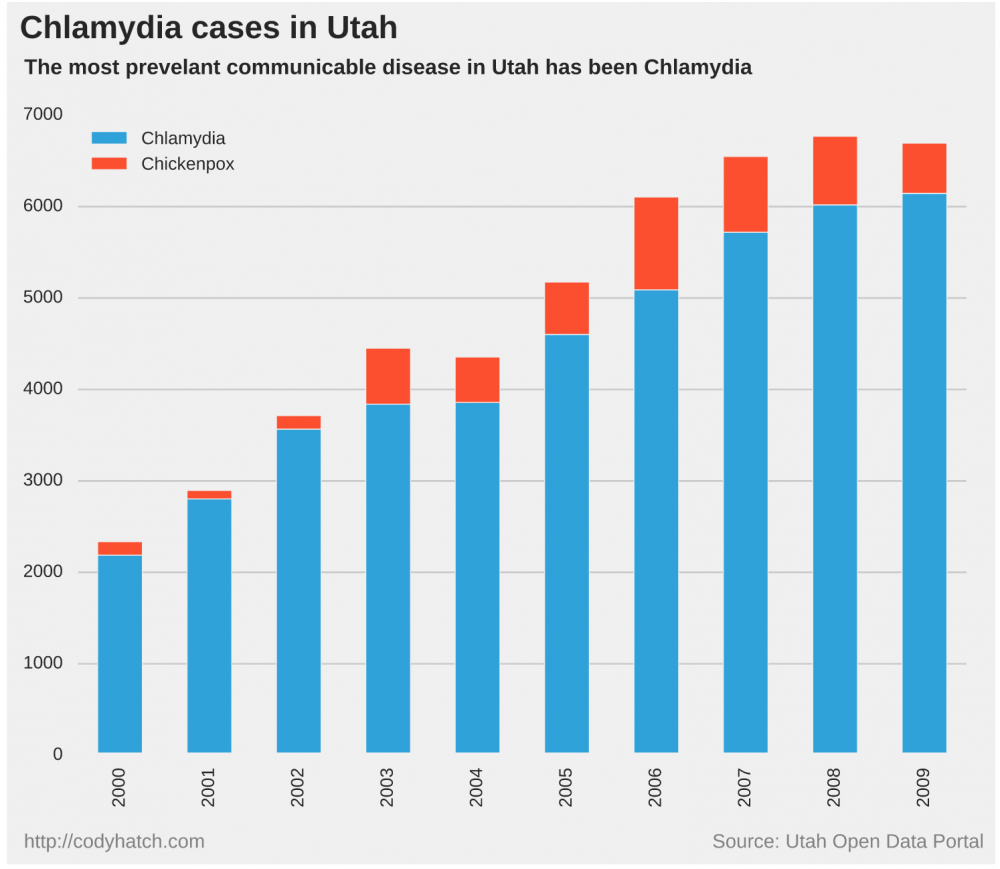
A couple questions:
- Why do you suppose Chlamydia is so prevalent in Utah?
- What effect does this have on our youth?
 Wheat & Tares
You really need a baseline for comparison. This is not my area but a quick online search suggests that chlamydia is the most common notifiable disease in the United States, at rates of 300-500 per 100,000 (depending on the year; has been rising), and that chickenpox is about 1/10 as common. It appears that Utah is low on both (lowest decile on chlamydia). So for discussion purposes, what does it mean that STDs are so common (everywhere)? And that Utah is low but not off-the-charts low?
Yes, this definitely needs a baseline for comparison with other states.
As for the increase, there are a lot of possible factors.
The obvious: increased sexual activity could account for more actual cases. Poor sex education could compound the problem.
Poor sex education in the past could also account for more actual cases due to higher prevalence in experienced sexual partners. Stigma in the past could account for underreporting due to less screening. (Only sexually active people need to be tested.)
Stigma in the present could account for the curve not being steeper.
Not sure why this surprises you. Chicken pox is vaccine preventable and chlamydia is not. Most kids get vaccinated for chicken pox so it has become relatively uncommon. Chlamydia is easily spread sexually. Most people basically have sex with everyone they date. Most active Mormons don’t do that but not everyone in Utah is an active Mormon. Certainly fewer than half of the young adult demographic in Utah are active LDS.
If these were counts of suicides, then some would believe that they indicate that Mormons need to show more love toward homosexuals. Of course, these statewide numbers, whether they be of chlamydia infections or suicides or hours watching TV, indicate nothing in particular about homosexuals.
This is a non-issue. Chlamydia is easily the #1 bacterial STI in the United States. There is no reason to suggest that it wouldn’t also be the case in Utah. As a side note, Chlamydia rates pale in comparison to the #1 overall STI in the United States, human papillomavirus.
To build on christiankimball, here is the link to the CDC’s stats for 2016 US chlamydia rates (per 100,000 population) – https://www.cdc.gov/std/stats16/figures/3.htm.
It looks like Utah is ranked about 5th from the bottom of states for infection rates. Idaho and Wyoming are ranked low as well (looks like 6th and 7th)
The District of Columbia has the highest levels of infection per population…triple the rates of Utah and over double that of the US average.
I don’t like the fact that chickenpox is on the rise either. I had it when I was a kid, and am concerned about getting shingles when I get older.
Thanks for the feedback. I didn’t include a baseline because I didn’t really care about how Utah compares to the rest of the United States. I wanted to focus on Utah itself, where those numbers are a bit shocking to me. I would have thought that it wouldn’t be quite so prevalent in Utah. I suppose I am a bit naive.
Good point about the chicken pox vaccines. I had completely forgotten that people are immunized for chicken pox these days.
WTF is John Mansfield going on about?
There’s more interesting here than absolute proportions. Why the climb? You can’t dismiss the increase over time just by pointing out that the absolute numbers are great.
Well, you can, I suppose…
Things that stand out to me (as an outsider to the fields who does not have the expertise to really know what to make of this):
“The MOST PREVALANT communicable disease in Utah has been chlamydia. [emphasis mine]”: I think of other common infections that go around. Common cold type stuff probably goes dramatically underreported (as far as something like this might go) because people don’t visit doctors for them and nobody really collects such statistics. But I also think of other infections (Strep throat — perhaps because I know of a couple of cases in my immediate circle and I recall when kids were younger how easily and quickly it seemed to move through classes — or influenza in all its forms, for example). As others have noted, chicken pox may not be a good comparison because of the vaccine (required for schools now). I guess it the “most prevalent” seems remarkable to me, because there are other communicable diseases that seem like they should also be in contention for “most prevalent” — many of which are spread through the air.
Wikipedia claims that a high percentage (majority??) of chlamydia cases are asymptomatic. How badly under reported might these numbers be?
In response to your questions:
Utah does not seem remarkable, because it seems so common everywhere. It suggests that, overall, our sex ed curriculum does not seem to have much impact on this particular STI (Can Utah’s sex ed curriculum be classified as “abstinence only”??).
Regarding youth: Does this say something about improving our sex ed? Until just now (reading this and Wikipedia), I had no idea how common chlamydia was, I had no idea how treatable it is. If I could classify my sex ed from way back when, it was basically, “be very afraid of sex because of STI’s like chlamydia which are very scary.” If I may say so, after reading the Wikipedia page, is chlamydia any scarier than strep A? Is there value in making our sex ed accurate enough so that our youth can make wise sexual choices rather than just being afraid?
Many infectious diseases are more common than chlamydia, including the viruses that cause colds. You’re right, these are not reportable to the Health Department. It would be more accurate to say that chlamydia is the most common reportable infectious disease in Utah. And probably nationwide.
The county in which I live in a large Southern city with a population of about 1 million has about 30,000 cases of chlamydia every 3 months. A handful of my non-LDS boy scouts in high school were treated for syphilis last year. S#i! happends. What I conclude from this data is that SOUTHERN WOMEN ARE MORE BEAUTIFUL and irresistible.
What might be more interesting is to look at these stats by county where reported (and treated). I bet Utah county, home of BYU, has a very low rate and that Salt lake county, home of U of U, has a comparatively high rate. But if you could capture zip codes of addresses of patients you might see the difference lessen. Because, I suspect BYU students go to Salt lake to get their STD’s treated and are not so stupid as to risk arousing any attention among local doctor’s office personnel who might blab it to a bishop.