
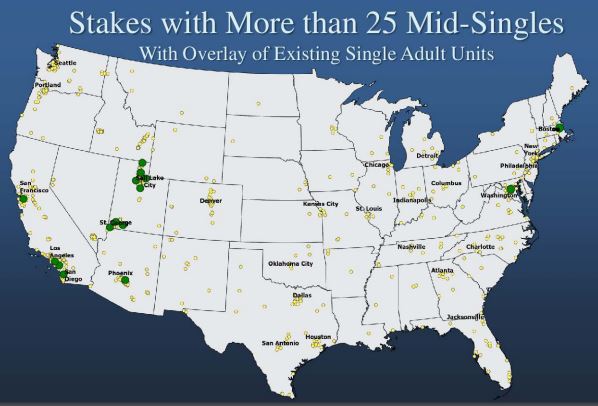
The MormonLeaks website released information from 2005 in March of this year about Young Single Adults (YSA – post high school to age 30) and I commented on this Mormon Leaks and YSA Trends. On September 26 a leak of a 2013 document covering “mid-single adults” or “Single Adults” (the terms seem to be used interchangeably) and units that focus on this demographic. Once a single member becomes 31 years old, the either go to a conventional unit (ward or branch) or they can attend a Single Adult Unit (SA Unit) if one is created within their stake.
 The handbook apparently at the time set the bar of having a 150 or more Single Adults (SA’s) needed in a stake before a SA Unit would be allowed to be created. This presentation focused on the U.S. (“domestic areas”) and did not mention anything outside of the U.S. I did about 20 minutes of searching to see if I could find a non-U.S. SA unit. I found YSA wards, but my non-extensive search didn’t find any. Several statistics were broken down specifically for the state of Utah (not a surprise).
The number of SA’s were increasing at the time of this document. They grew at a 31% rate from the decade roughly 2003 to 2013, but as a percentage of all members the category grew only 14% over the same period (SA’s were not growing as fast as general membership). In 2012 55% of the 5,215 moving from YSA to SA were in Utah. It was noted that temple married members in the age range 31-45 had an 81% attendance rate at weekly church meetings. Endowed single members in that age range were 41% or half as likely to attend weekly. Also highlighted was that temple married members in the age range 31-45 of had 81% regular temple attendance were as SA’s were at 11%. Quite a stark difference, but given that temples focus on marriage, it isn’t all that shocking.
The Proposal (that hopefully creates more marriage proposals)
It seems the purpose of this presentation was to propose that in addition to SA Units that an option of creating “Assigned Units” where 25 or more SA’s were in a stake. It appears these Assigned Units are conventional units, but all the SA’s wanting to attend with fellow SA’s in the stake could have their records moved to this unit. So in practice this would be if there were enough SA’s (25+) in a stake, all the SA’s that wanted to attend would be moved to a ward in that stake (most likely one that was a bit low on membership numbers). It was noted that there were some unofficial assigned units in some areas even though they were not defined as an option in the handbook. It is surprising that out of the 35+ SA units, that only 5 were complaint with the handbook.
The argument that was put forward was fairly clean and a good case was made for the change. The problem presented was that “mid-singles are stalling in Gospel” (similar to YSA’s, but probably for different reasons) and the solution was to keep doing what was being done, but also add more SA units. It seems that stake presidents generally were in favor of SA wards and Assigned Units (at least Utah Stake Presidents, but I guess that is all that matters).
Several statistics were given indicating that SA Units work better for SA’s.
- SA’s More active in SA units for those that are single (Utah 2008-2010)
- 95% activity rate for SA’s in SA units as they leave YSA wards
- 78% activity rate for SA’s in conventional units as they leave YSA wards
- More likely to get married
- Twice as likely to get married if attending an SA unit
- More likely to find a mate in unit (32% in SA unit vs 6% in conventional)
- More likely to enjoy their church experience
- Talks/lessons more applicable
- 90% liked lessons/talks in SA unit
- 48% liked lessons/talks in conventional unit
- Could it be less “worship of the family” in SA units?
One item that isn’t clear is that this was a document from 2012 and updated in 2013. But it included a memo dating 2009 that seemed to indicate approval of “mid-singles units” and “magnet wards”.
Are there SA wards outside of the continental U.S.?
Has anybody seen these proposed changes of “Assigned Units” implemented?
If so, has it been positive for the SA’s attending?
 Wheat & Tares
One of the things I really liked about this one was that it showed a clear recommendation for local leaders to do what makes sense to keep singles interested, including breaking with the church’s model. It ALSO identified that some local leaders had refused to do what they knew was right because it differed from the CHL. That says a lot, and it’s not good.
I too was surprised how many “rouge” ward configurations there were. I have only had 1 bishop that didn’t 100% tow the party line . Almost every one was of the mold of, “We do things by the CHI and I will not even go ask above to bend any rules as that is almost a sin in and of itself.” One person I really admire is Richard “Papa” Ostler. He was a YSA bishop for a while and it sure seems his #1 concern was loving the members of his YSA ward. I don’t know that he broke many rules, but I do get the sense he would certainly consider doing so if it would help one of his YSA ward members.
Recently I spoke with a mid-20s evangelical Christian who was “stalled” (their word, not mine) in their local church they had attended since a child and felt as if their faith wasn’t as “bright. There were no other folks in that age range. It was either families or elderly.
Flash back to my mission: megachurches were all the rage for families and even the young adults. They felt part of a community.
I am uncertain but haven’t ever heard of any other Church organizing specific phase-of-life congregations aside from LDS. Has anyone else? I think it is a strong point in our organization. Everything can always be improved but still a good thing.
Joe: Singles wards are in some ways a solution to a problem other churches don’t have. In other churches, people don’t need permission to attend a different congregation, so I would guess that it is common for singles to cluster in one congregation without needing official approval. Other churches don’t focus on family as much during talks and lessons, so there is less need for a different congregation for singles who don’t relate to those messages. Other churches also aren’t as focused on people marrying within the same church, so single people are more likely to naturally meet an acceptable dating partner that attends a similar church in the local community.