
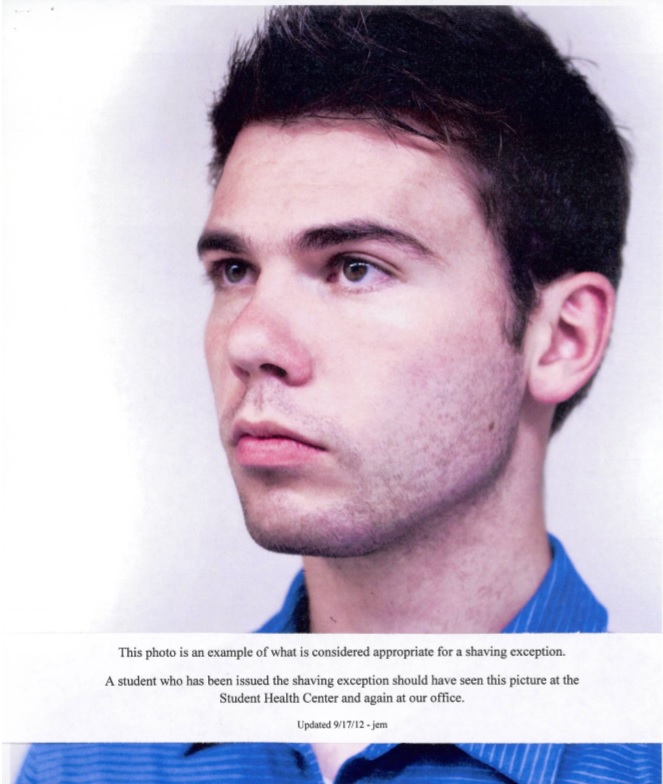
I got a copy of this photo from a teacher at BYU-Idaho. Is this a beard? If a person has a skin condition and can’t shave everyday, does this mean they have to shave every other day? Is this a health issue? I’m curious your thoughts. (Is this the same at BYU?) I’ve been trying to find a scripture that supports being clean shaven, or this photo. Can you find anything?
Then to top it off, I saw this on my Facebook feed. These are radio personalities on KSL radio, the LDS Church owned radio station. I don’t think some of the men could even walk on BYU-Idaho’s campus! (Some are clean shaven, but most are not.)
 Wheat & Tares
No. Of course that isn’t a beard.
The bigger question is why is there a beard ban at BYU Provo and Idaho?
My son unintentionally ran afoul of the beard ban his first day of class as a freshman at BYU In Provo. He has very dark hair and very fair, sensitive skin. Late in the day before classes started, he shaved.
In the morning he got up, got ready for the day and went to the cafeteria for breakfast.
However, the beard monitor denied him entry into the cafeteria. By the time he returned back to his dorm and shaved (again)there was no time for breakfast before class. Welcome to BYU!
At a minimum, it would seem more humane to teach students what counts as a beard–issue warnings rather than deny entrance that first week.
My husband would still be shaving every day just to meet the standard in that photo.
In Dallin H. Oaks’ speech explaining the grooming standards, he said there is nothing inherently wrong with beards and long hair. It’s not based on scripture.
“The rule against beards and long hair for men stands on a different footing. I am weary of having young people tell me how most of our Church leaders in earlier times wore beards and long hair, which shows that these are not inherently evil. Others argue that beards cannot be evil because they see bearded men enjoying the privileges of the temple. To me, this proposition seems so obvious that it is hardly worth mentioning. Unlike modesty, which is an eternal value in the sense of rightness or wrongness in the eyes of God, our rules against beards and long hair are contemporary and pragmatic. They are responsive to conditions and attitudes in our own society at this particular point in time. Historical precedents are worthless in this area. The rules are subject to change, and I would be surprised if they were not changed at some time in the future. But the rules are with us now, and it is therefore important to understand the reasoning behind them…
“In the minds of most people at this time, the beard and long hair are associated with protest, revolution, and rebellion against authority. They are also symbols of the hippie and drug culture. Persons who wear beards or long hair, whether they desire it or not, may identify themselves with or emulate and honor the drug culture or the extreme practices of those who have made slovenly appearance a badge of protest and dissent.” (Quoted in the Dec 1971 New Era – https://www.lds.org/new-era/1971/12/standards-of-dress-and-grooming?lang=eng)
We’re going on 45+ years, so I don’t think we’ll see change anytime soon.
Mary Ann, get out of the 50’s. Hippies and revolution, give me a break. How long must we deal with cultural closed minded people.
The beard policy is the least of the problems with the BYU-x honor codes.
Well, I’ve made my position on beards personally well-known, having had one since 1975 except for an 18 month period I was the Ward Missions Leader and was asked to shave it off. I am amused at those who process “sensitive skin.” I don’t like to shave period. And I like having a beard. I am not less or more faithful with a beard than without.
And a Dallin H. Oaks article from almost 50 years ago, when he wasn’t a GA, is not a bit persuasive to me. Another ridiculous Church standard that has to go.
In LDS culture, it seems much easier to create a new rule or restriction than to abandon an old one. The beard ban has not even a pretense of being doctrinally based, but it isn’t going away.
Similarly, the church used to discourage birth control. While officially birth control is now a decision left to married couples, many members still think that birth control should be avoided.
When I was a youth the annual lesson on following the prophet always listed face cards as one of the things the prophet counseled us to avoid. Then I’d go home and play Rummy with my temple worthy family.
I think the Oaks quote may accurately reflect the original reason for the beard ban, but does not explain why the ban still exists. One might argue that they beard ban exists because the leaders want the students to look clean and well groomed. I have some sympathy with that view. The military has similar grooming standards.
But in reality, I think a major reason the ban still exists is because to eliminate it would make the leadership *feel* like they are lowering their standards, which they are loathe to do.
It all depends on your culture. Super short hair in Europe may be associated with the thuggish behaviour of the far right. Beards are associated with learning and culture, or sailing.
The short hair and homburg hats once beloved of missionaries in Europe made them look like East German spies at the time of the cold war.
It seems our elderly GA’s see things differently than the rest of us.
All the men in my family have beards. Have for generations. Lovely, well manicured beards. And I’ve always been more interested in what’s in their hearts than on their faces. …tho I do love a well shaped beard.
My son’s beard was more impressive than that in elementary school. And ain’t nobody gonna tell me there’s ever been anything wanting in his character.
…or what he or any of my daughters should do with any part of their bodies.
At BUY-Idaho if you close your eyes and imagine what you’d look like with a beard you’re playing with hellfire.
I agree that the beard ban is absurd. However, I’d like to correct one point (although I don’t know if it was serious): It is not against the rules for a visitor to step on the BYU-I campus sporting a beard. I’ve done it many times.
When I was at BYU I shaved regularly and had no beard. Then I got married. I had no facial hair, but my wife was my beard. I wish at BYU beards like mine were prohibited (or at least more strongly discouraged) and facial hair was allowed. But I’m not holding my breath. As the scriptures say, “It is easier for a camel to go through the eye of a needle, than for the Mormon church to enter the 1980’s.”
I have identical twin cousins, who could switch identities and their parents couldn’t tell. Today one has a beard and is married, the other is clean-shaven and divorced. The remaining (and long-suffering) wife dislikes her husband’s twin, (not identical personalities) and told her husband she would divorce him if he ever shaved his beard off. He worked in the temple for many years but eventually was told the beard had to go. So he quit his calling as a temple worker. I offer this as an example of integrity and putting priorities in order.
And does anyone realize how flippin’ cold it gets in Rexburg in the winter? No beard is a health hazard for everyone, men and women alike!
A reasonable policy would require facial hair for all students regardless of gender or sexual preference.
The fact that we are talking about this is absolutely crazy.
Think what we could all do if the anti beard energy was channeled into something constructive….
1. Soldiers and BYU students are no similarly situated. The reasons why soldiers are required to be uniform largely do not apply to BYU students (at least no more so than they do to anyone else).
2. There’s a practical reason for soldiers to be clean shaven, which is so their gas masks can seal properly.
Kullervo: “Soldiers and BYU students are no similarly situated. The reasons why soldiers are required to be uniform largely do not apply to BYU students (at least no more so than they do to anyone else).”
For the record, I agree with this.
The military has what is called a beard profile for those who can’t shave everyday. A military doctor explained it so me as people with curly hair have trouble shaving everyday because the hairs become ingrown and may become infected. The hair needs to always have a very little length to it not a clean shave to prevent this, and this is more common for African American soldiers as they have curly hair. I also knew a US Army Doctor (normal doctor not special forces) stationed in Belgium and he was told not to have a military hair cut and facial hair was OK because they didn’t want their soldiers to stick out. So even the military can make adjustments when needed.
If you do not want to shave all the time, I have a suggestion for you: Go to a different university. Especially for BYU-I, the strict rules are what allows the school to admit a high percentage of those who want to attend. If the rules were really easy to follow, there would be too many students applying and the church would have either
1) Spend more money adding to the campus and hiring more professors
2) Make the academic standards more rigorous and thus deny a church university experience to young people who can qualify for many colleges.
I do not have a thick or really dark beard, especially back in my 20’s, and could get away with not shaving for 1 day. I am glad that we do not have the crazy beard policy for some callings in our ward or stake. Maybe the brother with a ponytail will get called onto the ward council some time.
I don’t understand what is supposed to be communicated in the caption to the photograph. If you get a rash at least this bad from shaving, you can get approval to have a beard? This is an example of a person with facial hair because he has a shaving exemption? This is the maximum stubble you are allowed if you have a shaving exemption? This is appropriate dress for when you come in and apply for your shaving exemption? You have to be as worthy and somber as this guy for it to be appropriate for you to have a shaving exemption?
The caption references appropriateness, but it isn’t clear to me what parameter is being illustrated as “appropriate.” I don’t know that they are saying that this is a “beard.” The caption is so poorly written, I don’t have any idea what they are trying to say.
It seems our elderly GA’s see things differently than the rest of us.
I certainly see a large number of conservative business
menpersons at my Fortune 10 employer wearing dress shirts in colors other than white, and ties that would give President Kimball a heart attack.I recall our MTC president telling us that yellow and pink ties were not appropriate for missionaries, and then L. Tom Perry, bless his heart, wore a yellow one at General Conference while I was in the MTC.
My husband would have to shave twice a day if he went to a church. The problem with the beard ban is it places unreasonable expectations on our more hirsute brethren.
I meant church school. Incidentally he works in the temple nights and will reshave before he goes in.