

Jeff posted last week, asking if 2017 would be the year that marked the end of White Guilt. Perhaps the assumption behind his question is that Obama was voted in because of “white guilt,” or perhaps that in a Trump America there is a “whitelash” (a white people backlash) as Van Jones called it, including disenfranchised white folks coming out of the woodwork on Facebook and Twitter with racist screeds, writing memoirs like Hillbilly Elegy, tired of being looked down on as “white trash,” and feeling every bit as disenfranchised as a minority or woman.
A Saturday Night Live skit portrayed this problem in Black Jeopardy, in which Tom Hanks plays “Doug” a disenfranchised white guy pitted against black contestants he finds, much to everyone’s surprise, that he has a lot in common with:
Political Correctness : Secularism as Commandments : Religion
Charles Taylor talks about what motivates people to behave morally, both in religious and secular societies. What would it take to sufficiently motivate moral sympathy? Human secularists would have us believe that our recognition of the dignity of others should be sufficient motivation. But we have seen that it is not, and when it fails to motivate us to behave morally, to (for example) treat others with equal dignity, rights and opportunities as we (and often by extension members of our group) are treated, what can we do about this?
The answer is a bit damning about our “secular” and “liberal” penchant for political correctness. The mechanism most often used to alter behavior is shame. We invoke shame whenever we perceive that someone fails to perform standards that we have come to identify with living a decent, civilized, pro-social, human life. In Taylor’s words:
One can see this at work in a heightened version of holier-than-thou: You don’t recycle (gasp)? You use plastic shopping bags (horror)? You don’t drive a Prius (eek!)? You won’t wear the ribbon?
 This is evidence of mutual display (insiders wear the ribbon, drive the Prius, use the cloth shopping bag) and the self-consciousness it generates (look at us doing the right thing, wink, wink). If you want to be seen as moral, you have to obey the code of conduct which requires that you display the code’s current list of behaviors, you perform according to the standards that are required by those around you, and you monitor the behaviors and words of others to determine their conformity with the code. You have to become self-conscious about the things you say and do, your performance. You don’t have to BE just or moral or good–you just have to PERFORM justice or morality or goodness through the set of behaviors outlined in the code. Which is frankly the exact same problem religion has. We mistake goodness for the appearance of goodness. Secularism is apparently no different from religion after all.
So, maybe that doesn’t matter. Maybe it’s OK to “fake it until you make it.” The problem is that self-congratulating, supposedly “enlightened” concern for others while policing non-conformity to the code is something that has a shelf life. We are susceptible to fatigue. We may not tire of our own superiority, but we tire of others’ inferiority, their continual failure to meet “the code of decency.”
While I’m motivated to help the poor and vulnerable and even the undeserving because of their inherent dignity, I’m at the same time quietly patting myself on the back, recognizing my moral superiority. So over time it becomes frustrating that these other humans do not exhibit the same enlightened other-regard: What’s wrong with these people? . . . Your philanthropy becomes misanthropy. . . Behind all your pity and compassion has been a secret loathing. And all this philanthropy has really been self-interest and self-congratulation.
Again, this is the same fragrance that clung to us within religion: monitoring our own and others’ performance to a group-designated code of conduct, feeling smugly superior, and demarcating outsiders and insiders. We don’t want to be tainted by those who don’t conform to the code. We want to remain pure from them if they can’t perform according to our unwritten expected mutual display.
Bootstraps vs. Grace
 Taylor posits that Christianity starts with the assumption that we will all fall short, all need the grace of God. Secularism, by contrast, holds a more optimistic view of man’s potential; it assumes that we have the ability to transform ourselves–no God required. Perhaps that’s why, as secularists, we have less tolerance for those who fail to meet that potential. We believe it was in their power all along. But as Christians, we can believe that the power wasn’t their own, that they had to be transformed by a higher power, and perhaps that simply hasn’t taken place yet.
Taylor is speaking of Christianity in a broad sense, and yet his descriptions are interesting in a Mormon context because our doctrine is very focused on an imminent framework (that which is within the person)–we individually have to work to merit the grace of God. We have a mixed view of humanity. Some leaders focus on our fallen nature (like most of Christianity does), while others focus on our personal responsibility to avoid making mistakes, our ability almost to save ourselves through our own worthiness and righteousness. Our failures are all individual. Our achievements are likewise evidence of our valiance and individual potential, at least as much as they are of the grace of God.
But, reverting to Taylor’s question, perhaps because religion expects us to fail (without divine intervention) whereas secularism expects us to succeed (on our own), we are more intolerant of mistakes, and mistakes are always more easy to perceive in others. Whether he’s right or wrong, the human tendency exists in both secularism and religion to reject others, even if the reason we are there is to hold ourselves and others to a moral standard that upholds human dignity. We want to uphold human dignity, and we’re not afraid to shame people, ostracize them, and even kill them, to do it.
Casting the First Stone
 I suspect that the same kind of person we are as members of the church is roughly the same kind of person we are if we are not members of the church. The codes may change, but the insider-outsider thinking is still appealing. The desire to feel smugly superior and to judge others by a code of conduct is the same. A paper hanging in my first mission apartment said “Life lessons will be repeated until they are learned.” This one’s a particularly hard one to learn.
I have noticed a few times in the last few years just how much people are greater than the sum of their parts. There have been a few fellow ward members who initially rubbed me the wrong way, making ill-informed political comments, sexist, homophobic, teaching a lesson they don’t understand or haven’t researched very well, simply not being that smart in that moment or on that topic, and a host of other “performance” issues. But that’s not the whole person, as I’ve discovered. Some of these individuals were really just beyond the pale in things they said in that one singular moment. As a result, my initial reaction was that I really did not like them.
At the same time, I noticed that my kids were getting older and were very self-righteous sometimes about other people’s political mistakes or not using the right terms that are currently used. Kids are too young to know what it was actually like living in the decades that preceded their birth, and they are much less forgiving of these types of mistakes. I gave myself a challenge to make friends with the people who had initially irritated me. I chatted with them in the hall. Our families had dinner or played games together. We hosted sleepovers with their kids. When it came to creating true friendships, I had varying levels of success. There were a few people I still didn’t like. But I often found that there was far more good than bad to a person, and that we were more alike than I would have thought in other areas of life and viewpoints.
In E. M. Forster’s book A Room with a View, Lucy’s persnickety fiance Cecil makes grimacing faces when confronted with the middle class mannerisms of his betrothed’s family. The diplomatic Mrs. Honeychurch intervenes with her daughter Lucy:
Mrs. Honeychurch: Is anything the matter with Cecil? Because otherwise, I cannot account for him. Whenever I speak, he winces. I see him, Lucy. It’s useless to contradict me. No doubt I am not artistic nor literary nor intellectual. Your father bought the drawing room furniture, and we must put up with it.
Lucy: Cecil doesn’t mean to be uncivil. He explained. It’s ugly things that upset him. He’s not uncivil to people.
Mrs. Honeychurch: Is it a thing or a person when Freddy sings?
Christianity says that we have to overcome our human weakness with love, and I find that like everyone else, it’s a whole lot easier to spot others’ weaknesses than my own. Am I Cecil, sneering at the unattractive drawing room furniture and spoiling everyone’s pleasure, or am I Mrs. Honeychurch, putting up with the furniture, and asking everyone to treat people with dignity and kindness? In my case, I’ve certainly been both. It’s easy to feel superior to racist comments, but there are people behind those comments with more potential than just those comments. Shaming people doesn’t change hearts or minds–mine or theirs. It just bolsters my existing feelings of superiority.
Is it a thing or a person when someone makes a racist, sexist or homophobic comment?
Conclusion & Discussion
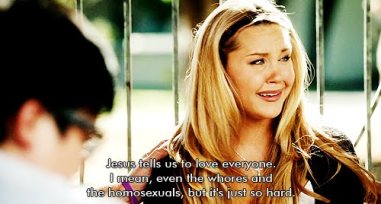 Last week I quoted the movie Easy A, and for some reason, reading Charles Taylor brings dialogue from that movie to mind. I’ll end with another quote from that movie, this time from Marianne, the uptight born again Christian girl at the school who leads a prayer group and wants to shame Olive, the lead character, into leaving the school because she doesn’t conform to the code of behavior Marianne and her friends believe is right:
Marianne: Jesus tells us to love everyone. Even the whores and the homosexuals, but it’s so hard. It’s so hard, because they just keep doing it over and over again.
Now substitute “racists, homophobes and sexists” where she says “whores and homosexuals.” Performance failures in others are hard to stomach, no matter what code of conduct you require. Often we only pay lip service to loving others, particularly when the church’s stance isn’t very loving or understanding. Is there secret loathing behind our behavior policing? That comes through.
- Is political correctness smugly superior and contemptuous of human failure? Is it a mask for contempt and misanthropy?
- Who’s smugger: Christians or secularists? Defend your answer without being smug or superior.
- Do you see humanity as fallen–needing grace to be redeemed, or as immanent–individuals needing to achieve their own potential?
- If shaming doesn’t work, how do we educate others to avoid offensive behaviors that merit correction? How do we do this without tiring of others’ failure to meet our performance expectations?
Discuss.
 Wheat & Tares
This is brilliantly written. I think the answer to your last question is to teach correct principles, and let people govern themselves. (Doctrinally and not legally speaking.)
Is there any other way to genuinely love?
A very good post . People giving Sacrament talks are discouraged from asking for a show of hands on specific issues. It wouldn’t take much to fracture the membership on social, political, and doctrinal points. That’s not what we’re there for.
The task to “educate others to avoid offensive behaviors that merit corrections ” would be all-over-the-map. Who categorizes offensive behavior? Tradition, Legal decisions, cultural diffs, persuasive people/groups with their own motivation? And is everyone held to the same standard? Certain words/behaviors are considered offensive when engaged by certain people but not by others?
One example. An RLDS theology class I participated in . A point was made how the Church no longer makes the “One True Church” claim. I responded that, if a member has that belief as part of their personal testimony, we do not have the right to forbid them. A lady responded “But it offends people”. Who made that decision?
I don’t think shaming is fundamentally a secularist or religious problem. I think it’s a human nature problem. We form identities through belonging to a community or group that shares our values and beliefs and then we compare ourselves to other groups with different values and beliefs and we judge and we shame.
So how do we progress as individuals and a society to a truly more tolerant place? I don’t think there are easy answers. On some level, “-isms” are always going to exist as long as the human race exists. Does that mean we don’t try? No. I think there are tools that can be used (such as education, exposure to the “other”, etc.) to help mitigate finger-pointing and shaming.
Also, I recently took a psychology well-being and happiness class. The happiest nations (Denmark, for example) tend to be wealthy (higher quality of life) and they provide equal opportunities to citizens for jobs, education, healthcare, etc. Some of these nations are also primarily atheistic but I’m not sure that means securalism is the best way, but rather that solving inequality and other social problems in pragmatic, concrete ways might be the best way. And, naturally, a by-product of this is that shaming is reduced and true tolerance is increased. People can be at their best when they don’t feel they have to compete for limited resources.
How about the attitude of “you take care of you” and “I’ll take care of me”! Is it our responsibility to judge the rightness, wrongness or political correctness of others? Where does this need to judge stem from. Can we not live and let live Each of us are on our own journey and have our own internal guidance system to attune to. Albeit, some are not connected currently. I feel like the more we just monitor and “correct” our own behavior, we may be surprised how quickly behaviors in others takes place. Where’s Nate when you need him? Can we not rise above some of the beliefs we have been programmed with??? shaming, judging–they all make us feel better about our own circumstances. Do we “need” to or do we “want” to? Maybe we should dig deeper and work on our own inward peace and it might exhibit outwardly more quickly! Thanks!
“If shaming doesn’t work, how do we educate others to avoid offensive behaviors that merit correction? How do we do this without tiring of others’ failure to meet our performance expectations?”
If anyone can answer this question, I’ll happily change. Until then, it seems that shaming is such an easy out!
Great Post! I am always impressed at your ability to take a look at multiple sides of an issue. I must confess though that I tend to be pro-shame, not because I like shame or shaming but because sometimes unpleasant things (like eating broccoli) can be good overall. That said, that is just my gut instinct and you have definitely given me reason to rethink my gut instinct.
I really liked this post. Full of good stuff to think about. I’m not totally sure that shaming doesn’t work or that it isn’t a good way to deal with behavior that society frowns on. If you catch a teenager shoplifting, is it better to send him to juvie or make him stand outside the store wearing a sign “I shoplifted from this store”? I think one could argue both sides of that. Shaming is really just a form of bullying, but if my behavior isn’t what society likes, I’d rather be shamed than forced.
And, while I think smug superiority can accompany those who shame, I’m not sure it’s a requirement or that it necessarily follows. I shamed some people who intended to vote for Trump despite how such a vote contradicted their stated values. I didn’t do it out of a sense of superiority — I did it out of a sense of alarm. I truly felt they were doing a bad thing. Yes, I admit to a little smugness now (one of my arguments was that Trump was a terrible national security risk), but my fear was far greater and still is. Did my shaming work? …. Well… probably not. But I watched the shaming on Facebook of those who would throw away their votes voting for McMullin and allow Hilary to pick supreme court justices, and I think that was effective.
If shaming doesn’t work, why does the LDS Church keep shaming us for sin? That’s where we learned the technique, after all.
I don’t think the LDS church has any monopoly, any novel technique, nor any particularly strong predilection when it comes to shame. The shame game is everywhere and has been for a very long time.
Okay so I have a spare minute to come and comment here. I just started a class on the History of Peace at BYUI by David Pulsipher. The first book we’re reading is called Nonviolent Action: what christian ethics demands but most Christians have never tried.”
The first half of the book is a history of the success of nonviolent action (NVA) in the history of the world. Most religious people who have used NVA have the ultimate goal of converting their oppressor and creating a beloved community. The one thing I noticed in many of the stories of the success of NVA is that much of the success came because the outrageous acts of the oppressors were publicized and public opinion shifted to outrage at the conditions/behaviors instead of indifference. Make no mistake it was outrage and shame that turned the tide for the CRM & VRA. It wasn’t the lack of moral judgement of others and their beliefs. It was Pressure. I guarantee you the passage of CRA & VRA didn’t change the hearts of the oppressors. The racism stayed there, but they knew the world was watching, now. The usage of the n— word fell out of usage because of the outrage/pressure/shame that came from changing societal standards of acceptability. People stopped using the N word but their hearts didn’t change. Their kids’ & grand kids were raised with the same hearts, but different standards in public. In some ways that just forced the racism to become more insidious. When you can’t wear a white robe and use the N word without social consequence, you find socially acceptable ways and code words to communicate the same intent and end goals.
Do I support a changing level of public standard of acceptability in language usage? I have loved being policed and called out because it’s an opportunity for me to learn. I didn’t think that saying “spirit animal” was using the spiritual language and beliefs of a group in the flippant and trivial way. Now that I know I ask myself how would I feel if that was done to me, and I change my behavior (patronus it is). I’m not sure whether it’s guilt or shame or public ostracism or awakening a moral center or development of empathy. . . . . but it worked for me.
Thanks, as usual, Hawkgrrl. I meant to engage with your post last week on Taylor, and I’m so excited that you’re using
A couple of thoughts. I don’t have time to be brief, so I beg your indulgence…
1. Jesus was not remotely hesitant to use shame as a teaching tool, particularly against the religious authorities. He also had a tendency to redirect society’s shame-attacks in surprising directions. What are we, as Christians, to make of this, particularly when we have also been commanded to forgive that we may be forgiven, or to judge not lest we be judged? I’m personally not sure.
2. I’m afraid I’ll come off too strongly here, so be patient with me, but I want to point out that, “Is it a thing or a person when Freddy sings?” seems to be a different kind of question than, “Is it a thing or a person when someone makes a racist, sexist or homophobic comment?” But that’s largely because I don’t take musical aesthetics as seriously as social systems of violence against human beings. When Freddy sings badly, he is threatening nothing but annoyance. When someone expresses support for racism, she is lending her support to a system that hurts actual people.
To pick a random example completely out of the air with no basis in current events at all, I do not feel shy about getting upset when someone says that Islam is a cancer or that Japanese internment camps might be a good precedent — because someday that person, or someone like them, might be selected to a government post to make things happen. Wisdom and prudence also govern here, but there is nothing wrong with attempting to persuade people that such opinions are bad.
So my unlearned but ardent (a dangerous combination) answer to your question is that it is a person when someone expresses a statement that violates humanist or Christian principles, and the person needs to be loved, but the person might also benefit from some shaming. Can we do both? Well, that leads me to the last point.
3. My two cents is that you got to the heart of it with this quote:
“But, reverting to Taylor’s question, perhaps because religion expects us to fail (without divine intervention) whereas secularism expects us to succeed (on our own), we are more intolerant of mistakes, and mistakes are always more easy to perceive in others. Whether he’s right or wrong, the human tendency exists in both secularism and religion to reject others, even if the reason we are there is to hold ourselves and others to a moral standard that upholds human dignity. –>We want to uphold human dignity, and we’re not afraid to shame people, ostracize them, and even kill them, to do it.<–"
Precisely well-stated, and I'm going to sidestep the immanence question lurking underneath the surface here to highlight a what I think is at the core of the post's central question about shaming. (But the immanence question is really good.)
The problem with shaming is that shame is a death threat: the tribe will throw you out and you will starve in the wilderness. Or we'll execute you. When secularism or Christianity does not seem credible in their claims of the infinite worth of human beings, then people rightfully react with terror at being shamed. How far will we go to enforce our values?
Or in other words, the problem here seems to be reproving with sharpness without showing thereafter an increase of love, that the shamed might know that our love is stronger than the bands of death.
It's not that shaming is an illegitimate tactic, as Kristine A points out well. I have no problem with Gandhi shaming the British into leaving India, but that might be because he has made it abundantly clear that he does not have any malice toward the British people. Et cetera. The problem is that neither Christians nor humanist secularists are considered credible in their professions of love to the people they shame.
Jesus shamed plenty, but he proved his love by getting himself killed and suffering everything we ever suffer. We love him because he first loved us. As usual, "Come, follow me," is pretty rough.
Edit to first line:
I’m so excited that you’re using Taylor (and his commentators) to approach some really great questions. It makes me so happy.
Another word on the limited capability of shaming to change. Neither Taylor (nor the OP really) are about changing society’s views through changing what is acceptable at large. This is about why individual level shaming as a tool within relationships (families, friends) doesn’t work.
Now, it’s certainly true that when society changes its views of what is acceptable, that kind of public pressure certainly does drive changed behavior. But there’s reason to believe that this didn’t really win hearts as evidenced by the Trump election. One of the narratives that has been very successful among conservatives is that political correctness (shaming) has gone “too far.” Why do they feel that way? Because their hearts haven’t been changed. Because they don’t agree with the values behind the change. They have been in hiding because of public shame, but they can anonymously and quietly vote without public scrutiny. Shame doesn’t apply in the voting booth. It’s limited.
Here’s another example. Mormon Heretic asked why the church continues to use shame if it’s ineffective. As Jerry Seinfeld humorously said about catcalls on the street “These are the best ideas we have.” But again, look at how ineffective shaming really is at changing hearts and minds. It just drives disagreement underground (or to the bloggernacle). As I noted elsewhere, they can correlate the manuals, but they can’t correlate the contents of my head!
“If shaming doesn’t work, how do we educate others to avoid offensive behaviors that merit correction? How do we do this without tiring of others’ failure to meet our performance expectations?”
I guess I’ve never felt it was my place to educate others or to correct their behaviors other than my own children when they were small. And for me being “politically correct” just seemed to be civil and considerate. It’s enough work minding my own business than to take on the neighbor’s.
jstricklan: I really appreciate how in depth your response is, and I’d love to engage further in these ideas, particularly this one: ““Is it a thing or a person when Freddy sings?” seems to be a different kind of question than, “Is it a thing or a person when someone makes a racist, sexist or homophobic comment?” But that’s largely because I don’t take musical aesthetics as seriously as social systems of violence against human beings. When Freddy sings badly, he is threatening nothing but annoyance. When someone expresses support for racism, she is lending her support to a system that hurts actual people.”
I think your point about the impacts to other people is valid (comedic songs are an aesthetic choice; the middle class family enjoys them, but Cecil’s refined sensibilities are offended by them. And racism and homophobia and sexism are broader problems than unartistic singing because they actually do harm people. BUT let’s not go too far down the rabbit hole. Making a racist comment or using a term for race that is now out of fashion aren’t necessarily the same thing as the racist systems that hold people back. Political correctness is mostly about words, not really about the systemic injustices. The PC policers use the words as part of the code of behavior that is required, but since that’s really the only thing they can police at the individual level (an individual isn’t responsible for institutional racism, for example), they are actually just shaming someone for the use of a word without addressing the systemic problems.
Just for a funny personal example, it is currently “correct” to refer to people from Asia as “Asian.” In older generations it was more common to use the term “Oriental,” but that term no longer sounds right. We don’t want to discriminate against or stereotype people, so when I hear the term “Oriental,” it’s like a record scratch. I think of Jerry Lewis putting in fake teeth, squinting his eyes and switching Ls for Rs (“flied lice”) and vice-versa. “Oriental” sounds like racism to me. I’m conditioned to think that people who say “Oriental” are (or might be) racists. If I correct them, I feel like I’m on the “good” side–the anti-racism side–and my correction has somehow made the world a less racist place. Go, me! I can pat myself on the back for single-handedly making the world a less racist place.
So, a few years ago when I was a business executive living in Asia, my assistant used the term Oriental. I opened my mouth to correct her, almost without thinking. Then I stopped myself for three reasons: 1) she is a few years older than me, 2) she is Singaporean, and 3) she was referring to herself.
Angela, I really like your example and I wonder where it might lead. Of course I’m no expert on social norms, let alone racism or anything else relevant, so I’m just offering my own opinion, for whatever little it’s worth. TLDR: When we talk about shaming, or about the silliness of “PC” culture, we’re usually actually fighting about the validity of the underlying values.
It seems to me ANY appeal to values is an appeal to shame, if the person you’re attempting to persuade is on the other side of the problem. Applying this analysis (it’s the values, not the shaming, that are disputed) to the three questions we’ve already brought up:
1. With Lucy and Mrs. Honeychurch, it could be understood that the latter’s rebuke is an appeal to shame in Lucy, who is supporting a classist system by siding with Cecil, or at the very least Cecil’s violation kindness and respect toward other people. If I were an aesthete, or an elitist, I might object, but mostly because my values are different.
2. In your personal anecdote. What a lovely example of how we have to navigate these complicated value systems in virtually every social moment. Since the value behind shaming the use of “Oriental” is fighting discriminatory social systems, there was no violation of the inclusion norm that needed shaming. Instead, you opted for self-restraint and kind silence, asserting those values instead.
3. In culmination, I feel like you summed up very well the perception of PC culture that creates objection:
“Making a racist comment or using a term for race that is now out of fashion aren’t necessarily the same thing as the racist systems that hold people back. Political correctness is mostly about words, not really about the systemic injustices. The PC policers use the words as part of the code of behavior that is required, but since that’s really the only thing they can police at the individual level (an individual isn’t responsible for institutional racism, for example), they are actually just shaming someone for the use of a word without addressing the systemic problems.”
I tentatively concede your first observation — that using racist terms is not necessarily the same as supporting racist systems — because of the strength your second point: Many people feel like PC is less about asserting the values of fairness and equality as it is asserting the values of elitism and classism, or ingroup-outgroup considerations first. (“You don’t really care about INCLUDING person X, you care about EXCLUDING person Y.) [1]
Because values often come in a bundle — say, liberal elitism and egalitarianism, or social hierarchy and inclusion in the “Christian Nation” — it is sometimes difficult to disentangle what exactly is being asserted by an attempt to shame others, but it is more useful to do so
I think many people who object to shaming are really saying that they object to the values involved, or that they feel the sense of threat I described above As a humanist and a Christian, I think I’m failing if I communicate that threat.
[1] I strongly assert that is not true that individuals are not responsible for institutional racism — there is no one but individuals to hold responsible, in the end, and it is individual decisions that create systemic problems — but if PC culture is not being used to promote those values and solely functions as a means of asserting eltiism, then there is a legitimate complaint. I find it unlikely that it is primarily being used in that way. (GBSmith’s comment comes to mind — at least on the conscious level, PC is mostly about asserting the value of civility for most people.)