
I recently returned from a trip to the Baltics. One of the best things about traveling to other countries, in my opinion, is coming into contact with other forms of worship and considering how those “other” sacred spaces and forms of worship feel in contrast to my own experiences as a Mormon. When you enter these places, you have to realize that to their worshipers, past and present, these are the places they have gone to experience the divine, to find comfort, and to understand their place in the universe. Come with me on a tour of some of the places I visited.
 Copenhagen’s Cathedral: Church of Our Lady
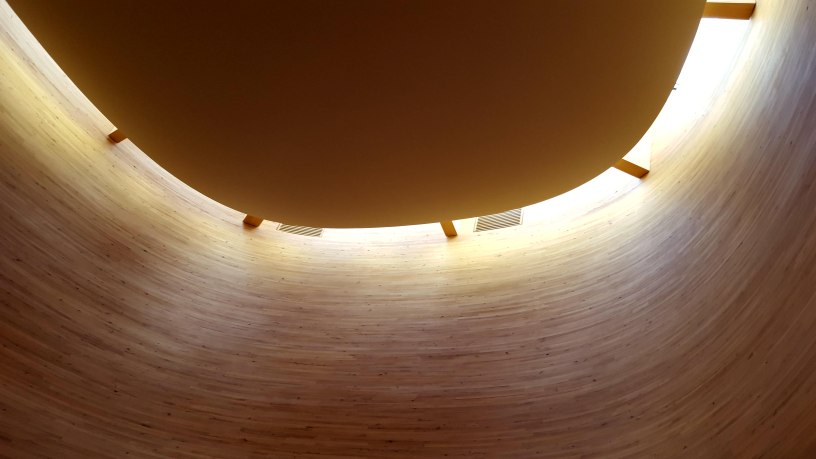
We started our trip with a day in Copenhagen, Denmark. This first church didn’t make my short list, but my husband wanted to see it, and I’m glad we went! The original Christus status by Danish sculptor Thorvaldsen is found inside. The chapel is currently lined with white statues of the apostles (also by Thorvaldsen). The interior is simple and light colored with graceful architectural features like the dome over the altar (see picture). The simplicity of the interior invites silence and reflection and has a feeling of peace and welcome.
There have been several churches built on the same site over the centuries (they kept burning down), with the original one dating to 1209. The current church, like most churches in Northern Europe, is Evangelical Lutheran (since the reformation came to Denmark in 1536). The church is still actively in use; in fact, a friend of mine attended a gay wedding there a week after I visited. Both Kierkegaard and Hans Christian Anderson’s funerals were held in this church. Of all the churches we visited, this one felt the most like a Mormon worship space in terms of mood and architecture.

Rostock, Germany: St. Mary’s Church
This is a huge red brick Gothic-style 13th century Cathedral (later expanded to a Basilica) that was modified with the reformation to become an Evangelical Lutheran Church. The building still has the smell of wax, incense and moldering dust that I usually associate with Cathedrals, and there are several ornate effigies and a dominating organ. There is a complicated still-working astronomical clock that dates to 1472 with apostles rotating around it. But the real piece de la resistance is seen as you exit the church: an enormous stained glass mural of Christ triumphant. It is truly a sight to behold.
The church fell into disrepair a little during the years Rostock was a part of East Germany. There is no air conditioning and no heating. I am always in awe at the devotion of those who built such lavish spaces for their worship, and wonder how it must have felt over the centuries to gather there and feel a part of such a legacy.
Stockholm, Sweden: the Royal Chapel
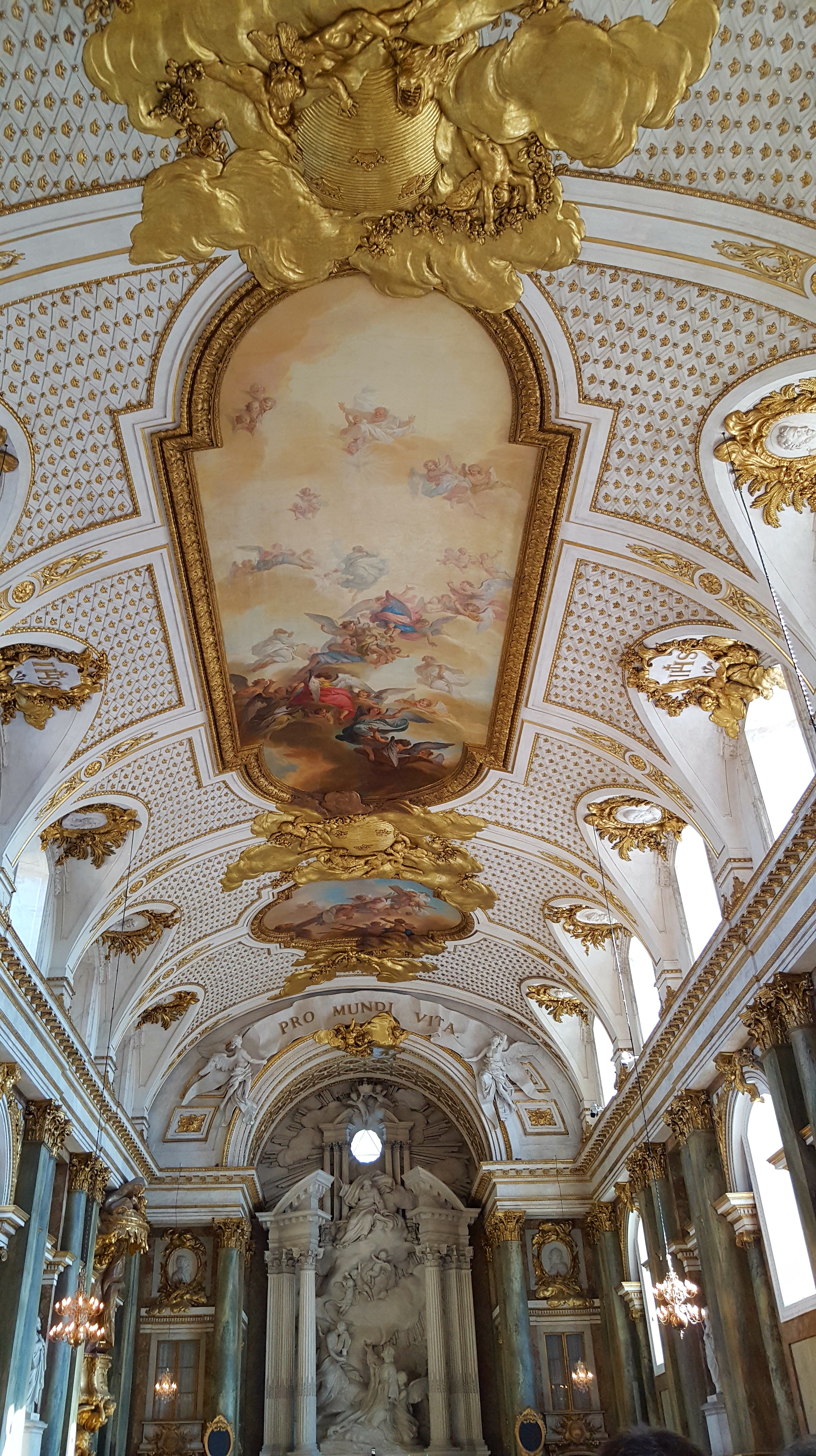 We briefly ducked into the royal chapel before visiting the armory (it’s free!). The royal chapel is part of the Church of Sweden, a Lutheran denomination, and was opened in 1754. Unlike other Lutheran denominations which are decidedly low church (less ceremonial), the Church of Sweden uses priests, vestments and a high mass to retain a high church worship service despite being Lutheran. The Church of Sweden is very liberal and ordained its first lesbian bishop in 2009. 63% of Swedes belong to the Church of Sweden, not surprising since until 2000 they were automatically enrolled at birth unless their parents had officially resigned. Only 2% of Swedes attend church regularly, but a whopping 17% consider religion an important part of their lives.
 Talinn, Estonia: St. Catherine’s Passage
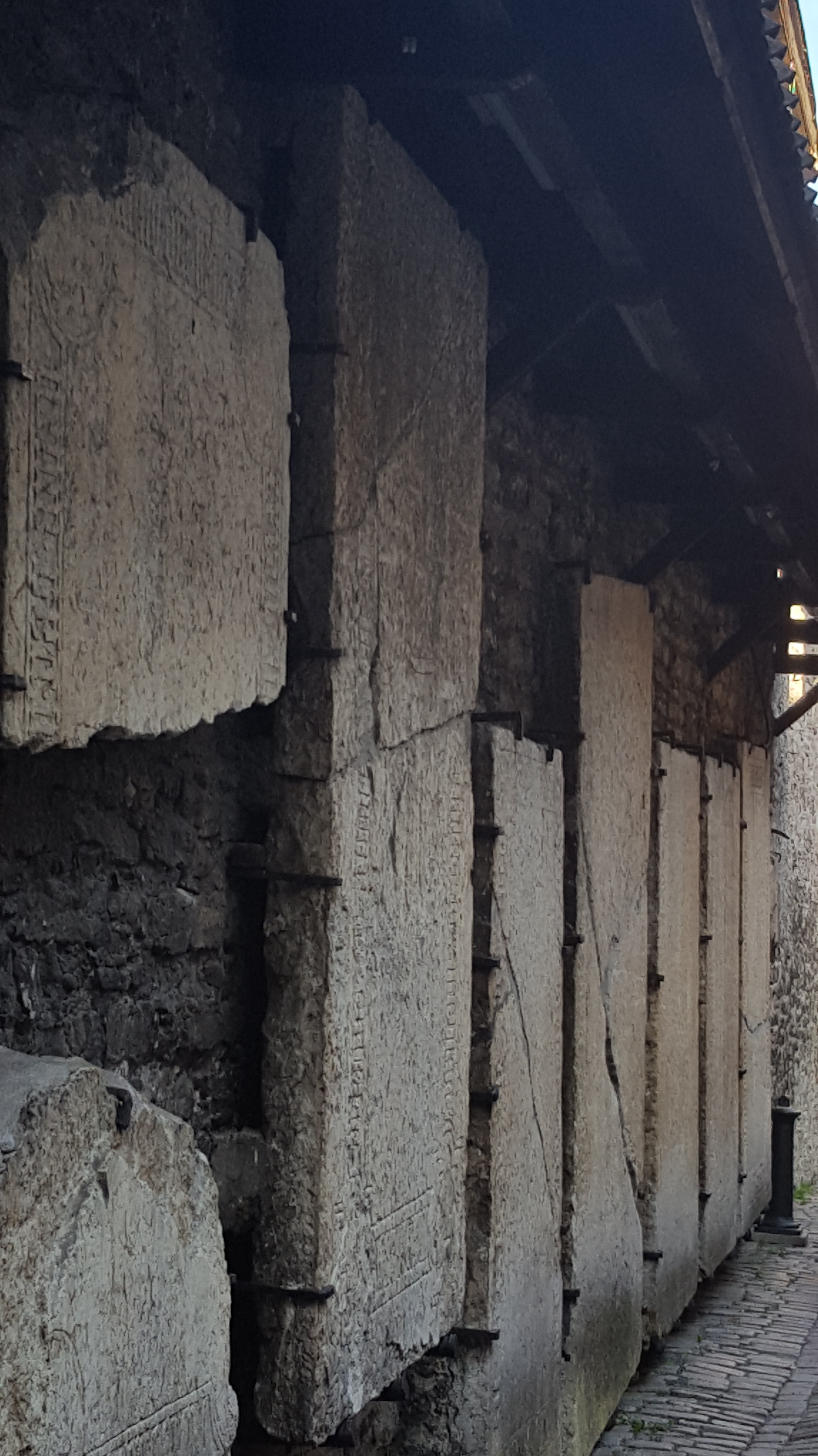
We visited several churches in Tallinn: the Alexander Nevsky Russian Orthodox Church (no interior photos allowed, but it was gorgeous), St. John’s, St. Olaf’s, St. Nicholas’, St. Mary’s and the Church of the Holy Ghost in the town square. But one thing that struck me as we walked down an alley was the gravestones tacked up in St. Catherine’s Passage, one of the oldest alleys in the medieval town of Tallinn. St. Catherine’s was originally an order of Dominican friars, and a church has been in this site since at least 1246. In the 16th century, a Lutheran mob destroyed the church and martyred the friars. The grave stones represent some of the earliest engraved stones in Estonia and are in one of the most charming streets to boot!
St. Petersburg, Russia: The Church of Our Savior on Spilled Blood
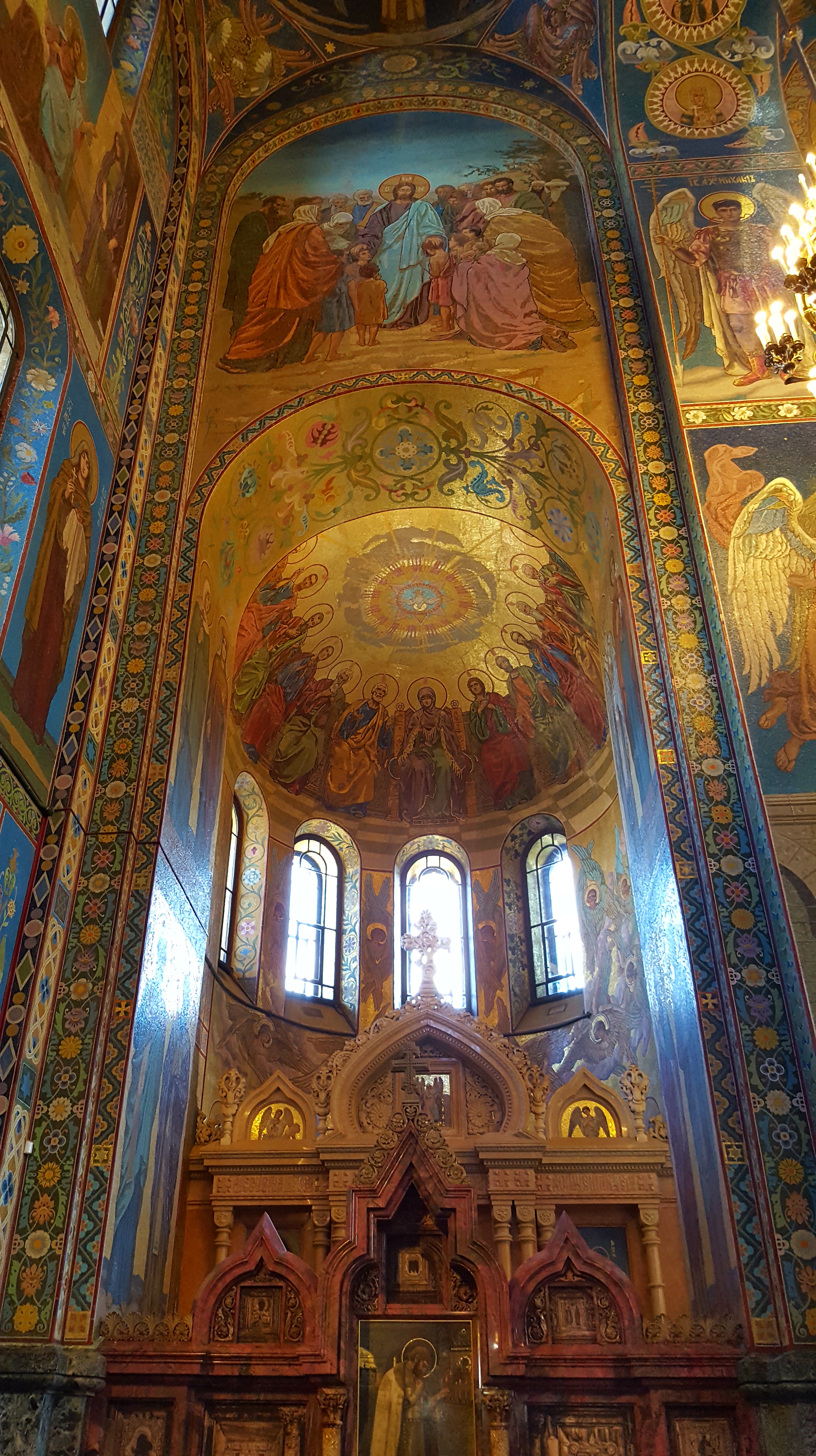
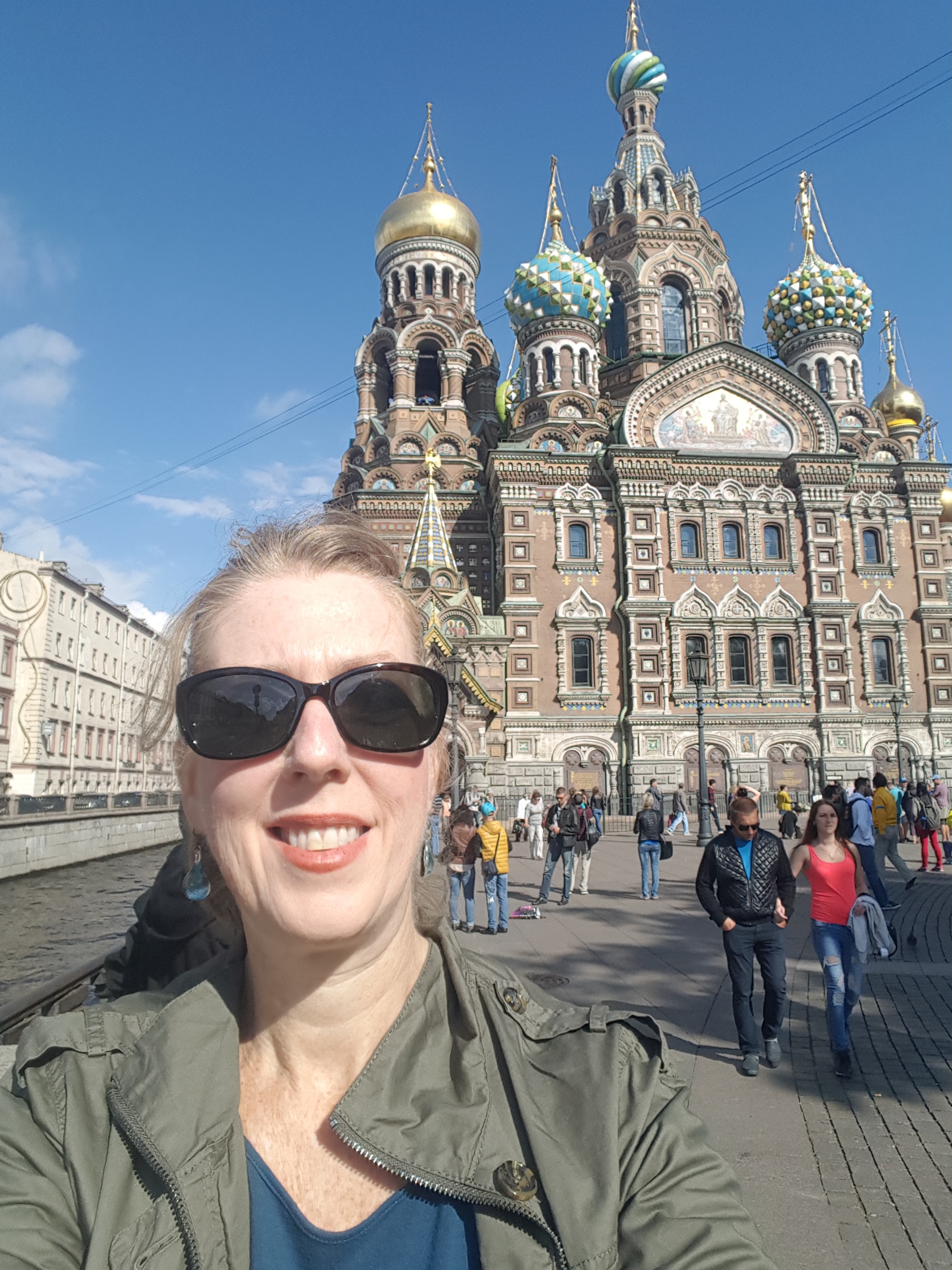
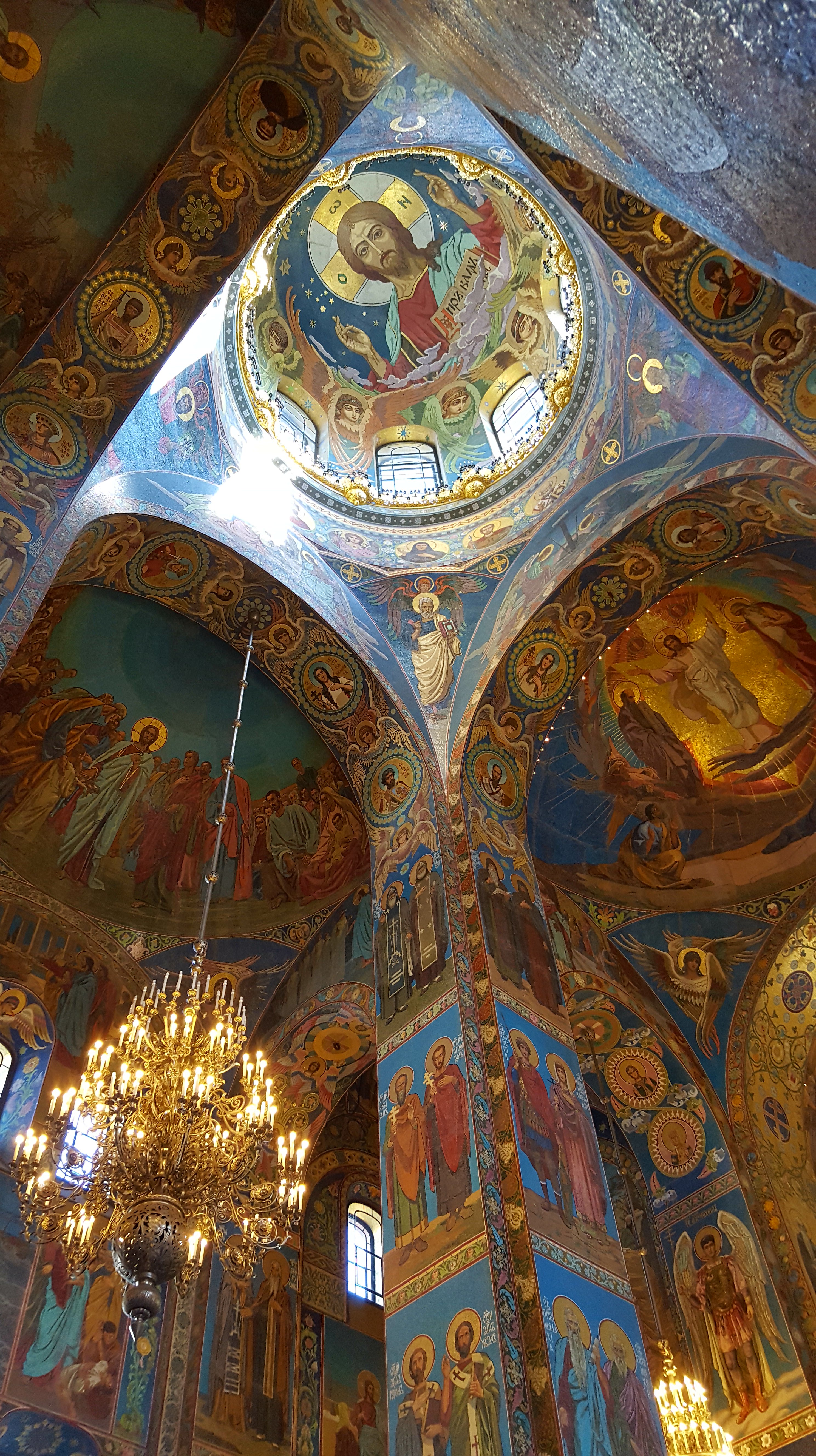

Every Russian Orthodox Cathedral is a work of art. We also saw the elegant Church of St. Peter & Paul where Peter the Great is buried along with other czars and czarinas. It was pretty amazing. But the most incredible site I saw during my trip, bar none, was the interior of the opulent Church of Our Savior on Spilled Blood. The exterior is a work of art, but nothing prepared me for the beauty of the interior. Every surface was covered with mosaics in vibrant colors and gold leaf. The architecture ensured that plenty of light filtered in, bathing religious art in splendor. I was speechless. This cathedral is a fairly recent construction, built between 1803 and 1907. The project was funded by the imperial family on the site of the fatal wounding of Alexander II in 1881. The church was ransacked shortly after its completion during the Russian revolution of 1917. It was used as a morgue during WW2 and a vegetable storage center after that, earning it the sardonic name Saviour on Potatoes.
It is no longer used for worship, although there are many Russian Orthodox churches still in use, including one we visited with our tour guide who informed us it remained in continuous use even during the decades of the Soviet Union. Photos are prohibited in active use Russian Orthodox churches, and women who worship must veil their heads when they enter (although pants are acceptable attire and female guests don’t have to cover their heads).

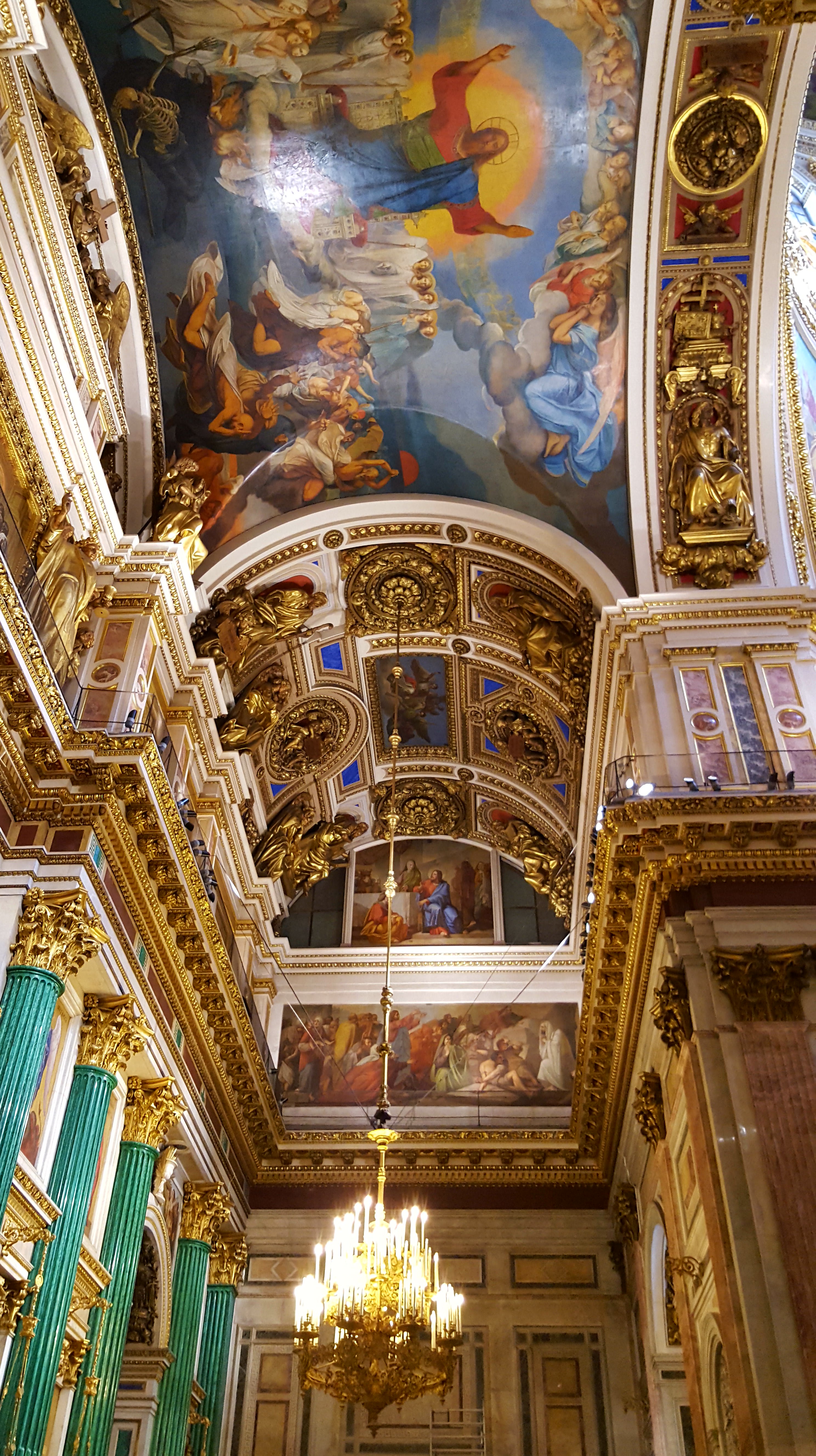 St. Petersburg, Russia: St. Isaac’s Cathedral
Like the Church of our Savior on Spilled Blood, St. Isaac’s was a masterpiece of religious art. It was larger and neoclassical rather than Russian medieval like Spilled Blood, but it was still awe-inspiring. Every surface was filled with images to contemplate, and the architecture created an interior that felt vast yet full of light.
St. Isaac’s is the 4th largest Cathedral in the world and is situated very near the square in front of the Winter Palace. It opened in 1858 after 40 years of construction. The Soviet regime stripped it of its religious trappings and in 1931 renamed it the Museum of the History of Religion and Atheism. After the fall of communism, the church resumed worship services in the left altar. The great dome honors the Holy Spirit, and a dove can be seen in its center, ascending or descending, depending on your perspective.
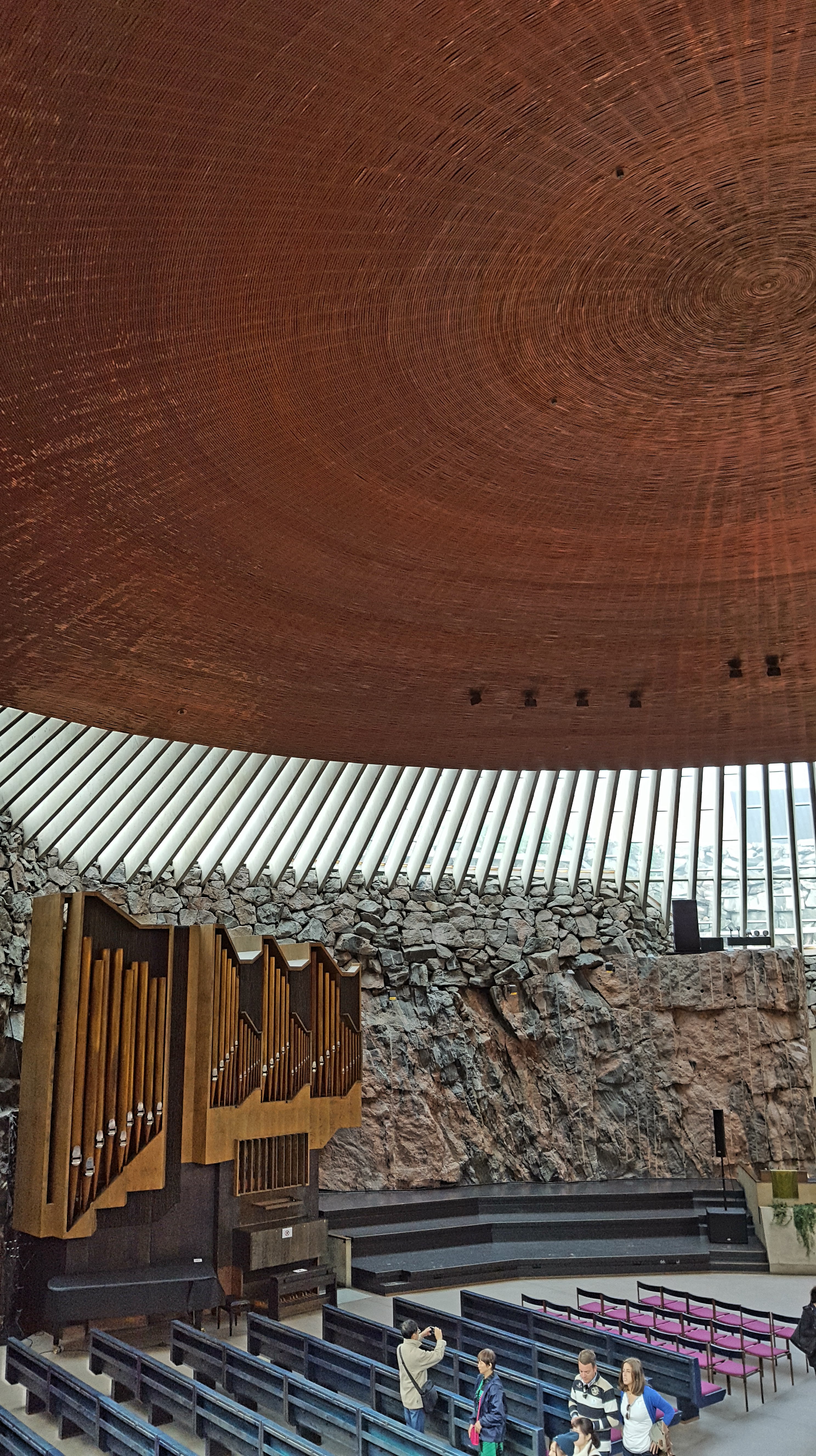
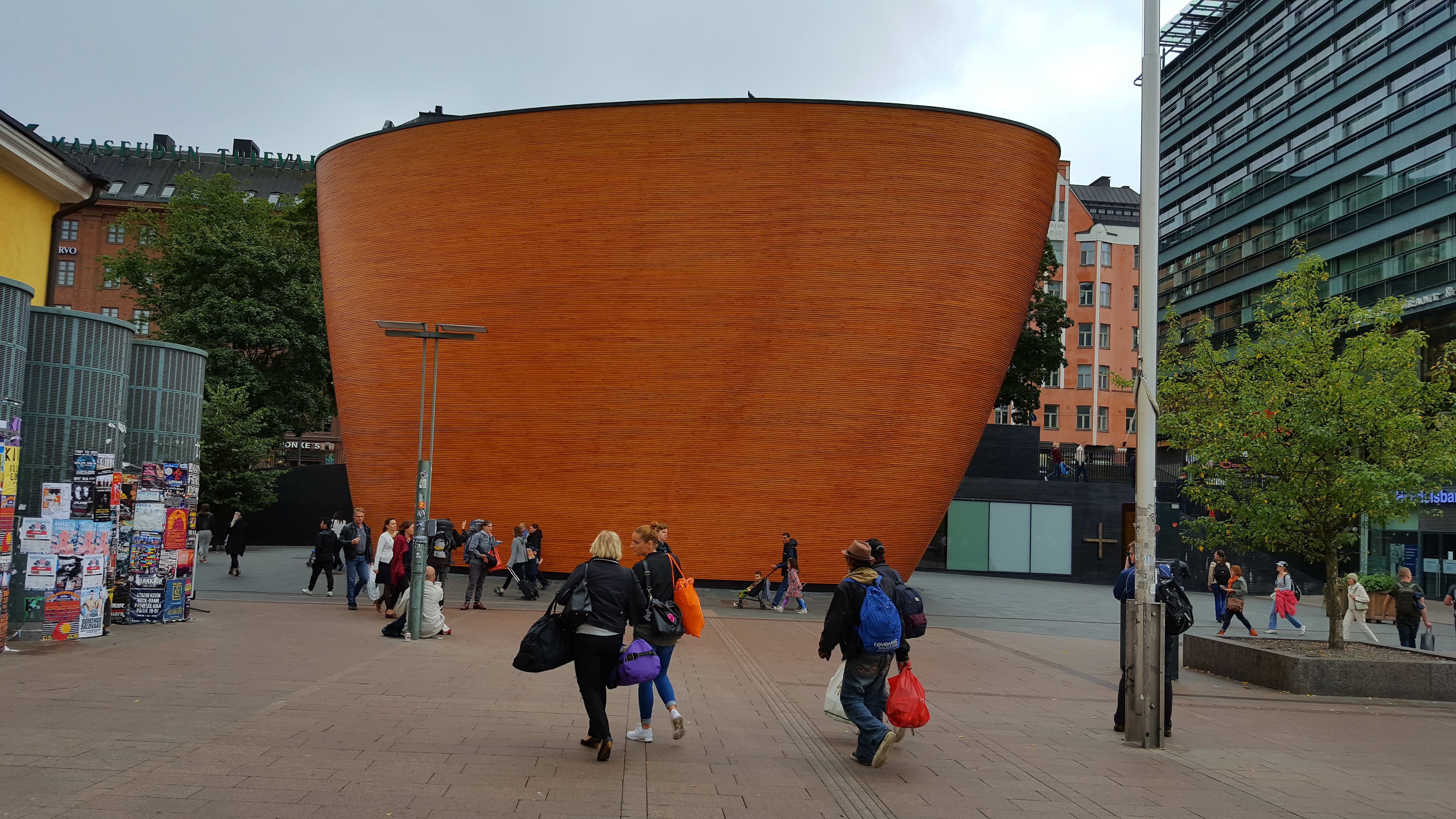 Helsinki, Finland: Church of the Rock & Chapel of Silence
Helsinki housed two of the most interesting churches we visited. While we also visited the Russian Orthodox Cathedral (no photos allowed) and the very large Lutheran Church (fairly barren after our Russian churches), there are two very unique and modern churches in Helsinki. The Church of the Rock, completed in 1969, is built directly in granite with rock walls surrounding the center seating and a domed ceiling made from a spiraled copper wire. The acoustic properties of the chapel are world class thanks to the surrounding rock walls and the copper dome. Lutheran services are held here Sunday afternoons. No services are held in the Chapel of Silence which opened in 2012. Volunteers staff it and are available for confidential conversations with any visitor who requests it. Located in the middle of a busy square, its sound-absorbing architecture offers a quiet sanctuary in a bustling city.


Stockholm, Sweden (again): St. Nicolas Church and the German Church
We spent most of our last day in Gamla Stan, the oldest part of Stockholm. The Church of St. Nicholas houses the amazing gothic statue of St. George slaying the dragon. It’s a pretty cool looking dragon, and I wondered how distracting it would be to see the dragon during worship services, although maybe that just keeps parishioners focused on the struggle between good and evil inside each of us (or more likely the political conflicts with the Danes over the centuries). This Church dates to the 13th century and is made of brick. The German Church dates to the 14th century, and is part of the Church of Sweden. What I found fascinating here was the German-influenced stained glass scenes of family life: a family surrounding a table to share a meal, a family working the farm, a family gathering as a loved one passes from this life. It was a real contrast from the loftier and more symbolic religious art in the other churches we saw, and the stained glass murals created a feeling of home and comfort, an integration of family into the church and church into the family.
Reflections
The familiar is always what’s comfortable, but a religious experience is also supposed to be about getting us out of our comfort zone, provoking us to overcome our base impulses and appealing to our better angels. Visiting these other houses of worship had me thinking about several things and how they alter our worship:
Art. The artwork differed so greatly from church to church and denomination to denomination. Medieval artwork was often used to illustrate the stories of the bible and help the masses visualize the teachings. Symbolic artwork (like the dragon slaying) created room for reflection, even if the sermon was boring. The family scenes in the German Church created a sense that the divine is involved in the domestic, not just reserved for Sunday worship, and that the family rather than the church is the center of life.
Most Mormon chapels have no artwork. My home ward had a picture of Christ knocking at heart’s door behind the choir seats, but I haven’t seen that in other LDS chapels. The focus seems to be on the pulpit and organ pipes, all of which are modern in design and not usually ornate.
Worship Theater. We usually think of the altar as the focal point of Cathedrals, but one thing that struck me as I visited many of the churches was the interplay between the organ and the pulpit, both of which were ornate affairs even in the somewhat stripped down Lutheran churches. The congregant watches from below as the preacher preaches God’s message down to them, and the organ responds to the preacher on behalf of the congregation, raising hymns and singing praises to God. Or maybe the congregants feel like they are watching an overhead tennis match. If so, I suppose their eyes are lifted up as they contemplate the interplay between divine and human.
The only theater I can think of that we engage in as Mormons is the need to perform the sacrament prayer perfectly. The young man who blesses it looks to the stand for a nod of approval, and then the sacrament can be passed to the congregation. In a sense it’s what the church is all about–older men mentoring younger men while the rest of us watch.
Patron Comfort. In Russian Orthodox churches, the congregants don’t sit. In the Lutheran churches, there were wooden pews. Some weeks I struggle to last 3 hours on lightly cushioned seats in our Mormon chapels. How does comfortable seating or lack thereof influence the length and nature of our worship services? Honestly, I don’t see anyone standing for three hours, regardless the type of service.
Modern vs. Ancient. Worshiping in a centuries old church is a sensation that feels almost like time travel. The smell of it is ancient, thanks to centuries of incense, smoke, candlewax, graves, and dust. It’s an earthy smell. It reminds us of the legacy of religion. Religion is usually inherited, often through multiple generations. Worship is a reminder that we are a link in a chain of devotees, usually within our own families, and also in our communities at large. In many of these countries, there was a historical state religion, so there is a form of nationalist pride associated with attending church. There’s also a solidity, an element of trust with a religion that has the backing of centuries as evidenced by the ancient building in which one worships.
But the more modernized, stripped down Lutheran churches introduced a new line of thinking, removing some of the pomp and institutional church from the worship and instead focusing individuals on Jesus more personally and less ceremoniously. The mood was decidedly different, and it felt more personal for some reason. The most modern churches take this idea even further, stripping away artwork and all the trappings of ceremonial form. Spirituality is found in silent contemplation in a beautiful but removed and unique setting. Within, one can commune with the divine in whatever way is comfortable and compelling for the individual. Worship becomes completely personalized and silent in these most modern settings. The architecture becomes its own metaphor for individualized worship. To quote E.M. Forster’s Mr. Emerson in Room with a View [pointing at himself with his dinner fork]:
“My vision is within! Here is where the birds sing! Here is where the sky is blue!”
As I think about our Mormon approach, to me it felt more similar to the modern churches than anything else. The spartan decor seems to say “bring your own spirituality and inspiration,” a very low church approach. Of course, to me that’s comfortable and what church looks like, but religious tourism is a chance to understand what worship looks and feels like to others. Seeing the opposite extreme in the Russian Orthodox Cathedrals, and watching the individual devotion as people lit candles and bowed, I had a twinge of holy envy. But it was wrapped up in the spirit of adventure and novelty of travel.
If I had to choose a place to actually worship, I would have picked the come-as-you-are Chapel of Silence of these options. An oasis in a busy square, it felt most familiar to me, the idea that you can step outside your life at any moment and connect with the divine or regroup before stepping back into the bustle of life. To me, that’s what faith feels like, the breath between actions, the silence between words.
Discuss.
 Wheat & Tares
“The familiar is always what’s comfortable, but a religious experience is also supposed to be about getting us out of our comfort zone, provoking us to overcome our base impulses and appealing to our better angels.”
Amen! Thank you for posting this. This reminds me of my time attending a Jesuit University. They maintained a nice garden and of course had a cathederal. I used to go to both, sometimes for more than an hour and just sit. Although reading this is not the same as actually same (or no where near as cool) as actually being in those places of worship, it did bring back fond memories for me, and I appreciated your thoughts on each place.
I love visiting churches and cathedrals. There’s a sense of worship, a sense of history, and sense of continuity over time. Of course many of our buildings here in Britain show the marks of our religious history, statues defaced, paint removed from walls etc during the reformation, giving us the plain stone interiors we see today.
Nate has some lovely photos on his blog, which I highly recommend.
Thanks Hedgehog!
I enjoyed this Hawkgrrrl, the Chapel of Silence looks beautiful. The more I’ve looked into the liturgies of the various churches, the more I feel drawn to more formal Catholic or Eastern Orthodox forms of worship. The “worship theater” you describe plays an important role in bridging the human and the divine, and I think this is very much the same spirit as in the LDS temple. If you imagine going to an LDS temple, and having the celebrant at the alter start by welcoming everyone in a very informal way, with a few jokes and random announcements, you can feel how this would cheapen the sacredness of the experience of the temple, which relies on extremely rigid formality and sacred austerity in order to create the appropriate atmosphere. When you go to Catholic mass, you see lots of poor people and immigrants, and they go to mass, not merely for traditions sake, or to be nourished, or reminded of their duty to God, or anything like that. They go because they have superstitious and transcendent ideas about communion, that it somehow connects them with God in a literal way, eating the body and blood of Christ. So it helps for the priest to be high up, somewhat inaccessible, celibate, standing in for the mystery of the Holy Trinity, rather than some jovial Protestant preacher encouraging good works.
Thanks for this. Very thoughtful.
It may be heresy, but I think there are parts of the world that have a special spiritual quality that one might sense. For me, Salisbury/Sarum in England is one of those–of course Stonehenge is located nearby. The cathedral at Chartres always makes me cry; it is such a testament to doing the best you can, and always getting up when you are knocked down. I have a friend who thinks the Sacred Valley near Machu Picchu is one of those places.
Not sure if it is still in use, but for a while LDS in Detroit,Michigan were attending in an old Greek orthodox building with a gold dome and everything. It was in a good location, so the church bought it–not sure if it was eventually replaced with a more standard building.
“I don’t see anyone standing for three hours, regardless the type of service.”
Some people think of football as a religious experience. I know attending U of U and Weber State games (as well as some other places) students stand for the entire game. I recently worked with some announcers in the tv booth and was surprised that they stood for the entire 3.5 hour game! (I had assumed they sat but was definitely wrong about that. Some games go well over 4 hours, especially if they are televised on national networks.)
Agree that there are some amazing religious buildings around the world. Have just been to Angkor Wat in! Cambodia, which is the largest religious complex in the world. I was amazed to find the inner wall of the main temple has the war in heaven engraved on it perhaps 400m long and 5 high. There did not seem to be a place to sit or stand to be preached to, more places to pass by, some to touch, and statues of buddah, smiling and otherwise.
Thanks for sharing. I was also in the Baltics this past summer, and saw many of these same amazing places, and also thought about how culture and religion have influenced each other in that part of the world–how people choose to engage with deity, the high church/low church dichotomy, etc.
I would add that the Helsinki LDS Temple contains some unique cultural influences. The décor has a distinctly Nordic flavor (think Disney’s Frozen), but more importantly, while the ordinances are the same as in any other temple, the Celestial Room is arranged in such a way that individual patrons have more privacy and space for quiet reflection. The furniture is predominantly winged high-backed, and not clustered into “conversation areas” as I often see at U.S. temples, but rather more separate and isolated. The result is a near-perfect silence, not even a whisper. Nobody talked to each other. I was there for a fairly long time, but no one told me to get out and make room for the next session (that has also happened to me at U.S. temples). It was a wonderful experience. I’m willing to bet that the famously introverted Finnish culture had something to do with this. Almost like a Mormon “Chapel of Silence”.
Don’t see anyone standing for three hours in our services? How about the mom who stands in the back rocking a fussy baby for an hour during sacrament meeting, then goes into Primary and organizes things and teaches Sharing Time twice and walks around giving 5-minute notice to teachers….is that not mere “standing” because she gets to walk around at some point, or is this yet another example of the invisibility of women’s work?
I’m an enthusiastic church tourist too, when I tire of the museum. One I appreciate for beauty is the Medici Chapel in Florence, where every surface is covered in marble or semi-precious gemstone panels and inlay. It’s jaw-dropping gorgeous. But not the most inspiring in Florence, for me that was Santa Maria Novella. I was familiar with a few of the very old and famous art works before I went there, but seeing them in the space they were created for, that was still in use for worship, brought a certain spirit of holiness that was most unexpected.
Geoff Aus – Angkor Wat is one of my favorites, too! Talk about grandeur of the past. It was a little unsettling to see the humble dwellings of the current culture on the temple complex side by side with incredibly sanskrit carvings and statues from the 1100s. And yes, I too enjoyed the richness of their creation story as well as the gateway with the row of demons on one side and the row of the heavenly warriors on the other, all holding the rope that was used to churn the sea of milk in the great war in heaven. Truly fascinating. I guess my favorite in the complex was the Bayon faces temple, although Ta Prohm is also cool with the trees growing on top of the buildings. Cambodia is one of my favorite countries.