

I recently had the opportunity to baptize a friend back into the Church. He had left about 25 years ago after encountering a good deal of anti-Mormon tripe. We’ve been friends for about seven years. Through honest careful seeking and nourishing his relationship with God he made it back. It was a great experience.
 [Not an actual picture from the baptism]
At the same time, I’ve a friend whose wife made contact with an old lover and started plunging into the same morass. Every bad, conflicting and contrary anti-Mormon account was suddenly new, fresh and definitely true. I knew the guy from when I was in apologetic circles. He had tried to interest her in everything he was in love with and she had always rejected any interest — until she hooked up with her old lover. He took it really hard that she would only show an interest in the material for her old lover and then only what he considered nothing but lies, poorly told. After I talked him out of suicide, we had a talk about some principles that seem to have helped him.
- It isn’t about you. Really, it isn’t. It is about her journey.[1]
- It isn’t about her old lover. Yes, when they argued, she always took the old lover’s side against her husband, which made him feel betrayed and rejected, but what she was really doing was taking her own side.[2]
- Like an alcoholic, you can’t work her program for her, you can only work your own. [3]
It isn’t about you. It may feel like it. After all, she had heard him bear his testimony, knew he served a mission and the implication is that she has decided his is a hypocritical liar and fraud. It isn’t that. What is usually up is that people have their own journeys and their own problems. They aren’t rejecting others, they are rejecting things in themselves.
It isn’t about someone else. Ok, sometimes it is. Sometimes it is tied to someone becoming generally unfaithful. But usually it is about what they are finding in themselves. It is like arguing Thoreau. Most people who read Thoreau don’t embrace what he actually wrote but instead embrace what they’ve found of Thoreau in themselves. His work acts like a large Rorschach ink blot. When they defend what they have found, they are defending themselves. Often their pain, their confusion and their own issues that they are acknowledging.
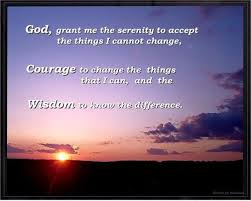
You can’t work it for them. While there is an entire movement (Al-Anon) to teach spouses of alcoholics that that they cannot control others, as a parent or spouse it is easy to lose sight of that rule. But you can’t fight their own internal spiritual battles for them, you can only work with yourself and love them.

Oh, and a last point Suicide is not an answer. It isn’t. He saw himself losing everything. His family, his plans for retirement (he had hoped to serve missions), future church service and his wife. He was consumed with despair. It helped that I am older. I’m going nowhere in the Church (hey, I’m almost sixty and an assistant ward librarian and high priests group instructor). All I’m really good for beyond what I do is to set up chairs and do some home teaching. But I can do that. I can be kind and love others. So can he. As for other things, well, there are other ways to be kind and to help and serve others.
Both my friends are doing better. The one bore his testimony and it really made me feel good to hear it. I’m sad his moving from DFW, but I can still follow him on Facebook. The other seems calmer now and has some hope. He has decided to just love his wife with kindness and patience, and without expecting it to do much more than make her life more supported.
And that is what I have to say about faith and faithlessness in the Church
 Wheat & Tares
Great principles. And, FWIW, if you can teach the high priests anything, you are definitely going somewhere.
While I don’t doubt that your advice was helpful to your friend, I am very uncomfortable with your comparison. My father is an alcoholic. Putting questioning mormons in the same category as alcoholics does not sit with me very well at all.
Dealing with a spouse who is not on the same path as you are is very painful for those of us who are active LDS members. The church is so geared towards family that any deviation from the husband/wife/children all active and sealed together living happily ever after for all eternity leaves one feeling unsatisfied and with a sense of missing something. I can relate to your friend on that level. It comes down to evaluating your own perspective and realizing that we all individually have to make it back to the presence of the Father on our own regardless of whether our family members do or not. Not one person can be dragged there on the coat tails (testimony) of another. As to the comment about callings of responsibilities I have never had any callings in that category either. Frankly,I enjoy being a small worker bee or drone in the beehive of church callings. I do not aspire for anything other than serving the Lord at least in some way that is needed.
Anonymous, it is similar in the amount of control you have, obviously different in other ways.
BTW, I see glaring typos. I’ll try to get them fixed when I get home tonight.
It’s unclear from the way its written – did the wife have an affair with the old lover? or just talk religion with him.
Also, what was it that the first friend encountered that made it be classified as “tripe” and “anti mormon”?
As far as I know it was just talk.
Some anti stuff is better than other. This was pretty bottom feeder stuff.
Of course that is how I generally view anti material.
Regarding your second friend, I have personally known a few and read many similar stories from blogs and message boards, but from the perspective of the non-believing spouse. The non believer often expresses exasperation that their sudden change in belief, which they neither expected nor sought out, has become a stumbling block in their marriage. The believing spouse does not want to understand their new beliefs but is only interested in fixing them. Disbelief is treated like unfaithfulness in the marriage that, if not corrected, will lead to divorce. If only their spouse could see what they see (that the church is not true), they would have a happy marriage, but their spouse is not interested and shuts down as soon as any “anti-mormon” topic is raised.
A lot of the advice in these cases is geared towards helping the believing spouse “wake up” and leave the church. (“Have you shared the CES Letter with them?”) But the wiser (in my view) advice calls instead for respecting individual autonomy and unconditional love, which seems to mirror a lot of the advice you gave to your friend.
So although I disagree with some of your underlying assumptions about why people leave the church, I very much support your approach. It’s not about trying to manipulate other people into doing what we want them to do. A mixed-faith marriage is always going to be difficult. But it’s much more difficult when one party is focused on fixing the other.
I’m not trying to define why anyone has the journey they have. Just that it is their journey, not yours. When they leave the church they do it for their own reasons, not yours. When or if they return it is their journey, not yours.
Now many people do feel betrayed by fate, if they had wanted a mixed faith marriage they could have had one. But that is not betrayal by the spouse.
The first friend was referenced for perspective and literary contrast.
BTW, how often do the spouses that lose faith feel suicidal? It seems common on the other side and I’m curious how it is from your perspective Joel?
Stephen, great story, and good luck in his return to the Church. You were fortunate to be the one to perform the BAPTISM (technically, there is no ordinance of RE-Baptism, though I recall that one’s ORIGINAL baptism date is kept on the Church records, I served as a ward membership clerk back in the 80’s and didn’t have to deal with a ‘re-baptism’ during my brief tenure.
You are right, and contrary to what Johnny Mandel and Mike Altman asserted in their M*A*S*H movie theme (“Suicide is Painless”), it ISN’T painless, though we can but speculate for the one that takes his/her own life. It’s certainly painful for the families and friends, for if nothing else there comes a round of ‘second-guessing’ as to how they could have intervened. I’d hope that anyone who has suicidal thoughts would consider not the ramifications not only for themselves but also for their loved ones. This is not to accuse suicides of being selfish, however, the psychology is very complex and to attach a perjorative label to the victim is insensitive, if not downright mean-spirited. At least many are waking up to this idea. I remember in the Disney World “Haunted Mansion”, that after the “Ghost Host” would declare, “There’s always…my WAY!”, then the room darkens, and we see the body of the “host”, still hanging from the high ceiling, and the TALKING Raven exclaims, “He chose the coward’s way out!”. The Raven part has been thankfully excised.
Great information and advice Stephen!
I’ve seen some people become suicidal after losing the faith. It’s often related to them losing their family and community, which they may in part be responsible for. It is a traumatic event for both members of the marriage, and can feel like a death. The believing spouse is experiencing the death of their eternal family. The non-believing spouse is experiencing the death of their former beliefs and identity. And these things can be quite fluid, so it’s best to give people time to work through them. I agree with you about the importance of allowing other people their own journeys. I know a lot of parents feel immense guilt if their children stray from the path.
Joel and Steven -the entire mess of one spouse losing faith is tough. Death is a good comparison. More than religion is lost. Camaraderie, sameness, safety, trust. Both parties grieve deeply and at this present era it is nearly impossible to move forward as a team. The normal dark night of the soul doubles. As a church we don’t talk about people having individual journeys, all journey’s are a group journey – any thing less is deeply less. As my spouse now likes to quote, “No other success can compensate for failure to be a full Mormon.” Parents have guilt, spouses feel betrayed, trust in people and organizations is lost and walls that are nearly unscalable pop up in an instant. Relationships are strained, conversation that once were easy are now painful or non-existent. Fear, loss, and anxiety are constant companions. So Suicide – totally on the table. Everything that once was is lost. Why live, why try and how do you try anyway, it’s all gone. Those are the parameters that meet marriages when a once believing spouse has a change in their journey.
Thank you for the comments and insight.
“many people do feel betrayed by fate, if they had wanted a mixed faith marriage they could have had one. But that is not betrayal by the spouse.”
Wow. Astute and beautifully put.
I have a friend whose husband has lost his faith and she describes it as a bomb being dropped in the middle of her house but not going off. So much fear and anger and tiptoeing when your life always has a ticking bomb in it. She lately said she has learned to love the bomb when she learned that the worst that could happen (him leaving) – she could still love that life – so she decided to love the bomb.
Or, with anger, a bomb constantly going off.
Thanks for keeping the comments civil and in line.
Anon says in #2, My father is an alcoholic. Putting questioning mormons in the same category as alcoholics does not sit with me very well at all.
I had to think through this one as well. As the child of an alcoholic parent myself, I think the reason this is a good analogy is because (Stephen, correct me if I miss the boat) it doesn’t equate questioning members to alcoholics. Stephen isn’t trying to show that they’re addicted to anti-Mormon lit, or anything like that. He’s merely saying that they’ve embarked on a course which is damaging to their relationship (objectively true, no matter the truth or falsehood of the faith claims at question).
More to the point, he’s equating the partner of the questioning Saint to a member of Al-Anon. As a veteran of Alateen and Al-Anon, one of the things you learn is that you can’t fix or change the other person. This is good advice whether the other person is drinking (my dad, when I was a kid) or whether she never cleans up the kitchen after cooking dinner (my wife). You can only deal with your own reactions and feelings, and learn to find peace – serenity – for yourself independent of what the other person does.
That is an extremely difficult task.
So, in short, we’re not equating doubting Saints with alcoholics. We’re equating all of us, in essence, with those who have to live with others who make decisions and choices which cause us pain. God grant us, indeed, the serenity to accept the things we cannot change, and the wisdom to know the difference.
Exactly.
It seems like before God answers you , if at all, you have to go to burn out to get an answer. Is this what he wants? It seems what the brethren and Brad Wilcox are saying and what the lived experience are sometimes different and people get confused and can’t even begin to think about how to run their life and you burn out and go down in flames