

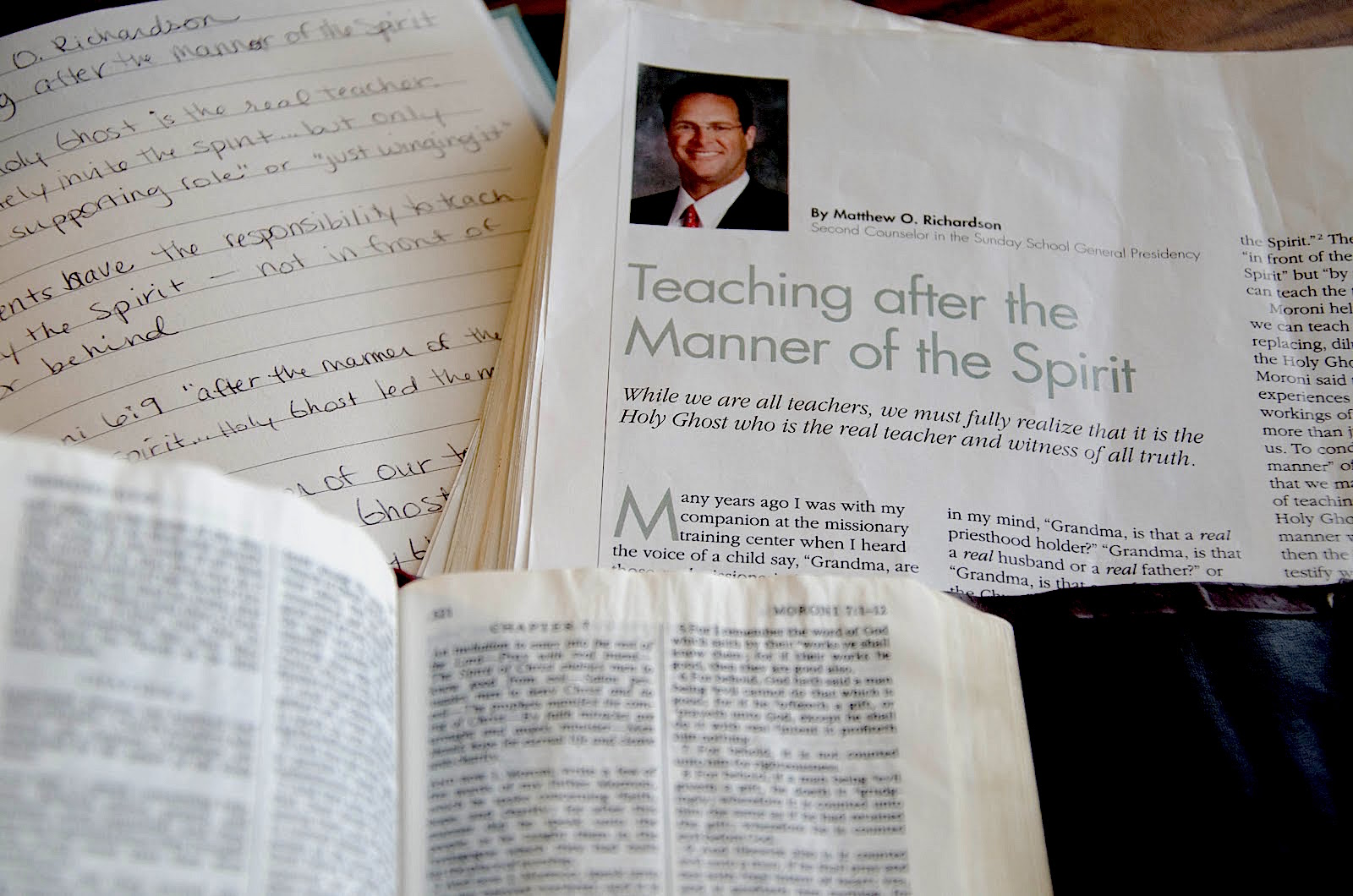
 This is a guest post from Ryan Lane:
I enjoyed reading Hawkgrrrl’s recent post on “Talks on talks.” I too am concerned that the scriptures are getting displaced by General Conference talks. I have heard church members say that Conference talks are more important than the scriptures, because Conference talks are the words of living prophets. Many Mormons, including me, have found the words of various Conference talks to be God’s words for them. Yet, I believe that Conference talks are not equivalent to scriptures. Scriptures are a different genre, and teach in different ways from conference talks. Here are some reasons why I keep returning to the scriptures.
The scriptures are a record of our story. If we forget what God has done for us and our forefathers, then we forget God. For centuries the stories of the scriptures have shaped, defined our collective faith. Without the words of the scriptures to anchor us, our religion will be lost as quickly as a message in a child’s game of telephone.
The scriptures contain covenants and ordinances. These days we hear many talks in church emphasizing the importance of covenants and ordinances. Yet the actual ordinances and covenants are not written in Conference talks, they are written in the scriptures. These include not only personal ordinances and covenants like baptism and the sacrament, but also the big overarching covenants of God with humanity. These include covenants with people like Noah, Abraham, Jacob, and Moses, and the New Covenant that was initiated by Christ. Dietrich Bonhoeffer said that Christian prayer is grounded in the promises of God (Life Together, Chapter 2). How can we know these promises if we haven’t studied the scriptures?
Scriptures contain prayers. General Conference includes prayers, but these function to open and close the meetings. They are not included in the Conference reports, and are not studied by church members. By contrast some of the most important words of the scriptures are contained within their prayers. Perhaps the most notable prayers in the scriptures are the prayers of Jesus and the Psalms. I pray Lord’s Prayer and the Psalms. This frees me from the obligation of thinking up my own words and helps me to better internalize the words of God.
The scriptures contain contradictions. Contradiction and paradox is a fundamental feature of the human existence and human faith. The scriptures are a complicated dialogue with many voices and perspectives. The gospel is not a well-ordered series of principles and doctrines. Rather, it is an evolving story of a relationship between humankind and a remarkable personality who we call God.
 The scriptures teach us that prophets are human. Prophets are products of their time and place. Prophets in the LDS scriptures had an unfortunate tendency to espouse violence, racism, and even genocide. This reflects the culture and values of the times in which they were written. The scriptures are full of humanity and were written according to the “knowledge” of the prophets (1 Ne 1:3). Moroni said that we should not “condemn” the prophets because of their imperfections, “but rather give thanks unto God that he hath made manifest unto you our imperfections, that ye may learn to be more wise than we have been (Mormon 9:31).
The scriptures remind us that we are often wrong. For my formative years I was taught and believed that the scriptures were literal history. But since then my thinking has changed dramatically. For example, I now believe that humans evolved from animals and that Native Americans came from Asia over 10,000 years ago. I’ve come to believe that the scriptures are true, but they are not always factual. This doesn’t decrease their worth, but rather increases it. We need to be reminded of the dangers of using religious text to infer factual knowledge. This reminds us to be humble and open-minded.
The scriptures teach moral responsibility. Sometimes they do this by showing us how we don’t want to be (see the section on violence). Rules, principles, and doctrines have a tendency to come with expiration dates. But stories have a way of teaching moral truth that is timeless. I believe that for fully-developed human adults, true moral responsibility is not ultimately defined by a set of fixed rules. I believe that morality is inherently contextual, and therefore can only be taught and understood through stories and experiences.
The scriptures teach a universal faith. I have a pastor friend who is fond of saying “When the Bible says all it means ALL”. It might surprise you to review how many universal promises are made, even in the Old Testament. The Book of Mormon teaches that “all are alike unto God”, and Paul teaches that in the gospel, “in Christ Jesus … there is neither Jew nor Gentile, neither slave nor free, nor is there male and female, for you are all one in Christ Jesus” (Galatians 3:26-28). The scriptures, for all their shortcomings and human failures, are remarkable in the fact that they teach a gospel that transcends all the ways that humans divide themselves up: like gender, race, nationality, religion, etc. In my mind, perhaps the greatest evidence of the truth of the New Testament is the miracle that people living in the cruel and “primitive” time of the Romans could set a standard of tolerance and love that we still struggle to live up to today.
The scriptures describe how Jesus lived, worked, taught, and prayed. One re-occurring theme of the gospels is that it’s difficult to put Jesus in a box. While he was on earth, even the Apostle’s don’t fully understand who he was and what his mission was about. He has a way of surprising people and challenging their religious priorities. Jesus is not a political cause or a set of religious obligations or principles; he is a person. The best way to remember this is to read what he actually said when on earth. When we do this, we might find ourselves surprised and perplexed by him, leading us to learn more about him.
The scriptures are the foundational text for (probably) all of the greatest talks that have been given by the General Authorities. Why not read the original text too? Once I went to a Regional Conference, cynically expecting there would be more quotations from General Authorities than from the scriptures. For most the meeting I was right, and General Authority quotations were leading scriptural references. But the last speaker, Elder Oaks, had so many scriptural references that he turned the count of the entire meeting in favor of the scriptures. My conclusion was that if you want to talk like an Apostle, use the scriptures.
 The scriptures are leather-bound. Scriptures are permanent, and meant to be preserved for all time. Conference talks come in a magazine; they are more contemporary and transient in nature, being replaced or updated every six months. As we move to digital devices this difference in formats is becoming less apparent. Perhaps this homogenization of media contributes to the growing notion in the church that scriptures and Conference talks are interchangeable. I think this is why I like to carry my old leather-bound scriptures to church, as a reminder of the “olden days” when the church experience was more scripture-based.
Because the scriptures are so old, it is easy for us to see that they are messy, complicated, contradictory, and full of humanity with all its shortcomings, weaknesses, problems, and mistakes. Yet the miracle is that they are God’s Words. Sometimes, when I have Spirit with me, the words of the scriptures come alive for me and I understand new things, at a higher plane. God is taking a message from the book and writing it onto my heart, transforming me into a new person. The scriptures are the Word of God, not because of their doctrinal purity, but because they lie at the intersection of human weakness and divine transformation.
 Wheat & Tares
Some great points here Ryan. In a way, it is sort of strange that our scriptures are so random and non-cohesive. I think the Koran is quite different, from what I’ve heard, more of a collection of cohesive teachings. But the standard works are these unwieldy, monstrous histories that are impossible to really grasp fully, even after a lifetime of study. You would think that a religion like ours, which values correlation so highly, would not trust its members to really study the scriptures. After all, Richard Dawkins thought the best way to create atheists would be to have them read the Bible, and then it would be obvious how idiotic religion really is. Yet somehow, when we dive into them, we experience something which draws us closer to God, not further away from Him.
Thank you Nate. The shear size of the bible can be overwhelming but sometimes we LDS people try to bite off chunks that are too large. Like in gospel doctrine we try to study several chapters during a single lesson. By contrast, Bonhoeffer used to make his divinity students ponder just one verse of the bible for an entire day. When we ponder or memorize just a verse or two it really sinks in, and we internalize it better. Perhaps memorization of scriptures is becoming more rare in the church?
I really like your insight about the humanity in the scriptures and the contradictions. I sometimes hear that there are contradictions and humanity in the Bible (because, you know, it’s truth only so far as it’s translated correctly), but with the Book of Mormon AND the Bible, you could know the truth–they help to clarify each other. I have always disagreed with that. I think when you put them together, there are even more lovely contradictions and even more humanity. It’s in the humanity that I feel reassured that God can work with imperfect people.
Why wouldn’t conference talks be expected to show the same humanity and contradictions?
I’d also agree conference talks are not scripture. A couple of years ago I expressed this in Sunday School, and the teacher fought back hard, and conceded perhaps I could consider them “scripture-lite”, but was not prepared to drop the scripture appellation altogether. When I expressed a similar view at home recently, my husband checked the handbook, and conceded that I was correct in my definition of scripture.
Handbook 2 17.1.1
“The standard works of the Church are the Holy Bible, the Book of Mormon, the Doctrine and Covenants, and the Pearl of Great Price. In many languages, the Church has approved one edition of the Bible to be used in Church meetings and classes. Likewise, the latest authorized edition of the other three books of Latter-day Saint scriptures should be used. No other works are to be promoted or used in the Church as scripture.”
Thanks very much for the information from the handbook. It is a nice quote to have. However, if you look up the definition of “scriptures” on lds.org you get a definition that implies that could be used to imply that Conference Talks are scripture:
What are the scriptures?
When holy men of God write or speak by the power of the Holy Ghost, their words “shall be scripture, shall be the will of the Lord, shall be the mind of the Lord, shall be the word of the Lord, shall be the voice of the Lord, and the power of God unto salvation” (D&C 68:4). The official, canonized scriptures of the Church, often called the standard works, are the Bible, the Book of Mormon, the Doctrine and Covenants, and the Pearl of Great Price.
https://www.lds.org/topics/scriptures?lang=eng&query=scriptures
However, the D&C scripture also applies to missionaries. Indeed, I was introduced to that scripture at the MTC by Joseph McConkie who told us to go back to our rooms that night and write some scriptures of our own in our journals!
It just goes to show that gospel terms rarely have exact definitions. I guess the handbook trumps lds.org, though.
Also, I think that your handbook quote also means that technically my New Revised Standard Version of the Bible is not scripture, though I use it often at home and at church!
Is the Handbook scripture?
Ryan, I think we can consider other Bible translations as scripture in the sense that they are for other denominations, even if they are not regarded as official lds scripture.
Kullervo, no the handbook isn’t scripture, but usually it’s seen as having the final word on a query of that sort.
So it’s a higher authority than scripture?
Ryan,
Thanks for this thoughtful post. I think that the point which touched me most was that the scriptures should surprise us! They should be challenging, difficult, and difficult to understand. I think this matches the injunction to become as a child. Most importantly, that humbling experience leads us to God, the only source of truth.
Ryan, are certain scriptures ‘more valuable’ than others? At least for LDS, the Lord personally specifies that we are to SEARCH the words of Isaiah (3 Nephi 20:11, 23:1-2). Nephi explains how to read Isaiah (1 Nephi 19), and of course Nephi and Jacob think Isaiah’s words are interesting enough to quote and expound for most of the Second Book of Nephi. Abinadi, Matthew, Paul, Peter, John…the list goes on. I think you could argue that there is NO more important work to read than Isaiah.
While we’re talking translations, however, can I recommend a ‘new’ translation of Isaiah that has meant a lot to me? You can find it here: http://www.isaiahexplained.com/. Gileadi, the author (studied under Nibley), brings out Isaiah in its poetic richness in a way that does not exist elsewhere. I highly recommend it for anyone.
Yes, the handbook is actually a higher authority than scripture, at least concerning the administrating of official church policy.
Is the Handbook God’s word?
The brethren would probably say that its more “God’s will” than “God’s word.” It’s a rather inelegant, legalistic document. But it keeps the priesthood in line with top leadership, which is a manifestation of Christ’s admonition: “if ye are not one, ye are not mine!”
That’s an interesting question, Kullervo. I haven’t read much of the handbook. But it seems to me that as with Conference Talks, it’s a differen genre than the scriptures. It’s a handbook of instructions about how to run the church. It’s not devotional reading, right? We read and search and study the scriptures each day to know how to approach God. The handbook doesn’t replace this function, right? I think it’s good to follow the handbook. But it’s kind of like as missionaries we had our “white handbook of instructions”. We followed the rules, but I never thought of it as replacing scriptures.
Incidently, I know this is weird for Mormons, but I have a copy of the Book of Common Prayer, which is basically how to run an Episcopal Church. It has many prayers and devotionals that you can use in daily life, including all the psalms. It also has the words for all important ceremonies (or ordinances as Mormons would say): healing, Eucharist (Sacrament), ordaining priests, consecrating churches, liturgies for holy week, baptism, marriage, etc. It is a wonderful book because it has been developed over centuries so it is very well thought-through. Beautiful prayers for all sorts of situations and circumstances. I use one of the prayers for my blessings on the food now because it is lovely and well written. I’m not sure what the counterpart of this book would be in Mormonism, maybe the portions of the handbook that have instructions about how to perform ordinances. But the Book of Common Prayer is much thicker; it is several hundred pages.
Thinking about the scriptures in the light you have cast on them, Ryan, helps me make sense of things that have been uncomfortable to me in the past, like Israel playing favorites or Jacob wearing fur on his arms to impersonate Esau. In that sense the scriptures tell us the stories of how God has worked patiently through imperfect humans (and imperfect translations/scribes) who were just trying to do the best they could to do His will. In that sense, however, I feel the words of modern prophets are no more perfect than ancient ones and even conference talks are not immune to contradictions and paradoxes, perhaps the most important being the ways in which the speakers themselves are capable of falling short of their own messages, as is (even more) true of all of us. But that doesn’t mean those messages shouldn’t be given just as much as the uncomfortable stories in the Bible shouldn’t be explored. I agree that the scriptures and modern teachings are different genres and both should have a place in our worship and learning. The prophets in our time as well as times of old “open the scriptures to [us]” and help us know how to best apply them in the setting of our culture, times and society. Perhaps that’s why their words get emphasized in our meetings, perhaps they are easier to understand. But it absolutely behooves every member of the church to go beyond that and feast on the scriptures for themselves- regularly and deeply- and seek the living Word through the Spirit and prayer, something I’m sure we could all do better.
Hi Weak Servant,
I didn’t notice your comment until now. I have been reading Gileadi’s translation and his book, and I think they are fascinating. The way he connects Isaiah to other books of scriptures is fascinating. His book opens up the text for me in new ways. When I was in graduate school about 10 years ago, I wandered into a bookstore and purchased my NRSV bible. I began to read Isaiah and I couldn’t put it down because it was so fascinating to read in language that I could understand.
Yes, I agree that some scriptures seem to be more important than others. I’ve been studying the epistles of Paul a lot in recent years. He says a lot of things that don’t “sound LDS”. And I find that fascinating. I think of him as kind of a “Maverick” apostle, arguing with Peter and apparently insisting that he was preaching the gospel before he even met the other apostles. I’m also fascinated with the Psalms these days.
You raise some interesting points. I like the fact that you point out the humanity, contradictions, and imperfections that the scriptures illustrate. I find those stories reassuring for myself and for my understand of how God interacts with modern day prophets and apostles.
I guess one of the things that I think that we should consider is that most people in the history of the world didn’t have scriptures as we have them. The people of the Old Testament didn’t have an Old Testament, they had the writings and teachings of various contemporary prophets and those writings that had been handed down and existed long enough for groups of people to start putting them together as a collected book of sacred writings. The people of the New Testament didn’t have a New Testament. They had various letters and sermons that the leaders of their day gave them. Eventually they were collected into a book that was considered sacred. In both of those processes much was left out as decisions were made about what to include and what to exclude. For those who believe in the Book of Mormon, it didn’t exist in that form for the people who lived it–they simply had the writings and teachings of their contemporary leaders and writings which had been handed down. Eventually these were put together in a book that was considered to be sacred. What makes us different than those ancient people, other than more time has passed for more sacred texts to be gathered up?
So I guess that ultimately it comes down to whether a person believes that living apostles and prophets have as much authority as dead ones. If we do, then we have to turn to Paul’s statement in 2 Timothy 3:16, ” All scripture is given by inspiration of God, and is profitable for doctrine, for reproof, for correction, for instruction in righteousness.” (We should note that at the time Paul wrote those words his letter wasn’t even yet considered part of the scriptures as it is today.)
I guess a question we have to consider is if we believe that the patterns of how God dealt with man anciently in those books apply today, or if we should just be grateful that we have wise old books to study, ponder, and give us insight that has stood the test of time.
That’s a good comment Doug. Scriptures have had many forms over the years. But I do think that the prophets of the scriptures were obsessed with their scriptures. Like how the Book of Mormon prophets are constantly quoting the book of Isaiah and the Psalms. The big idea of the Book of Mormon is that the words of the ancients are exactly what we need to hear today. Many Book of Mormon prophets tell us that they have seen our days. President Benson said that the church was under a curse because we didn’t pay enough attention to the Book of Mormon. What is it about these old scriptures that are so important?
Maybe the dead prophets are important because they can get away with saying outrageous things that we need to hear. For example, take Mormon 8:35-38. Moroni says:
35 Behold, I speak unto you as if ye were present, and yet ye are not. But behold, Jesus Christ hath shown you unto me, and I know your doing.
36 And I know that ye do walk in the pride of your hearts; and there are none save a few only who do not lift themselves up in the pride of their hearts, unto the wearing of very fine apparel, unto envying, and strifes, and malice, and persecutions, and all manner of iniquities; and your churches, yea, even every one, have become polluted because of the pride of your hearts.
37 For behold, ye do love money, and your substance, and your fine apparel, and the adorning of your churches, more than ye love the poor and the needy, the sick and the afflicted.
38 O ye pollutions, ye hypocrites, ye teachers, who sell yourselves for that which will canker, why have ye polluted the holy church of God?
Now, if I were to interpret this scripture by saying that it applies to Mormons, or to a certain type of Mormon, it would be extremely controversial and politically polarizing. People might think I’m an anti-Mormon. Or they might decide the church is evil and stop believing in God and start smoking marijuana, drinking beer, and parking in handicapped spaces. The point is that the argument would become political in nature. It would contribute to the dangerous idea that what distinguishes the righteous and wicked are their political convictions. This idea is dangerous because it leads to “holy wars”, tribalism and the neglect of personal repentance and transformation.
By contrast, when a dead prophet says such outrageous things, it is more ambiguous. Who is the dead prophet really talking about? Is it me? Is it you? We don’t really know for sure. Many won’t even notice the scripture, and won’t care about it. But the humble seeker of God can quietly contemplate it and maybe the Spirit can help her work out what it means. If the Spirit is working with the person she will interpret the scripture with peace, tolerance, love, and understanding. By using the dead prophet, God has found a way to deliver a message that couldn’t be delivered through a forum that is very public and politically charged.
Now, I recognize that this idea of the “secret message” has done a lot of damage in the church, and has caused people to hold on to old ideas that should have been discarded. (Ideas and practices relating to racism, polygamy, or mistreatment of gays). But what if the “secret messages” of the scriptures related to other values, like removal of social injustices, wealth inequality, and the promotion of tolerance?
Right. That’s why we need both those who have gone before and those who are present now.
Yes, you are right. That is why we need to pray for the leaders of our church, even when it is hard to reconcile with them. It reminds me of one of my favorite prayers from the Book of Common Prayer:
Gracious Father, we pray for thy holy Catholic Church. Fill it with all truth, in all truth with all peace. Where it is corrupt, purify it; where it is in error, direct it; where in any thing it is amiss, reform it. Where it is right, strengthen it; where it is in want, provide for it; where it is divided, reunite it; for the sake of Jesus Christ thy Son our Savior.