

I was listening to a talk given by President Gordon B. Hinckley on November 4, 1969 entitled “The Loneliness of Leadership.” 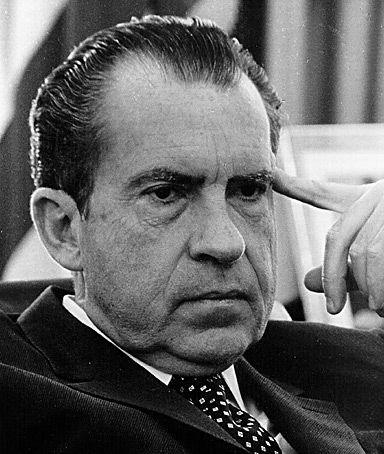 The audio is here. It was given at a BYU devotional. It is a very interesting talk, as he begins by discussing President Richard Nixon and the Vietnam War. He alludes to be somewhat critical of the war, but really focuses on the loneliness of the President in having to make decisions and appear before the American people and the world by himself.
He goes on to say, “The price of leadership is loneliness. The price of adherence to conscience is loneliness. The price of adherence to principle is loneliness. I think it is inescapable. The Savior of the world was a Man who walked in loneliness. I do not know of any statement more underlined with the pathos of loneliness than His statement: “The foxes have holes, and the birds of the air have nests; but the Son of man hath not where to lay his head” (Matthew 8:20). “
I thought about the great deal of discussion that has gone on this past week or so about the new Church Handbook of Instructions (CHI). There are been many reports about the handbook and the leadership training meeting that introduced it. The reports I have read from those in attendance (that are leaders) have been generally positive. In fact, for most, the handbook itself was also viewed positively.
But, of course, there are the critics. They squawk like birds when their personal situation is somewhat hampered by rules and guidelines. Rules and guidelines they know and understand, but for whatever reason choose not to follow. But, it is not their fault. It is the general leadership of The Church who are at fault for creating the rule or guideline. It is the fault of local leadership who follow it. It is everyone else’s fault. But it is not theirs.
The new handbook gives a significant amount of leeway to a local leader in the implementation of some of the rules and guidelines. In the portions I have seen, if a situation is absolute, it is directly stated. If there is judgment and inspiration needed on the part of a local leader, it is less so. The words are different, they are softer. According to the talk given by President Boyd K. Packer, it is clear that revelation and inspiration must play a significant role in implementing the things in the handbook. He said, “Once again: “Notwithstanding those things which are written”—meaning, regardless of what is in print, including the handbooks—“it always has been given to the elders of my church from the beginning, and ever shall be, to conduct all meetings as they are directed and guided by the Holy Spirit” (D&C 46:2). “ (https://new.lds.org/training/worldwide-leadership/2010/11/concluding-remarks?lang=eng)
Back to the Loneliness of Leadership. I know it is just as hard for a Bishop or Priesthood Leader to tell a member that they cannot do something as it is for the person being told. Hopefully, the message is delivered in the spirit of love and respect and with due considerations to the feelings of the person and the impact of the decision. I recall the story of one of the General Authorities who had to tell an impending bride she could not be married in the Temple in a few days hence because of a confessed moral transgression. What a painful situation for both, what an embarrassing situation for the young woman. One might ask, why did she tell? She could have had her Temple marriage and celebration and no one would know. But she would. The Lord would. And she would have to live with that burden.
We are ultimately sympathetic to the person who is denied the ability to do what they are seeking. But what about the one who must sit in judgment and be the one to render a decision?
Somewhat akin to the Savior carrying the burdens of the whole world on his shoulders, the leader must often time carry the burden of knowing how they might have affected the person denied.
You can do the right thing and still feel terrible about it. Such is the Loneliness of Leadership
 Wheat & Tares
It is everyone else’s fault. But it is not theirs. Isn’t that the truth 😉
Hi Jeff,
The talk you referred to is very challenging, coming at a very important time for the US and the church. I think the essence of the challenge comes from the following quote from the talk:
“I would like to offer the thought that no institution and no man ever lived at peace with itself or with himself in a spirit of compromise. We have to stand for the policy that we have adopted. We may wonder in our hearts, but we have to stand on that position set for us by him who leads us, our prophet. It was ever thus. The price of leadership is loneliness. The price of adherence to conscience is loneliness. The price of adherence to principle is loneliness.”
The core issue is that adherence to conscience and principle is equated to adherence to someone else’s conscience even if we really do think and feel differently. By definition the prophet’s conscience is our conscience, and to disagree with the prophet is to violate our own conscience. Doing this makes us a leader, according to the talk.
Many organizations ask their members to go against their consciences sometimes, and some have teachings that devalue the individual conscience. This is one example.
Submitting one’s will to the Lord’s is a hard doctrine, best exemplified by Christ being willing to undergo the atonement, when it wasn’t his will but his Father’s. Examples of submitting to a priesthood leader against your own conscience includes Hugh B. Brown giving in to Harold B. Lee and signing a statement he absolutely disagreed with. (See end of Ed Firmage biography of HBB.)
The examples in the talk included doing something you don’t want to (Christ), supporting something you may disagree with or think is wrong (BYU students supporting a racist policy), and doing something your conscience agrees with (the lonely convert).
You seem to be implying that the church’s rules and guidelines are always correct; otherwise, why would the critics “squawk like birds when their personal situation is somewhat hampered by rules and guidelines.” Is it so impossible for you to think that someone may have a legitimate difference with a church leader?
Or, is it just always a sin to believe and act differently than the church dictates in their guidelines?
When I was in the ward council in my ward, my bishop took away a woman’s temple recommend because (as he put it) she wasn’t paying tithing. On her husband’s earnings. Who was inactive, and didn’t attend church, and gave her a paltry allowance to feed and clothe her and the kids.
This same bishop proposed to inspect everyone’s food storage so we could see if the ward was really living up the standard of one year. The entire ward council meeting, priesthood leaders, YW/WM leaders, RS leaders, we all rejected the plan and refused to cooperate, despite him telling us over and over how it was inspired and the Stake President had tasked him with it. It was still wrong, and we were right to oppose him. But he clearly never understood why we were standing against him; he only gave in because we “squawked like birds” and refused to go along with his plan.
Remember, at the time this talk was given, people had been disciplined for preaching that Blacks should have the rights to the priesthood, and several Apostles believed the same thing, and both turned out to be right. What happens when acquiescing to authority is more important than Truth?
I think leadership can be very lonely. I can’t imagine what it would be like to have the “weight” of millions of people on my shoulders, much like President Monson does today.
I think the essence of this post (and all of the comments related to the CHI) comes down to what difference, if any, there is between the Church as an organization and the Gospel of Jesus Christ.
At the end of the day, the gospel is individual. It is between a single person and God. Churches, marriages, families, society, etc. and call help/hinder this relationship, but this is what it is all about.
The Church is an organization that exists to facilitate the relationship of individuals with God. It does a great many things good in this regard. It teaches about God and Christ. It has various rituals and ordinances that turn the mind to God and help us see our divine potential in this mortal world. At the same time, the Church is still an organization run by mortal men. Even McConkie, when asked about his thoughts on blacks and the priesthood after 1978, said “I was wrong”. Also, the Church as an organization absolutely has to have something like the CHI. Leaders also have to do things to protect the organization as a whole.
I don’t think there is anyone on this board who would NOT submit to literally anything commanded by God. If I absolutely knew that God wanted me to do something, I would like to think that I would do it.
The question, however, is how much we equate the “Lord’s will” with “a Church leader’s will”. Much of the time, these are synonymous. However, based on human nature and our own history, we know that these aren’t always the same. This is the real issue.
I have to agree with goldarn here. andrew ainsworth’s post ‘when sameness chokes oneness’ seems to apply. a certain amount of squawking is legitimate. I understand that bishops are supposed to listen more and use the chi as a guidance, not commandment. let’s hope bishops remember mercy as well as justice.
This post reminds me of the Abraham Lincoln quote: “He has the right to criticize who has the heart to help”
Leadership can be lonely. It’s even lonelier when you’re wrong.
The fact that Westerners — including Christian Westerners — are given to “squawk like birds” when they see something they disagree with, is why the West is competent and certain other, less self-critical religious traditions are not.
There may well be something self-serving about people’s tendency to “squawk” more when a policy inconveniences them personally. But that something is done or believed from less than totally selfless reasons, does not mean the thing is wrong. A good society does not depend on all of its members always being angels for the society to progress. Whatever a person’s incentive may be for calling attention to a wrong, if the thing is in fact wrong, the society generally benefits from attention being called to it.
There’s a story, referenced by Winston Churchill, that in imperial China, any bureaucrat had the right to present to the Emperor an objection to how things were being done — provided he killed himself immediately afterwards. This was supposed to prevent self-serving criticism and petty backstabbing. It may well have done that — but China’s experience suggests that (if something anything like this mentality towards criticism was actually China’s case), it also reinforced stagnation and incompetence.
Obviously you can be too critical, or too self-serving. There is a balance to be struck between loyalty and dissent. But writing off a whole class of people as “squawkers” is exactly what you, Jeff, have often objected to: The other side is not just wrong, but evil, or contemptible.
#3,
“Is it so impossible for you to think that someone may have a legitimate difference with a church leader?”
Not in the least. I’ve done it myself. That wasn’t what I was referring to. I was referring to rules and guidelines, not the implementation of them. Even President Monson gave examples where implementation was wrong, even if the intention was noble.
“But he clearly never understood why we were standing against him; he only gave in because we “squawked like birds” and refused to go along with his plan.”
I do not think we are comparing apples and oranges here. Your Bishop’s plan was clearly not within the policy of the church to police its members in that way, anymore than it is to look at paystubs when asking if they are full tithe payers. So, in my estimation, he was plain wrong and you were correct to oppose him. i do not view that as “squawking like birds.” You might check back in the original post to see why I made that connection to squawking birds.
I am specifically referring to individuals whom, for one reason or another, do not think the commandments fully apply to them and complain when they are not allowed to do something because of that reason.
Mike S.,
“The question, however, is how much we equate the “Lord’s will” with “a Church leader’s will”. Much of the time, these are synonymous. However, based on human nature and our own history, we know that these aren’t always the same. ”
I do agree with you on this, however, this is the same slippery slope that causes some members to think that God and Christ will give them instructions that go against what the Church teaches and practices. codeword: polygamy….
Thomas,
“But writing off a whole class of people as “squawkers” is exactly what you, Jeff, have often objected to: The other side is not just wrong, but evil, or contemptible.”
I didn’t and I didn’t call anyone evil and contemptible.
We can always see up the skirts of people higher than us on the ladder. That doesn’t mean we should always pass comment.
I do agree that when a complaint is self-serving we should question our motives, especially if there are no unaffected people who agree. But that’s setting a high standard for personal expression, and we are a nation of complainers who extoll the virtues of dissent. I’m as American as the next person in this love of whining, but there’s some room for reflection about our motives too. Some criticism is more noble and necessary than other.
Well, Jeff, neither do I, if one reads closely, but sometimes one doesn’t.
“Squawk like birds” is a tad less respectful than “roar like lions,” no? Or even “buzz like bees.”
“We are ultimately sympathetic to the person who is denied the ability to do what they are seeking. But what about the one who must sit in judgment and be the one to render a decision?”
He has a heavy burden. It’s made heavier by the imposition on him of the duty of enforcing rules that may not be either divinely ordained or practically necessary.
Thomas,
“It’s made heavier by the imposition on him of the duty of enforcing rules that may not be either divinely ordained or practically necessary.’
That’s a pretty easy thing to say when one disagrees with the rule or guideline. As I stated there is typically a lot of leeway for the leader who we hope, uses prayer and inspiration in making those kind of decisions.
Jeff,
I agree that it can be a “slippery slope” when we try to distinguish between “God’s will” and “Church leaders’ will”. At the same time, I do think that there is a necessary role for questioning in the Church, just as there is for people who take everything leaders say at absolutely face value and ask “How high…”
We need members who basically go along with anything given from a pulpit, in a handbook, etc. If not, the Church would basically be a place of anarchy, with everyone doing his/her own thing.
At the same time, it seems that change only really occurs where there are at least a subset “kicking against the pricks”. Changes seem to only come when church leadership considers what is coming up from the masses.
Perhaps blacks would have received the priesthood despite the beliefs of McConkie, etc., but it seems that protests against BYU, at conference, from members, etc. at least caused the leaders to ask the question. Perhaps women would have been allowed to pray in sacrament meeting regardless, but perhaps the women’s rights movements occurring in the 1970’s at the same time at least caused the leaders to question their policies.
So, I think there is a balance. I think there needs to be people who accept the status quo, but there also needs to people who question the status quo. The first group are quite at home in their Sunday blocks, their meetings, and in the official programs.
However, there isn’t really much room for the second group of people in the “official” Church program, meetings, etc. (and in fact we have specifically been told NOT to bother the GAs), so I think that an inordinate percentage of “questioners” end up here.
Jeff: “I know it is just as hard for a Bishop or Priesthood Leader to tell a member that they cannot do something as it is for the person being told.”
This is absolutely true. Having been on both sides of this statement I can also say that correction given with love and compassion can be received with joy, even though also with a bit of discomfort. I had a stake president who was a master at this very thing; his capacity to show love even when reproving with the sharpness of a clear photograph (but never the sharpness of an acid) was simply remarkable.
#2 Paul — I read Elder Hinckley’s comment differently than you do. Your comment: “The core issue is that adherence to conscience and principle is equated to adherence to someone else’s conscience even if we really do think and feel differently” suggest the “we” in his comment refers to members at large rather than “the church”. I think there’s a difference between the two.
#15, Paul,
I am in agreement on your analysis of Paul #2. I always find this attitude in the Church to be odd.
It always boils down to whether you believe there was a restoration or not. Whether you think that this is Christ’s church or not. whether you think it is led by Living Prophet’s or not.
Certainly, we can have disagreement with policy and local implementation of policy, or the actions of a local leader. But then the overriding reason for being in the Church has to be Jesus, the Restoration and eternal life. And becoming a better person and serving others. What else is it all for?
A club, a social organization?
Mike S,
“at least caused the leaders to question their policies.”
In almost every circumstance that I can think of, revelation and change came through the questions made to the Lord by His Prophets. The question might have been as simple as “What would you have me do, Lord.” Or as complex as “Should the Priesthood be extended to all worthy males at this time?”
So why wouldn’t those changes come about when the Lord was questioned or petitioned about them?
Jeff, what’s your thinking about Paul’s attack on Peter in Galatians ch. 2?
That something is “easy to say” doesn’t speak one way or the other to whether that something is true.
Yes, criticism can be evil — it can be exaggerated, self-serving, bad-faith. Some might say that some of the nastier comments about the last President fell into this category. But at the same time, a person who insists on too much deference to his authority — “Your province is to echo what I say or remain silent” — may not be taking the best course.
The heritage of the Restoration is diverse enough — with Joseph, and his successors, swinging at various times between openness and authoritarianism — that to claim the mantle of the Restoration for the authoritarian tradition is not as simple as it’s made out to be.
Thomas,
“Yes, criticism can be evil — it can be exaggerated, self-serving, bad-faith. ”
You’re kind of getting off on a tangent, don’t you think. the post is on the Loneliness of leadership, not criticism of the leadership. How about tough it is to make decisions affecting people’s lives.
#18 Thomas, there is value in remembering this is a conversation (or argument, if you prefer) between apostles. We know from other written histories that the apostles often have differing opinions and work to find unity before establishing (or changing) policy.
Jeff’s post is different. It applies to leaders who are called to implement the church’s agree policy (after the kind of debate that went on between Paul and Peter in Galatians 2). It also aludes to the difficulty Peter might have felt, once the policy was agreed, to teach the Jews that circumcision would not be required of Gentiles.
In a church which is based on revelation, not ever dissenting voice will carry the same weight in the discussion of policy. Those dissenting voices on a council (as described by Goldarn #3) will be heard (hopefully) as the council seeks collective inspiration on how to move forward. In the end, we seek to implement the Lord’s will.
“How about tough it is to make decisions affecting people’s lives.”
Well, yes. I completely agree. It’s hard. But the argument (unless I’m totally misreading it) is that therefore one shouldn’t “squawk.” And that’s just one of the two means of mitigating the loneliness of leadership.
Thomas,
The squawking part was really very much a side issue to the post. It was really meant to be tied to the comment about the impressions on the new CHI. As I’m sure you’ve read, some are very not happy with some of the new items on Priesthood and worthiness (See BiV’s recent post). These folks knew they had some issues, but seem to want a pass or exception. In some cases, the leader must wrestle with a decision to give them that pass or not. That is part of the struggle that the post is really about.
On a number of occasions I have felt jealous of the support, companionship, and love leaders in the church receive. The Prophet has his 14 Apostles. One of the things that irk me is Area Seventies who come to speak at Stake Conference boasting about the meetings they have with Apostles, and the support they recieve.
In a church that claims to believe that a calling does not make a person more righteous or worthy of greater respect. That a Sunday school teacher is as worthy as a stake president, we certainly don’t give equal respect.
There a retreats for Bishops and Stake Presidents but not for me.
I am not at all convinced that leadership in the church is a lonley situation. I had a Bishop try to excommunicate me a few years ago and although he couldn’t because I was a HP and although the Stake Pres wouldn’t, the SP certainly didn’t withdraw support from the Bishop. Which of us do you think was lonliest for the couple of years it took before things normalised?
“You can do the right thing and still feel terrible about it.”
This certainly applies to parenting.
I agree with Geoff of A. In my ward, leadership seems to be (at least in part) like a stand-offish, self-congratulatory club. If that sounds bitter, I am ashamed to admit that I am bitter. Leadership callings are treated like corporate promotions, and those in leadership are held up as worthy or adulation.
It’s kind of odd. As I’ve thought about this over the past day or two, I think there are 2 general types of leaders in the Church. There are the more justice, letter-of-the-law, CHI-following types of people. While there may be more “loneliness” in the decisions they have to make, they are more supported by the hierarchy.
The second type is the more mercy, spirit-of-the-law, ignore-the-CHI type of people. They may feel a closer bond to the people with which they counsel and therefore not as “lonely”, but they generally don’t have the support of the hierarchy as much as they are a bit more of a loose cannon. So there are trade-offs.
Loosely alluding to another post, it’s the same on missions and in other aspects of the Church. At least in my mission, the missionaries that were perhaps a bit more lax actually had more “success” with investigators. The more “book-following” missionaries seemed to have less “success” with numbers of investigators, but were rewarded in other ways, as they seemed to drift higher up the hierarchy in callings, etc.
I think the leader that we would like to see, and the one the church would like to see, is different from those two types you describe, Mike S (though I can understand how one might look from the outside like one or the other).
According to the new handbook (and, frankly, everything I’ve ever been taught), a leader is first and foremost a disciple of Christ, one who keeps the commandments and is a humble example of righteousness.
I’ve been fortunate to know this kind of leader in my life. I acknowledge that not everyone seems them this way all the time to all people. But I can think of several in particular who were exemplary in this way, and they have been my models when I’ve been in a similar position.
Geoff of A and Angie,
As Paul pointed out, Leadership is not supposed to go the way you have experienced. But, unfortunately, if it does, there is not much stomach to remove a leader before his or her time, unless it get really, really bad or the leader requests a release.
I suggest that good leadership is often lonely because no matter how much a person serves, listens to, cares about, and prays for the people that they are called to lead, they will be critized and rejected by some that they lead. Since no leader is perfect, they will make mistakes, and it is easy to criticize leaders whose mistakes are sometimes quite visible.
Any good leader needs to realize that they will never be able to please everyone that they serve. Although we should not be expected to condone bad or abusive behavior by any leader, we need to show our fallible but caring leaders the same mercy that we would want if we were serving in their position.
Chris, YES! It is true.