

Peter Brimelow, a British journalist, is credited with coining the term “War on Christmas” in 1999 to describe the politically correct movement in English-speaking countries to neutralize public references to Christmas out of deference to non-Christians. This term has been popularized, especially by right-winger Bill O’Reilly and folks over 65 who like to forward outraged spam emails about how the world is going to hell in a handbasket. So, who’s winning the War on Christmas?
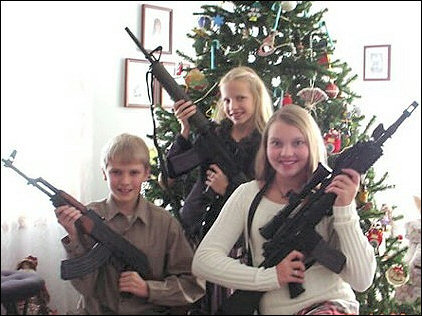 First of all, what is the War on Christmas? Here are six of the skirmishes:
- Governments, retailers, employers and public schools avoid, censor or neutralize all references to Christmas. In some cases, this is an effort to maintain separation of church and state (for government run institutions), and in other cases, it is an effort toward inclusion (for employers, retailers and individuals).
- Rather than referencing Christmas, verbiage has been changed to things like “holiday tree,” “winter break,” “end-of-year bonus,” and “holiday season.”
- Glenn Beck, in a silly mood, suggested the term “RamaHanaKwanMass” as an amalgam holiday covering all the major bases.
- On Seinfeld, George’s father creates his own holiday “Festivus.” Festivus is the holiday for “the rest of us.” They decorate the silver festivus pole while screeching “serenity now” at each other.
- Traditionalists (who also happen to be Christians in this case), not content to sit on the porch and shake their canes at the world as it goes by, have fought to re-include the word Christmas in public settings and protested its exclusion in various ways:
- attempting to change the official state tree name in CA from “State Holiday Tree” to the “California State Christmas Tree.” The measure failed, although Gov. Schwarzenegger still called it a “Christmas tree.”
- Sears and Kmart ran deliberate campaigns in 2005 and 2006 to re-popularize the use of Christmas in the signage in their stores.
- Responding to threats of a boycott, Wal-Mart relented on its policy of neutrality and changed its “holiday shop” to a “Christmas shop” in 2006.
- The focus has begun to shift away from neutrality toward inclusion and diversity.
- After receiving a signed petition of almost a million shoppers, Target relaxed its policy of using the term “holiday” and began including references to both Christmas and Hanukkah in its store signage stating that the use of the word holiday was a “mistake.”
- Schools study holiday traditions around the world and across religious boundaries; however, non-religious greetings are still encouraged: as my 6 year old daughter proudly proclaimed: “Best wintry wishes!”
- Many point out the fact that Christmas was not really a Christian holiday anyway, but was in fact an effort to recast Pagan elements with newly acquired Christian themes in order to win converts and de-emphasize immoral but fun practices.
- Christmas trees, yule logs, candles, holly and mistletoe all have pagan origins that were later re-imagined as Christian symbols.
- Originally, young men would go to houses demanding alcohol and food rather than a focus on making children happy (or making them behave). Parties and debauchery were the rule (before it became commercialism).
- Obviously, Christ wasn’t even born on December 25 anyway, unless those shepherds were wearing Gortex parkas (slight exaggeration) as they watched their flocks by night.
- Stripping away the religious elements of Christmas leaves just the commercial elements, opening the door for some very well-founded criticism of the holiday.
- Without religion, you’ve basically got a retailer’s and bank’s holiday that instills greed in children and adults alike.
- Some have even gone so far as to suggest that Santa Claus was introduced by competing religions to deliberately draw focus away from Christ. Some people also think the moon launch was faked.
- Abbreviating the name “Christmas” to “Xmas” has been alternately rejected and embraced by Christians.
- Some view the “X” as a way of taking Christ out of the holiday.
- Others view the “X” as a symbol of Christ, essentially the cross.
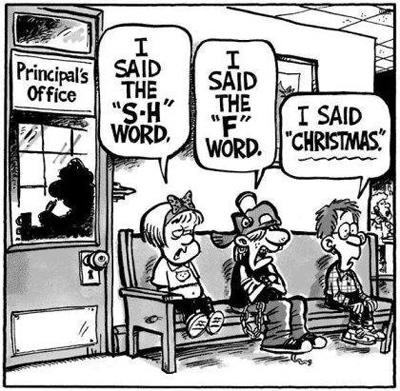 My own view on these 6 battles is: 1) separating church & state feels important to me; also I liked the Festivus episode, 2) I wouldn’t sign the petition, but I don’t care if they say Christmas along with other holidays, 3) I’m all for more holidays, not fewer, 4) I have to work hard to see Christmas as a Christian holiday, 5) see #4, and 6) I use Cmas to abbreviate, but then we don’t focus on the cross as a symbol of Christianity.
So, where do you fall out on each of these battles? Until then: “Best wintry wishes!”
 Wheat & Tares